
When overseas buyers look for suppliers of educational toys for 3–4 year olds, they often face the same confusion. The products in front of them look almost identical, but the quotes from different Chinese suppliers can vary drastically. Whether it’s wooden puzzles, Montessori toys, counting toys, stacking toys, or sensory toys, one supplier may quote $1.20 per piece, while another may only quote $0.75 per piece—a difference of more than 40%.
It is difficult to identify these differences simply by looking at the surface. Product photos appear similar, the listed functions are almost the same, and even the packaging styles are nearly identical. However, buyers gradually realize that what truly determines the price is never these visible factors, but the hidden details behind them—materials used, safety certifications, production consistency, MOQ requirements, customization level, export compliance, supply chain strength, and shipping terms.
Many buyers have experienced choosing the supplier with the lowest quote at first, only to discover that it became the most expensive purchasing decision. Behind a low price, there are often hidden risks, such as fake certification reports, unstable product quality, frequent delivery delays, numerous Amazon complaints, customs inspection issues, and continuous customer returns.
Jaredrise has found through serving global buyers that truly experienced buyers never ask about price first. Instead, they ask why the price is different and which supplier is more reliable for long-term cooperation. This article will systematically explain the core reasons behind the significant price differences among Chinese educational toy suppliers and help buyers judge which quotation is truly trustworthy and worth building a long-term partnership with.
Understanding Why Supplier Prices for Educational Toys Differ in China
Many buyers assume that if two products look the same, their prices should be similar. However, in China’s educational toy manufacturing industry, this assumption is usually incorrect. Behind a seemingly identical product appearance, there may be completely different raw material quality, certification standards, manufacturing precision, quality control systems, packaging structures, and export compliance processes. These invisible differences are ultimately reflected in the quotation.
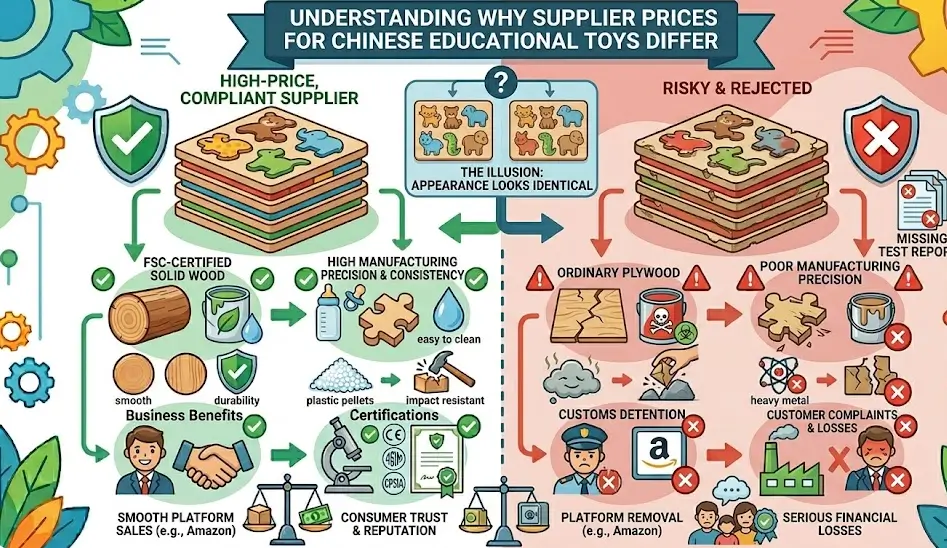
The Illusion of Identical Products
Take wooden puzzles as an example. For the same puzzle, some suppliers use FSC-certified solid wood combined with water-based non-toxic paint and have passed comprehensive EN71 and ASTM F963 testing, ensuring every stage meets the safety requirements of international markets. Other suppliers may use ordinary plywood paired with low-cost industrial paint and may not even be able to provide complete product testing reports, let alone meet international safety standards.
From the outside, these two types of puzzles look almost identical, and most people can hardly tell the difference at a glance. However, their cost differences are significant, and the risk gap is even greater. The former can pass customs inspections smoothly, sell normally on platforms such as Amazon, and gain consumer trust. The latter may face customs detention, platform removal, customer complaints, and serious financial losses, as well as damage to the buyer’s reputation.
The Hidden Drivers of Price Differences
Jaredrise works with global buyers who often discover that the biggest price differences are hidden in compliance, materials, and production consistency—not in product appearance. Many buyers fall into sourcing traps because they focus only on the visible product style and ignore these critical factors behind it.
To understand supplier pricing correctly, buyers must look beyond appearance and focus on the real cost drivers behind educational toy production. Only by recognizing the details hidden behind quotations can they make the most reasonable purchasing decisions and avoid paying a much higher price later for temporary savings.
Material Quality and Safety Standards: Core Price Determinants
Many articles simply state that different materials lead to different prices, but that explanation is too vague to be useful. For educational toys for 3–4 year olds, the specific material differences are what truly determine pricing. Let’s take wooden Montessori toys as an example to explain this in detail.
Almost all suppliers claim they use safe materials, but “safe materials” is a vague term without a unified standard. What really affects both price and safety is the exact type and grade of the materials used.
Wood Type Differences
From the perspective of wood selection, different choices create completely different costs. Some suppliers use FSC-certified solid wood, which is durable, environmentally friendly, and produced under strict sourcing and processing standards, so the cost is naturally higher. Some suppliers use ordinary plywood, which costs less but has a looser structure, weaker durability, and potential safety risks such as excessive formaldehyde. There are also some low-price suppliers using low-cost recycled boards, which not only have unstable quality but may also contain harmful substances that pose risks to children’s health.
Paint, Plastic, and Fabric Quality
Paint quality is another major factor affecting price. High-quality suppliers use water-based non-toxic paint, which is odorless and free from harmful substances. Even if children accidentally ingest a small amount, it does not pose serious health risks. It also has strong adhesion, resists peeling, and keeps the product visually attractive for a longer time. Low-price suppliers may use ordinary industrial spray paint, which often has a strong chemical smell and may contain harmful substances such as heavy metals. Long-term exposure can affect children’s health, and the paint peels easily, reducing both product lifespan and appearance quality.
In addition to wood and paint, the quality of plastic and fabric also affects pricing. For educational toys with plastic components, reliable suppliers use virgin ABS plastic, which is durable, non-toxic, odorless, and highly safe. Low-cost suppliers may use recycled plastic, which is brittle, easy to break, and may contain harmful impurities. For toys containing fabric, high-quality suppliers use skin-safe textiles that are soft, comfortable, and non-irritating for children. Low-price suppliers may use cheap ordinary fabrics that feel rough, may contain formaldehyde, and can easily trigger skin allergies.
Safety Certifications: A Non-Negotiable Cost for Export
These material differences not only affect production costs, but also directly influence durability, odor control, child safety, customer satisfaction, and Amazon review quality. Especially for Amazon sellers, one negative review can affect the weight of the entire store, and the resulting loss is often far greater than the few cents saved during purchasing.
In addition to materials, safety certifications are also a key pricing factor. European and American markets have strict certification requirements for educational toys for 3–4 year olds. Common certifications include EN71, ASTM F963, CPC, CPSIA, and CE. These certifications require suppliers to invest significant time and money in product testing. Only after passing the tests can they obtain valid certification reports and legally enter European and American markets.
Without these certifications, products may face customs detention during export. Even if they enter the market successfully, they may be removed from platforms like Amazon or rejected by customers, creating legal and financial risks for buyers. Many low-price suppliers reduce costs by avoiding proper testing or using outdated certification reports. While this lowers the quotation, it creates serious compliance risks for buyers. Once a problem occurs, the buyer bears the full cost of the loss.
Jaredrise helps buyers verify both material quality and certification authenticity before production begins, reducing hidden sourcing risks and preventing expensive mistakes later. We also strongly remind all buyers that when working with suppliers, they should always request the original certification report—not screenshots. Only this ensures the authenticity of the certification and helps avoid being misled by fake reports.
Manufacturing Processes and Production Technology
Many buyers focus only on unit price when selecting suppliers and overlook how manufacturing processes and production technology affect product quality. In reality, product quality is often determined by the production process—not the quotation itself. For educational toys for 3–4 year olds, differences in manufacturing processes influence not only cost, but also product safety and long-term stability.
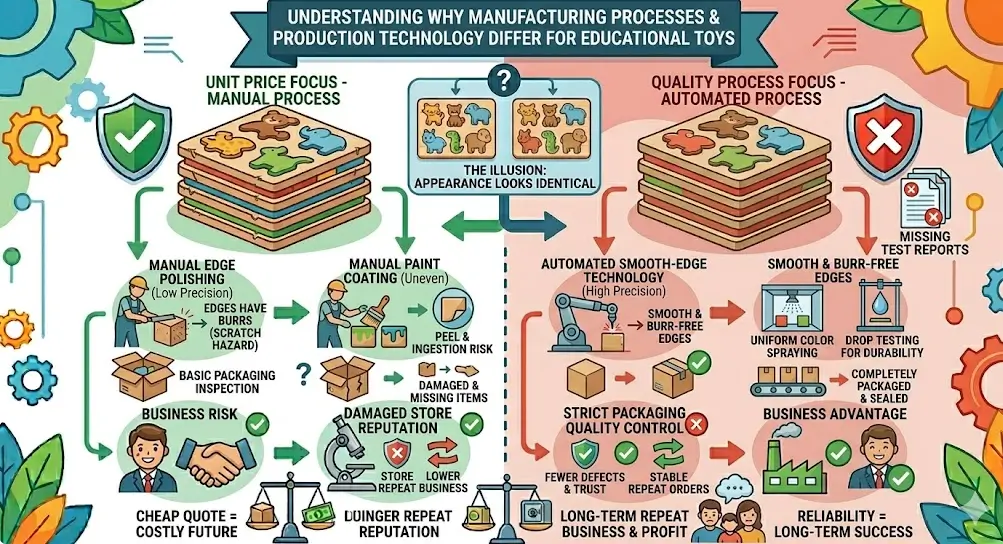
Manual vs. Automated Manufacturing Processes
Take stacking toys as an example. For the same stacking toy, different suppliers may use completely different production methods. Some factories rely on manual edge polishing, which offers lower precision. The product edges may have burrs that can scratch children’s hands. Paint coating may be uneven and easy to peel off, creating potential ingestion risks for children. Packaging inspection is also often basic, leading to issues such as damaged packaging or missing items.
Other factories adopt automated smooth-edge finishing technology, ensuring all edges are smooth and burr-free, significantly reducing the risk of injury. They perform drop tests to ensure products are not easily broken during use, apply uniform color spraying technology to ensure stable and durable coating, and maintain strict packaging quality control to prevent missing products and damaged packaging.
Impacts of Production Consistency on Cost and Risk
From the outside, these two types of stacking toys may look almost the same, but their defect rates, complaint rates, and repeat order potential are completely different. Products produced through manual processes often have higher defect rates, more customer complaints, and lower chances of repeat business. Products made through automated systems offer more stable quality, fewer defects, and stronger customer trust, which leads to more repeat orders.
Especially for preschool toys, edge treatment quality is directly related to children’s safety. If there are burrs on the edges, children’s delicate skin can be scratched easily, causing safety incidents and serious reputation and financial losses for buyers.
At Jaredrise, production consistency matters more than simply offering the lowest price, because repeat business depends on reliability—not one-time low quotations. Many buyers choose the lowest quote because they want to save money, but eventually discover product quality issues after shipment. They not only face return losses, but also damage their store reputation and lose far more in the long run.
Experience proves that the cheapest quotation often becomes the most expensive order once shipment problems arise. When selecting suppliers, buyers must pay attention to manufacturing processes and production technology rather than simply pursuing the lowest price, so they can avoid a long chain of costly problems later.
Product Category, Complexity and Pricing
How Product Complexity Affects Cost
Many articles analyzing the price differences of educational toys overlook one key factor: product category and complexity. In reality, different types of educational toys have completely different cost structures, and supplier quotations will naturally vary significantly.
Simply put, the more complex the product, the higher the production cost, and the higher the supplier’s quotation. For example, simple flash cards and wooden Montessori busy boards follow completely different pricing logic. Flash cards have a simple structure and a straightforward production process. They do not require complex molds or significant labor input, so the production cost is low, and the supplier’s quote is naturally lower. In contrast, wooden Montessori busy boards have a much more complex structure, often including multiple moving parts, requiring complicated molds and a large amount of manual assembly. As a result, the production cost is much higher, and the supplier’s quote increases accordingly.
Cost Differences Between Different Toy Types
In general, educational toys with moving parts, multiple components, sound functions, or interactive learning features usually require more molds, more assembly labor, stricter safety testing, and stronger packaging protection. All of these increase production costs and result in higher supplier quotations.
For example, sensory busy boards usually include multiple movable components that require separate mold development and assembly. At the same time, strict safety testing is necessary to ensure that none of these moving parts can fall off and create hazards for children. Alphabet puzzles require precise cutting technology to ensure every letter fits perfectly and must also pass non-toxic material testing. Magnetic learning toys require high-quality magnetic materials to ensure stable magnetism, prevent detachment, and pass anti-ingestion safety tests. These products are structurally more complex and therefore cost significantly more than simple toys such as standard stacking blocks.
Many buyers mistakenly believe that suppliers are artificially increasing prices because they do not fully understand how product complexity affects cost. Jaredrise helps customers evaluate in advance whether a supplier’s quote reflects normal pricing caused by product complexity or an unreasonable price increase, helping buyers avoid sourcing traps and choose the most cost-effective supplier.
For buyers, understanding how product category and complexity affect pricing makes it much easier to judge whether a supplier’s quote is reasonable. It helps avoid rejecting high-quality suppliers due to misunderstandings about cost structures, while also preventing overpayment caused by unfair pricing from unreliable suppliers.
Hidden Cost Factors: MOQ and Customization
MOQ Requirements and Unit Price Correlation
Beyond materials, manufacturing processes, and product complexity, MOQ (Minimum Order Quantity) requirements are another often-overlooked factor that directly affects supplier pricing. For Chinese educational toy suppliers, MOQ is closely linked to production cost. A lower MOQ usually means a higher unit price, while a higher MOQ allows suppliers to spread fixed costs—such as mold fees, setup fees, and labor costs—across more units, reducing the cost per piece.
For example, a supplier may quote $1.20 per piece for a wooden Montessori toy with an MOQ of 500 pieces, but reduce the price to $0.90 per piece if the MOQ increases to 2000 pieces. This is because producing 2000 pieces at once lowers the per-unit cost of mold usage, raw material purchasing, and production setup. On the other hand, small-batch orders such as MOQ 100 pieces require frequent production line adjustments, increased labor input, and higher material waste rates, all of which drive up the unit price.
Customization Level: Cost Increases and Flexibility
Customization level also plays a major role in pricing. Many overseas buyers require customized educational toys, such as adding private label logos, changing product colors, adjusting packaging design, or even developing unique educational features. Every customization request increases the supplier’s workload and cost.
For example, logo printing requires additional printing equipment and materials. Color changes require new paint formulation and testing. Packaging customization involves designing new packaging structures, molds, and sample proofing. A supplier may quote $0.80 per piece for a standard stacking toy without customization, but the price may increase to $1.30 per piece if the buyer requests custom colors, logo printing, and branded packaging.
Some low-price suppliers may refuse customization entirely or charge unreasonable fees for it, while professional suppliers like Jaredrise can offer flexible customization solutions at a reasonable cost, helping buyers balance branding needs and budget control.
Many buyers fail to consider MOQ and customization when comparing quotations, which leads to misunderstandings. They may think one supplier is too expensive without realizing that the quote includes customization services or is based on a much lower MOQ. It is essential for buyers to clearly define MOQ and customization requirements before requesting quotations so suppliers can provide accurate pricing and fair comparisons can be made.
Long-Term Cost Guarantees: Export Compliance and Supply Chain
Export Compliance: The Hidden Cost of Risk Avoidance
Export compliance is often ignored by buyers who focus only on short-term unit prices, but it is one of the most important factors determining the long-term cost of purchasing. For educational toys exported to European and American markets, compliance is not optional—it is essential. Any compliance failure can lead to customs detention, heavy fines, or even product recalls, and these costs are far greater than the difference in unit pricing.
Professional Chinese suppliers invest heavily in building complete export compliance systems. They closely follow updates to EN71, ASTM F963, CPSIA, and other standards, conduct regular product testing, and maintain detailed compliance documentation. These investments are reflected in the quotation, but they also protect buyers from serious compliance risks.
In contrast, low-price suppliers often reduce costs by cutting corners on compliance. They may use untested materials, provide fake certification reports, or ignore labeling requirements. While this may reduce short-term purchasing costs, it creates major long-term risks for buyers.
Supply Chain Strength: Stability and Cost Control
Supply chain strength is another critical factor affecting both pricing and long-term cooperation. Suppliers with strong supply chains maintain stable relationships with raw material suppliers, allowing them to secure high-quality materials at better prices and avoid shortages or sudden price increases. They also work with efficient logistics partners, helping reduce shipping costs and ensure on-time delivery.
For example, a supplier with a strong supply chain may be able to absorb small increases in raw material costs without increasing unit prices, while a weaker supplier may frequently raise quotations due to unstable material sourcing.
Jaredrise has built a strong supply chain network covering raw material procurement, production, testing, and shipping. This allows us to provide stable pricing and on-time delivery even during market fluctuations, helping global buyers reduce long-term procurement costs. Many buyers who choose low-price suppliers with weak supply chains eventually face delivery delays, unstable material quality, and sudden price increases, which ultimately make procurement more expensive.
How to Choose the Right Supplier: Beyond Price Comparison?
Step 1: Verify Material Quality and Safety Certifications
First, verify material quality and safety certifications. Ask suppliers for original test reports and material certificates, and confirm certification authenticity through official verification channels. For wooden toys, confirm whether the wood is FSC-certified. For painted products, request testing reports for harmful substances such as heavy metals.
Do not accept screenshots of reports or verbal promises—only original documents can ensure real compliance.
Step 2: Evaluate Manufacturing Processes and Consistency
Second, evaluate manufacturing processes and production consistency. Ask suppliers to provide factory audit reports or production videos to understand their production technology, quality control procedures, and defect rates.
If possible, request product samples before placing large orders. Carefully inspect edge finishing, paint adhesion, and overall craftsmanship. A high-quality sample is often the best indicator of consistent mass production quality.
Step 3: Clarify MOQ and Customization Needs
Third, clearly define MOQ and customization requirements. Before requesting quotations, determine your expected MOQ and the level of customization you need, and confirm whether the supplier can meet these requirements at a reasonable price.
Always compare quotations based on the same MOQ and customization level to avoid inaccurate comparisons.
Step 4: Assess Export Compliance and Supply Chain
Fourth, assess export compliance systems and supply chain strength. Ask suppliers about their testing procedures, compliance systems, and logistics partnerships.
Choose suppliers who understand the regulatory requirements of your target market and maintain stable supply chains. This helps reduce the risk of customs issues and delivery delays.
Step 5: Prioritize Long-Term Cooperation Value
Finally, focus on long-term cooperation value. A strong supplier is not only a product provider, but also a long-term business partner who helps reduce risks and improve profitability.
Suppliers like Jaredrise not only provide high-quality products at competitive prices, but also offer value-added services such as pre-production testing, customization support, and after-sales service. These services help buyers save both time and money over the long term.
Conclusion
The price differences among Chinese suppliers of educational toys for 3–4 year olds are not random. They are determined by a combination of factors, including material quality, safety certifications, manufacturing processes, product complexity, MOQ requirements, customization level, export compliance, and supply chain strength.
The cheapest quotation is not always the best option. In many cases, it hides significant risks such as fake certifications, unstable quality, and compliance problems.
For overseas buyers, successful sourcing depends on looking beyond the surface price and focusing on the real value and hidden risks behind the quotation. By verifying material quality and certifications, evaluating manufacturing processes, clarifying MOQ and customization requirements, and assessing supply chain strength, buyers can choose suppliers that offer fair pricing, reliable quality, and strong long-term cooperation value.
Jaredrise has been serving global buyers of educational toys for many years, and we understand the real challenges buyers face. We are committed to providing high-quality, compliant, and cost-effective educational toys while helping buyers avoid sourcing mistakes.
Whether you are an Amazon seller, retail store owner, or distributor, we can provide customized solutions that match your needs and budget. Remember: the most cost-effective quotation is not the cheapest one—it is the one that delivers long-term stability, safety, and sustainable profit.