
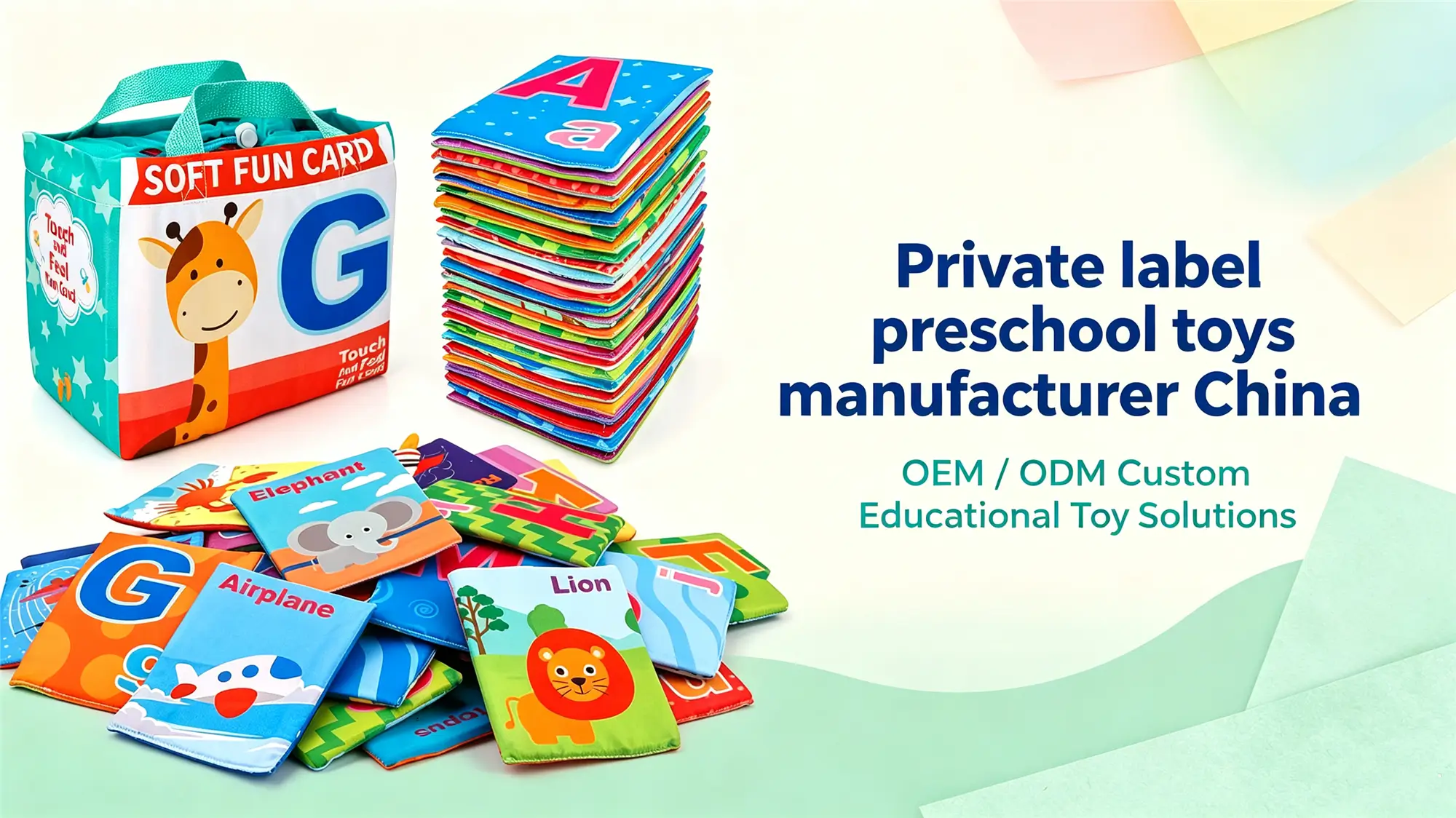
Private label preschool toys manufacturers in China provide OEM production ODM development custom branding packaging customization and full compliance support for overseas educational toy brands.
Typical factory prices range from $1.5–$8.5 per piece depending on materials customization level MOQ and certification requirements.
These manufacturers deliver four core buyer values including cost efficient product development brand differentiation supply chain stability and standardized market compliance for long term brand growth.
Pricing Structure for Private Label Preschool Toys from Chinese Manufacturers
Cost evaluation is the primary step for overseas buyers to screen reliable Chinese preschool toy manufacturers.
Clear tiered pricing and cost components help buyers complete budget estimation and supplier qualification efficiently.
Unit Cost Range by Product Category
Basic educational toys are priced at $1.5 to $3 per unit, with costs influenced by raw material grade and basic assembly processes.
Wooden preschool toys fall in the $3 to $6 per unit range, affected by wood texture and structural design complexity.
Customized Montessori toys cost $5 to $8.5 and above per unit, with pricing determined by functional complexity and personalized design requirements.
MOQ Tiered Pricing Rules
MOQ level one covers 500 to 1000 units with a 15 to 30 percent price premium, making it suitable for newly established startup brands for market testing.
MOQ level two includes 1000 to 5000 units with standard factory pricing, matching the operational needs of offline and online retailers.
MOQ level three supports orders of 5000 units and above with a 10 to 25 percent cost reduction for large-scale distributors.
Typical Production Cost Breakdown (%)
- Raw materials account for 30 to 45 percent of total costs, covering plastic, wood, silicone, and hardware components for preschool toy production.
- Production and labor costs take 20 to 30 percent of overall expenses.
- Custom packaging occupies 5 to 15 percent, while safety testing accounts for 5 to 10 percent.
- Product development and mold modification costs make up 10 to 20 percent of the total manufacturing budget.
One-Time Upfront Costs
Tooling fees range from $1000 to $10000, charged per independent mold and single product SKU.
Prototype development costs fall between $100 and $500 for initial product sample confirmation.
Global certification testing fees vary from $200 to $5000 based on different regional safety standards.
After understanding the cost structure, buyers should evaluate whether the manufacturer has the production capability to deliver consistent quality at scale.
Full-Spectrum Private Label Manufacturing Capability
Genuine factory manufacturing capacity distinguishes professional private label toy suppliers from intermediary trading companies.
Stable independent production systems support long-term cooperative development for overseas brand buyers.
In-House ODM Development & Tooling Workshop
The factory maintains a full-time professional design team and complete mold processing equipment to support independent product structure design, mold opening, and prototype polishing.
Based on production data from Jaredrise, in-house tooling reduces mold development lead time by approximately 30 percent compared with outsourced solutions and avoids repeated modification delays and extra costs.
The entire prototype confirmation process can be completed within 7 to 10 working days to accelerate new product launch progress.
Flexible Production Lines for Trial & Mass Orders
Independent flexible production lines support two core order scenarios for overseas buyers.
- Trial production lines stably handle small-batch orders of 500 to 1000 units for new product market verification.
- Large-scale mass production lines can complete orders of 5000 to 50000 units with standardized production processes.
The factory reserves peak season production capacity every year to ensure stable lead times and timely delivery for bulk orders.
Integrated Packaging & Branding Execution
The integrated post-production workshop supports one-stop brand customization services without third-party outsourcing cooperation.
Jaredrise handles all packaging design, proofing, and production in-house to maintain color consistency and brand accuracy across bulk orders.
It covers custom retail box design, exclusive color printing, branded instruction manuals, and personalized outer packaging processing.
All packaging production and quality inspection processes are independently controlled by the factory to ensure consistent brand presentation of finished products.
MOQ Tiers & Transparent Pricing Model
Transparent tiered MOQ and open pricing systems eliminate hidden markup risks, helping buyers match suitable procurement solutions according to brand operation stages.
Tiered MOQ Matching Brand Growth Stages
- Start-up brand stages adapt to 500 to 1000 unit MOQ to lower market trial risks and reduce initial investment pressure.
- Growing brands with stable sales adopt 1000 to 5000 unit MOQ to balance inventory turnover and procurement costs.
- Mature established brands choose 5000 unit plus MOQ to obtain optimal unit pricing and realize large-scale market supply layouts.
Transparent Unit Price Composition
All quotation items are fully split and displayed, including raw material procurement, labor processing, customized packaging, safety testing, and basic logistics costs.
At Jaredrise manufacturing facility, all pricing quotes include standard QC inspection and export document support with no additional hidden service fees.
Buyers can clearly check every cost item to avoid blind quotation markups from intermediate suppliers.
One-Time Cost & Recurring Cost Separation
Primary cooperation generates one-time costs, including mold opening, sample development, and product certification testing fees.
Subsequent repeat orders only involve conventional production and customized packaging costs without repeated charges for upfront fees.
Long-term stable cooperation can continuously dilute fixed upfront costs and reduce overall unit procurement expenditure for buyers.
Hidden Costs & Supply Chain Risks in Preschool Toy Sourcing
Low unit prices do not represent low comprehensive procurement costs.
Many hidden supply chain risks can bring extra losses to overseas preschool toy procurement and brand operations.
Non-Compliant Product Recall & Penalty Risks
Preschool toys belong to high-safety-standard children’s products.
Non-compliant products will face multiple risks, including customs rejection, offline retailer returns, and large-scale market recalls.
All customized products strictly follow mainstream international safety standards such as ASTM F963, CPSIA, and EN71 to help buyers avoid policy-related penalties and brand reputation losses caused by unqualified products.
Inferior Material Rework & After-Sale Costs
Some suppliers adopt low-cost inferior raw materials to reduce quotation prices.
Such materials can easily cause product quality defects, leading to batch reproduction, customer returns, and product replacement issues.
Related rework and after-sales maintenance costs can increase total procurement expenditure by 10 to 30 percent, creating long-term operational pressure for toy brands.
Unstable Capacity & Delivery Delay Losses
Small-scale processing factories often face capacity shortages during overseas sales peak seasons, resulting in delayed shipments and missed market sales windows.
Buyers need to verify the stable monthly production capacity of manufacturers before cooperation to avoid inventory shortages and market share losses caused by uncontrollable delivery cycles.
Intermediary Markup & Quality Control Gaps
Trading companies rely on external factory resources to complete orders, resulting in uncontrollable product quality and invisible price markups.
Buyers should verify factory ownership, real production site photos, and complete QC process documents before cooperation to ensure direct communication with formal manufacturers and reduce risks from intermediate links.
Compliance & End-to-End Quality Assurance System
Complete quality control and compliance systems are the core guarantees for preschool toy manufacturers to support overseas brands’ long-term cooperation and cross-market sales.
Pre-Production Material Safety Verification
All raw materials used for preschool toy production undergo strict safety verification before mass production.
The inspection covers heavy metal content, phthalate residue, and mechanical safety indicators that meet international children’s product standards.
Unqualified materials are completely rejected from production processes to eliminate potential safety hazards at the source.
In-Line & Pre-Shipment Dual QC Mechanism
A real-time in-line inspection mechanism is implemented throughout the entire production process to check product appearance, structure, and safety performance in batches.
Jaredrise applies a two-hour interval in-line inspection standard for all preschool toy production lines, with dedicated QC officers assigned to each production batch.
All finished products undergo comprehensive final QC inspection before shipment.
Only products that meet all safety and quality standards can be approved for delivery to ensure batch product qualification rates.
Full-Cycle Global Certification Support
The manufacturer provides full-cycle certification support for global market access.
For the US market, it supports ASTM F963, CPSIA, and CPC certification services.
For European market expansion, it provides standard EN71 and CE certification compliance guidance to help buyers quickly complete market access qualifications in different regions.
Buyers looking for reliable private label preschool toy manufacturing support can request a private label toy quotation based on customized product needs or submit product concepts for professional manufacturing evaluation to obtain targeted production and cost solutions.
Next Steps for Private Label Preschool Toy Cooperation
For overseas brands building exclusive preschool toy lines, stable manufacturing capacity and comprehensive compliance support are essential for achieving sustainable market competitiveness.
You can request a private label toy quotation with specific product details or submit a product concept for professional manufacturing feasibility analysis and cost evaluation.