
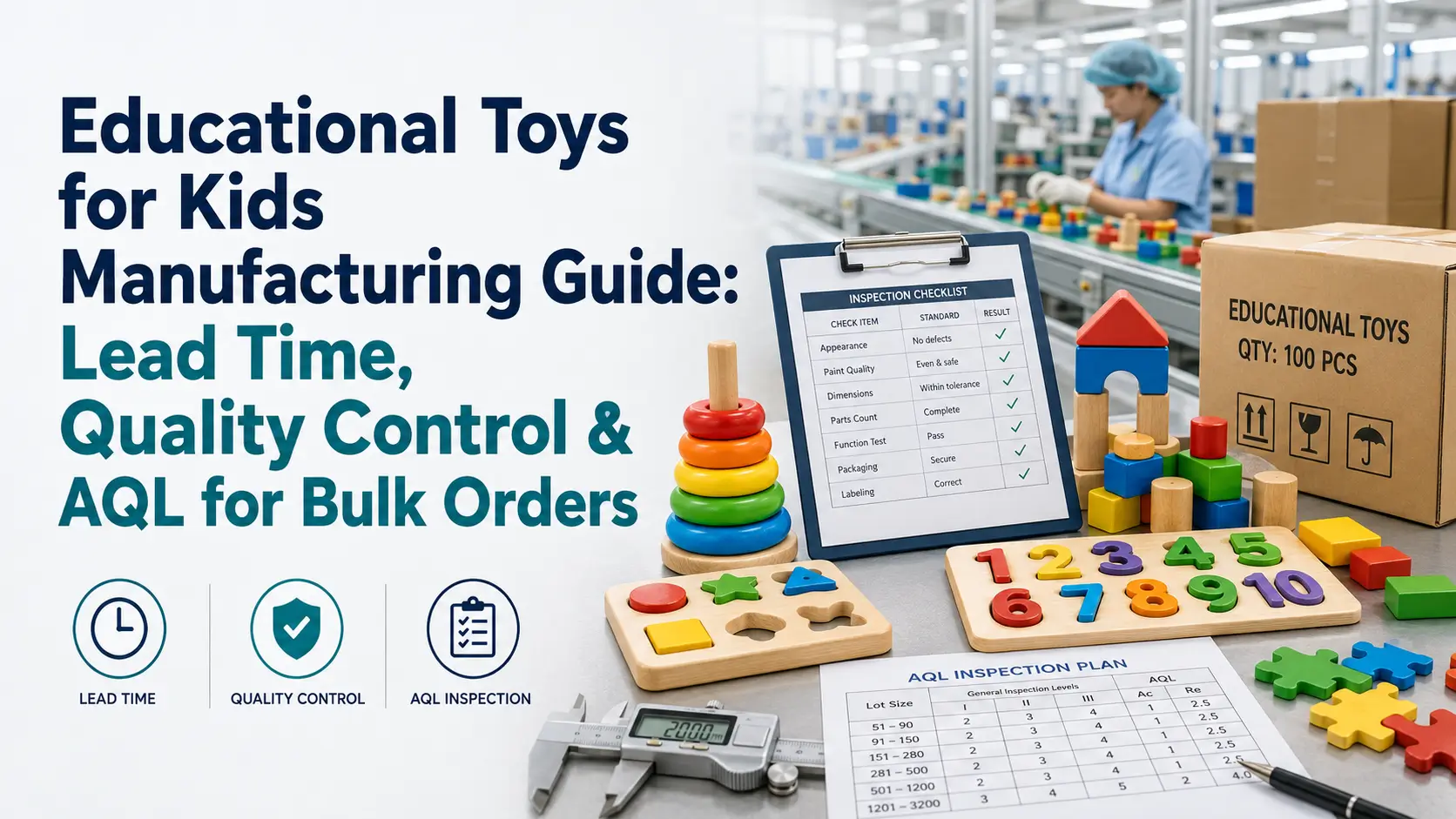
Prototype approval does not guarantee that an educational toy bulk order will be delivered on time or pass final inspection.
Delays and quality failures usually occur when production dependencies, inspection checkpoints, defect classifications and lot-acceptance criteria are not defined before mass production begins.
This guide addresses five project questions that determine whether a bulk order actually ships on schedule and in acceptable condition:
- How should manufacturing lead time be planned?
- Where should quality control happen during production?
- How should defects and AQL acceptance criteria be defined?
- What happens when inspection fails?
- When is the lot actually ready to ship?
The answer to all five sits on the same foundation: production planning, process control, lot acceptance, and shipment release are four separate decisions, and each one needs its own criteria before mass production starts.
Quick Decision Summary
| Project Question | What Must Be Defined |
|---|---|
| When can the order ship? | The critical production path |
| How is quality controlled? | IQC + First Article + IPQC + FQC |
| How is the finished lot inspected? | Defect catalogue + AQL sampling plan |
| What happens if inspection fails? | Containment + rework/sorting + reinspection |
| When can goods ship? | QC + AQL + packaging + documentation, all closed |
AQL should be used to make a production-lot acceptance decision, not as a replacement for process quality control or toy-safety compliance testing.
What Determines the Manufacturing Lead Time for Bulk Educational Toy Orders?
Educational toy manufacturing lead time is determined by the complete production critical path rather than assembly time alone.
Material preparation, component manufacturing, printing or decoration, assembly, inspection, packaging, buyer approvals and production capacity should all be included before establishing a reliable shipment schedule.
Treating assembly time as the whole timeline is the most common reason a promised ship date slips.
What Should Be Included in the Production Timeline?
A realistic timeline follows the full critical path, not just the factory floor steps:
PO Confirmation → Specification / BOM Freeze → Material Preparation → Component Production → Printing / Decoration → Assembly → QC → Packaging → Pre-Shipment Inspection → Shipment Release
The distinction that matters here is that production lead time is not the same as shipment lead time. Production lead time ends when the goods are packed and accepted; shipment lead time adds booking, customs, and transit on top of that.
Buyers who quote only the factory’s stated “production days” and back-calculate a delivery date are usually missing this gap.
Which Variables Can Extend Manufacturing Lead Time?
The core variables that push a timeline out are:
- Order quantity
- Number of SKUs
- Component count
- Material availability
- Custom colors
- Printing processes
- Electronic components
- Multi-material construction
- Assembly complexity
- Packaging customization
- Buyer approval cycles
- Testing holds
- Production capacity at the factory
Lead-Time Risk Table
| Project Condition | Lead-Time Risk | Reason |
|---|---|---|
| Existing material + simple packaging | Low | Fewer dependencies |
| Custom color/printing | Medium | Additional approval and setup steps |
| Multiple components | Medium–High | More supply dependencies |
| Electronics | High | Component sourcing plus functional QC |
| New tooling | High | Tooling fabrication and validation required |
Where Should Schedule Buffer Be Added?
Buffer should be built into the parts of the timeline that are outside the factory’s direct control, not just added as a flat percentage at the end:
- Material arrival
- Buyer approval
- Production changeover
- QC and rework
- Packaging
- Final inspection
- Shipment cutoff
Do not confirm the final shipment date until materials, BOM, artwork, packaging and production configuration are sufficiently frozen. A shipment date confirmed against an unfrozen specification is a placeholder, not a commitment.
In practice, this means the shipment date quoted at costing stage and the shipment date confirmed after BOM freeze are two different numbers, and buyers should expect the second one to move if any of the frozen inputs change afterward — a late color change or a swapped component supplier resets the clock on whichever stage it touches, not the whole schedule from zero.
How Should Quality Control Be Structured During Educational Toy Mass Production?
Educational toy quality should be controlled at the production stages where defects are created rather than relying only on final inspection.
A practical bulk-production QC system connects incoming inspection, first-article verification, in-process QC and finished-product inspection to the approved specification, BOM, reference sample and Critical-to-Quality (CTQ) characteristics.
The production control chain runs: IQC → First Article → IPQC → FQC → Pre-Shipment Inspection.
Catching a defect at IQC or First Article is far cheaper than catching the same defect after the full lot has been assembled and packed — this is why each checkpoint exists separately rather than being consolidated into one final check.
Each stage also answers a different question, which is why collapsing them into a single end-of-line inspection loses information. IQC answers whether the inputs match the specification.
First Article answers whether the process, as currently set up, is capable of producing conforming output.
IPQC answers whether that capability is holding steady across the run. FQC answers whether the finished units, as a population, meet the agreed criteria.
A single final inspection can only answer the last of these four questions — by the time it runs, any problem rooted in the first three has already been built into the entire lot.
What Should Incoming Quality Control Check?
IQC verifies that what arrived matches what was approved, covering:
- Material specification
- Color
- Dimensions
- Hardware
- Fasteners
- Electronic components
- Printed components
- Packaging materials
- Supplier and batch information
The purpose of IQC in one sentence: received materials must equal the approved production specification. If they don’t, everything downstream is built on an unapproved input.
What Should Be Verified During First-Article Production?
Before full-volume production runs, a first article should confirm:
- Critical dimensions
- Component fit
- Assembly
- Color
- Printing position
- Surface finish
- Function
- Moving mechanism
- Accessory configuration
Full-volume production should not continue until stable first-article output matches the approved production specification.
Approving a first article that still needs adjustment locks the same problem into thousands of units.
What Should In-Process and Final QC Monitor?
In-process and final QC should be organized around Critical-to-Quality categories rather than a generic checklist:
Dimensional — critical dimensions, fit, clearance
Structural — joint strength, fastener retention, component security
Functional — movement, buttons, switches, lights or sound, the educational mechanism itself
Appearance — printing, color, flash or burr, scratches
Configuration — components, accessories, instructions, labels, packaging
CTQ Control Table
| CTQ | Control Stage | Failure Impact |
|---|---|---|
| Critical dimensions | First Article / IPQC | Assembly failure |
| Component security | IPQC / FQC | Function or safety risk |
| Function | IPQC / FQC | Product unusable |
| Printing | First Article / IPQC | Commercial rejection |
| Packaging | FQC / Pre-Shipment Inspection | Retail or shipping problem |
How Should Defect Classification and AQL Be Defined for Educational Toy Final Inspection?
An educational toy AQL inspection should begin with an agreed defect catalogue and a complete sampling plan.
Buyers and manufacturers should define Critical, Major and Minor defects first, then establish lot size, inspection level, sample size, applicable AQL values and acceptance/rejection criteria before final inspection begins.
The sequence matters: Defect Definition → Sampling Plan → Inspection → Ac/Re → Lot Decision.
Skipping straight to “what AQL number should we use” without first agreeing on what counts as a defect is how disputes happen at the inspection stage.
How Should Critical, Major and Minor Defects Be Classified?
Critical defects affect safety, regulatory compliance, or represent a serious foreseeable hazard — for example, a hazardous sharp point, a safety-critical component failure, or a dangerous component detachment.
Major defects affect function, usability, or saleability — for example, a product that does not function, a missing component, incorrect assembly, or a major printing defect.
Minor defects are limited to cosmetic variation or a small non-functional blemish.
Decision rule: a cosmetic issue should only remain classified as Minor if it does not affect safety, regulatory compliance, intended function, required information, or reasonable customer acceptance. If any of those are affected, it is not a Minor defect regardless of how small it looks.
This is also where most buyer-factory disagreements at inspection actually originate — not from the counting, but from a defect being logged at a different severity than either side expected.
Agreeing on a written defect catalogue with example photos before production, rather than relying on a verbal understanding of critical versus major,removes most of that ambiguity before the inspector ever opens a carton.
What Information Is Required to Build an AQL Sampling Plan?
A sampling plan is built in this order: Lot Size → Inspection Level → Code Letter → Sampling Plan → Sample Size → AQL → Ac/Re → Accept/Reject.
Before inspection day, the following need to be defined and agreed in writing:
- Lot definition
- Lot size
- Inspection level
- Sampling scheme
- Defect categories
- AQL values
- Ac (acceptance) number
- Re (rejection) number
The current governing standard for count sampling procedures indexed by AQL is ISO 2859-1, which provides sampling schemes and plans for inspection by attributes using the acceptance quality limit.
This edition technically revises and replaces the earlier ISO 2859-1:1999, with updated switching rules and guidance covering skip-lot sampling.
Buyers and manufacturers referencing an inspection standard in a contract should confirm they are citing the current edition.
Which Inspection Level and AQL Should Be Used?
There is no single mandatory answer here — the right choice is a trade-off between inspection effort and detection sensitivity:
| Direction | Advantage | Trade-off |
|---|---|---|
| Lower inspection intensity | Less inspection effort | Lower detection sensitivity |
| Standard inspection | Balanced approach | Medium effort |
| Higher inspection intensity | Greater detection capability | More time and cost |
A commonly used commercial example is Major AQL 2.5 with Minor AQL 4.0.
These values are examples of buyer-manufacturer quality agreements, not universal mandatory toy-industry requirements.
The correct AQL for a given order depends on the product’s risk profile, the buyer’s tolerance for defects, and the retail channel it’s going into — a strict retailer program and a low-cost promotional order will reasonably use different values.
Why Does Passing AQL Not Mean the Toy Is Safety-Compliant?
This distinction has to be kept explicit: AQL is a production-lot acceptance tool. It answers does this batch of finished goods match the agreed specification within an acceptable defect rate.
It does not answer is this toy safe under applicable regulations.
Toy-safety regulations such as ASTM F963 or EN 71, and other applicable regional requirements, address product safety compliance — a separate testing process with its own scope, methods and certification.
Passing an AQL inspection does not demonstrate regulatory compliance, and a passed AQL report should never be substituted for required safety test reports in a shipment file.
Define defect classifications, inspection levels and acceptance criteria before production begins — not when the inspector arrives at the factory.
What Should Happen When an Educational Toy Lot Fails Inspection?
A failed educational toy inspection should trigger containment and a defined disposition process rather than automatic shipment or automatic rejection of the entire production lot.
The appropriate response depends on defect severity, affected quantity, root cause, rework feasibility, and whether corrective action can be objectively verified.
What Should Happen If Critical Defects Are Found?
The sequence for a critical defect finding is: Stop Shipment → Contain Lot → Root Cause Analysis → Determine Affected Scope → Correct/Replace → Verify → Reinspect → Release Decision.
Critical defects are not negotiated down to a concession — the lot does not move forward until the root cause is identified and the affected scope is corrected and verified.
What Should Happen If Major or Minor Defects Exceed the Limit?
When Major or Minor defect rates exceed the agreed Ac number, the options are:
| Action | When to Use | Main Trade-off |
|---|---|---|
| Rework | Defects can be repaired | Labor cost and delay |
| 100% Sorting | Defects are identifiable individually | Inspection cost |
| Component Replacement | The problem traces to a local component | Component lead time |
| Reproduction | The problem is systemic to manufacturing | Highest delay and cost |
| Buyer Concession | Deviation is limited and non-safety | Requires written approval |
A concession should never be used to bypass product-safety or regulatory requirements — it is only appropriate for non-safety deviations the buyer explicitly agrees, in writing, to accept.
When Should Reinspection Be Performed?
Reinspection is appropriate once: the root cause has been identified, corrective action has been completed, the affected units have been controlled, the lot has been reworked or sorted, and the corrected population has been clearly defined.
The flow is: Failure → Containment → Correction → Verification → Reinspection → Release.
How Does Inspection Failure Affect Cost and Lead Time?
An inspection failure sets off a chain: Inspection Failure → Sorting → Rework → Reinspection → Repacking → Shipment Delay → Additional Cost.
Detecting a repeatable defect during production is normally less disruptive than discovering the same defect after the full lot has been completed and packed.
This is the practical argument for weighting QC toward IQC, First Article and IPQC rather than treating final inspection as the only checkpoint.
What Should Be Verified Before an Educational Toy Bulk Order Is Released for Shipment?
An educational toy order should not be released simply because manufacturing is complete.
Shipment release should verify product conformity, inspection results, corrective-action closure, packaging configuration, order quantity and required compliance or shipment documentation against the approved project requirements.
What Product and Quality Conditions Must Be Closed?
Product: approved specification, approved reference sample, correct BOM, critical dimensions, function, appearance, accessories, assembly.
Quality: IQC complete, First Article approved, IPQC complete, FQC complete, AQL disposition complete, corrective actions closed, reinspection passed where required.
What Packaging Must Be Verified?
Packaging verification should confirm: retail packaging, instructions, warnings, labels, barcode, inner-pack quantity, master-carton quantity, shipping marks, and overall packaging configuration against the approved specification.
What Documentation Should Be Ready?
Documentation requirements vary by market and project, but typically include: the inspection report, applicable test reports, compliance records, CPC (Children’s Product Certificate) where applicable, batch identification, packing list, and shipment documents.
Final Shipment Release Decision Table
| Status | Condition | Action |
|---|---|---|
| GO | QC passed + lot accepted + documents ready | Ship |
| CONDITIONAL GO | Approved non-safety deviation | Close before release |
| HOLD | Corrective action open | Stop shipment |
| REINSPECT | Failed lot corrected | Inspect again |
| NO-GO | Critical safety or compliance problem | Do not ship |
The condition for release, stated as one formula: Shipment Ready = Production Complete + Quality Accepted + Corrective Actions Closed + Packaging Verified + Documentation Ready.
How Jaredrise Supports Bulk Educational Toy Production Control
Jaredrise supports the production-control chain described above rather than replacing it: production planning, specification and BOM control, incoming QC, first article, IPQC, finished QC, AQL inspection preparation, packaging verification, and production traceability.
The flow this supports is: Approved Specification → Production Planning → IQC → First Article → Production → IPQC → FQC → AQL Inspection → Shipment Release.
Jaredrise’s role here is production execution support — helping a buyer’s specification, BOM, defect catalogue and sampling plan actually get carried through each stage of manufacturing — not a claim to be “the best toy manufacturer.”
Before Releasing Your Educational Toy Bulk Order
Before production:
- Freeze the specification
- Freeze the BOM
- Freeze the artwork
- Freeze the packaging
- Define the CTQs
- Define the defect catalogue
- Define the AQL plan
- Confirm the timeline
Before shipment:
- Complete QC
- Complete lot acceptance
- Close corrective actions
- Verify packaging
- Verify documentation
- Approve shipment
Plan the complete production critical path before production, control quality while the order is being manufactured, define AQL criteria before inspection, and release the shipment only after all product, quality, packaging and documentation gates have been closed.
Send your product specification, target quantity, packaging requirements and required delivery date for a preliminary production timeline and quality-control review.