
Choosing the wrong preschool toy supplier doesn’t just delay shipments — it can create safety risks, compliance issues, and damage your brand reputation. One failed batch can lead to costly recalls and lasting harm to customer trust.
If you’re sourcing a new supplier, expanding your preschool toy product line, or switching manufacturers after problems with quality or communication, you’re likely balancing time pressure with the need for reliability.
The preschool toy market demands strict safety standards and transparency, so choosing a supplier who can meet these expectations from the start is essential.
This guide helps you evaluate suppliers before committing to production.
The right questions reveal whether a partner truly understands safety compliance, sustainable materials, and consistent delivery performance. Use the ten questions below as your checklist for supplier evaluation:
- What safety standards do your products meet, such as ASTM F963 or EN71?
- Can you share valid third-party testing or certification reports?
- What materials and coatings do you use, and are they free from harmful substances?
- How do you manage quality inspection and control?
- Can you support product customization and prototypes?
- What’s your standard production and delivery timeline?
These questions help you spot potential risks before production begins and ensure your brand remains safe, reliable, and trusted by parents. Many buyers only learn these lessons after a failed order — the questions below help you avoid that cost.
Why Choosing the Right Preschool Toy Supplier Matters?
Preschool toys are not ordinary consumer goods — they are regulated products tied to child safety. One defective item or failed lab test can quickly escalate into a costly problem for importers, retailers, and brand owners.
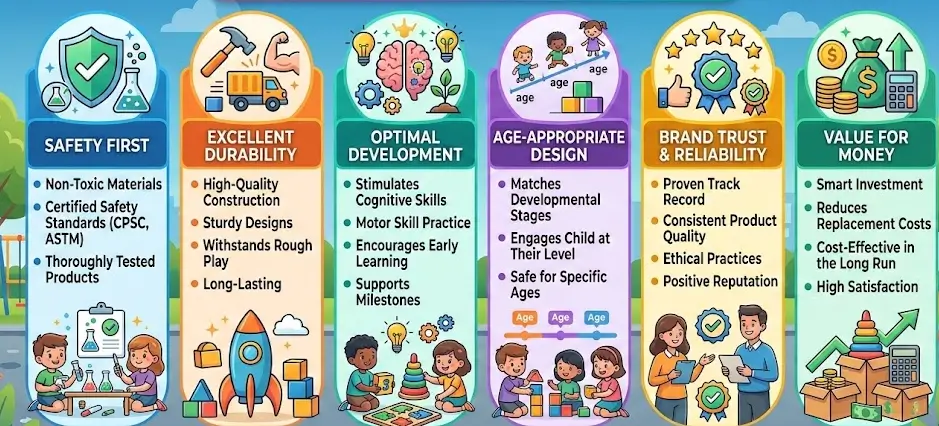
When choosing a preschool toy supplier, buyers face multiple layers of risk that go far beyond price negotiations. These risks fall into three main categories: regulatory, commercial, and brand-related.
Understanding them upfront helps you prevent problems that may surface months after production ends.
Regulatory risk
Preschool toys are subject to strict safety standards like ASTM F963, EN71, and CPSIA. If a supplier fails to meet these rules or provides outdated certification, the consequences can be severe — from import rejections and product recalls to government fines.
Each violation brings not only financial loss but also lengthy customs delays.
Imagine a shipment rejected at customs because the test reports didn’t match the latest version of EN71.
The toys stay stuck in the port warehouse, storage fees mount daily, and the holiday selling season slips away.
This kind of scenario happens more often than many importers realize — simply because supplier documentation wasn’t verified in advance.
Commercial risk
Even with compliant products, poor supplier management can cause business disruptions. Late shipments, inconsistent product quality, or sudden material changes without approval jeopardize your supply chain stability.
A delay of just two weeks can break retail delivery schedules, cause stockouts, and trigger extra shipping costs to catch up.
Reliable suppliers plan production carefully, communicate proactively, and manage raw materials responsibly — ensuring every batch meets your expectations.
Brand risk
Parents and preschool educators expect toys to be safe, durable, and educational.
When product quality slips, negative reviews spread quickly online.
Retailers may refuse to restock your brand, and distribution partners may question your due diligence process.
In severe cases, a single safety complaint can tarnish years of brand-building efforts.
Protecting your brand reputation starts with choosing a supplier that values safety and consistency as much as you do.
Selecting the right preschool toy supplier isn’t just about reducing production costs — it’s about safeguarding compliance, ensuring operational reliability, and protecting your market credibility.
That’s why experienced buyers evaluate suppliers before sampling — not after production.
Question 1:Do They Meet International Toy Safety Standards?
Preschool toys must comply with strict safety standards before entering most markets. These rules ensure that every toy designed for young children meets legal, safety, and chemical requirements — helping prevent accidents and protect both consumers and importers.
What Compliance Means?
In the United States, preschool toys must meet the Consumer Product Safety Improvement Act (CPSIA) standards. CPSIA regulates lead and phthalate content, mandates third-party lab testing, and requires tracking labels for traceability.
In the European Union, the EN71 directive outlines toy safety requirements covering mechanical strength, flammability, and chemical content. It ensures toys for preschoolers are free from harmful substances and designed to eliminate choking risks or sharp edges.
Globally, many testing facilities and manufacturers follow ASTM International standards, which reinforce consistency in safety testing and product materials.
Together, these frameworks set limits on materials, control choking hazards, and define acceptable chemical content levels for children’s toys.
For importers, compliance means that every product in your shipment aligns with these standards in both design and documentation. It’s not enough for a supplier to claim compliance — the evidence must be verified before production.
How Buyers Can Verify Compliance?
Compliance verification is one of the most critical steps in evaluating a new preschool toy supplier.
Even experienced buyers can face delays if validation is incomplete. Here are key actions to take:
- Ask for the latest test report. Ensure the report is current and corresponds to the exact product you plan to order. Reports older than one year may be outdated or no longer cover all material changes.
- Check laboratory accreditation. Only accept reports issued by accredited, independent testing labs such as SGS, Intertek, or TÜV. Look for ISO/IEC 17025 accreditation to confirm the lab’s methods meet international reliability standards.
- Confirm that the product name matches the report. The model number, photo, and material description should be identical to the toy you’re ordering. This is an easy way to catch reused or irrelevant documentation.
👉 Many suppliers reuse old reports for new products. It’s a common shortcut in the toy industry — a supplier might provide a test result from a similar item to save on testing fees.
However, even small differences in material or design can trigger non-compliance under CPSIA or EN71. Always verify that test dates and sample names align with your production run.
- Request verification from the laboratory. Some testing agencies allow importers to confirm report authenticity directly through online databases or customer service verification.
- Keep digital copies for customs clearance. Having compliant reports ready speeds up customs checks and prevents border delays.
Taking these steps demonstrates due diligence. More importantly, it separates verified suppliers from those who rely on outdated or incomplete compliance claims.
Why It Matters?
Without valid compliance, your shipment may be stopped at customs. Border agents routinely inspect preschool toys and request supporting test documentation.
If your products fail to meet CPSIA or EN71 standards — or if your documentation cannot be verified — customs may detain or reject the shipment entirely.
The consequences go beyond logistics. Non-compliant products can lead to product recalls, destruction costs, penalties, and reputational damage with retailers.
Once a recall occurs, it’s exceptionally difficult to regain consumer trust in a preschool product line.
A single non-compliant batch can undo months of marketing and product development. Ensuring every product is correctly tested before shipment not only protects your customers but also strengthens your standing with distributors who prioritize verified safety.
We often help buyers review test reports before production to avoid costly delays. Verifying compliance early ensures smoother customs clearance, consistent quality control, and the long-term reliability of your preschool toy supply chain.
Question 2:What Materials Do They Use for Preschool Toys?
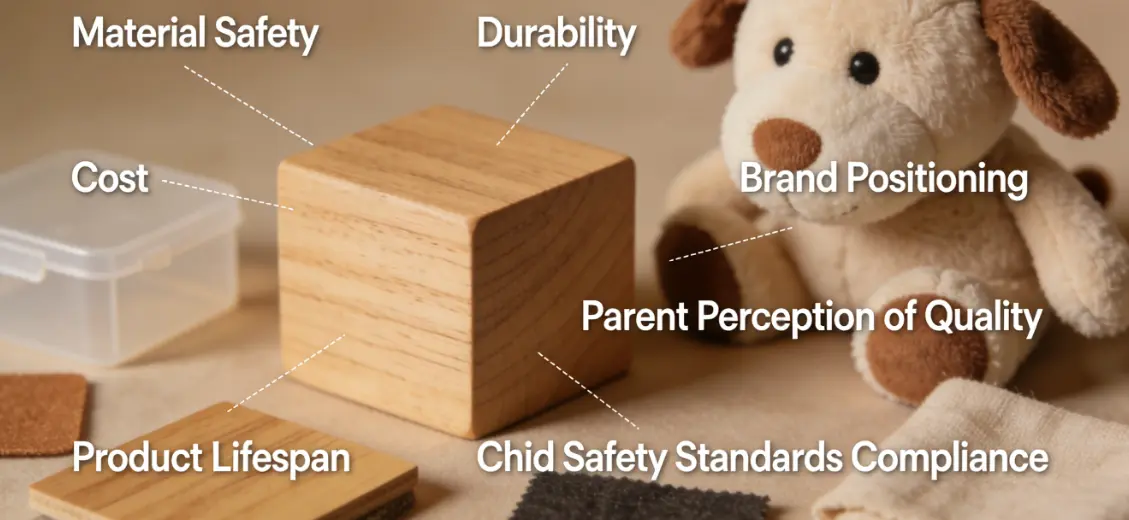
Materials determine not only safety, but also durability, cost, and brand positioning. For preschool toys, the material choice affects how parents perceive quality, how long the product lasts in use, and whether it complies with child safety standards in key markets.
How Materials Influence Safety?
The safety of preschool toys begins with their raw materials. Even when designs look harmless, unsafe materials can turn a simple toy into a compliance nightmare. Toxic paint risk, splintering wood, or cheap plastic smell are all warning signs that the supplier might be cutting corners on quality or safety testing.
Paints containing lead or formaldehyde residues can cause serious health risks for children. Similarly, poorly treated wooden parts may splinter, creating a choking hazard or injury during play. Low-grade plastics sometimes release a strong odor, which indicates volatile organic compounds (VOCs) or unapproved chemical additives such as phthalates.
In contrast, reputable suppliers use high-quality, tested materials — water-based paints, smoothly sanded wood, and food-grade plastics that meet CPSIA or EN71 standards.
Materials determine not just the tactile experience of the toy but also whether your shipment will pass safety inspections. A single unsafe component can jeopardize an entire order.
When evaluating a preschool toy manufacturer, don’t assume non-toxic on the label guarantees compliance.
The only reliable proof is a verified material declaration and testing documentation from recognized labs.
How Materials Affect Pricing and Market Position?
Material choice doesn’t only influence safety — it also defines your brand’s target segment. High-quality natural wood appeals to eco-conscious and premium markets.
These toys often feature minimalist designs, non-toxic finishes, and sustainable sourcing, making them ideal for boutique retailers or educational brands that emphasize quality over volume.
On the other hand, plastic toys dominate the mass retail segment because they allow scalability and lower cost per unit.
Durable plastics like ABS or HDPE can still meet safety standards while offering bright colors, lightweight handling, and compatibility with injection molding.
Properly managed, plastic-based preschool toys can maintain consistent quality and visual appeal across large production runs.
Hybrid models — combining wood with safe plastic or silicone parts — are becoming popular for brands targeting both affordability and eco-conscious families.
How Buyers Should Verify Material Quality?
Even when a supplier claims to use safe materials, it’s critical to verify every component before production. Here are three practical steps buyers should take:
- Request a material declaration sheet. This document lists every raw material, coating, and additive used in the toy. It should identify suppliers, chemical composition, and applicable safety limits under CPSIA, EN71, or related standards.
- Ask for paint supplier information. Reliable manufacturers should disclose their paint brands and confirm that all coatings are non-toxic and water-based. You can cross-check these details with the paint manufacturer’s compliance documents.
- Confirm BPA, lead, and phthalate limits. Request laboratory tests from an accredited third-party lab (such as Intertek or SGS) verifying that material samples meet required thresholds.
If a supplier hesitates to share these reports or avoids technical questions, it’s a red flag. Transparent communication about materials demonstrates professionalism and commitment to child safety.
Additionally, you can physically assess sample materials — checking for odor, texture, and finish consistency. Smooth sanding, stable color, and absence of chemical smell are early indicators of proper material processing.
By documenting each verification step, you protect your business from future disputes or recalls. Regulatory authorities may ask for proof of compliance during customs clearance, and complete material declarations significantly speed up the process.
Experienced suppliers should be able to explain materials clearly before sampling. A partner who understands material science, safety standards, and market positioning is more likely to help you build a preschool toy line that meets both compliance and commercial goals.
Question 3:Do They Have Experience Producing Educational Preschool Toys?
Not every toy factory understands early childhood development. Some may produce toys that look attractive but fail to support real learning or age-appropriate safety. The difference between a generic toy producer and an educational toy manufacturer lies in expertise, not just equipment.
A generic toy factory focuses primarily on appearance, cost, and production speed. Their teams often specialize in mass-market toys — simple molds, flashy colors, and quick lead times. While they can deliver volume efficiently, they may overlook critical details such as color psychology or small-part design, both of which directly affect preschool learning outcomes.
In contrast, an educational toy manufacturer designs with purpose.
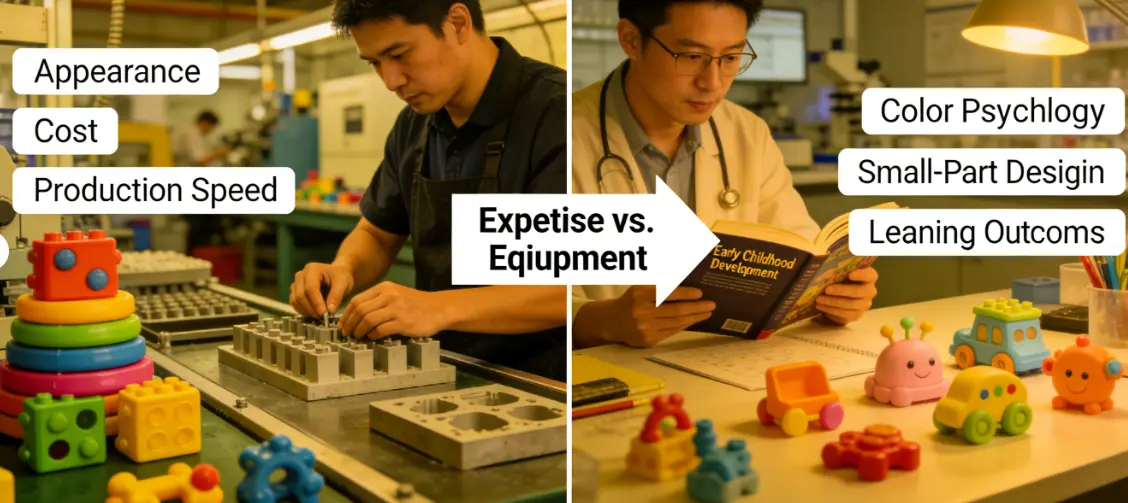
They work closely with child development specialists or early education consultants to ensure every product encourages creativity, problem-solving, or fine motor skill growth. Materials are carefully selected for tactile feedback, color palettes are chosen to promote visual recognition, and shapes are tested for safe, ergonomic interaction.
These differences matter. Color selection affects learning, especially in preschoolers who are still developing memory and visual discrimination.
Size and proportion influence motor skills, helping children practice grasping, stacking, or coordination safely. Design choices impact safety, because small or uneven parts can pose choking hazards or limit usability for younger age groups.
👉 Educational toys require understanding how children interact with products — not just how to manufacture them.
Factories experienced in this niche can anticipate how toddlers grip blocks, how paint finishes feel in tiny hands, and how sound or motion enhances engagement. This knowledge doesn’t come from general production experience; it grows from years of developing toys that combine pedagogy with practical safety design.
When sourcing suppliers, look beyond capacity and price. Ask how they design for skill development, what certifications their products have earned, and whether they’ve collaborated with educational brands before.
Ask for past projects instead of catalogs. Real production references reveal whether a manufacturer can blend learning value, safety, and consistency — the true hallmarks of an educational preschool toy partner.
Question 4:Can They Provide Product Testing and Inspection Reports?
Many buyers assume factory inspection is enough — but internal QC often misses export standards. Without verified testing and independent inspection, even a visually perfect batch can fail safety or compliance checks once it reaches customs.
A professional preschool toy supplier should understand that quality assurance involves multiple layers of verification. Passing the factory’s own internal check is only the starting point. To protect your order and your brand, insist on three essential inspection stages.
Material test
Before production begins, materials must be tested for lead, phthalates, and other restricted substances under CPSIA, EN71, or similar standards.
A material test ensures that paints, plastics, and coatings meet child safety regulations. This step prevents compliance failures that can lead to shipment rejection or recalls.
Production inspection
Also known as during-production inspection,this review monitors assembly quality, color consistency, labeling, and packaging.
It helps detect problems early — before the full order is completed — so corrections can be made without major delays or waste.
Pre-shipment inspection
This is the final checkpoint before goods leave the factory. Inspectors randomly sample finished products to confirm workmanship, safety labeling, and packaging integrity. Only after passing this step should the balance payment be released or goods shipped.
To make these inspections meaningful, buyers should ask direct, practical questions:
- Do you inspect before packing?This ensures finished toys are verified before they’re sealed and shipped.
- Can I use a third party?Professional suppliers should allow neutral inspection firms such as SGS or Bureau Veritas to verify product quality.
- What defect rate is acceptable?Clear definitions (for example, AQL 2.5) prevent misunderstandings and align expectations before production begins.
These questions not only clarify procedures but also reveal a supplier’s transparency and confidence in their own operations.
Reliable suppliers welcome inspections because they protect long-term cooperation.
When both sides trust the testing and inspection process, the result is safer preschool toys, smoother shipments, and stronger business relationships.
Question 5:What Is Their Minimum Order Quantity and Lead Time?
MOQ and lead time directly affect your risk when testing a new supplier.
These two numbers decide how much capital you need upfront and how quickly your product reaches the market — both critical factors for preschool toy importers.
A high minimum order quantity (MOQ) increases cash flow risk. If you’re testing a new design or verifying quality from an unproven factory, a large MOQ can lock you into inventory before knowing if the supplier delivers as promised.
Smaller initial orders reduce exposure and give you flexibility to adjust designs or packaging later.
Lead time impacts seasonal sales timing. Preschool toys sell strongly during school enrollment, holiday gifting, and educational campaigns.
A production delay of even two weeks can shift container arrival into the wrong purchasing window, shrinking your return on investment.
Sampling time affects your launch schedule. Approving prototypes late pushes back testing, packaging, and marketing preparation.
When samples take months instead of weeks, every stage that follows — production, certification, and shipping — moves behind schedule.
👉 Missing the back‑to‑school season often means waiting an entire year. Retailers will have already placed orders, and warehouse space will be committed. A single timeline misstep can turn a promising product into leftover stock.
That’s why it’s essential to clarify expected timelines during negotiation, not after the deposit is paid.
Transparent communication about both MOQ and production schedules helps plan inventory, marketing, and cash flow effectively.
Flexible MOQ often signals a supplier experienced in working with international buyers. Such partners understand market testing cycles and can adjust capacity to support your long‑term growth.
Question 6:Do They Offer Custom Design or Private Label Services?
Private labeling turns a generic toy into a branded product with higher margins. For preschool toy importers, customization adds differentiation and builds long‑term brand equity that standard catalog items can’t achieve.
Suppliers typically offer three levels of customization, each with its own commercial benefit.
Logo printing is the entry point. It allows you to apply your brand name or symbol directly onto existing toy models.
This option has minimal setup cost and is ideal for small test orders. Adding visible branding helps build recognition in both retail and online listings.
Custom packaging comes next. Thoughtfully designed boxes or sleeves increase shelf appeal, improve perceived value, and align with your brand story.
Even when the toy itself is standard, distinctive packaging can justify a higher retail price and make your products more memorable to parents.
At the top level is an exclusive mold — a fully custom design created only for your company.
This option demands higher tooling investment but offers the strongest commercial advantage.
An exclusive mold reduces price competition, since no other brand can legally reproduce your toy. It also strengthens long‑term customer loyalty and allows you to build a trademarked product line rather than competing on cost alone.
Custom packaging improves shelf appeal, but a unique shape or mold defines brand identity for years. The key is balancing design investment with realistic sales volume.
When considering custom or private‑label services, ask suppliers how ownership of molds and design files is managed.
Always confirm whether molds are exclusive to your brand. This ensures your investment creates a lasting competitive edge in the preschool toy market.
Final Checklist Before Choosing a Preschool Toy Supplier
Before signing any agreement, review these five areas. Selecting the right partner early prevents compliance failures, shipment delays, and costly misunderstandings later.
Compliance
Ensure every product meets required safety standards such as CPSIA, EN71, or ASTM.
Verify that all test reports are current, issued by accredited laboratories, and linked to the correct product model. Non‑compliant toys can be rejected at customs or recalled after release — both damaging and expensive.
Materials
Confirm that paints, plastics, and coatings come from verified, safe sources. Request a material declaration sheet and check for limits on BPA, lead, and phthalates. Material transparency is often a good indicator of a supplier’s professionalism and ethical sourcing.
Production
Evaluate how the factory manages inspection and testing. Ask whether they perform in‑process checks and allow independent third‑party inspections before shipment. Consistent quality control signals an organized, reliable supplier ready for export standards.
Communication
Strong suppliers respond promptly and clearly. Effective communication helps resolve design changes, certification issues, or packaging updates before they escalate. A responsive manufacturer shows respect for timelines and partnership integrity.
Scalability
Consider whether the factory can handle your growth. A supplier suitable for 500 units may struggle with 10,000.
Discuss capacity, delivery schedules, and capability to expand production without compromising quality. The right partner supports your brand as orders grow, not just at the prototype stage.
Assessing these five areas gives you a complete view of competence, reliability, and long‑term potential. Preschool toys combine regulatory complexity with design sensitivity, so supplier evaluation should be both technical and strategic.
👉 If you want, we can help review supplier documents or test reports before you confirm your order. That independent check can reveal red flags early and help you move forward with confidence.