
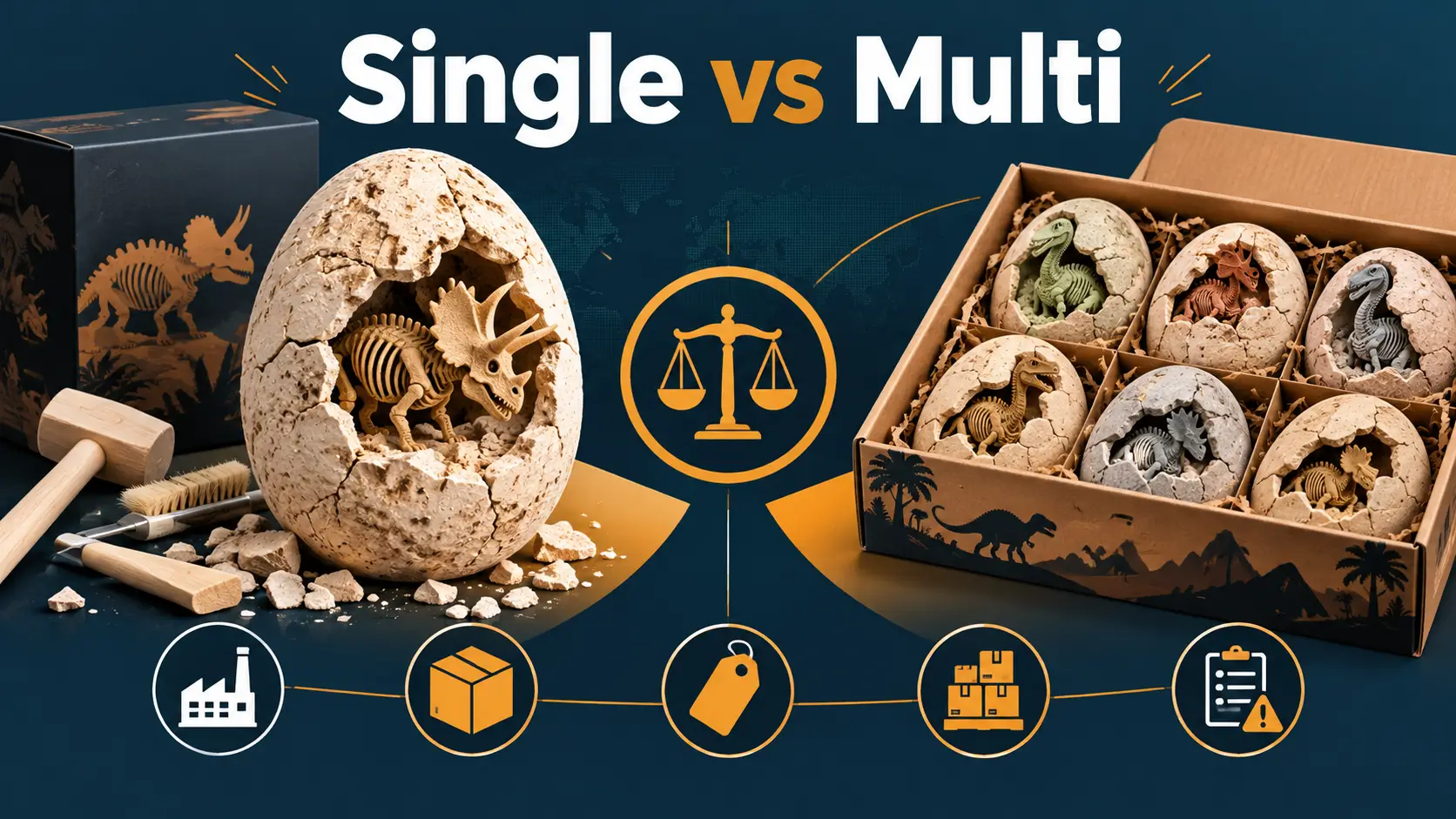
Choosing between a single large dinosaur egg excavation kit and a multi egg kit affects manufacturing cost, minimum order quantity, packaging, retail pricing and inventory risk. Neither format is automatically cheaper or more profitable. Toy brands, importers and retail buyers should compare complete retail sets under equivalent specifications and purchasing conditions.
Three measures are useful throughout this comparison. Cost per retail kit supports pricing decisions, cost per egg describes how expense is distributed across the blocks, and cost per independent activity helps evaluate the intended customer experience.
Single Egg vs Multi Egg Dinosaur Dig Kits, Key Purchasing Differences
The main distinction is how excavation blocks, dinosaur figures, tools and packaging are arranged within one saleable kit. That configuration, rather than egg count alone, determines what a buyer is purchasing.
Single Large Egg vs 12 Pack, Product Configuration at a Glance
A large single egg concentrates the excavation experience in one block, which may contain one or several figures. A 12 Pack distributes the activity across twelve smaller blocks. Some multi egg products supply individual tools, while others provide shared tools. These versions are not directly equivalent.
| Purchasing factor | Single large egg | 12 Pack |
|---|---|---|
| Excavation blocks | One larger block | Twelve individual blocks |
| Material use | Weight of one block | Combined weight of twelve blocks |
| Tools | Usually for one main activity | Shared or individually allocated |
| Packaging | Protection for a large block | Separation of multiple blocks |
| Potential retail use | Single gift experience | Repeated or group activities |
These are common product formats, not fixed specifications. Always check the actual contents of each proposed SKU.
Key Differences in Cost, MOQ and Retail Positioning
A larger block may need more material and protective packaging. Twelve smaller blocks may require additional handling, figures, tools and internal compartments. Manufacturing cost therefore depends on the complete bill of materials and assembly method. MOQ can depend on production batches and custom packaging, while retail positioning depends on whether customers value one large experience or several independent activities.
What Buyers Should Compare Before Choosing
First, define one retail selling unit and the accessories it contains. Then compare complete kit cost, the number of usable activities, minimum order requirements, packed dimensions and expected selling price. A low cost per egg does not necessarily mean a low cost per kit or a strong retail margin.
How Product Configuration Affects OEM Pricing
OEM pricing changes when material consumption, figures, accessories or packaging change. A quotation is useful only when these specifications are clearly defined.
Egg Size, Excavation Material and Dinosaur Figure Configuration
Compare the total net weight of excavation compound in each finished kit. External dimensions alone are insufficient because density and formulation can vary. Figure cost also depends on quantity, size, detail, material and available tooling. Existing figures may avoid development expense, while new designs can require molds and samples. Confirm whether any tooling charge is separate from the unit price.
Shared Tools vs Individual Excavation Tool Sets
A 12 Pack with individual brushes and chisels uses more tool components than a version with one shared set, assuming comparable accessories. Extra tools can also increase counting, inspection and packing work. Yet shared tools may restrict simultaneous group participation. Select tool quantities according to the activity promised to customers rather than minimizing component cost alone.
Retail Packaging, Inserts and Private Label Requirements
A large egg may need a secure insert to prevent movement, while twelve eggs may need compartments or individual wrapping. Custom boxes, printed instructions and inserts can add setup charges and packaging minimums. Ask for separate quotations for standard packaging and the proposed branded version. Packaging savings are only useful when product protection and retail presentation remain adequate.
Single Egg vs 12 Pack, Manufacturing Cost Breakdown
A 12 Pack may cost less per small egg without costing less per retail set. A valid comparison combines material, figures, tools, packaging, assembly and relevant production overhead under equivalent order conditions.
Excavation Material, Dinosaur Figures and Tool Costs
The combined compound weight may be greater for the large egg or for the twelve smaller eggs. Neither result should be assumed before measurement. Compare figure sizes and counts as well as tool quantities. Twelve simple figures can have a different cost from several larger detailed figures, particularly when one configuration requires new tooling.
Packaging, Assembly and Per Set Manufacturing Costs
A larger block can require more protective material, whereas multiple eggs can add positioning and individual wrapping operations. Obtain component and labor costs for the complete retail kit, and separate one time development charges from recurring expenses. Confirm whether quotations include printing, assembly, inspection and setup work.
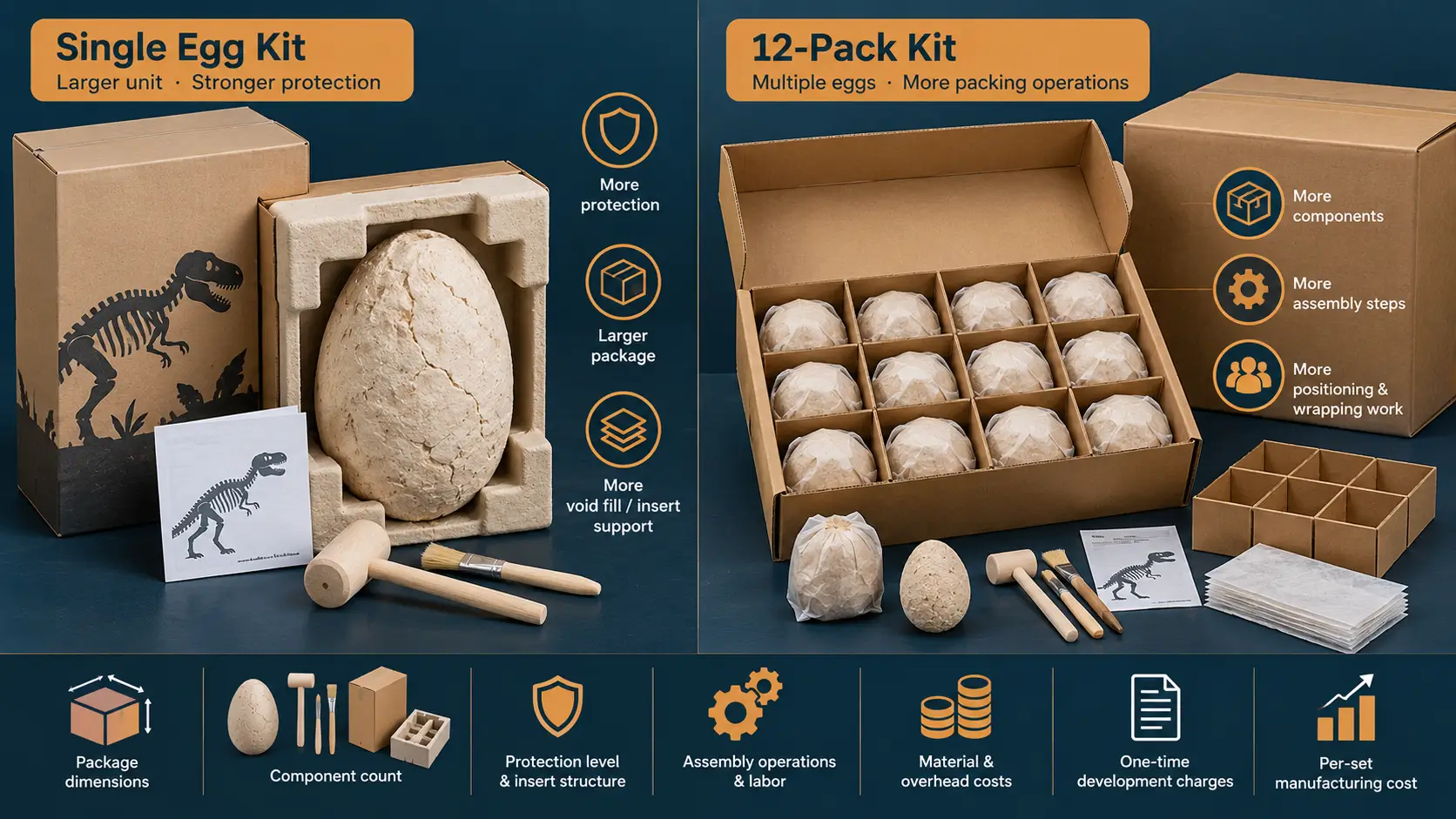
| Cost input | Single large egg | 12 Pack |
|---|---|---|
| Compound | Measured large block weight | Total twelve block weight |
| Figures and tools | Verified component list | Verified component list |
| Packaging | Box and protective insert | Box, dividers and wrapping |
| Labor and overhead | Actual operations and allocation | Actual operations and allocation |
Why a 12 Pack Is Not Always Cheaper to Manufacture
Multi egg production may share packaging or tools and benefit from standardized components, but twelve blocks still require material and handling. Individually wrapped eggs or separate tool sets can offset those efficiencies. A large egg may use more compound yet involve fewer individual packing operations. The outcome depends on actual component quantities and production conditions, not egg count alone.
Cost per Retail Set, per Egg and per Excavation Activity
Cost per egg equals the full retail kit cost divided by the number of eggs.
Cost per activity equals the full retail kit cost divided by the number of independent excavation activities.
A jumbo egg with several figures is not automatically several independent activities. Similarly, twelve eggs supplied with one tool set may not serve twelve participants at once. Keep cost per complete retail set as the main purchasing measure, then use the other measures to evaluate consumer value.
MOQ Differences and the Impact of Order Quantity
MOQ depends on production arrangements, component purchasing and customization depth. Neither product format has a universally lower minimum order quantity.
MOQ for Standard Dinosaur Dig Kit Configurations
Existing molds, defined accessories and standard packaging may make smaller orders more practical. However, an established SKU is not necessarily held in stock, and manufacturers can still require a minimum production batch. Confirm whether finished inventory is available or the order requires new production.
Private Label Packaging vs Fully Customized OEM Orders
Changing only printed packaging may preserve the core product process but introduce print run minimums. New figures, tools or egg dimensions may require molds, trials and dedicated component batches. Ask the manufacturer which requirement sets the finished kit MOQ and whether unused custom packaging can be stored or separately charged.
MOQ per Retail Set, Individual Egg and Custom Component
One thousand single egg retail sets contain one thousand excavation blocks, whereas one thousand 12 Pack sets contain twelve thousand blocks. These are arithmetic examples, not quoted MOQ requirements. Record minimums in finished retail sets and identify separate requirements for printed boxes, figures and tools. The production cost will not necessarily scale directly with block count.
How Order Quantity Changes Unit Pricing
Estimated unit manufacturing cost equals recurring cost per kit plus the fixed production cost allocated to each ordered kit.
Larger batches may spread setup expenses and improve purchasing efficiency, but price breaks occur only when actual production or supplier conditions change. Request comparable quotations at several quantities and assess savings against additional inventory investment, storage requirements and demand uncertainty.
Retail Price per Kit vs Purchase Cost and Gross Margin
Retail selling prices reflect brand, configuration, channel and promotion as well as physical contents. A higher shelf price does not prove a higher manufacturing cost or a better margin.
Comparing US Retail Prices for Single Egg and 12 Pack Kits
Public US retail listings show that jumbo single egg products and twelve egg assortments can occupy overlapping price positions. The products are not necessarily comparable because figure counts, tools, branding and promotional conditions differ. Use dated samples with the product link, configuration, actual price and discount status, rather than treating isolated prices as industry averages.
For product examples, see Target jumbo dinosaur egg listing and Target twelve egg kit listing. Check current product information and availability before relying on either listing.
Retail Price per Kit vs Price per Excavation Activity
Retail price per activity equals the selling price of the kit divided by its independent excavation activities.
This measure can clarify the value of a multi activity kit but does not replace the complete selling price. Gift buyers may value a larger excavation block and presentation, while group buyers may prioritize independent activities and tool access. Compare value using the intended customer experience.
How Landed Cost Affects Gross Margin
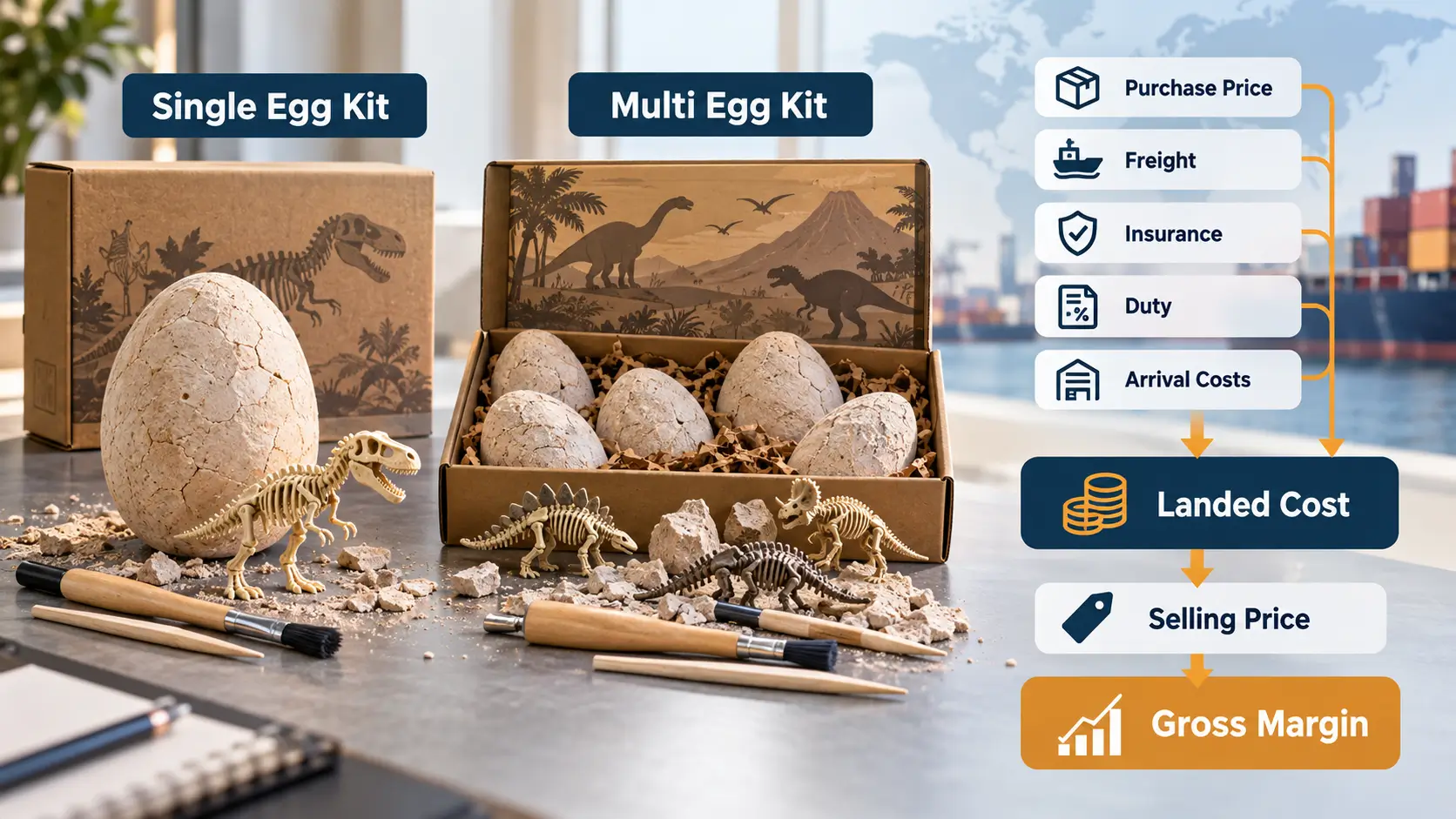
Landed cost per kit is its purchase price plus the allocated freight, insurance, applicable duties and other arrival costs not already included.
Gross margin percentage equals selling price minus landed product cost, divided by selling price, then multiplied by 100.
Use a selling price excluding sales tax and do not count charges twice. This simplified gross margin excludes marketplace commissions, fulfillment, storage, advertising and returns. Packed weight and carton dimensions may change freight cost, so compare landed cost rather than factory price alone. For general guidance see the International Trade Administration pricing resource.
Setting a Target Retail Price Before OEM Sourcing
Maximum target landed cost equals the planned selling price multiplied by one minus the desired gross margin expressed as a decimal.
Set a realistic selling price and margin target before choosing expensive packaging or accessories. Then test whether each quoted configuration fits the allowable cost. If not, review features that do not weaken the intended retail experience, such as unnecessary packaging complexity or tooling changes. Never reduce applicable safety or product quality requirements to meet a price.
Which Dinosaur Dig Kit Format Fits Different Retail Strategies?
Product format should match what the retailer promises the customer. Single large eggs can emphasize one substantial experience, while multi egg kits can emphasize activity quantity and distribution among users.
Jumbo Single Egg Kits for Gift Oriented Retail
A jumbo egg may suit a gift proposition built around one larger excavation block and its presentation. Assess the figures, digging experience, packaging strength and achievable selling price. A visually impressive package is not commercially attractive if material and delivery costs prevent the required margin.
12 Pack Kits for Group Activities and Multi Activity Products
A 12 Pack may suit classroom activities, parties or repeated individual sessions. For simultaneous group use, confirm whether each participant receives adequate tools and separately usable materials. For one child completing activities over time, shared tools may be sufficient. These configurations should not be priced or marketed as identical products.
E Commerce, Distributors and Private Label Retail Programs
Online sellers should evaluate packed size, shipping cost and platform fees. Distributors need enough room between acquisition and resale prices for their commercial requirements. Private label buyers must also consider custom packaging MOQ. Test both formats against the actual channel economics rather than choosing by egg quantity.
| Retail objective | Format to evaluate | Decision condition |
|---|---|---|
| Single gift experience | Large single egg | Presentation supports target price |
| Group activities | 12 Pack | Tools and individual activities are sufficient |
| Marketplace or distribution | Compare both | Landed cost and channel margins are viable |
What to Confirm Before Requesting Comparable OEM Quotes
Comparable quotations require consistent specifications, quantities, delivery terms and quality expectations. Otherwise, the lowest offer may simply exclude important components or services.
Confirm Egg Size, Accessories and Retail Packaging Specifications
Specify block dimensions, target material weight, figure count, figure designs, tools, instructions and retail packaging. Clarify whether existing tooling is acceptable or new development is required. This prevents suppliers from quoting materially different kits under similar product names.
Align Order Quantity, Customization Scope and Trade Terms
Express quantities in finished retail sets and identify how many eggs each set contains. State expected repeat orders separately from the initial purchase. Compare prices under the same currency, quotation date and agreed Incoterms rule with a named place. Differences between EXW and delivered prices must be reconciled before comparing total cost.
Verify Sample, Testing and Packaging Requirements
Samples should confirm excavation performance, components, tools, appearance and package protection. For the US market, determine applicable toy safety and certification requirements based on actual product materials, age grading and intended use. The US Consumer Product Safety Commission toy safety guidance provides an official starting point.
Before requesting final pricing, confirm these project inputs.
- Product format, egg quantity, dimensions and material requirements.
- Dinosaur figures, tools, accessories and packaging specifications.
- Initial quantity, customization scope, target market and delivery terms.
- Sample approval, applicable testing, target retail price and cost ceiling.
Final Buying Decision, Single Egg or 12 Pack Dinosaur Dig Kits?
Choose the format that delivers the intended consumer experience within the allowable MOQ, landed cost and retail margin. No format wins under every purchasing condition.
Single Egg vs 12 Pack Purchasing Decision Matrix
The following rules are starting points for evaluation, not claims that one format always performs better.
| Buyer priority | Initial option | Required verification |
|---|---|---|
| One substantial gift activity | Large single egg | Experience, packaging and margin |
| Multiple independent activities | 12 Pack | Activity count and accessory allocation |
| Lowest complete acquisition cost | Compare both | Same basis and complete kit quotations |
| Smaller opening order | Compare both | Actual MOQ and total inventory investment |
Choose Based on MOQ, Landed Cost and Retail Price Target
Begin with the required activity format, then verify the supplier can produce it at the planned quantity. Compare landed costs for the complete selling units and calculate margin at a realistic retail price. Also consider replenishment, storage and the risk of unsold inventory. A lower factory price is only useful when the overall commercial result improves.
Finalize Your Preferred Configuration Before Requesting a Quote
Buyers can compare the 12 Pack dinosaur digging kit with the large dinosaur egg excavation kit as two potential starting configurations. Confirm current contents, customization options and quotations before relying on either product for a cost comparison.
When the preferred format remains uncertain, request quotations for two fully specified alternatives under the same purchase conditions. The most useful decision is not which kit contains more eggs, but which complete product meets consumer expectations while supporting feasible production, acceptable inventory risk and a sustainable retail margin.