
The global educational toy market in 2026 has shifted toward experiential learning. Among the most viral products is the Magic Water Elf Kit—a chemistry-based toy that transforms liquid sodium alginate into 3D colorful figures. For brand owners and Amazon sellers, the path to market dominance lies in a robust Magic Water Elf Kit OEM Service.
This guide provides a comprehensive, step-by-step breakdown of the manufacturing journey, explaining how to transition from a simple Idea to Mass Production while ensuring safety,compliance, and profitability.Leveraging China’s manufacturing core (which produces over 70% of global toys according to Statista 2024/2025 data), we reveal the technical secrets of the OEM model.
Step 1: Define Your Magic Water Elf Kit Product Concept
Defining a clear product concept is critical in Magic Water Elf Kit OEM projects because age grading, target market regulations, and differentiation features directly affect formulation, compliance, and production efficiency.
Success in the B2B toy sector starts with a unique value proposition (UVP).
A generic “Idea” must be refined into a technical specification before entering the OEM pipeline.
Clarify Product Positioning Before OEM Development
- Target Market Analysis: Requirements for the EU market (EN71-3) differ significantly from the US market (ASTM F963).
- Age Grading: Kits are typically graded for 6+ or 8+. This choice dictates the chemical concentration and the complexity of the instructional design.
- Differentiation Strategy: Consider adding color-changing pigments, glow-in-the-dark additives, or specialized glitter gels to stand out.
Based on 12 years of OEM management, manufacturers report that 80% of project delays are caused by “concept drift”—unclear specifications during the initial phase that lead to repeated sampling failures.
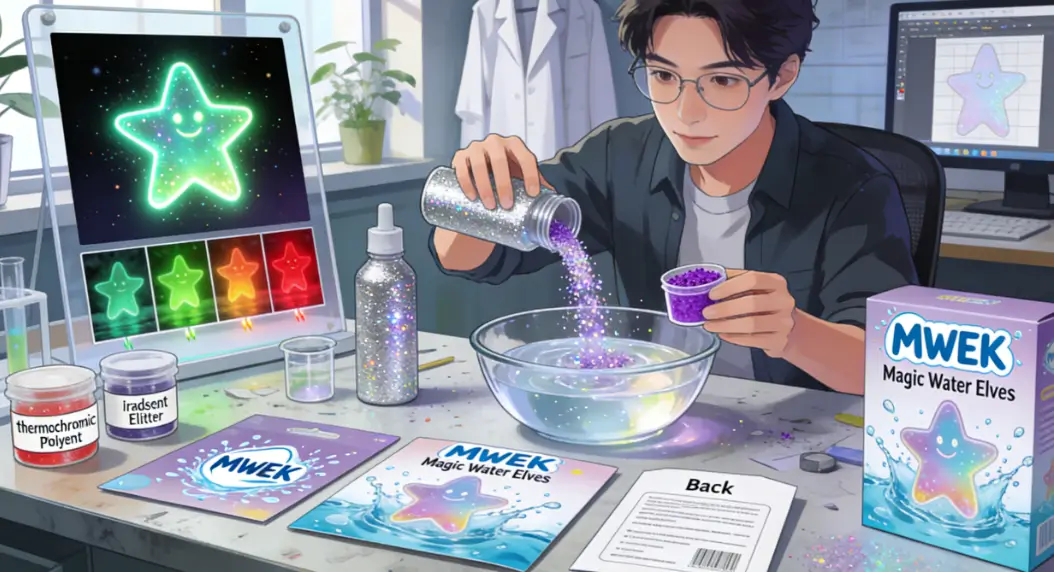
Step 2: OEM Design & Customization (Core Differentiators)
A Magic Water Elf Kit OEM service allows brands to customize molds, chemical formulations, visual effects, accessories, and packaging.
In 2026, most OEM projects focus on proprietary molds, sodium alginate viscosity tuning, and brand-exclusive visual elements to avoid product homogeneity.
The “Original” in OEM means your product should not be a carbon copy of existing market offerings.
Our Magic Water Elf Kit OEM Service focuses on four customization pillars.
What Can Be Customized in a Magic Water Elf Kit OEM Service
- Custom Mold Development: Creating unique 2D and 3D shapes (e.g., themed marine life, alphabets, or brand mascots).
- Chemical Formulation: Adjusting the Sodium Alginate viscosity for easier squeezing and faster cross-linking reaction.
- Visual Branding: Custom-colored gel bottles, specialized nozzle designs, and exclusive glitter/pearl powder mixes.
- Comprehensive Accessories: Themed playmats, specialized storage tanks, and multi-language instruction manuals.
Mold Development & Cost Structure
To move from an idea to physical reality, a physical mold is required. In 2026, the cost structure for high-precision injection molds generally follows these benchmarks:
- Standard 2D Mold: USD 2,000 – 3,500.
- Complex 3D Mold: USD 4,500 – 8,000.
- Lead Time: 15 to 30 days for CNC machining and T1 sampling.
Procurement Decision Example
1. Application Example: Creative Play
2. Case Reference: OEM Customization
3. Procurement Decision Example
4. Cost Control Case
Understanding the cost structure is essential for budgeting. The Cost Breakdown for Sourcing Magic Water Elf Kits from China explains materials, packaging, shipping, and import fees in detail.
5. Quality Management Example
To ensure product safety and reliability, the Common Quality Issues in Magic Water Elf Kits and How Manufacturers Control Them shows real-world quality control measures applied by leading manufacturers.
6. Production and Customization Application
Learn how materials, production processes, and customization options affect product quality in the Magic Water Elf Kit Manufacturer: Production Process, Materials, and Custom Options.
7. Top Manufacturer Reference
If you plan to source directly, check out the Top 5 Magic Water Elf Kits Manufacturers for Kids in 2025 for reliable suppliers.
8. Choosing a Reliable Manufacturer Example
Use the How to Choose a Reliable Magic Water Elf Kit Manufacturer in China guide to evaluate credibility, production capacity, and compliance.
9. Bulk Order Evaluation Case
For large orders, the How to Evaluate a Magic Water Elf Kit Manufacturer for Bulk Orders explains supplier assessment and cost analysis for volume procurement.
10. Beginner Guide Application
New users can learn how to start with Magic Water Elf Kits via the What Is a Magic Water Elf Kit? Complete Guide for Beginners, covering gameplay, kit contents, and educational value.
Step 3: Sampling, Testing & Iteration
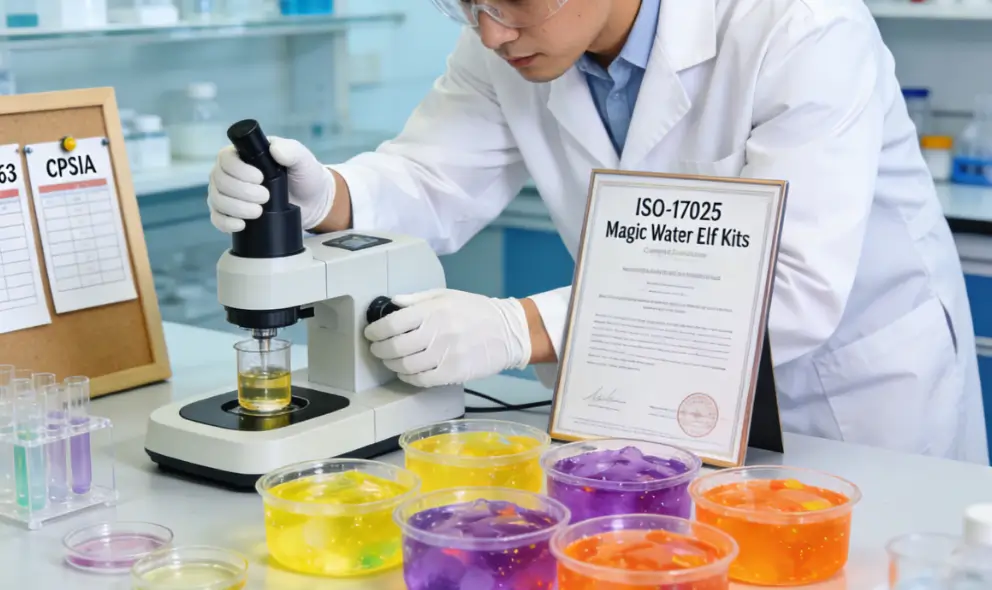
Sampling and compliance testing are mandatory before mass production of Magic Water Elf Kits because the product involves liquid chemicals and children’s use.
In 2026, EN71, ASTM F963, and CPSIA testing typically take 7–14 working days through ISO 17025 certified laboratories.
OEM Sampling Process Explained
- Initial Prototype: A 3D-printed mock-up to verify size and ergonomics.
- Functional Testing: We test the expansion time and gel integrity. Does the “elf” maintain its shape after 48 hours in the setting solution?
- Iteration Cycles: Brands usually undergo 2–3 rounds of refinement to perfect the bottle’s “squeeze-force” and the gel’s color vibrancy.
Safety Testing & Compliance (Critical for Importers)
Selling a Magic Water Elf Kit legally requires passing specific safety tests by accredited labs.
| Market | Mandatory Standards | Key Certificate | Test Duration |
|---|---|---|---|
| European Union | EN71 Parts 1-3 | CE Mark | 7-14 days |
| United States | ASTM F963 & CPSIA | Children’s Product Certificate (CPC) | 7-14 days |
| General (Chemicals) | REACH & Phthalates | — | Included |
The Magic Water Elf Kit involves liquid chemicals, making it subject to strict oversight. Our OEM service ensures compliance with:
- EN71 Parts 1, 2, and 3: Mandatory for the European Union market.
- ASTM F963 & CPSIA: Required for the United States, necessitating a Children’s Product Certificate (CPC).
- REACH & Phthalates: Ensuring all plastic materials and gels are non-toxic and skin-safe.
We utilize ISO 17025 certified labs like SGS, TUV, and Intertek. Average testing duration is 7–14 working days.
Step 4: Costing, MOQ & Production Planning
For Magic Water Elf Kit OEM projects, the typical MOQ ranges from 1,000–3,000 sets for private label orders and 5,000–10,000 sets for fully customized molds.
Mass production usually takes 20–35 days, with an additional 15-day buffer during peak seasons.
MOQ & Unit Cost Breakdown
Minimum Order Quantity and cost depend on your customization level.
- Private Label (Standard Mold): 1,000 – 3,000 sets.
- Fully Custom OEM (Exclusive Mold): 5,000 – 10,000 sets.
- Cost Drivers: Material purity (Sodium Alginate grade), mold amortization, and packaging complexity (e.g., spot UV, matte finishes).
Production Timeline Overview
A typical Mass Production cycle takes 20–35 days. However, during the Q3–Q4 peak season, brands should add a 15-day buffer to account for supply chain congestion.
Step 5: Quality Control During Mass Production
OEM quality control for Magic Water Elf Kits typically includes IQC, IPQC, and FQC inspections, with AQL standards of 2.5/4.0 applied to ensure consistency, leak prevention, and packaging integrity during mass production.
OEM Quality Control Standards
- IQC (Incoming Quality Control): Testing raw powders and gel pigments for purity before production.
- IPQC (In-Process Quality Control): Monitoring automated filling lines to ensure accurate bottle volumes (±0.5ml).
- FQC (Final Quality Control): Conducting AQL 2.5/4.0 inspections on finished kits for leaks or packaging defects.
Common Quality Risks & Prevention
We mitigate risks such as color bleeding and uneven expansion by using high-purity medical-grade Calcium Lactate and standardized mixing ratios. Our packaging uses K=K double-corrugated cartons to prevent deformation during sea freight.
Step 6: Packaging, Branding & Compliance Labeling
Packaging is a critical component of the Magic Water Elf Kit OEM Service Explained, as it serves both marketing and regulatory roles.
OEM Packaging Options
- Full-Color Cardboard Boxes: Most common for retail and Amazon FBA.
- Plastic Storage Tubs: Provides higher perceived value as the container is reusable as a “habitat.”
- Eco-Friendly Solutions: Recycled kraft paper inserts are becoming a 2026 industry standard for sustainable toy brands.
Mandatory Label Information
To avoid customs seizures, all OEM kits must feature: Age Warnings (Small Parts Hazard), Country of Origin (Made in China), and Manufacturer/Importer contact details alongside CE/UKCA marks.

Step 7: Logistics, Shipping & Market Launch
The final phase is the physical delivery of your Mass Production order to global distribution centers.
Shipping Methods for Magic Water Elf Kits
- Sea Freight (FCL/LCL): The most cost-effective method for bulk OEM orders.
- Rail Freight: Efficient for EU-bound shipments via the China-Europe Express.
- Amazon FBA Prep: Professional OEM partners provide FNSKU labeling and Palletization directly at the factory.
Step 8: Long-Term OEM Partnership & Scaling
Look for partners with 5+ years of chemical toy experience, an in-house R&D lab, and a proven track record in the US and EU markets.
A reliable partner doesn’t just manufacture; they consult on safety regulations and market trends.
Conclusion: Turning Your Idea Into a Market Leader
Navigating the Magic Water Elf Kit OEM Service: From Idea to Mass Production requires technical precision and market foresight.
By following this step-by-step roadmap, brand owners can minimize risk, maximize quality, and scale their toy business in the competitive 2026 STEM market.
Frequently Asked Questions (FAQ)
Q: What is the typical MOQ for a custom kit?
A: Standard OEM kits usually require 1,000 sets for box customization and 5,000 sets for mold customization.
Q: How do you ensure the gel doesn’t leak during shipping?
A: We use induction sealing on all gel bottles and perform vacuum pressure tests to simulate high-altitude air freight conditions.