
As a procurement consultant, I often hear buyers confused about educational toys material cost comparison in China. When sourcing from China toy manufacturing cost, you may find a huge price gap between different suppliers—even for the same educational toy, the price can differ by 30% or even double.
This confusion often leads to wrong purchasing decisions, either overpaying for unnecessary materials or choosing low-quality options that hurt brand reputation.
Let’s get straight to the point. More than 70% of this price difference comes from material selection. Among common materials for educational toys, plastic vs wooden toys have the most obvious cost gap, and silicone is also much more expensive than ordinary plastics.
The choice of material directly determines the base cost of the product, which is the core factor affecting the final quotation.
This guide is designed to help you solve these pain points. It will help you understand the specific cost composition of different materials, avoid being misled by excessive quotations, and choose the most cost-effective material plan that maximizes your profit.
If you already have a product idea, we can help you estimate the exact material cost within 24 hours.
Why Material Choice Is the #1 Cost Driver in Educational Toys
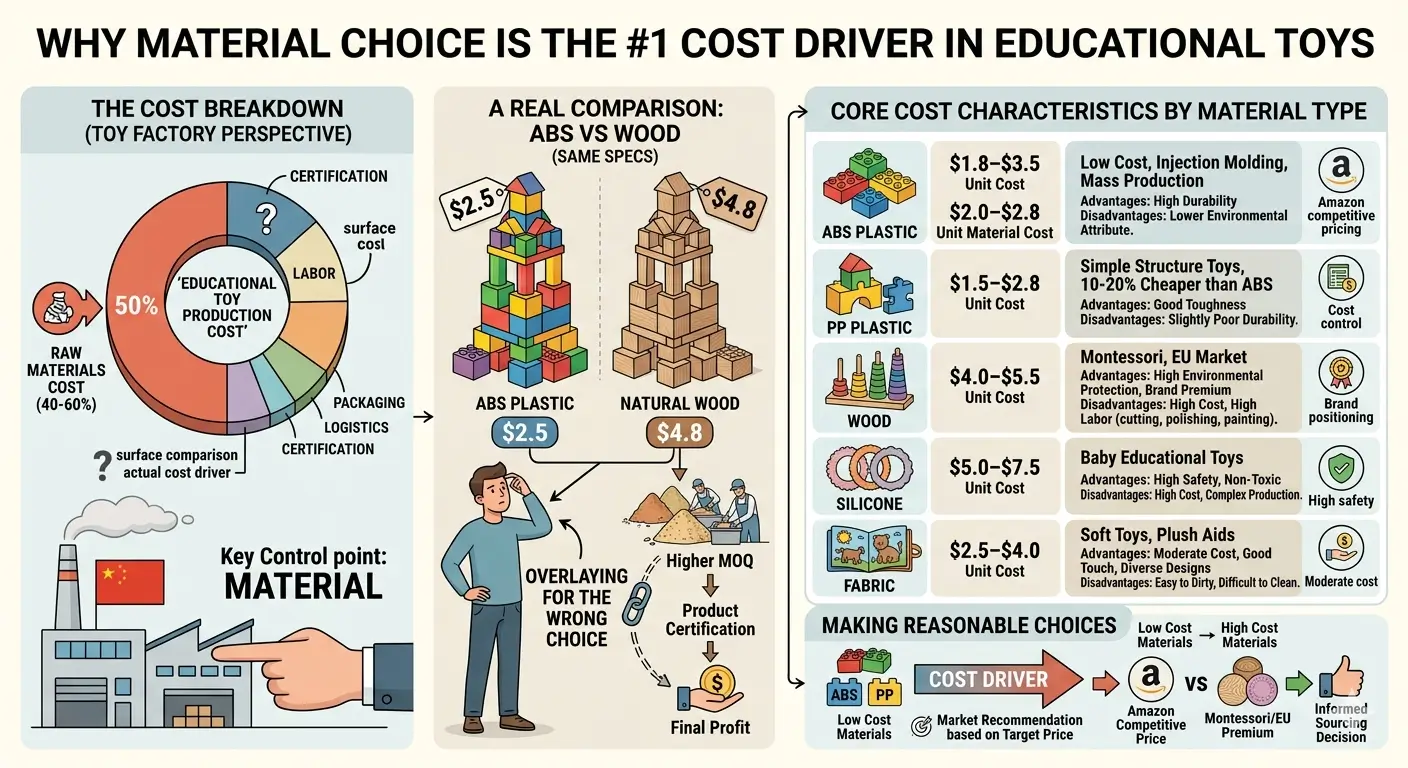
To understand why material choice affects cost so much, we first need to look at the toy cost breakdown. In the production of educational toys, the cost of raw material cost toys usually accounts for 40% to 60% of the total production cost, which is much higher than the proportion of labor, packaging and other links.
This means that choosing the right material is equivalent to grasping the key to controlling costs, which is also a key point in China toy factory pricing.
A real comparison can help you intuitively feel this gap. Take the same building block toy of the same size and specification. If made of ABS plastic, the unit material cost is about $2.5; if made of natural wood, the unit material cost will rise to $4.8.
This nearly double gap is not due to differences in craftsmanship, but purely the difference in raw material costs. Many buyers overpay simply because they choose the wrong material at the beginning.
It is worth noting that different materials not only affect the direct material cost, but also have a chain reaction on MOQ, product certification and final profit. For example, wooden toys require higher MOQ due to the need for large-scale material procurement and processing, while plastic toys have lower MOQ and more flexible production.
Next, we will break down the cost characteristics of different materials and explain how they influence the overall cost of manufacturing educational toys in China, helping you make more informed sourcing decisions.
| Material Type | Unit Material Cost (Approx.) | Key Cost Influence Factor |
|---|---|---|
| ABS Plastic | $2.0–$2.8 | Raw material price, injection molding efficiency |
| Wood | $4.0–$5.5 | Wood species, processing labor |
Material Cost Comparison Table (China Manufacturing)
| Material Type | Unit Cost Range | Suitability | Key Advantages | Key Disadvantages |
|---|---|---|---|---|
| ABS Plastic | $1.8–$3.5 | Injection molding, mass production | Low cost, high durability, easy to process | Lower environmental attribute |
| PP Plastic | $1.5–$2.8 | Simple structure toys, low-cost products | Cheaper than ABS, good toughness | Slightly poor durability |
| Wood | $4.0–$5.5 | Montessori toys, EU market products | High environmental protection, strong brand premium | High cost, high labor demand |
| Silicone | $5.0–$7.5 | Baby educational toys, safe-required products | High safety, non-toxic, soft texture | High cost, slow production efficiency |
| Fabric | $2.5–$4.0 | Soft educational toys, plush toys | Moderate cost, good touch, diverse designs | Easy to dirty, difficult to clean |
The above table clearly shows the plastic vs wooden toys cost and the cost differences of other common materials, which is the core reference for your procurement decision. If you’re not sure which material fits your market, we can recommend based on your target price.
Below, we will examine each material in detail, including its cost characteristics, performance, and ideal applications, so you can select the right material for your product and budget.
If you are evaluating suppliers or planning a new product line, you may also find these resources helpful: how educational toy pricing varies among Chinese manufacturers and the key differences between educational toys and traditional toys.
ABS Plastic
ABS plastic is one of the most commonly used materials in educational toys due to its low cost. It is suitable for injection molding production, which can realize mass production in a short time and greatly reduce the unit cost.
Its durability is also excellent, not easy to break, and can adapt to the use scenario of children’s toys. Best choice for Amazon sellers looking for competitive pricing, because it can balance cost and quality, and gain advantages in price competition.
Read more:Plastic vs wooden educational toys price
PP Plastic
PP plastic is cheaper than ABS plastic, and its cost is usually 10–20% lower than ABS. It has good toughness and is not easy to brittle, which is suitable for making educational toys with simple structure such as toy blocks and puzzle pieces.
However, its durability is slightly worse than ABS, and it is easy to scratch or deform under long-term heavy use. It is suitable for buyers who pursue cost control and have no high requirements for product durability.
Wood
Wooden educational toys have high cost, mainly because the raw material price of wood is high, and a lot of manual processing is needed in the production process such as cutting, polishing and painting, which increases the labor cost.
But it has strong environmental protection attributes, which are in line with the consumption concept of modern consumers pursuing green and healthy products. Popular in Montessori and EU markets, wooden toys can often gain higher brand premium, which is suitable for buyers who focus on brand positioning and environmental protection.
Silicone
Silicone is a high-cost material among educational toys, and its unit cost is much higher than that of plastic and wood. The main reason is that its raw material is expensive, and the production process is more complex, requiring high-temperature vulcanization and other processes.
However, it has extremely high safety, non-toxic, tasteless, soft texture, and is not easy to hurt children, so it is especially suitable for baby educational toys and products that require high safety standards.
Fabric
Fabric materials have moderate cost, between plastic and wood. It is suitable for making soft educational toys such as cloth books, plush teaching aids and puzzle mats. The fabric material has a good touch, which is suitable for young children to touch and play, and can be designed in various colors and patterns to enhance the attractiveness of toys.
However, it has obvious disadvantages: it is easy to get dirty, difficult to clean, and not as durable as plastic and wood, so it is suitable for toys with short service life or easy replacement.
Detailed Cost Breakdown by Material (Real China Factory Data)
To help you better grasp the cost details, we will use real China factory data to break down the cost of each material in detail. This part will be presented in the tone of a factory owner, telling you the real cost composition and influencing factors, so that you can clearly know where your money is spent.
Plastic (ABS/PP)
The cost of plastic educational toys is mainly composed of three parts: raw material cost, mold cost and processing cost. The raw material cost of ABS plastic is usually between $0.8–1.2/kg, and PP plastic is slightly lower, between $0.7–1.0/kg.
The mold cost is a one-time investment, generally between $3000–8000, and the specific price depends on the complexity of the toy structure—the more complex the structure, the higher the mold cost. The unit price of plastic toys after mass production is between $1.8–3.5, and the cost will decrease with the increase of order quantity.
For example, if the order quantity exceeds 10,000 pieces, the unit cost can be reduced by 10–15% due to theamortization of mold cost and raw material purchase discount.
Wood
The cost of wooden educational toys is mainly affected by wood species and labor cost. There is a big gap in the price of different wood species: pine is cheaper, about $1.5–2.0/kg, while beech is more expensive, about $2.5–3.5/kg.
In addition, wooden toys require a lot of manual processing—each toy needs to go through cutting, polishing, painting and other processes, and the labor cost accounts for 30–40% of the total cost, which is the key factor affecting the cost of wooden toys.
The unit price of wooden toys is usually between $4.0–5.5, and the cost of high-end wood such as beech can even reach more than $6.0.
Eco Materials
Eco-friendly materials for educational toys mainly include degradable plastic, recycled wood and other materials.
The cost of these materials is 20–50% higher than that of ordinary materials. The main reason is that the raw material supply is small, the production technology is more complex, and the yield is lower. For example, the raw material cost of degradable plastic is about $1.5–2.0/kg, which is nearly twice that of ordinary ABS plastic.
However, with the increasing emphasis on environmental protection in the global market, eco-friendly toys can gain higher brand premium, which is suitable for buyers who focus on the high-end market. We often help clients reduce 10–20% cost just by adjusting material and structure.
In addition, the cost per unit toys China also includes processing fees, packaging fees and other links.
For OEM toy manufacturing cost, the factory will also add a certain profit margin on the basis of the above costs, which is usually 10–15%. Understanding this toy production cost breakdown can help you better negotiate with suppliers and avoid overpaying.
Plastic vs Wooden vs Eco Toys — Which One Is More Profitable?
For procurement buyers, the ultimate goal is to obtain higher profits, so choosing the right material according to their own business model is the key. In fact, different materials correspond to different profit models, and there is no absolute good or bad, only whether it is suitable for your own market and sales channel.
Plastic toys have low cost and large market demand, but the competition is also fierce. The profit model of plastic toys mainly relies on scale—by expanding the order quantity, reducing the unit cost, and then gaining profits through thin profit and high sales.
It is suitable for buyers who pursue large sales volume and have price advantages, such as Amazon sellers. Wooden toys have high unit price and strong brand premium, and the competition is relatively small. The profit margin is higher than that of plastic toys, and the profit model mainly relies on brand value and product quality.
It is suitable for buyers who have their own brand and focus on the mid-to-high-end market. Eco-friendly toys have the highest premium, but the market size is relatively small. The profit margin is the highest among the three, but the sales volume is difficult to compare with plastic toys.
It is suitable for buyers who focus on the high-end environmental protection market and have stable high-end customer groups.
To sum up, the suggestion for you is: if you do Amazon or other e-commerce platforms that focus on price competition, plastic toys are your best choice; if you do your own retail brand and focus on product quality and brand image, wooden toys can help you gain higher profits; if you focus on the high-end market or environmental protection projects, eco-friendly toys are more in line with your needs. Tell us your sales channel, we can suggest the most profitable material.
Hidden Costs Most Buyers Ignore (But Factories Won’t Tell You)
When purchasing educational toys from China, many buyers only pay attention to the unit price of the product, but ignore many hidden costs. These hidden costs often account for 10–20% of the total cost, which is where many buyers lose profit without realizing it. Below we will detail these hidden costs to help you avoid losses.
Tooling Cost
Tooling cost, also known as mold cost, is a one-time cost that many buyers ignore when calculating costs. For plastic toys, the mold cost is usually between $3000–8000, and for complex toys, it can even reach more than $10,000. This cost needs to beamortization into the unit cost of each toy.
If your order quantity is small, the unit cost will increase significantly. For example, if the mold cost is $5000 and the order quantity is 1000 pieces, the mold cost per piece is $5; if the order quantity is 10,000 pieces, the mold cost per piece is only $0.5.
Therefore, when negotiating with the factory, you need to confirm the mold cost and how toamortization it, and try to increase the order quantity to reduce the unit mold cost.
Certification Cost
Educational toys need to pass relevant safety certifications to enter the market, especially in the EU and US markets.
The common certifications include EN71 for the EU and ASTM for the US. The cost of these certifications ranges from $200–5000, depending on the type of toy and the scope of certification.
For example, the certification cost of ordinary plastic toys is about $200–500, while the certification cost of wooden toys or baby toys with high safety requirements is about $1000–5000.
Many buyers do not consider this cost in advance, which leads to unexpected additional expenses and reduces profits.
Packaging
Packaging cost is another easily ignored hidden cost. If you need custom packaging, such as printed brand LOGO, special packaging structure or high-grade packaging materials, the cost will increase significantly.
For example, the cost of ordinary plastic packaging is about $0.1–0.3 per piece, while the cost of custom color box packaging is about $0.5–1.5 per piece.
In addition, if the packaging requires environmental protection materials, the cost will also increase by 20–30%. Therefore, when determining the packaging plan, you need to balance the brand image and cost control.
Logistics
Logistics cost is also an important hidden cost, especially for bulk toy procurement. The logistics cost is affected by factors such as shipping volume, shipping method and oil price.
For example, the sea freight from China to the US West Coast is about $1500–2500 per container, and the air freight is more expensive, which is 5–10 times the sea freight. In addition, plastic toys are affected by oil price fluctuations—when the oil price rises, the cost of plastic raw materials and logistics will increase accordingly.
Therefore, it is necessary to pay attention to the oil price trend and choose the appropriate shipping method to control logistics costs.
How to Choose the Right Material Based on Your Market?
Choosing the right material is not only related to cost control, but also related to whether the product can adapt to the target market. Below we will target different market types and give specific material selection suggestions to help you match the most suitable material for your product.
Amazon Sellers
Amazon sellers face fierce price competition, and the key to winning is cost control and high sales volume. Therefore, plastic toys are the best choice for Amazon sellers, especially ABS and PP plastic. These materials have low cost, high durability, and can be mass-produced to reduce the unit cost.
At the same time, plastic toys have a wide range of styles and can meet the needs of different consumer groups, which is conducive to expanding sales volume.
When choosing, you can give priority to PP plastic if you pursue lower cost, or ABS plastic if you pay more attention to product durability.
Retail Brands
Retail brands pay more attention to product quality and brand image, and the target consumers are usually willing to pay a higher price for high-quality products.
Therefore, wooden toys or high-quality plastic toys are more suitable for retail brands. Wooden toys have strong environmental protection attributes and high brand premium, which can help brands establish a green and healthy image.
High-quality ABS plastic toys with good design and durability can also gain the recognition of consumers. When choosing, you can combine your brand positioning—if you focus on environmental protection, choose wooden toys; if you focus on product diversity and durability, choose high-quality ABS plastic toys.
Baby Market
The baby market has extremely high requirements for product safety, and the core of material selection is safety. Silicone is the best choice for baby educational toys, because it is non-toxic, tasteless, soft texture, and not easy to hurt the baby’s skin and mouth.
In addition, food-grade PP plastic can also be used to make baby toys, but it is necessary to ensure that it passes relevant safety certifications such as EN71 and ASTM. When choosing, you must pay attention to the safety of materials and avoid using materials that may cause harm to the baby. We can match your product with the right material based on your target market.
How to Reduce Educational Toy Material Cost? (Factory-Level Strategies)
Controlling material cost is the key to improving profit margin. Below we will introduce four factory-level cost reduction strategies, which can help you reduce 10–20% of the material cost on the premise of ensuring product quality.
Material Substitution
Material substitution is the most direct and effective cost reduction strategy. Under the premise of meeting product performance and safety standards, replacing high-cost materials with low-cost materials can significantly reduce the unit cost. For example, replacing ABS plastic with PP plastic can reduce the material cost by 10–20%; replacing beech with pine in wooden toys can reduce the raw material cost by 30–40%. When substituting materials, it is necessary to test the product performance to ensure that the quality is not affected.
Weight Reduction
For plastic toys, reducing the weight of the product can reduce the raw material usage, thereby reducing the material cost. For example, optimizing the product structure, reducing the thickness of the product shell, or using hollow structures can reduce the weight of the product by 10–15% without affecting the product durability. It should be noted that the weight reduction should be reasonable, and the product strength and safety should not be sacrificed for cost reduction.
Structure Optimization
Optimizing the product structure can reduce the number of parts, thereby reducing the material usage and processing cost. For example, integrating multiple parts into one part through mold design can reduce the number of parts by 20–30%, and at the same time reduce the assembly cost. In addition, simplifying the product structure can also reduce the mold cost and improve the production efficiency.
Increase MOQ
Increasing the order quantity (MOQ) can help you gain more discounts from the factory. Factories usually give 5–15% discount on raw materials when the order quantity reaches a certain scale, and the mold cost can also be betteramortization.
For example, if the order quantity is increased from 5000 pieces to 10000 pieces, the unit cost can be reduced by 10–15% due to the raw material discount and mold costamortization. Therefore, if you have stable sales volume, increasing the order quantity is an effective way to reduce cost. Send us your design, we can suggest cost-saving improvements within 24 hours.
FAQ
What is the cheapest material for educational toys?
The cheapest material for educational toys is PP plastic. Its unit material cost is usually between $1.5–2.8, which is 10–20% cheaper than ABS plastic. PP plastic has good toughness and is suitable for making educational toys with simple structure such as toy blocks, puzzle pieces and simple teaching aids. It is the first choice for buyers who pursue cost control and have no high requirements for product durability.
Is wood more expensive than plastic?
Yes, wood is more expensive than plastic. The unit cost of wooden educational toys is usually between $4.0–5.5, which is nearly twice that of plastic toys. The main reasons are two aspects: first, the raw material price of wood is higher than that of plastic; second, wooden toys require a lot of manual processing such as cutting, polishing and painting, which increases the labor cost. However, wooden toys have strong environmental protection attributes and high brand premium, which can gain higher profits in the mid-to-high-end market.
How much does it cost to manufacture toys in China?
The manufacturing cost of educational toys in China varies greatly according to the material, structure and order quantity. The unit manufacturing cost of plastic toys (ABS/PP) is usually between $1.8–3.5; the unit manufacturing cost of wooden toys is between $4.0–5.5; the unit manufacturing cost of silicone toys is between $5.0–7.5; the unit manufacturing cost of fabric toys is between $2.5–4.0. In addition, it is necessary to add mold cost, certification cost, packaging cost and logistics cost, which usually account for 10–20% of the total cost.
Are eco-friendly toys worth it?
Whether eco-friendly toys are worth it depends on your target market. Eco-friendly toys have high cost, which is 20–50% higher than ordinary toys, but they have high brand premium and are in line with the global environmental protection trend. If your target market is the high-end market or the EU market that pays attention to environmental protection, eco-friendly toys are worth choosing, because they can help you gain the recognition of consumers and establish a good brand image. If your target market is the low-end market that pursues low price, eco-friendly toys may not be cost-effective. Still unsure? Contact us for a quick cost comparison.
In conclusion
The material selection of educational toys directly determines your cost control and profit margin. This guide has covered all key aspects of material cost comparison, cost breakdown, hidden costs, market-based material selection and cost-saving strategies, designed to help you make informed procurement decisions.
Whether you are an Amazon seller, a retail brand or a buyer focusing on the baby market, we can provide tailored material suggestions and cost estimation services. From material selection to cost optimization, we are committed to helping you reduce unnecessary expenses and maximize your profits.
Feel free to contact us at any time, and our professional team will provide you with one-stop procurement support within 24 hours.