
Choosing between educational toys and traditional toys often leaves parents confused unsure of which option holds more value for their children’s growth while toy buyers struggle to determine which type has greater market potential and can better meet consumer demands.
This uncertainty not only wastes time and money but also may fail to align with children’s developmental needs or market trends.
This article will clearly clarify the differences between educational toys and traditional toys delve into their respective learning values and detail the materials used in each helping both parents and toy buyers resolve doubts and make informed decisions.
Understanding educational toys vs traditional toys is crucial for anyone involved in toy selection or procurement as the learning toys benefits are closely linked to children’s cognitive and physical development especially for those sourcing toys for retail or distribution grasping these key points can better grasp market demand and improve product competitiveness.
What Are Educational Toys?
Educational toys are tools designed with a learning objective. They are primarily used to develop cognitive skills including problem solving critical thinking and memory which makes them widely used in classrooms and homeschooling settings.
Children solving puzzles to connect pieces and form a complete image kids building structures with interlocking blocks to understand spatial relationships these scenes show how educational toys integrate learning into play.
Unlike ordinary toys they focus on guiding children to explore and learn while having fun ensuring each interaction contributes to developmental growth. Many importers are now shifting toward educational toys due to their higher perceived value.
Educational Toys vs Traditional Toys: Key Differences
With a clear definition of educational toys in mind we can now explore the core differences between educational toys and traditional toys focusing on aspects that matter most to parents and toy industry professionals.
Learning Purpose
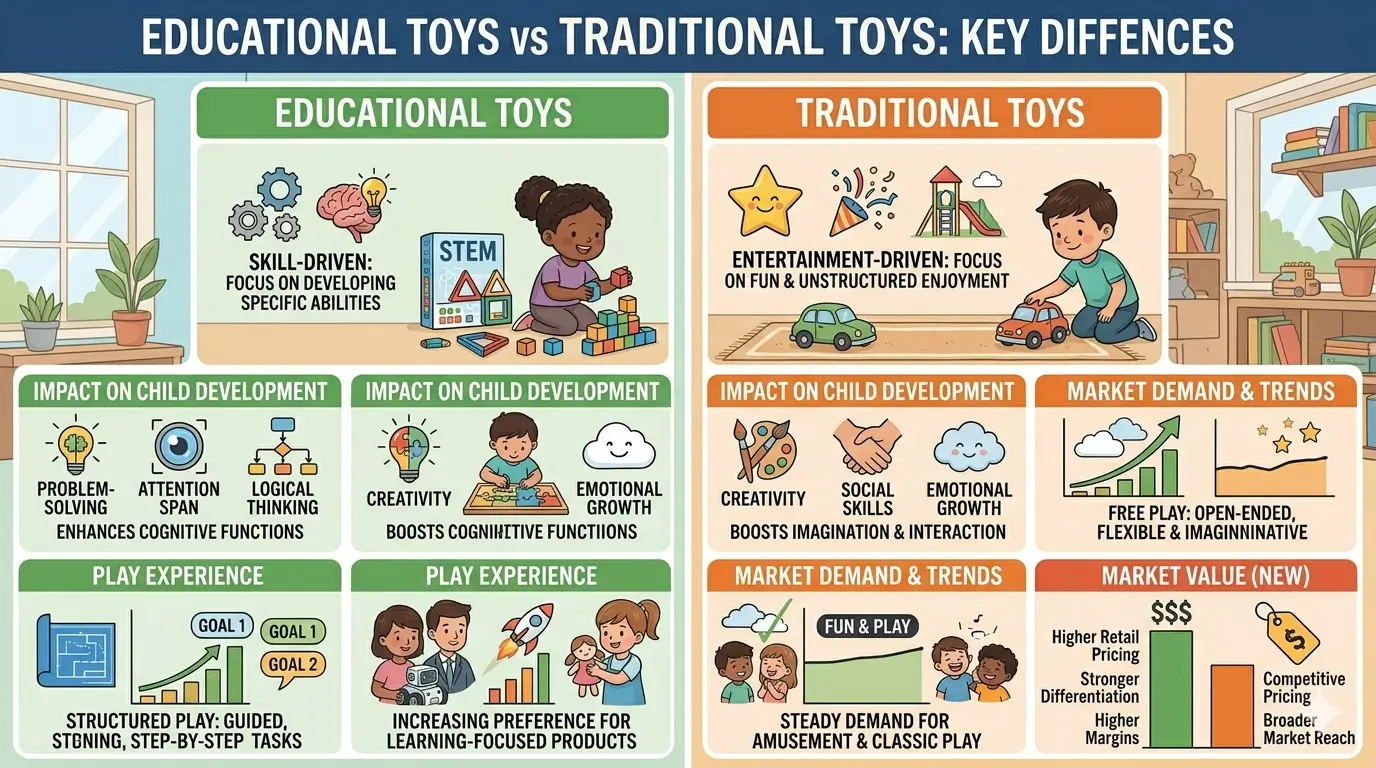
While educational toys are skill-driven each design focusing on specific developmental goals traditional toys are entertainment-driven prioritizing fun and unstructured enjoyment. Educational toys center on intentional learning helping children build practical skills through play.
Traditional toys focus on amusement with no predefined learning outcomes. This contrast is clear in every aspect of their design and use. This difference directly affects how products are positioned in the market.
Read more:Educational Toys Types, Benefits, Materials & Learning Impact Explained and Educational Toys Properties and Applications
Impact on Child Development
Educational toys helps children develop problem-solving abilities through hands-on challenges and improves their attention span by encouraging focused engagement. They also enhance logical thinking as kids work through guided tasks to reach specific outcomes.
Traditional toys mainly boost creativity and social skills through free play but have less direct impact on cognitive development. They support emotional growth but do not target specific skill development. This is one of the key reasons why educational toys are gaining popularity in export markets.
Play Experience
Educational toys offer structured play with clear guidance guiding children through step-by-step tasks. Traditional toys provide free play allowing kids to use their imagination without fixed rules. Educational play is guided with clear objectives while traditional play is open-ended and flexible. Different play styles also influence how products are marketed to different customer segments. Each style caters to different needs making both types relevant to specific audiences.
Market Demand & Trends
There is a growing demand for educational toys as parents show an increasing preference for products that combine play with learning. STEM educational toys in particular have seen rapid growth due to their focus on science technology engineering and mathematics skills.
Educational toys often have higher retail pricing and better branding potential compared to traditional toys. This is driven by parental focus on early childhood development and the perceived long-term value of learning-focused products. For importers and retailers choosing educational toys can lead to stronger product differentiation and higher margins.
Read more:Educational toys manufacturer China price list
Materials Used in Educational vs Traditional Toys
Beyond learning purposes and market trends the materials used in educational and traditional toys also play a critical role especially for safety compliance and market acceptance. Understanding these materials helps both parents make safe choices and industry professionals meet market requirements.
Common Materials in Educational Toys
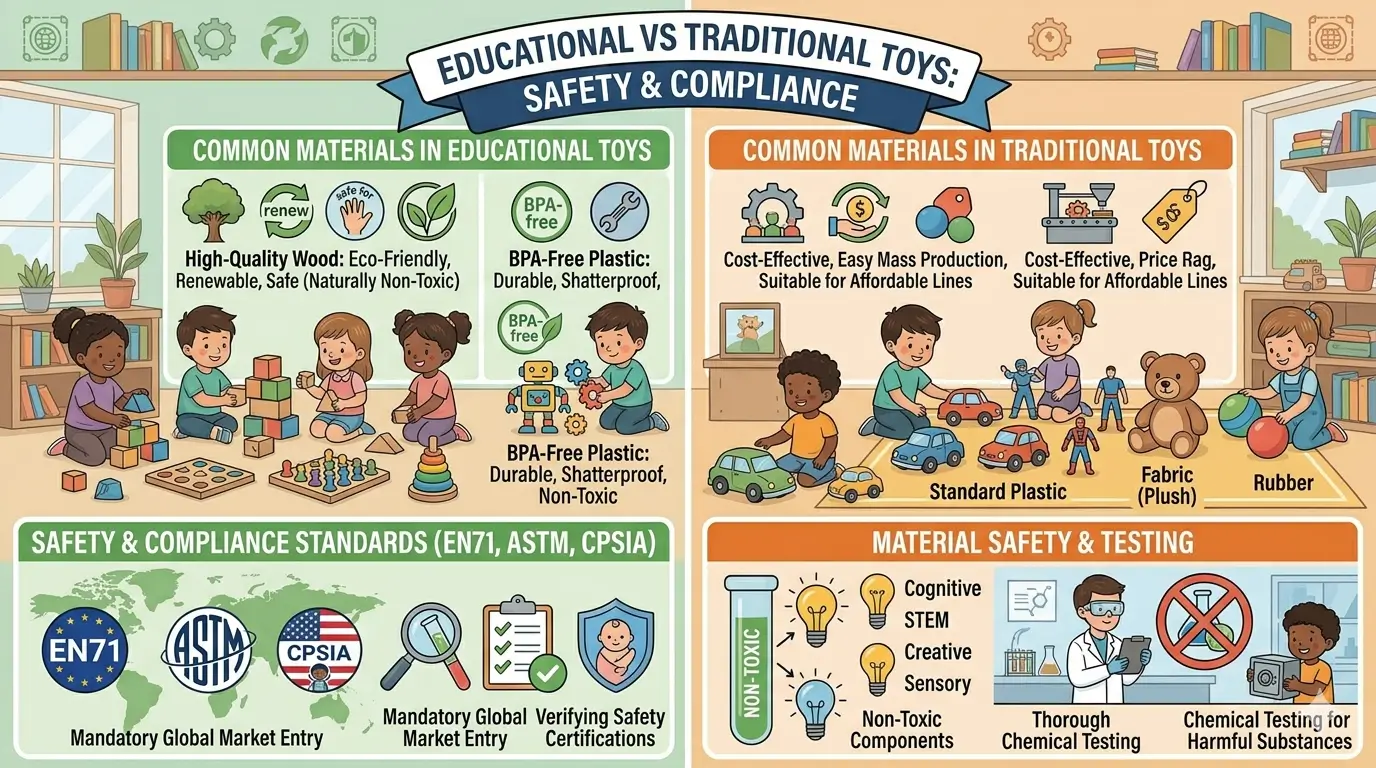
Many educational toys use high quality wood which is eco-friendly renewable and safe for children to handle. Wood materials are naturally non-toxic and free from harmful chemicals making them ideal for young kids. Another common material is BPA-free plastic which is durable shatterproof and also non-toxic ensuring safety during play.
These materials are often preferred in high-end markets such as the US and Europe.
Read more:Plastic vs wooden educational toys price
Common Materials in Traditional Toys
Traditional toys typically use more common materials such as standard plastic fabric and rubber. These materials are cost-effective and easy to mass produce making them suitable for affordable toy lines. They are often lightweight and durable meeting basic play needs without the extra focus on eco-friendliness or specialized safety features.
Safety & Compliance Standards
Safety and compliance are non negotiable in the toy industry and both educational and traditional toys must meet strict standards including EN71 in Europe ASTM in the US and CPSIA in the US. Manufacturers must ensure material safety by using non-toxic components and conduct thorough chemical testing to detect harmful substances.
Compliance with these standards is mandatory to enter global markets and protect children from potential risks. If you are sourcing toys internationally verifying safety certifications is essential to avoid compliance risks.
Read more:Educational toys material cost comparison China and Why Source Educational Toys from China?
Are Educational Toys Better Than Traditional Toys?
Whether educational toys are better than traditional toys depends on the specific needs of children and the goals of those purchasing them.
Educational toys are better when parents or educators aim to foster specific cognitive skills or support structured learning such as during homeschooling or early skill development. They excel in providing targeted growth opportunities that align with developmental milestones.
Traditional toys work well when the priority is to encourage free play imagination and social interaction.
They allow children to explore without guided objectives fostering creativity and emotional expression that is equally important for holistic development. Neither type is inherently superior as both serve distinct purposes in a child’s growth.
Many successful brands combine both categories to meet different market needs ensuring they cater to diverse customer preferences and maximize market reach while providing children with a balanced play experience.
How to Choose the Right Toys?
Choosing the right toys requires aligning options with specific needs whether you are a parent buying for a child or an industry professional sourcing for the market. The following practical tips help simplify the selection process and avoid common pitfalls.
For Parents
For parents focus on your child’s age developmental stage and interests. Choose toys that match their current skills while encouraging slight growth.
Balance educational and traditional toys to support both structured learning and free play. Prioritize non toxic and durable materials to ensure safety during regular use.
For Importers / Retailers
For importers and retailers start by defining your target market including regional preferences and compliance requirements. Ensure all products meet local safety certifications such as EN71 ASTM and CPSIA to avoid market entry issues.
Consider pricing strategies that align with market demand balancing profitability and competitiveness. Most importantly learn how to identify manufacturer vs trader as this impacts product quality control and pricing flexibility. If you are sourcing from China one of the biggest risks is choosing the wrong supplier type.
Read more:Top 5 educational toys manufacturers in China
Verifying whether a supplier is a real manufacturer can significantly impact product quality pricing and delivery stability. Partnering with reliable manufacturers also ensures better customization options to meet specific market needs.