
Children aged 3–4 are in a critical period of rapid physical, cognitive, language, social, and emotional development. Each developmental stage has specific characteristics that directly determine the design direction, function, and safety requirements of preschool educational toys. Unlike simple entertainment toys, educational toys for this age group must closely align with children’s developmental milestones to effectively promote their comprehensive growth while ensuring safety and playability.
Ignoring these developmental needs will result in toys that fail to meet children’s growth needs and may even create potential safety hazards, which is why understanding the developmental characteristics of 3–4-year-olds is the first step for importers sourcing high-quality preschool educational toys from China.
Below, we detail the specific developmental needs of this age group and map them to corresponding toy design requirements to help importers better judge whether a manufacturer’s products are professional and suitable for their target market.
Physical Development Needs (Fine & Gross Motor Skills)
Children aged 3–4 are in a period of rapid development of both fine and gross motor skills. Their bodies are gradually becoming more coordinated, and they begin to master more complex movements. Gross motor skills such as running, jumping, climbing, and balancing are continuously improved as they explore the world around them, while fine motor skills including finger dexterity, hand-eye coordination, and wrist control are developing rapidly through small movements like grasping, pinching, and stacking.
At this stage, children’s hands are still developing, and they need toys that can exercise these skills without causing fatigue or injury. For example, toys that require stacking, sorting, or stringing can effectively train their fine motor skills, while large-scale activity toys like slides or balance beams can promote the development of gross motor skills.
Preschool motor development at this stage focuses on coordination between movement and sensory perception, so toy design must consider appropriate size, weight, and operational difficulty for 3–4-year-olds. That is why professional manufacturers design toys based on developmental milestones rather than simple age labeling.
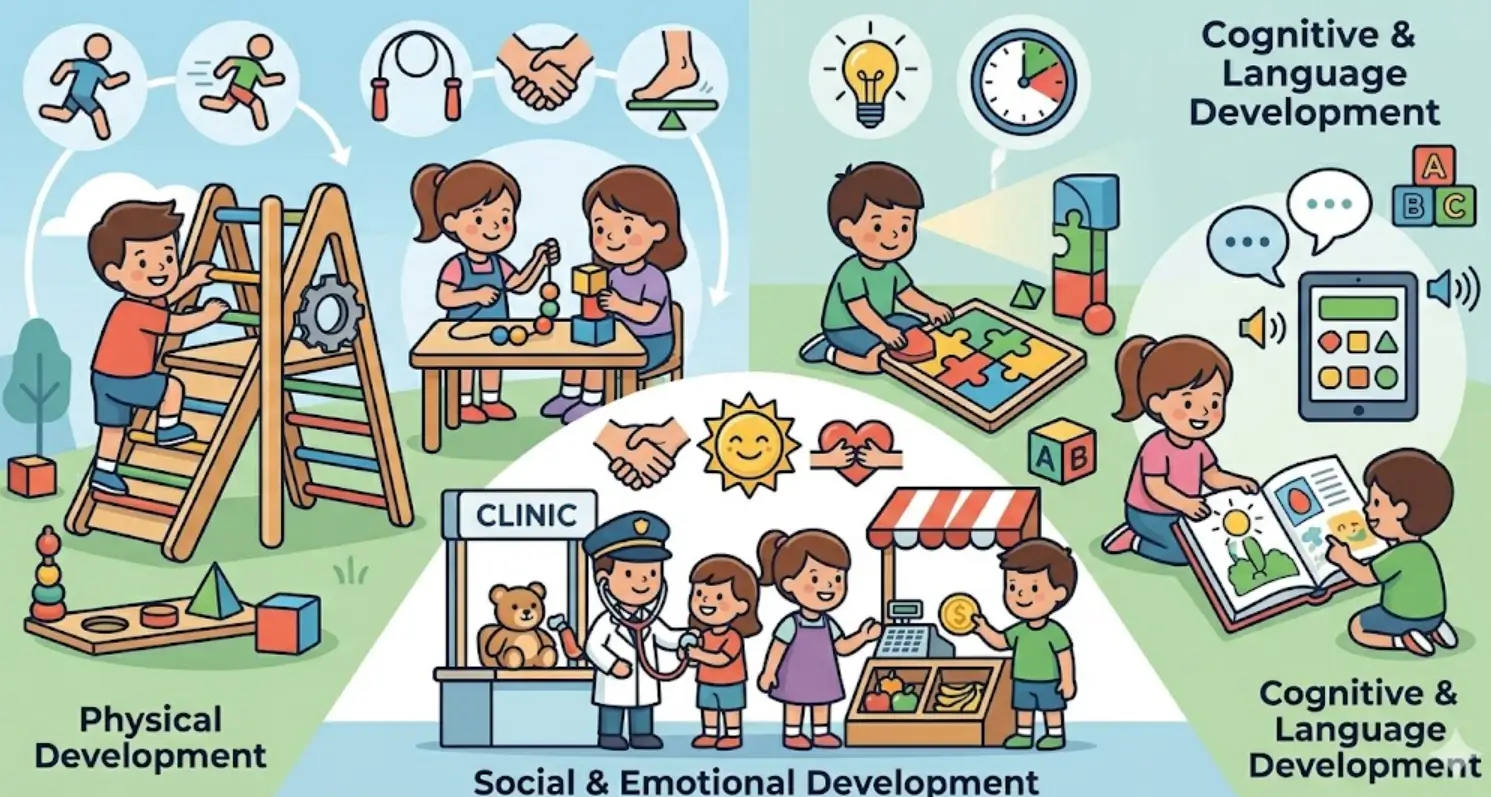
Cognitive & Language Development (Early Learning Foundation)
3–4-year-old children have short attention spans, usually ranging from 5 to 10 minutes, and they are easily distracted by external stimuli, which is a key characteristic of their cognitive development. At this stage, their cognitive abilities are developing rapidly, including memory, imagination, classification, and logical thinking. They begin to recognize colors, shapes, numbers, and simple words, and show a strong interest in new things.
Language development is also in a critical period. They can speak simple sentences, communicate their needs, and understand basic instructions, but their expression ability is still limited. The challenge for importers is choosing toys that can attract children’s attention while promoting cognitive and language development.
Preschool cognitive development toys and early learning toys for age 3–4 are designed to solve this problem. They use vivid colors, interesting shapes, and interactive gameplay to extend children’s attention span and help them learn through play. For example, puzzle toys can exercise logical thinking, while picture books with simple words can promote language development.
Language development toys often incorporate interactive elements such as sound feedback to encourage children to speak and communicate. This is why learning toys must be designed to stimulate interaction instead of passive viewing.
Social & Emotional Development in Preschool Stage
Children aged 3–4 begin to show a strong desire to interact with peers. They gradually learn to play with other children, share toys, and cooperate in simple activities. Pretend play and role play are important ways for them to develop social and emotional skills. Through simulating real-life scenarios such as playing house, being a doctor, or running a shop, they learn to understand others’ emotions, express their own feelings, and master basic social rules.
Social emotional learning toys and role play toys for preschool are specially designed to meet these needs. They provide children with scenarios and props to simulate social interactions, helping them build confidence, learn to share, and develop empathy.
For example, a pretend kitchen set allows children to play the role of a cook and interact with peers, while a doctor’s kit lets them experience caring for others. When children play together, they learn to resolve small conflicts and develop teamwork awareness. These developmental needs directly influence how preschool toy manufacturers design role-play product lines.
What Makes a Reliable Preschool Educational Toys Manufacturer in China?
For importers sourcing preschool educational toys for age 3–4 from China, choosing a reliable manufacturer is the key to reducing sourcing risks, ensuring product quality, and achieving long-term cooperation. A reliable manufacturer is not only able to produce high-quality products but also has strict compliance capabilities, flexible production capacity, perfect quality control systems, and rich export experience.
In the highly competitive Chinese toy market, many manufacturers claim to be professional but lack the core capabilities required to meet international standards, which may lead to issues such as product safety violations, customs rejection, and market complaints.
Below we detail the core criteria for judging a reliable preschool educational toys manufacturer in China, helping importers efficiently screen and identify high-quality suppliers.
Factory Certification & Export Compliance (Non-Negotiable)
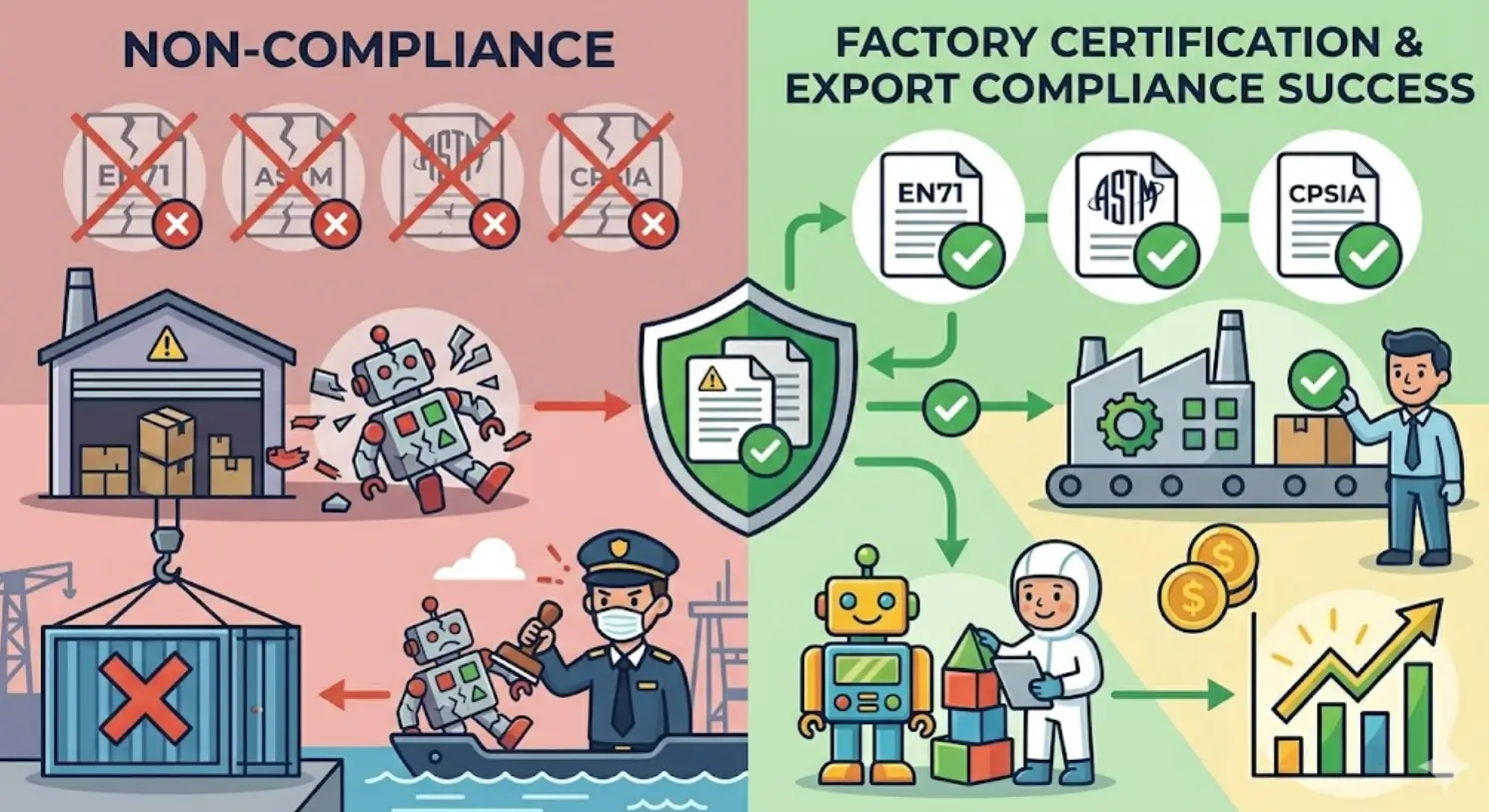
Factory certification and export compliance are non-negotiable conditions for reliable preschool educational toys manufacturers in China because they directly relate to product safety and smooth import/export processes. For importers selling products in the US, EU, and other markets, failure to meet relevant certification standards may result in customs detention, product recalls, and even legal liability.
Certification ensures toys meet safety requirements such as non-toxic materials, reasonable structural design, and absence of potential hazards. Key certifications include EN71 for the EU market, covering material safety, mechanical properties, flammability, and chemical substances; ASTM for the US market, which defines safety standards for children’s toys; and CPSIA, which focuses on lead content and phthalate limits.
Without these certifications, products cannot enter mainstream international markets. Importers must verify the validity of these certifications and avoid suppliers with fake or expired documents.
Production Capability & OEM/ODM Flexibility
Production capability and OEM/ODM flexibility are important factors for importers, especially those who want differentiated or customized products. OEM educational toys China refers to manufacturers that can produce based on existing designs or samples, while ODM preschool toy manufacturers have independent design capabilities and can develop new products based on market needs.
A reliable manufacturer should have advanced production equipment, sufficient capacity, and a professional R&D team to meet different customization requirements. In addition, MOQ flexibility is also critical. Manufacturers with flexible MOQ policies better support small and medium importers, helping them reduce inventory risks.
For example, some manufacturers support small-batch customization while maintaining quality and delivery time. Strong OEM/ODM capability helps importers create differentiated products in competitive markets.
Material Safety & Quality Control System
Material safety is the top priority for preschool educational toys for age 3–4 because children at this age often put toys into their mouths. Reliable non-toxic preschool toy suppliers in China use materials such as food-grade ABS plastic, natural solid wood, and BPA-free components to ensure toys do not contain harmful substances like lead, mercury, or phthalates.
A complete quality control system includes incoming raw material inspection, in-process production inspection, and final product inspection before shipment. During incoming inspection, raw materials are tested for compliance. During production, structural stability and assembly quality are checked.
Before delivery, full safety and appearance inspections are conducted. A safe educational toy manufacturer must maintain a complete QC chain to ensure no defective products leave the factory.
Export Experience & Market Understanding
Export experience and market understanding are important advantages of reliable Chinese toy manufacturers because they help importers avoid many risks in international trade. Experienced export toy manufacturers in China are familiar with import policies, customs procedures, and market requirements in different regions such as the US and EU.
For example, the EU requires multilingual warning labels, while the US requires CPSIA-compliant labeling. Experienced manufacturers also communicate more efficiently with importers, offering suggestions on product design optimization and packaging improvements to better match local markets. This reduces communication costs and prevents compliance mistakes.
Types of Preschool Educational Toys for Age 3–4 You Can Source from China
China is a global leader in preschool educational toy manufacturing, offering a wide variety of products for children aged 3–4 that cover physical, cognitive, social, and emotional development needs.
Importers can source different types of high-quality educational toys depending on their target market. Each category has unique educational value and aligns with developmental milestones of this age group.
Building & Construction Toys (STEM Foundation)
Building and construction toys are ideal for promoting both physical and cognitive development in 3–4-year-old children. They include blocks, magnetic tiles, and similar products that allow children to stack, assemble, and create freely. These STEM toys from China help children develop fine motor skills, hand-eye coordination, and spatial imagination while improving logical thinking and problem-solving abilities.
For example, blocks of different shapes allow children to build structures such as houses and bridges, while magnetic tiles enable 3D construction. These toys are usually made from non-toxic plastic or wood with smooth edges for safety.
Role-Play & Pretend Toys
Role-play and pretend toys support social and emotional development by simulating real-life scenarios. Common products include kitchen sets, doctor kits, shop counters, and dollhouses. Chinese pretend play toy manufacturers focus on creating realistic and interactive props to enhance immersion.
For example, kitchen sets include cooking tools and food models, while doctor kits include medical instruments such as stethoscopes and thermometers. These toys encourage communication, cooperation, and sharing among children.
Puzzle & Problem-Solving Toys
Puzzle and problem-solving toys are essential for cognitive development in 3–4-year-old children. They improve logical thinking, shape recognition, memory, and problem-solving skills. Common products include jigsaw puzzles, shape-matching toys, and maze toys.
These toys are designed with different difficulty levels, starting from simple puzzles and gradually increasing complexity. Children develop patience, focus, and hand-eye coordination while playing.
Early Learning Educational Sets
Early learning educational sets help children build foundational learning skills. They include alphabet sets, number sets, Montessori kits, and other educational tools that combine learning with play. These sets help children recognize letters, numbers, colors, and simple words in an engaging way.
Montessori-style kits encourage hands-on learning and independence, helping children develop early self-learning abilities.
Learn more:Which Educational Toys Have the Highest Repeat Purchase Rate?
How Chinese Manufacturers Control Cost Without Reducing Quality?
One of the main reasons global importers choose to source preschool educational toys from China is the cost advantage. Chinese manufacturers can offer high-quality products at more competitive prices compared with suppliers in other countries. However, many importers worry that cost control may compromise product quality.
In reality, reliable Chinese manufacturers apply scientific and structured cost-control methods while maintaining quality standards.
They rely on mature supply chains, advanced production technologies, and optimized production processes to eliminate unnecessary expenses. Below we explain the key methods used to control cost and help importers better understand pricing structures and make more informed purchasing decisions.
Material Selection Impact on Price
Material selection is one of the most influential factors in the cost of preschool educational toys. Different materials vary significantly in price, durability, and performance, and manufacturers choose materials based on product positioning and target market requirements to balance cost and quality.
Wood and plastic are the two most commonly used materials in toy manufacturing. Wood is more eco-friendly and has a premium texture, but it is more expensive and sensitive to moisture and deformation. Plastic materials such as ABS and PP are more affordable, lightweight, and highly versatile in shaping, making them widely used in toy production.
Toy manufacturing cost in China is strongly affected by raw material prices; for example, solid wood toys can be 30%–50% more expensive than plastic alternatives. Manufacturers may also use recycled materials for certain low-cost product lines, but they still ensure compliance with non-toxic and safety standards.
Mold Cost & Design Complexity
Mold cost is another major component of toy production expenses, especially for customized products. Custom molds are expensive, and the cost depends on design complexity, size, and material. More complex toy structures require more sophisticated molds, increasing production costs.
For instance, toys with multiple parts or intricate shapes require higher mold investment. Chinese manufacturers often reduce mold costs by optimizing structural design, simplifying product components, or sharing molds across similar product lines.
Order volume also plays a critical role in cost distribution; larger orders significantly reduce per-unit mold cost. Importers can lower mold expenses by choosing simpler designs or increasing order quantities.
Labor & Assembly Structure Differences
Labor and assembly costs are key components of total production cost. Chinese manufacturers manage these costs by optimizing assembly structures and adopting semi-automated production systems. Manual assembly is typically used for complex toys or small batches, but it increases labor cost and reduces efficiency.
Semi-automated production allows machines to handle repetitive tasks while workers focus on precision assembly, improving efficiency and reducing cost. For example, small plastic components may be machine-assembled, while role-play toys often require manual assembly.
Manufacturers adjust production methods based on product structure to achieve a balance between cost efficiency and product quality.
Quality Control Process for Preschool Educational Toys
Quality control is a critical stage in preschool educational toy production for children aged 3–4, as it directly impacts product safety and market reputation. Reliable Chinese manufacturers implement comprehensive quality control systems covering the entire production cycle from raw materials to final shipment. Third-party testing also plays an important role in ensuring compliance with international safety standards. Below we explain how quality is controlled in practice.
IQC / IPQC / FQC
Quality control in Chinese toy factories generally follows three stages: IQC (Incoming Quality Control), IPQC (In-Process Quality Control), and FQC (Final Quality Control). IQC focuses on testing raw materials such as plastic, wood, and paint to ensure they meet safety and non-toxic requirements.
IPQC is conducted during production to monitor assembly quality and detect defects such as structural issues or surface imperfections. FQC is the final inspection stage before shipment, where finished products are tested for safety, appearance, and functionality. This structured QC system significantly reduces the risk of defective products entering the market.
Third-party Testing Options
Third-party testing provides independent verification of product safety and compliance. Internationally recognized testing organizations such as SGS, Intertek, and Bureau Veritas conduct detailed evaluations covering material safety, mechanical safety, flammability, and chemical composition.
For exports to the US and EU markets, third-party testing is often required. Manufacturers typically provide these reports to confirm compliance with standards such as EN71, ASTM, and CPSIA. This process enhances product credibility and reduces import risks for buyers.
How to Choose the Right Preschool Toys Manufacturer in China?
Selecting a reliable preschool toy manufacturer in China is essential for minimizing sourcing risks and ensuring long-term success. Given the large number of suppliers, importers need a structured evaluation process to identify trustworthy partners. Below is a practical guide.
Buyer Checklist
When evaluating manufacturers, importers should verify several key factors. First, confirm certification validity, including EN71, ASTM, and CPSIA. Second, assess production capability, including equipment, capacity, and R&D strength. Third, evaluate the quality control system, including IQC/IPQC/FQC processes and third-party testing cooperation. Fourth, review MOQ policies, delivery timelines, and after-sales support. Fifth, request product samples for real testing. Finally, check export experience and client feedback to assess reliability.
Red Flags
Several warning signs should be considered when selecting suppliers. Missing or suspicious certification documents indicate potential compliance risks. Prices significantly below market levels may suggest compromised materials or quality. Lack of clarity on MOQ, delivery time, or refusal to provide samples is also a major concern. Poor communication or unprofessional responses often lead to operational issues in long-term cooperation.
Evaluation Workflow
A structured evaluation process helps reduce sourcing risks. First, define clear product requirements, including type, quantity, customization, and target market. Second, shortlist suppliers through B2B platforms or industry referrals. Third, request product details and samples for evaluation. Fourth, assess product quality, safety, and compliance. Fifth, conduct factory audits if necessary. Finally, negotiate pricing, MOQ, and delivery terms before signing contracts.
Why Global Buyers Choose Chinese Manufacturers?
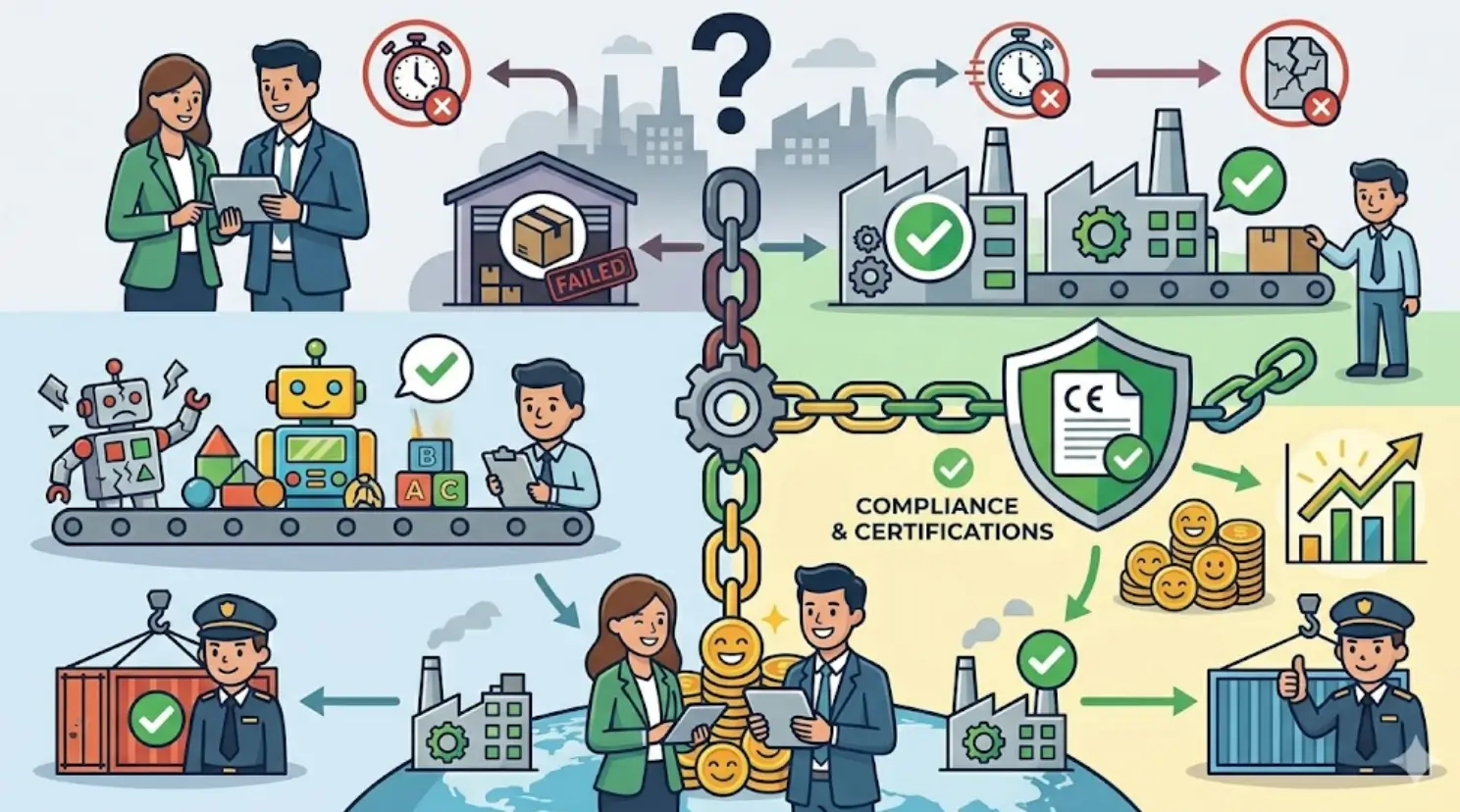
Global buyers consistently choose Chinese suppliers for preschool educational toys due to strong cost advantages, mature supply chains, OEM/ODM capabilities, and strong export experience. These factors collectively make China a dominant sourcing hub.
Cost Advantage + Supply Chain
China has a complete industrial ecosystem covering raw materials, mold manufacturing, production, and logistics. This integrated supply chain significantly reduces production costs and shortens delivery cycles. Strong labor resources and efficient manufacturing systems further enhance cost competitiveness, allowing Chinese toys to perform strongly in global markets.
OEM Capability + Export Experience
Chinese manufacturers offer strong OEM/ODM capabilities, enabling customized production based on client designs or market needs. Many suppliers also have extensive export experience, understanding compliance requirements, customs procedures, and labeling standards for different regions. This reduces operational risk and improves communication efficiency.
Market Adaptation Ability
Chinese manufacturers can quickly adapt products to different regional markets by adjusting design, packaging, labeling, and safety requirements. They also continuously innovate based on global toy trends, including integrating educational and interactive features to improve market competitiveness.
Request a Custom Quote for Preschool Educational Toys
Importers seeking preschool educational toy suppliers in China can request customized quotations based on specific needs. Manufacturers typically provide full-service support from design to delivery.
What to Provide?
To receive an accurate quotation, importers should provide product type, design requirements, size, material, color, order quantity, target market, and customization needs such as logo printing or packaging design.
Lead Time & MOQ
Lead time varies depending on product complexity and order size. Standard products typically require 15–30 days, while customized or large orders may take 30–60 days. MOQ generally ranges from 500 to 1000 units, with flexibility depending on product type and customization level.
Final Thought
Sourcing preschool educational toys from China can be efficient and reliable when working with the right manufacturer. By providing your product idea and requirements, suppliers can turn concepts into market-ready products with full support in design, production, quality control, and logistics.