
In the world of educational toys, the true measure of success is not just the initial buzz or viral popularity. What truly drives sustainable business growth is repeat purchase rate. Long-term revenue depends on educational toy systems that support product line expansion and age-progressive learning. Many toys may trend once, but the products that keep customers returning are designed as stage-upgradable, content-expandable, and refill-supported ecosystems.
Parents across Europe and North America tend to repurchase educational toys because of homeschooling needs, continuous learning habits, and increasing awareness of child development stages. Curriculum-based learning also plays a major role in sustaining engagement, as it integrates toys into structured educational journeys rather than positioning them as one-time entertainment products.
From a sourcing perspective, experienced buyers are shifting their priorities. Instead of chasing one-hit products, they are looking for educational toy systems that encourage long-term reorder potential. At Jaredrise, we have observed that overseas buyers increasingly prefer educational toy systems that support recurring orders rather than short-lived trend products. This reflects a deeper understanding of long-term market dynamics rather than a simple focus on product features.
Why Repeat Purchase Rate Matters More Than Viral Sales in Educational Toys?
Understanding the critical difference between temporary viral success and sustainable repeat purchasing is essential for building a profitable educational toy business. Let’s examine why focusing on repeat purchase rate creates more stable long-term revenue than relying on short-term trends.
Recognizing why repeat purchase rate outperforms viral sales is essential for anyone involved in educational toy sourcing or product development. A viral product may create a sudden spike in sales, but it rarely guarantees lasting profitability.
Repeat purchases, however, establish a stable revenue stream over time, reduce dependence on continuous customer acquisition, and strengthen long-term brand loyalty.
The Hidden Problem With One-Time Educational Toys
Many educational toys achieve strong early sales because they attract attention on platforms such as Amazon, TikTok, or Instagram. However, most of these products suffer from extremely low repeat purchase rates. The primary reasons include the lack of expansion packs, absence of next-level learning opportunities, missing refill systems, and no curriculum continuity.
Examples of these low-repeat products include one-time puzzles, simple DIY kits, novelty sensory toys, and basic slime sets. Customers rarely purchase them again because the products do not evolve or provide ongoing educational value. Without continued engagement, there is little incentive for customers to return.
For importers and Amazon sellers, these low-repeat products often result in increasing advertising costs, shorter SKU life cycles, and unstable inventory turnover. Many buyers working with Jaredrise now prioritize educational toy systems with long-term reorder potential instead of trend-driven single products.
- Best selling educational toys importers are reordering amazon
- Best educational toys for 3 4 year olds supplier amazon
- What affects educational toys for 3-4 year olds price from suppliers China?
Why High Repeat Purchase Toys Create Long-Term Revenue?
The profitability of repeat purchases cannot be overstated. While a one-time toy sale generates only a single transaction, a system with expansion opportunities can produce recurring revenue for years. For example, a Level 1 phonics kit may encourage customers to later purchase a Level 2 reading system and eventually an advanced vocabulary expansion pack.
Instead of depending on constant customer acquisition, repeat-purchase educational products increase customer lifetime value while reducing long-term marketing pressure. This business model is fundamental for B2B buyers seeking sustainable growth.
Brands in Europe and North America increasingly emphasize curriculum-based systems because they encourage multi-stage purchasing behavior and stronger long-term brand retention.
Which Educational Toy Categories Have the Highest Repeat Purchase Rate?
After understanding why repeat purchase rate is so important, the next step is identifying which product categories naturally encourage continuous customer engagement and multiple purchases over time. Below are some of the educational toy categories with the strongest proven repeat purchase performance and the reasons behind their success.
Montessori Busy Books and Progressive Learning Kits
Montessori educational toys naturally encourage repeat purchases because they are designed around developmental stages. This approach makes them one of the strongest repeat-purchase categories in the global educational toy market.
The age progression path often includes fine motor development, letter recognition, number matching, and problem-solving advancement. Child development progression is the core driver behind repeat purchases, as parents consistently seek the next stage within the learning system.
Parents who trust a Montessori learning system are significantly more likely to continue purchasing additional versions instead of switching brands. Many importers sourcing from Jaredrise focus heavily on Montessori product lines because they naturally support age-based expansion and recurring orders.
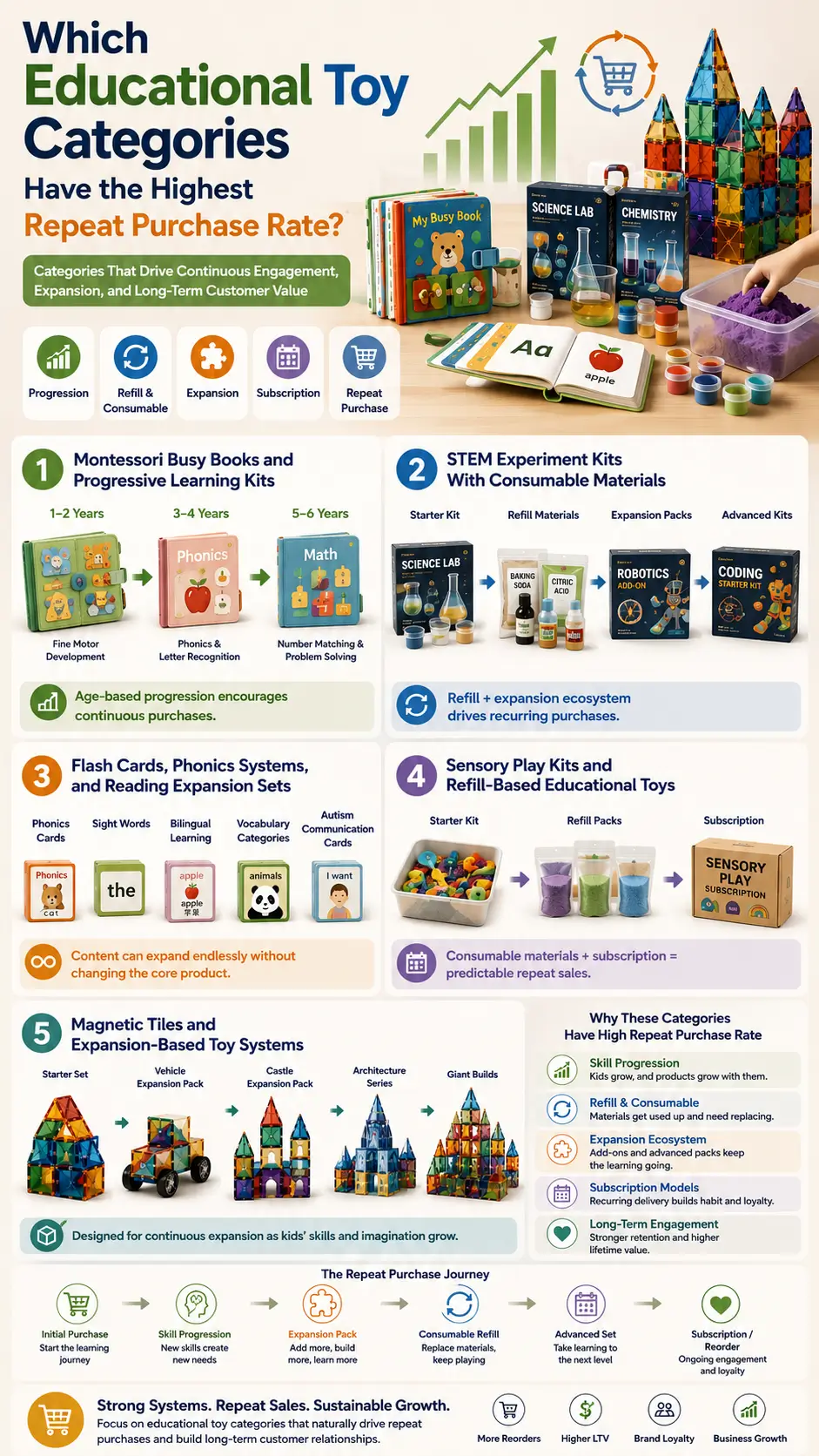
STEM Experiment Kits With Consumable Materials
The real profitability in STEM toys often comes not from the initial kit itself, but from the refill ecosystem surrounding it. Successful brands generate recurring revenue through refill materials, expansion experiments, and advanced learning packs.
Examples include chemistry refill powders, robotics add-ons, coding upgrades, and science lab consumables. This structure creates a STEM ecosystem that encourages continuous purchasing behavior.
Rather than depending on temporary viral trends, STEM systems with refill-based models create ongoing customer engagement and stronger long-term retention.
Flash Cards, Phonics Systems, and Reading Expansion Sets
Unlike traditional toys, educational content systems such as flash cards can expand almost endlessly without changing the core product structure. This allows continuous content growth through sight words, phonics levels, vocabulary categories, bilingual learning, and autism communication cards.
Schools and homeschooling families continue purchasing because these systems support structured long-term learning progression. Educational brands working with Jaredrise often expand flashcard systems into multi-level learning collections to increase reorder opportunities over time.
Sensory Play Kits and Refill-Based Educational Toys
Sensory educational toys achieve high repeat purchase rates because many of the materials are consumable. Products such as kinetic sand, slime, play dough, and sensory bins require regular replenishment.
This natural consumption pattern drives recurring purchases, while subscription models further strengthen predictable revenue streams by delivering replacement materials to families on a recurring basis.
Magnetic Tiles and Expansion-Based Toy Systems
Many magnetic tile systems are intentionally designed for continuous expansion rather than one-time purchases. Examples include vehicle expansion packs, castle sets, architecture series, and large-scale structure kits.
Parents typically purchase additional pieces as their child’s building skills improve and construction complexity increases. Buyers cooperating with Jaredrise increasingly prefer expandable educational toy systems because they support long-term SKU expansion and recurring reorder potential.
What Makes Educational Toys Naturally Repeat-Purchase Products?
To fully understand why certain educational toys achieve exceptionally high repeat purchase rates, it is important to examine the deeper factors driving this behavior. This section explores the core principles and product characteristics that naturally position educational toys for recurring sales.
Age Progression and Skill-Level Upgrades
The most powerful driver behind repeat purchases is age progression. Educational toys structured around beginner, intermediate, advanced, and next-stage learning create a clear developmental pathway for children.
This learning progression encourages customers to remain loyal to the same brand as their child grows. Many educational toy systems developed with Jaredrise are designed around clearly defined age progression frameworks to strengthen long-term customer retention.
Curriculum-Based Learning Systems
Leading educational toy brands focus on building structured learning systems rather than offering isolated standalone products. These systems often include weekly learning goals, developmental milestones, guided progression plans, and homeschooling support materials.
This strategy aligns educational toys with real learning curricula, which naturally drives consistent repeat purchasing behavior. Curriculum-based systems are widely recognized as a core component of long-term educational value.
Expansion Packs and Collectability
Customization and collectability play a major role in encouraging ongoing purchasing behavior. The more expandable a toy system becomes, the stronger its long-term repeat purchase potential tends to be.
As educational toy systems become increasingly customizable and expandable, customer engagement and recurring purchase behavior typically strengthen over time. This principle is broadly recognized throughout the educational toy industry.
How Smart Toy Brands Build Repeat Purchase Systems?
Understanding the core drivers behind repeat purchases naturally leads to the next question: how do successful brands strategically design products and business models to maximize long-term customer engagement? Below are some of the key approaches leading educational toy brands use to build sustainable repeat purchase systems.
Why Subscription-Based Educational Toys Are Growing Fast?
Subscription models create predictable recurring revenue while maintaining continuous engagement between parents, children, and educational brands. Monthly STEM kits, seasonal learning packs, and age-based subscription boxes are strong examples of this growing trend.
The subscription economy is rapidly reshaping the educational toy industry by encouraging ongoing interaction and stronger long-term customer loyalty.
How Top Brands Turn One Toy Into a Product Ecosystem?
Leading educational toy brands develop clear SKU expansion pathways, such as starter kits followed by refill packs, advanced learning versions, and teacher editions. This strategy creates a product ecosystem that sustains buyer interest and encourages recurring orders.
Buyers working with Jaredrise increasingly seek OEM partners capable of supporting long-term product ecosystem expansion instead of simply manufacturing single standalone products.
How Importers Can Identify High Repeat-Purchase Educational Toys Before Buying?
With a clearer understanding of what drives repeat purchasing and how successful brands operate, importers also need practical evaluation criteria before sourcing products. This section outlines the key questions and warning signs buyers should consider when assessing educational toy opportunities.
Questions Buyers Should Ask Before Sourcing Educational Toys
Buyers should first determine whether a toy can evolve across multiple learning stages. If the answer is no, the product’s repeat purchase potential may be limited. Understanding this early helps avoid short-lived products with weak long-term performance.
Other critical questions include whether the toy supports curriculum continuity, offers refill or expansion opportunities, and aligns with homeschooling needs. These factors are important indicators of long-term reorder potential.
Red Flags That Usually Mean Low Repeat Purchase Potential
Buyers should be cautious of trend-driven products with no refill potential, no age progression, limited educational continuity, and excessive dependence on advertising. These characteristics often indicate unstable repeat purchase performance.
Experienced suppliers typically evaluate long-term reorder potential before recommending product categories to overseas buyers.
Why China Suppliers Are Becoming Strategic Partners in Educational Toy Product Development?
To fully capitalize on these market opportunities, it is equally important to understand the changing role of Chinese suppliers. Today, many suppliers operate as strategic development partners rather than simple manufacturers. This evolution creates significant advantages for both educational toy brands and global buyers.
From Toy Manufacturing to Educational Product System Development
China’s educational toy supply chain has evolved far beyond basic manufacturing. Many suppliers now provide strategic support in OEM development, ODM services, packaging systems, learning roadmap planning, and seasonal product extension strategies.
This level of industry integration has become increasingly valuable as brands seek comprehensive support for building scalable educational toy ecosystems.
Learn more:How to Choose a Reliable Educational Toy Manufacturer?
How Jaredrise Supports Long-Term Educational Toy Brands?
Jaredrise supports clients in building sustainable educational toy brands through multilingual packaging solutions, Amazon-ready labeling, curriculum alignment, expansion planning, and compliance support. This integrated approach helps brands achieve scalable repeat-purchase growth across multiple learning stages.
If you are evaluating educational toy categories with strong long-term reorder potential, Jaredrise can help assess whether your product strategy is positioned to support scalable repeat-purchase growth across multiple educational stages.