
Many Amazon sellers are constantly dealing with disruptions that threaten account health. A single safety complaint can trigger a listing suspension, while a spike in CPC costs erodes margins overnight. Shipments often arrive with packaging that does not meet FBA prep requirements, leading to extra fees or rejection.
You might approve a perfect sample only to receive bulk production with inconsistent quality. Smaller sellers are routinely told that the MOQ is too low and the factory cannot run the order. Worse, when a compliance issue arises, the supplier provides no lab testing support and disappears. Unreliable lead times during Q4 can leave you out of stock and tank your seller metrics.
Every lost Buy Box or stranded inventory unit eats into your hard-earned margins. For Amazon sellers sourcing educational toys, these are not rare occurrences. They are the daily reality of choosing a supplier based on price alone.
The best supplier is not the cheapest factory, but the supplier that reduces Amazon business risk. A capable educational toy supplier in China understands that your business depends on compliance.
They proactively handle EN71 and ASTM F963 testing, prepare FBA packaging that protects products and meets labeling rules, and accept low MOQ so you can test the market without heavy inventory risk. They treat safety and documentation as a service, not an afterthought.
When you work with a supplier that aligns with Amazon’s performance standards, you stop fighting supply chain fires and start scaling.
Your account health becomes predictable, and your time is spent growing sales rather than resolving defects. This risk-first approach is what actually defines a reliable partner for Amazon sellers.
Why Most Educational Toy Suppliers in China Fail Amazon Sellers?
Before selecting the right factory, it is important to understand exactly how a poor supplier choice can damage an Amazon business. In most cases, the problem is not basic manufacturing capacity.
The real issue is that many factories lack an understanding of how Amazon evaluates listings, handles safety complaints, and enforces packaging requirements.
The three issues below explain why a supplier that works well for traditional importers can quickly become a serious risk for an Amazon seller account.
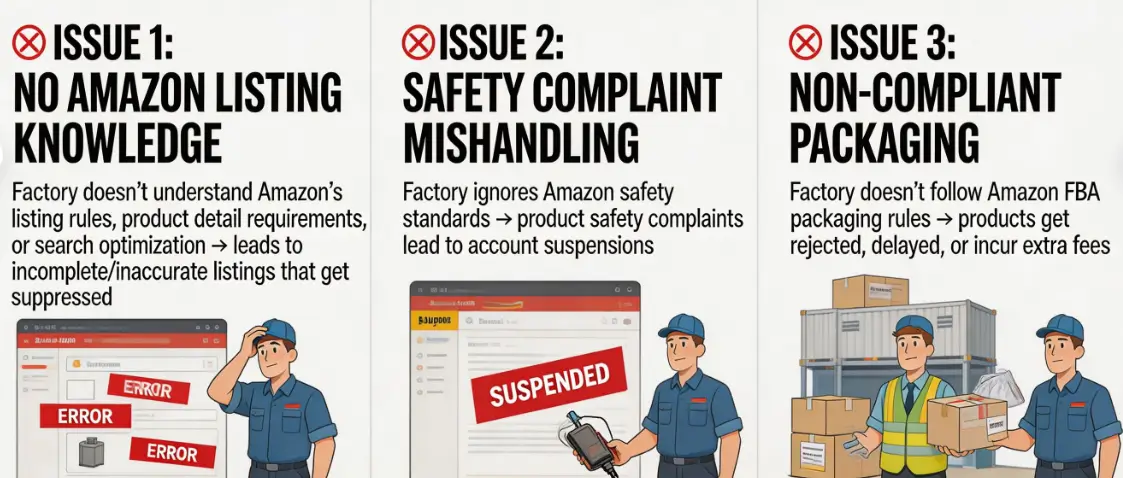
Educational toys are one of the highest-risk categories on Amazon
Educational toys face strict regulatory scrutiny because they are intended for children. Products such as wooden puzzles, Montessori busy boards, and counting toys must comply with mandatory safety regulations including ASTM F963 in the United States, CPSIA requirements, and EN71 standards in Europe.
Many Amazon sellers underestimate this complexity until Amazon suddenly requests CPC documentation or suspends a listing during a safety review.
Something as simple as a missing choking hazard warning on a small component, or paint that fails heavy metal testing, can immediately trigger a listing suspension.
The consequences extend far beyond a blocked ASIN. Stranded inventory generates storage fees, best-seller rankings decline, and PPC campaigns built over months lose valuable historical data.
In a category where parents expect complete safety, a single compliance issue can damage customer trust and severely reduce organic traffic.
This makes choosing the right educational toy supplier in China far more critical than many new Amazon sellers initially realize.
One supplier mistake can destroy an Amazon listing
A single oversight from a supplier can undo months of careful Amazon optimization work. Imagine a shipment of educational sorting toys arrives at an Amazon fulfillment center, only for the supplier to forget suffocation warning labels on the poly bags.
Within days, Amazon flags the inventory as non-compliant and suspends the listing. By the time the issue is resolved, often requiring inventory removal and relabeling, the product may have already lost its keyword rankings, organic traffic may collapse, and the PPC campaign history containing valuable conversion data may become useless.
Other common risks include customer returns caused by a strong chemical odor from unverified paint, missing wooden components leading to negative reviews, or weak packaging resulting in damaged products during transit.
Even incorrectly printed barcodes that fail to scan at Amazon warehouses can create expensive receiving delays.
The real damage is rarely limited to the manufacturing cost of the product itself. The bigger problem is the loss of ranking stability, hard-earned reviews, and weeks of zero sales while competitors take market share. This is why supplier evaluation should focus on risk reduction rather than simply chasing the lowest unit price.
Why traditional OEM factories are not enough for Amazon sellers
Most traditional OEM toy factories in China were originally built to serve wholesale importers placing large container orders once or twice per year. Their priorities are production efficiency, low unit costs, and high minimum order quantities.
Amazon sellers, however, operate under a completely different business model. They need to test multiple educational toy variations through small initial orders, validate niche categories such as Montessori math or sensory play, and frequently adjust packaging based on customer feedback or FBA preparation requirements.
A conventional factory that insists on a 3,000-piece MOQ and refuses to modify inner carton labels quickly becomes a liability instead of an asset.
Suppliers experienced with Amazon sellers understand that operational flexibility, including low MOQ testing, combining multiple SKUs into a single shipment, and rapidly updating packaging, often provides more value than saving a few cents on production costs.
Professional suppliers like Jaredrise understand that Amazon sellers need operational flexibility, not just manufacturing capacity.
This shift in mindset transforms the supplier relationship from a simple transaction into a long-term growth partnership.
In short, most supplier failures happen because factories ignore the realities of selling on Amazon.
A factory that treats an Amazon listing like a traditional wholesale order leaves sellers exposed to compliance issues, packaging problems, and inventory disruptions that gradually erode profits and account health.
What Amazon Sellers Actually Need From an Educational Toy Supplier?
Once the common failure points become clear, the real requirements are easier to identify. Amazon sellers need a factory that operates as a risk management partner, not simply a production facility.
The most important needs revolve around reliable compliance support, flexible low-volume product testing, and packaging that meets FBA inbound standards without generating additional fees.
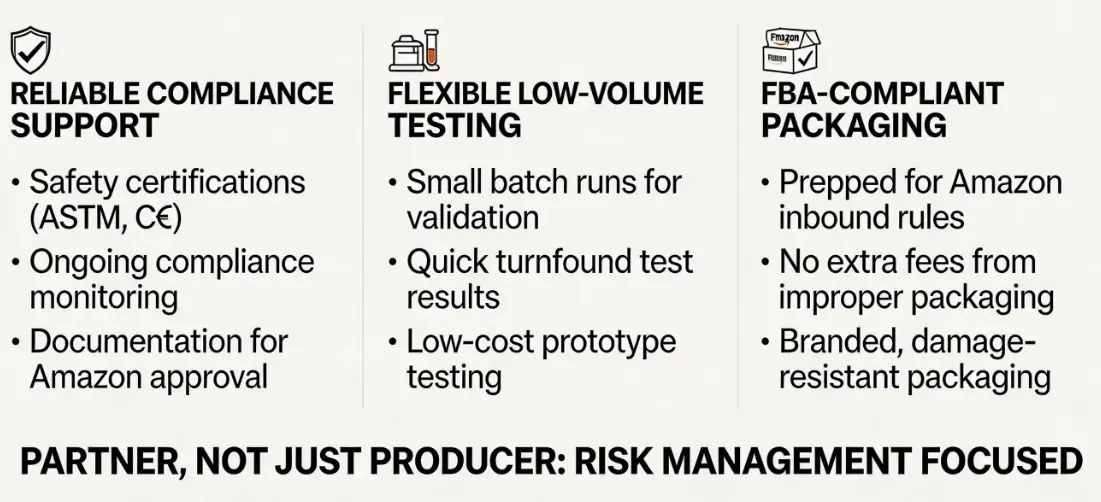
Compliance support is more important than cheap prices
The temptation to choose the lowest-priced supplier often leads to much higher long-term costs. Some factories cut expenses by replacing materials with cheaper, untested alternatives or by skipping third-party lab testing required to verify compliance with ASTM F963 and CPSIA standards.
When Amazon later requests Children’s Product Certificate documentation, something that can happen randomly or after a customer complaint, a supplier that cannot provide valid test reports immediately puts the entire listing at risk.
Failed compliance checks can result in customs rejection, forced inventory removal, and even a Section 3 account review that threatens every listing within the seller account.
In the educational toy category, where products are heavily scrutinized, a factory’s commitment to certified non-toxic materials and traceable quality control records becomes far more valuable than saving five percent on unit cost.
A supplier that proactively coordinates lab testing and maintains complete compliance documentation gives Amazon sellers the confidence to scale their business without interruptions.
Low MOQ flexibility helps sellers test products safely
Successful Amazon brands rarely launch products with massive inventory commitments. Instead, they usually validate a niche by ordering a small batch of educational toys, perhaps 200 units of a wooden pattern block set, to measure customer demand and gather initial reviews.
This strategy allows sellers to test multiple variations, such as adding a storage bag or adjusting color themes, without taking on heavy storage costs or the risk of unsold inventory.
A supplier that offers low minimum order quantities and supports mixed SKUs within a single production run enables this data-driven product launch strategy.
Instead of forcing a standard 1,000-piece order for a single design, a flexible factory can produce 300 units of three different puzzle variations, helping the seller identify which theme resonates most effectively with parents.
For many Amazon sellers, validating a product through smaller initial orders is far safer than committing to large inventory volumes too early.
Suppliers that support this approach understand that long-term partnerships are built by helping sellers discover winning products, not simply by maximizing order volume.
Amazon packaging experience matters more than most buyers think
Product quality means very little if the packaging fails Amazon’s strict preparation requirements. FBA inbound shipments require every unit to display a scannable FNSKU label, cartons must include correct shipment labels, and any poly bag with an opening larger than five inches must clearly display a suffocation warning.
Many sellers only discover packaging problems after inventory reaches Amazon warehouses, resulting in relabeling fees and delays in stock availability.
Educational toys with multiple components, such as counting bead sets or letter matching games, often require additional inner packaging to prevent transit damage. Packaging that can withstand drop testing, properly positioned barcodes that avoid scanning errors, and durable color box designs capable of surviving the supply chain are not secondary concerns.
They are essential elements for maintaining strong seller performance metrics.
A factory experienced in Amazon packaging understands that carton overweight charges or rejected warehouse deliveries can quickly eliminate profit margins.
Factories like Jaredrise often collaborate with Amazon sellers to optimize packaging before mass production begins, reducing relabeling risks, minimizing warehouse delays, and ensuring inventory becomes available for sale without unnecessary costs.
Ultimately, the right educational toy supplier does far more than manufacture products. It actively closes the operational gaps that lead to listing suspensions, inventory holds, and negative reviews, allowing sellers to focus on scaling their business instead of constantly solving preventable problems.
How to Identify a Reliable Educational Toy Factory in China
Moving from theory to action, there are several practical ways to evaluate whether a factory is truly prepared to support Amazon sellers. Instead of relying on sales pitches, sellers should focus on three critical areas during the vetting process. This approach helps distinguish factories that genuinely understand the Amazon business model from those that simply manufacture toys.
Check whether the supplier understands Amazon compliance
Many Chinese toy factories have extensive experience exporting to traditional wholesale markets but have little or no direct experience working with Amazon sellers. As a result, they may not fully understand the documentation required for a Children’s Product Certificate, the exact compliance formats Amazon expects, or the carton size requirements for FBA shipments.
Before paying a deposit, ask the factory direct and detailed questions. Do they understand what information must appear on a CPC for wooden toys. Can they provide examples of Amazon-compliant tracking labels. Are they familiar with Amazon’s suffocation warning requirements for poly bags.
A supplier that hesitates, responds vaguely, or insists that the buyer should handle all compliance issues independently may represent a significant risk. The most reliable educational toy factories serving Amazon sellers can clearly explain how they coordinate with third-party testing laboratories, maintain technical documentation for every product, and stay updated on evolving regulations.
This level of expertise separates a simple transactional vendor from a supplier that actively helps protect your Amazon business.
Ask for real production and inspection processes
Quality control should never rely on a single final inspection. A dependable factory uses a multi-stage quality management system designed to identify problems early in production.
This usually begins with incoming quality inspections for raw materials, including checks on wood moisture content and paint certifications, helping prevent defects that may only become visible after shipping. During production, inline inspections identify assembly problems, rough wooden edges, or packaging print misalignment before large quantities are completed.
A proper final quality inspection should involve random sample testing against the approved production sample, including verification of dimensions, product functionality, and cosmetic appearance. In addition, dedicated drop testing and packaging inspections help ensure that educational toys arrive safely at the customer’s doorstep.
Without structured inspection procedures, the quality of bulk production can differ significantly from the approved sample, a problem many Amazon sellers only discover after receiving negative customer reviews.
Requesting documented inspection reports and asking about the factory’s acceptable defect tolerance are practical ways to determine whether the supplier’s quality processes meet Amazon-level expectations.
Evaluate product development capability, not just manufacturing
The most successful private label Amazon brands do not rely on a single educational toy listing forever. Instead, they continuously expand and evolve their catalog by introducing themed bundles, such as Montessori fine motor skill kits, seasonal variations like Christmas-themed threading toys, or product extensions that combine puzzles with matching cards and educational books.
This type of growth requires a supplier with strong product development capabilities, not merely a factory that copies existing products.
A responsive development team can quickly create updated samples with custom accessory modifications, suggest packaging improvements that increase perceived brand value, and recommend material upgrades that improve product durability.
Factories with in-house design support also help sellers launch unique OEM and ODM educational toys that avoid direct price competition on identical Amazon listings.
When evaluating a supplier, look beyond the current product catalog. Ask how they handle customization requests, what their average sampling lead time is, and whether they have experience developing Montessori or STEM-focused toy lines.
A supplier that contributes creative ideas and supports rapid prototyping becomes a valuable strategic partner for long-term brand growth.
By focusing supplier evaluation on compliance expertise, genuine quality systems, and product development capability, sellers move from simply hoping a factory is reliable to confidently knowing it can support an Amazon business.
Common Mistakes Amazon Sellers Make When Choosing Toy Suppliers
Even after understanding what to look for, many sellers still fall into several common traps. These mistakes usually happen when the urgency to launch products overrides careful supplier evaluation. Recognizing these patterns early can help prevent operational problems that later damage account health.
Choosing the cheapest supplier
The appeal of the lowest unit price often prevents sellers from noticing the hidden costs associated with poor materials and inconsistent workmanship.
A cheap wooden puzzle may contain rough edges capable of scratching a child, or low-quality varnish that produces a strong chemical odor. Inconsistent finishing frequently leads to customer complaints and negative reviews from parents, who are the primary buyers of educational toys.
In addition, suppliers competing only on price often struggle with cash flow problems that result in delayed production and shipping. These delays can cause inventory stockouts, which then damage organic keyword rankings on Amazon.
Packaging designed to save only a few cents per unit often results in damaged products during transit, generating additional negative feedback.
In a product category built on safety and trust, the true cost of choosing a cheap supplier is reflected in declining account health and long-term brand damage.
Ignoring compliance until Amazon requests documents
A common scenario occurs when an Amazon seller launches a wooden alphabet board, begins generating sales, and suddenly receives an automated request from Amazon requiring CPC documentation within 48 hours.
Because the supplier was never asked to provide compliance documentation before production, the seller scrambles to arrange testing while the listing becomes suppressed.
During this period, the product becomes inactive, inventory may be marked as unfulfillable, and keyword rankings can collapse rapidly. In some cases, listings may even face permanent removal if submitted documents fail Amazon’s review process.
Experienced sellers treat compliance as a pre-production requirement rather than a reactive solution. Verifying that a supplier can provide complete compliance documentation, including reports from CPSC-accepted laboratories, before placing an order eliminates the risk of a documentation crisis that could severely damage the business.
Working with suppliers that cannot support small improvements
Success on Amazon depends heavily on continuous product iteration.
An insert card designed to encourage reviews may require updates, packaging may need a new barcode position, or customer feedback may inspire the addition of extra activity cards to a busy board set.
Many traditional factories view these requests as unnecessary disruptions and either resist making changes or charge excessive modification fees.
This rigidity limits a brand’s ability to improve products and stay competitive in the marketplace. The right supplier embraces continuous improvement as part of the partnership, allowing Amazon sellers to refine their products based on real customer feedback and performance data.
Avoiding these three common mistakes protects sellers from operational disruptions that can quickly destroy hard-earned rankings. The objective is to choose a supplier relationship that supports listing stability rather than introducing ongoing risk.
Why Long-Term Supplier Partnerships Matter More Than One-Time Orders?
Beyond simply avoiding supplier mistakes, there is a strong strategic advantage in building stable, long-term factory relationships. The Amazon sellers who scale most sustainably are usually those who stop chasing the lowest quotation on every order and instead invest in partnerships that generate compounding value over time.
The best Amazon sellers scale through supply chain stability
Amazon’s A9 algorithm rewards stable sales velocity and strong in-stock performance.
A seller who frequently runs out of inventory loses organic keyword rankings, and rebuilding those rankings often costs more than the original product launch itself.
A dependable supplier that consistently delivers on schedule with predictable lead times enables sellers to plan replenishment accurately, avoid expensive emergency air freight, and maintain Buy Box stability.
Supply chain stability is not a luxury for Amazon sellers. It is the operational foundation required for sustainable long-term growth.
Long-term partnerships with factories that understand your sales cycle and reserve production capacity for repeat orders provide sellers with the confidence to invest more aggressively in marketing and brand development.
A good factory helps sellers launch products faster
In the fast-moving Amazon marketplace, speed often determines whether a product successfully captures seasonal demand or completely misses the opportunity.
A factory capable of producing samples within one week, revising packaging designs within days, and beginning production shortly after approval allows sellers to capitalize on back-to-school demand, holiday sales periods, and trending educational toy categories.
Fast replenishment turnaround also minimizes stockout periods and protects keyword rankings.
A supplier committed to rapid prototyping and flexible production scheduling effectively becomes a speed multiplier for the brand, turning new product ideas into active Amazon listings much faster.
Product development partnerships create long-term profits
As more sellers enter the educational toy market, competing solely on price becomes increasingly unsustainable.
The path to maintaining healthy profit margins lies in product differentiation through exclusive offerings.
A factory that collaborates on developing private label bundles, such as branded counting and sorting kits paired with unique activity guides, creates products that are significantly harder for competitors to copy.
Joint product development allows sellers to introduce unique educational concepts, improve generic designs, and build a recognizable brand identity that earns customer loyalty over time.
This transition from simply purchasing ready-made products to co-developing exclusive product lines transforms the supplier relationship into a long-term profit-generating partnership.
When a supplier relationship evolves into a genuine partnership, the focus shifts from simply fulfilling purchase orders to jointly building a defensible Amazon brand. The long-term benefits appear in the form of more stable rankings, faster product launches, and stronger profit margins.
How Jaredrise Supports Amazon Educational Toy Sellers?
The previous sections explained what a risk-aware educational toy supplier should look like. The following examples demonstrate how those principles translate into Jaredrise’s approach when working with Amazon educational toy sellers.
The primary goal is to eliminate the operational obstacles that commonly disrupt Amazon businesses.
Amazon-focused compliance and packaging support
Jaredrise integrates compliance verification directly into the pre-production workflow.
Their team reviews packaging designs for FBA compliance, confirms that suffocation warnings and country-of-origin labels meet Amazon standards, and coordinates third-party testing through recognized laboratories.
By identifying labeling and packaging issues before mass production begins, Amazon sellers avoid expensive relabeling fees and shipment rejections.
This proactive system transforms compliance from a stressful last-minute issue into a structured part of the manufacturing process.
Flexible MOQ for product testing and new launches
Understanding that Amazon sellers need to validate demand before placing large inventory orders, Jaredrise offers flexible minimum order quantities designed to support small-batch product testing.
Sellers can launch a new educational toy with a manageable quantity, monitor customer feedback and sales performance, and then confidently scale production afterward.
This approach reduces the financial risk associated with slow-moving inventory while allowing brands to test different product variations without excessive inventory commitments.
OEM and product customization for private label sellers
For sellers developing their own brand, Jaredrise supports a wide range of customization options, including laser-engraved logos, custom color packaging, and original educational toy development.
Whether a seller wants to create a Montessori-inspired math kit with branded activity cards or a seasonal sensory play set with custom inserts, the factory’s in-house design and sampling team supports rapid prototype development.
This flexibility enables private label sellers to launch differentiated products that strengthen brand positioning in the marketplace.
To discuss upcoming educational toy projects, sellers can reach out directly to explore potential collaboration opportunities.
The consistent theme throughout this process is reducing operational complexity for Amazon sellers, ensuring that compliance, packaging, and testing challenges do not distract from long-term business growth.
Checklist What to Ask Before Choosing an Educational Toy Supplier in China
A practical checklist converts all of the previous recommendations into a clear set of verifiable questions.
Reviewing these points with a potential supplier quickly reveals whether they are capable of supporting an Amazon business or whether they simply operate as a traditional factory.
Compliance Questions
- Can they provide a complete Children’s Product Certificate for educational toys.
- Which CPSC-accepted laboratory do they use for compliance testing.
- What experience do they have with ASTM F963 and EN71 standards.
- How do they manage labeling updates when regulations change.
- Can they provide examples of Amazon-approved tracking labels.
- Do they understand choking hazard warning requirements for small parts.
Production Questions
- What is the actual MOQ for launching a new educational toy.
- Can multiple SKUs be combined within the same production run.
- What is the standard lead time from sample approval to ex-factory shipment.
- How is quality control managed from raw material inspection to final inspection.
- How are production defects handled.
- What is the normal sample turnaround time.
- Can they support rush production during peak seasons.
- What backup plans exist for raw material shortages.
Amazon-Specific Questions
- Can they print FNSKU labels directly onto packaging.
- Can they ensure carton-level shipment labeling compliance.
- Do they fully understand Amazon poly bag warning requirements.
- Can they provide packaging suitable for drop-test standards.
- Can they support Amazon-compliant bundle assembly.
- Can they provide examples of shipments that passed Amazon inbound receiving checks without additional prep work.
Using this checklist ensures that critical compliance, production, and Amazon operational details are not overlooked before entering a supplier partnership.
It transforms supplier evaluation from a subjective judgment into a structured, risk-focused process.
Final Thoughts The Best Educational Toy Supplier Is the One That Reduces Risk
The choice of an educational toy supplier affects every aspect of an Amazon business, including listing stability, inventory health, brand reputation, and long-term profitability.
A factory that prioritizes compliance, supports flexible production, and understands the complexities of FBA packaging helps protect sellers from the hidden operational risks that gradually erode rankings and profits.
When supplier evaluation focuses on risk reduction instead of simply obtaining the lowest price, procurement becomes a strategic competitive advantage.
If a supplier fully understands compliance requirements, packaging standards, flexible production needs, and Amazon operations, the partnership becomes significantly more valuable than basic manufacturing alone.
Build supplier relationships around these principles, and an Amazon educational toy business can scale with greater confidence, stability, and long-term consistency.