
Many first-time importers focus heavily on unit price, minimum order quantities, and shipping deadlines when sourcing educational toys.
However, compliance failures are what truly cause financial damage. Shipments get flagged at European ports when customs authorities request EN71 documentation that the buyer does not have.
Amazon listings for science kits or wooden puzzles get removed because the platform demands ASTM F963 test reports that were never commissioned.
In more severe cases, missing Children‘s Product Certificates block the entire ASIN creation process, and a single children’s safety complaint can trigger a forced recall that destroys brand credibility overnight.
These scenarios are not theoretical. They happen regularly when educational toy compliance is treated as an afterthought rather than a pre-production priority.
Why Educational Toy Compliance Matters More Than Price?
For many importers, the real expense is not the product itself. It comes after the shipment arrives and the goods are discovered to be non-compliant for legal sale. Containers remain in customs storage while daily fees continue accumulating. Amazon compliance teams request documentation that the supplier never prepared.
Retail chains reject shelf placement after quality assurance teams identify missing safety markings. Children’s product liability complaints escalate into formal investigations. Product recalls force inventory out of warehouses and customers’ homes, completely destroying profit margins.
Educational toys face stricter regulatory scrutiny than ordinary consumer products for one fundamental reason: they are designed for children. Regulators in both the European Union and the United States operate under the assumption that children cannot reliably recognize or avoid hazards.
As a result, testing protocols automatically evaluate small parts that could present choking risks, lead content in surface coatings, phthalate levels in soft plastics, sharp edges on wooden components, flammability of fabric elements, and battery compartment security in electronic learning devices.
A magnetic science toy or chemistry kit that passes general product safety checks may still fail children’s product standards unless it has been specifically tested against the correct requirements.
Low-cost factories often have limited exposure to these regulations. Some manufacturers can produce toys that appear market-ready but have never undergone EN71 mechanical testing, ASTM F963 chemical migration evaluations, CPSIA lead substrate verification, CPC documentation procedures, or tracking label compliance reviews for children’s products.
The buyer receives the shipment, submits samples to a testing laboratory, and only then discovers that accessible components exceed heavy metal thresholds or that the age grading cannot be justified. At that point, the original production savings disappear entirely.
Re-testing, re-labeling, destruction of non-compliant inventory, or re-exporting goods to markets with less restrictive regulations consume significantly more capital than selecting a supplier that understands compliance requirements from the beginning.
As a professional educational toy manufacturer, Jaredrise focuses not only on production, but also on helping importers understand compliance expectations across different markets before tooling begins. A failed compliance issue can cost far more than paying a slightly higher product price upfront.
Educational toys are heavily regulated products in the EU and US
Educational toys are automatically classified as children’s products. European and American regulatory systems are built on the principle that children lack the judgment necessary to identify risks independently.
As a result, the regulatory oversight applied to a wooden number puzzle or an interactive flashcard reader is inherently stricter than the oversight applied to ordinary consumer merchandise. Any accessible component is treated as a potential ingestion, inhalation, or skin-contact hazard until laboratory testing demonstrates otherwise.
This creates highly specific technical requirements. Small parts testing simulates the forces a child may apply before a component detaches. Heavy metal migration testing evaluates whether toxic elements dissolve under conditions that imitate stomach acid exposure.
Phthalate restrictions target plasticizers that may leach from soft PVC during prolonged mouthing.
Battery enclosure tests determine whether a child can access coin cell batteries without using tools. Sharp edge and sharp point evaluations identify hazards on injection mold parting lines or poorly finished wooden surfaces.
Regulators do not accept visual inspection as a substitute for laboratory verification, and the burden of proof rests firmly with the importer or brand owner placing the product on the market.
The regulatory philosophies also differ between regions in ways that directly affect sourcing strategies.
The European system revolves around CE marking supported by EN71 harmonized standards, requiring the manufacturer or authorized representative to compile a Technical File demonstrating conformity before issuing a Declaration of Conformity.
The American system ties toy safety to federal law through the Consumer Product Safety Improvement Act (CPSIA), enforced through mandatory third-party testing at CPSC-accepted laboratories and the issuance of a Children’s Product Certificate (CPC).
A product compliant in one market does not automatically satisfy the requirements of the other. Importers selling into both regions must budget for separate testing protocols.
| Market | Main Regulation | Key Testing Standard | Certification Document |
|---|---|---|---|
| EU | Toy Safety Directive 2009/48/EC | EN71 series | Declaration of Conformity |
| USA | CPSIA | ASTM F963 | Children’s Product Certificate |
Cheap toys can become expensive after import problems
Many buyers focus heavily on unit price during sourcing while overlooking the potential compliance costs that arise after importation. Goods arriving without proper documentation cannot legally be distributed, and warehousing charges begin accumulating immediately.
Some brands learn this lesson after their first Amazon suspension, when the platform’s automated compliance review blocks a listing and requests test reports the factory cannot provide for that specific SKU.
The financial impact compounds across multiple areas. Amazon listing removals halt revenue generation while advertising expenses may continue if campaigns are not paused quickly. Container delays at customs trigger demurrage and detention fees that accumulate daily.
Retesting fees apply when initial laboratory results fail and reformulated samples must be submitted. Product destruction costs arise when non-compliant inventory cannot be remediated and customs authorities reject re-export requests. Refund claims from wholesale buyers damage both cash flow and business relationships.
Brand reputation damage is even harder to quantify, but often exceeds every other cost combined, especially when customer complaints appear publicly in product reviews.
Professional educational toy suppliers address these risks before production begins. Target market requirements influence material selection because materials that satisfy EU phthalate restrictions may still require reformulation for CPSC compliance.
Testing requirements determine which laboratories and test scopes are appropriate instead of relying on generic reports already on file. Packaging warnings and age grading recommendations are developed specifically for the intended market’s labeling standards.
Tracking labels containing batch codes, production dates, and manufacturer identification are integrated into packaging artwork before printing because retroactive labeling is both expensive and operationally disruptive. Buyers should verify compliance capabilities before comparing prices alone.
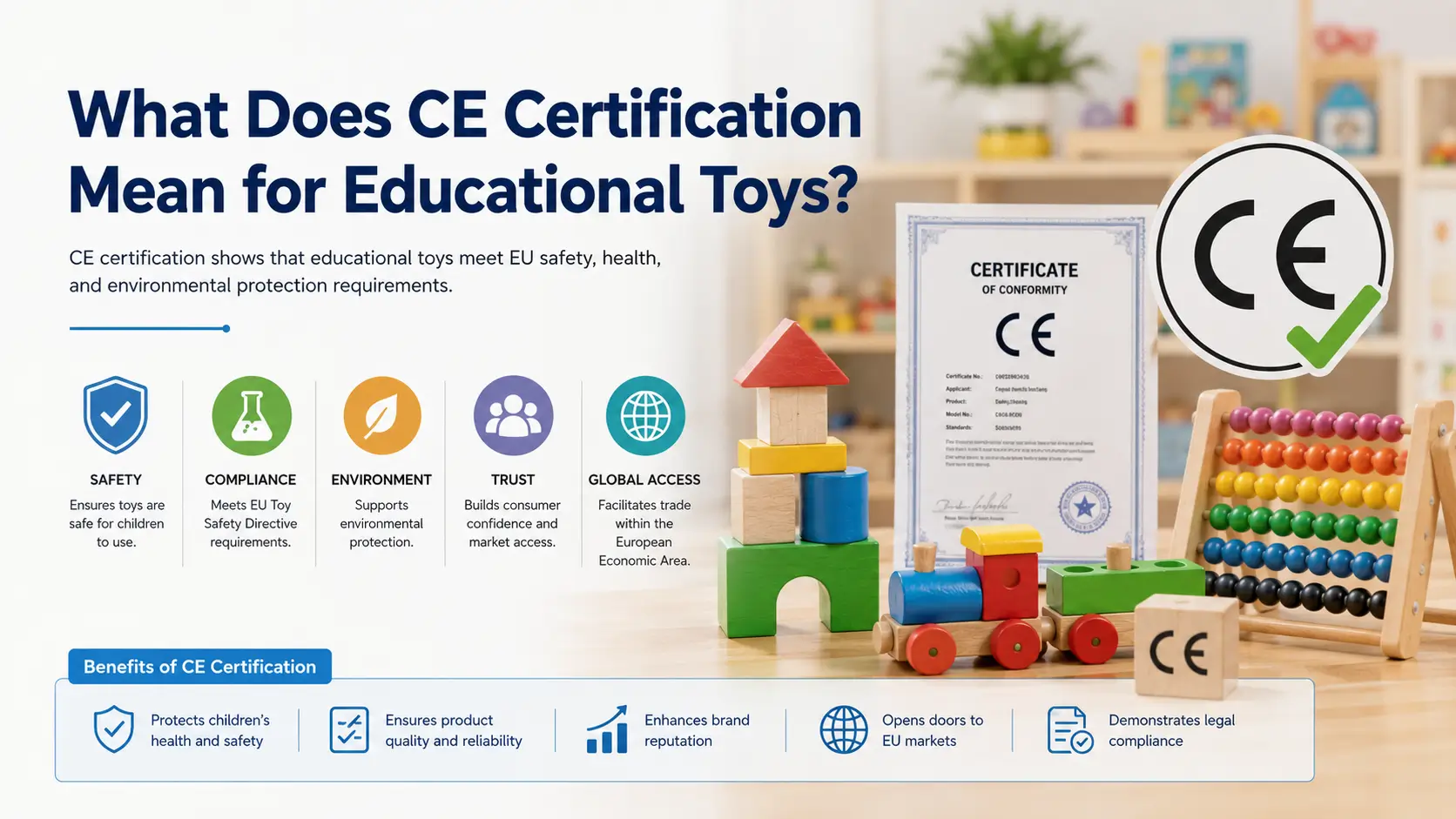
What Does CE Certification Mean for Educational Toys?
A common misconception among importers is treating CE as a certificate issued by an external authority. In reality, CE marking is a manufacturer’s declaration that the product complies with applicable European Union regulatory requirements.
It is not a quality seal, a government endorsement, or a certification issued after official inspection. The manufacturer or importer placing the toy on the EU market is legally responsible for ensuring conformity and affixing the CE mark only after completing the required conformity assessment procedures.
CE compliance for toys is structured around the Toy Safety Directive 2009/48/EC. The directive establishes essential safety requirements but does not specify detailed testing methods. That role is fulfilled by the EN71 standards. EN71 is the harmonized standard providing the technical specifications used to demonstrate compliance with the directive.
When a product is tested against EN71 and passes, it creates a presumption of conformity, meaning it is considered compliant with the directive’s essential requirements. CE is not a single document.
It is a visible mark supported by an entire chain of evidence, including test reports, product descriptions, material specifications, labeling records, and a signed Declaration of Conformity.
The Technical File is the least discussed yet most critical element of the CE compliance system. This file must contain a detailed product description, design drawings, material and component lists, safety assessment documentation, EN71 test reports, a copy of the Declaration of Conformity, and manufacturing process descriptions.
It must be retained for ten years after the product is last placed on the market and must be made available to market surveillance authorities upon request. Importers who receive only a test report from their supplier, without the complete Technical File structure, are exposed to significant compliance risks.
If authorities request the file and it cannot be produced, the product may be removed from the market even if the physical toy itself is safe.
Importers making sourcing decisions should look beyond the presence of a CE logo printed on the product or packaging.
Verification should include checking the testing laboratory’s name and accreditation status, comparing the test report date with the actual production batch, confirming SKU consistency between tested samples and shipped goods, and reviewing whether testing covers all relevant EN71 sections for that product category.
Jaredrise helps educational toy buyers prepare testing documentation and packaging compliance before shipment to reduce EU import risks. Confirming these details before production is significantly less expensive than dealing with enforcement actions after goods arrive in Europe.
Common Compliance Mistakes Educational Toy Buyers Should Avoid
Compliance failures rarely result from one catastrophic mistake. In most cases, they develop through a chain of smaller oversights that gradually compound until the product reaches a regulatory checkpoint and can no longer proceed. Recognizing these patterns early in the sourcing process helps importers avoid disruptions that only surface after significant capital has already been committed.
Selecting suppliers based solely on unit price remains the most common source of compliance issues. Factories quoting far below market averages often reduce costs by substituting materials without retesting, reusing reports from unrelated products, or bypassing third-party testing entirely in favor of internal inspections that regulators do not recognize.
Any initial savings disappear the moment a shipment is flagged during a documentation review.
Using outdated or recycled test reports creates both legal and commercial exposure. A report referencing an older version of EN71 or ASTM F963 may no longer satisfy current regulatory standards.
Likewise, a report issued for a similar — but not identical — SKU fails traceability verification when regulators or ecommerce platforms compare the tested product description against the actual shipped item. Compliance audits require exact matches, not approximate similarities.
SKU-to-report mismatches are particularly problematic for educational toy brands that update products frequently. A building block set with a revised color formulation, a science kit containing additional experiment materials, or a flash card reader upgraded with a different battery all require fresh testing if the modification affects materials, components, or safety performance. Assuming the original report automatically covers the revised version is a common route to compliance rejection.
Packaging labels receive far less attention than laboratory testing, yet they trigger just as many enforcement actions. Missing age grading, absent choking hazard warnings for products intended for children under three years old, CE marks without supporting documentation, and missing tracking labels can stop products at customs or during platform listing reviews.
Some importers invest heavily in premium packaging design while completely overlooking the regulatory markings required to legally sell the product.
Supplier unfamiliarity with Amazon-specific compliance procedures is becoming increasingly common. A factory that has never supplied FBA sellers may not understand CPC preparation timelines, ASIN-level compliance review triggers, or Amazon’s image submission requirements for tracking labels.
Educational toy importers relying primarily on ecommerce channels should confirm that suppliers fully understand the platform’s compliance workflow, because the factory’s inability to provide proper documentation directly translates into listing suppression or suspension for the seller.
How Professional Educational Toy Factories Reduce Compliance Risks?
Professional educational toy factories integrate compliance planning into product development itself rather than treating compliance as a final inspection issue. This distinction becomes visible throughout multiple stages of the production cycle and directly impacts whether shipments clear customs and pass ecommerce platform reviews without delays.
Material selection is the first area where true compliance capability becomes visible. Factories with regulatory expertise understand which paint formulations satisfy both EN71-3 migration requirements and CPSIA lead substrate limitations.
They specify phthalate-free plastic compounds for products intended for the US market and verify supplier certifications rather than assuming compliance. Wood sourcing decisions also consider whether MDF binders contain formaldehyde levels that could complicate European market access.
These decisions are made before tooling begins, not after a failed laboratory result requires remediation.
Testing coordination is handled very differently by factories that understand compliance timelines. They arrange testing using production-representative samples instead of hand-made prototypes that fail to reflect real mass-production conditions.
They know which laboratories hold CPSC acceptance or EN71 accreditation and can provide reports recognized by regulators and ecommerce platforms. They also maintain version control systems ensuring test reports correspond exactly to the shipped SKUs, including color variations and packaging configurations.
When product families include multiple configurations, they structure testing plans strategically to cover all variants efficiently instead of improperly extending one report across unrelated SKUs.
Amazon-specific operational knowledge further distinguishes factories experienced with ecommerce brands. These suppliers understand that CPC documents must identify every applicable regulation alongside the laboratory responsible for testing. They prepare tracking label artwork before packaging production begins.
They also understand that Amazon evaluates compliance documentation against the ASIN level rather than the broader brand level, and that inconsistencies between product listings and test reports often trigger rejection.
This operational awareness prevents the repetitive cycle of document submission, rejection, and resubmission that consumes seller support resources without resolving the underlying compliance issue.
Long-term educational toy brands prioritize compliance stability because their entire business model depends on uninterrupted market access. Brands with retail contracts, established Amazon rankings, and intellectual property investments cannot afford listing removals or customs seizures.
These buyers evaluate supplier compliance capabilities as a core supplier selection factor rather than an afterthought.
Jaredrise supports educational toy brands through compliance-focused production planning for both EU and US markets, helping buyers manage regulatory obligations as part of the manufacturing process rather than treating them as last-minute shipping paperwork.
Educational Toy Compliance Checklist Before Shipment
A systematic review of documents and products before container shipment prevents the vast majority of post-import compliance emergencies that disrupt educational toy businesses. Completing this verification process while the goods are still at the factory gives importers time to resolve issues before incurring warehousing charges, customs penalties, or platform suspensions.
- ☑ Test reports verified against the latest EN71 or ASTM F963 version
- ☑ Test reports matched to the exact SKUs being shipped, including color and packaging variations
- ☑ CPSC-accepted laboratory used for ASTM testing
- ☑ Accredited laboratory used for EN71 testing
- ☑ Children’s Product Certificate prepared with correct importer and product information
- ☑ Declaration of Conformity signed and referencing all applicable EU directives
- ☑ Technical File compiled and accessible for EU market surveillance requests
- ☑ Tracking label confirmed with manufacturer details, production location, and batch identification
- ☑ Warning labels verified, including choking hazard warnings for relevant age categories
- ☑ Age grading displayed on packaging and aligned with testing scope
- ☑ Packaging reviewed for all mandatory regulatory markings
- ☑ CE mark properly affixed to the product or packaging where applicable
- ☑ Battery compartment security verified for electronic educational toys
- ☑ Material compliance confirmed for lead, phthalates, and heavy metal restrictions
This checklist serves a practical purpose beyond simple documentation tracking. When buyers share it with suppliers before production begins, it establishes clear compliance expectations and reduces the likelihood that factories will proceed based on assumptions that do not align with target market requirements.
Suppliers capable of confirming each item confidently are usually the ones operating genuine compliance systems rather than simply applying a CE logo file to packaging artwork.
FAQ About Educational Toy Safety Standards
Is CE mandatory for toys sold in Europe?
Yes. Educational toys sold within the European market generally require CE marking under the Toy Safety Directive. Importers should also ensure that EN71 testing and complete technical documentation are available before shipment.
Is CE marking accepted in the United States?
No. The US market requires compliance with ASTM F963 and CPSIA regulations, supported by testing conducted at CPSC-accepted laboratories. CE documentation does not replace American regulatory requirements.
Do all educational toys require ASTM F963 testing for Amazon?
Toys intended for children under 14 years old generally require ASTM F963 testing and a Children’s Product Certificate for Amazon listings. Amazon’s compliance review system enforces these requirements regardless of material composition or toy category.
Do existing test reports from a factory cover new orders?
Not necessarily. Test reports are SKU-specific. Any modification involving materials, components, color formulations, or production locations may invalidate the original report. Fresh testing using production-representative samples remains the safest approach.
How long does EN71 testing take for educational toys?
Standard EN71 testing timelines typically range from one to three weeks depending on laboratory workload, applicable EN71 sections, and whether the samples pass during the first submission. Importers should incorporate this timeline into production planning and avoid treating rush testing as standard procedure.
Can suppliers reuse test reports for different clients?
No. Test reports identify both the applicant and the specific product. A report issued to one company for a particular SKU cannot automatically transfer to another importer even when the physical product appears identical. New documentation must be prepared for each responsible entity placing the product on the market.
Why do some toys fail EN71 even when they look safe?
Visual inspection cannot evaluate heavy metal migration, detachment force for small parts, or phthalate concentration levels. Products that appear well-manufactured may still fail chemical or mechanical testing that only laboratory equipment can accurately assess.
Why Compliance Knowledge Is Becoming a Competitive Advantage in Educational Toy Manufacturing
The educational toy industry is rapidly shifting toward a compliance-driven environment, and the pace is accelerating. Every revision to toy safety regulations, every new platform enforcement system, and every improvement in customs screening technology pushes the market further in favor of companies that treat compliance as a core operational capability rather than administrative paperwork.
Regulatory pressure is increasing across all major markets. The European Union continues updating EN71 requirements while also signaling broader chemical restriction initiatives.
In the United States, the Consumer Product Safety Commission enforces CPSIA regulations with increasing rigor, while Amazon’s automated compliance systems detect violations algorithmically that previously may have gone unnoticed.
Customs authorities are also sharing regulatory information internationally, meaning compliance issues identified in one market can affect shipments entering another. Ecommerce platforms that once accepted supplier declarations with minimal scrutiny now routinely require laboratory reports and certification documents as mandatory listing prerequisites.
Against this backdrop, the definition of a premium supplier is evolving. Historically, supplier selection focused primarily on low tooling costs, rapid lead times, and competitive unit pricing. Those factors still matter, but they are no longer enough on their own.
The suppliers educational toy brands increasingly value as long-term partners are those capable of demonstrating genuine regulatory expertise that translates into operational reliability. They keep products on shelves, maintain active listings, and ensure shipments move through customs without interruption.
They anticipate regulatory changes and adapt production practices before those changes create compliance gaps. They treat compliance not as an inconvenient after-sales task, but as one of the primary reasons buyers choose to work with them.
Professional educational toy manufacturers are increasingly expected to function as long-term compliance partners rather than simple product suppliers.
Companies embracing this role build durable client relationships because their value proposition aligns directly with what importers and brands truly require: reliable market access, uninterrupted sales continuity, and protection against regulatory liability. A product that cannot be legally sold has no commercial value, regardless of how low its production cost may be.