
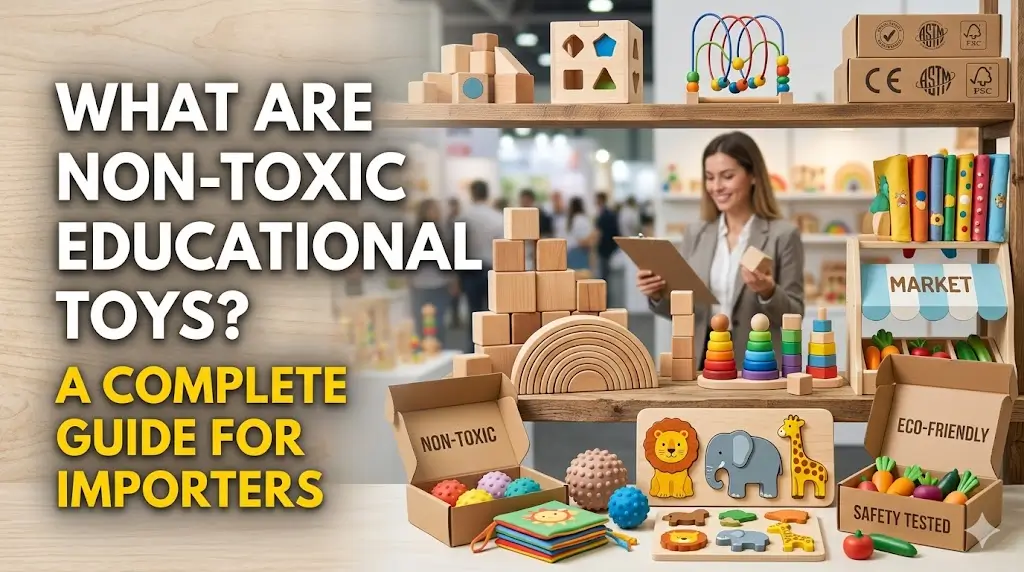
Non toxic educational toys are learning tools designed to stimulate cognitive development while being manufactured without chemicals or materials known to pose health risks to children.
For importers, this definition moves beyond simple product descriptions and becomes a critical compliance and supply chain requirement.
Definition of Non-Toxic Educational Toys
A non-toxic educational toy combines two essential characteristics. It delivers measurable learning value through play while ensuring chemical safety by eliminating harmful substances from every component.
This means the base materials, paints, inks, adhesives, and surface coatings must comply with strict regulatory limits for substances such as lead, phthalates, and formaldehyde.
Educational value may include motor skill development, problem-solving abilities, language acquisition, or sensory exploration.
When these two attributes are intentionally integrated, the result is a product that supports child development while safeguarding children’s health.
Why Educational Value Alone Is Not Enough?
A wooden alphabet puzzle or a set of counting blocks may effectively teach letters and numbers, but educational benefits alone do not guarantee safety.
Many toys with strong learning functions still contain hidden chemical risks.
Painted Montessori trays, printed flashcards, and plastic math manipulatives may introduce lead, phthalates, BPA, or heavy metals through paint layers, adhesive joints, or recycled plastic content.
Without rigorous chemical verification, an educational toy can quickly become a liability.
This is why searching for safe educational toys or chemical-free toys must go hand in hand with understanding the risks associated with toxic materials.
Why Are Buyers Concerned About Non-Toxic Educational Toys?
Buyers are concerned because a single safety failure can severely damage brand reputation, freeze inventory, and trigger costly regulatory penalties.
Educational toys are used in homes, schools, and daycare centers, and scrutiny regarding their chemical composition has never been greater.
The Hidden Chemical Risks in Educational Toys
The most common risk sources in educational toys are not always obvious. Paint applied to wooden number blocks may contain lead or other heavy metals.
Inks used on puzzle surfaces or activity cards may contain phthalates.
Adhesives used in stacking toys and plastic additives found in sorting shapes can introduce BPA or formaldehyde.
Even protective surface coatings may contribute hazardous compounds if they are not properly formulated. Importers must evaluate the entire material supply chain, not just the primary structure of the toy.
What Can Happen If Toys Fail Safety Requirements
When educational toys fail chemical testing, the consequences can escalate rapidly. Amazon may remove listings that lack proper documentation, sometimes without advance notice.
Customs authorities may detain shipments at ports, resulting in demurrage charges and missed delivery deadlines.
A formal product recall can force a company to issue refunds and destroy inventory. Major retailers often reject non-compliant products outright, while consumer safety complaints can quickly develop into social media crises.
Each of these outcomes represents significant financial losses and long-term damage to brand credibility.
Why Regulatory Compliance Matters More Than Marketing Claims?
A label stating safe for kids carries no legal significance unless it is supported by compliance documentation.
Marketing claims can create a false sense of security, whereas a CPSIA-compliant test report provides verifiable evidence.
The gap between a marketing statement and an official certification is where importers face the greatest risk.
Buyers who rely solely on supplier assurances instead of laboratory documentation are effectively self-insuring their inventory against chemical hazards, which is an increasingly unsustainable approach in today’s retail environment.
What Materials Are Commonly Used in Non-Toxic Educational Toys?
Material selection directly impacts both product safety and market accessibility. Importers who understand the advantages and potential risks associated with each material can make more informed purchasing decisions and minimize compliance-related delays.
Natural Wood Educational Toys
Solid wood provides a premium appearance and exceptional durability, making it a popular choice for educational toys.
However, the wood itself is rarely the source of concern. Most risks originate from the paints, varnishes, and coatings applied during manufacturing.
Some low-cost factories continue to use solvent-based finishes that contain elevated levels of volatile organic compounds (VOCs).
Buyers should always request complete coating disclosures and test reports covering every surface treatment applied to the product.
BPA-Free Plastic Educational Toys
Plastic educational toys remain widely used because of their design flexibility and cost-effectiveness.
The safest options are typically manufactured from polypropylene (PP) or polyethylene (PE), both of which are broadly accepted across North American and European markets.
Recycled plastics may introduce unpredictable chemical contaminants and should generally be avoided unless the supplier can provide batch-specific migration test reports.
BPA-free claims should always be supported by independent third-party verification, as the term itself is not a regulated certification standard.
Food-Grade Silicone Learning Toys
Food-grade silicone is a preferred material for infant learning toys, teethers, and sensory play products.
Its chemical stability and resistance to bacterial growth make it particularly suitable for products that are frequently mouthed by young children.
However, silicone should still be tested for volatile compounds and filler content, as some manufacturers use unauthorized extenders that compromise material purity.
For products intended for children aged zero to three, silicone often offers one of the most straightforward routes to EN71 and CPSIA compliance.
Water-Based Paints and Non-Toxic Coatings
Water-based paints have largely replaced solvent-based alternatives in compliant educational toy manufacturing.
They typically generate lower VOC emissions and align more closely with major international safety standards.
However, water-based does not automatically mean non-toxic. Pigments and binding agents still require comprehensive heavy metal screening. Importers should verify that the paint supplier has completed migration testing under the intended conditions of use.
What Chemicals Should Be Avoided in Educational Toys?
Identifying and controlling specific substances is one of the most effective ways to reduce risk in an educational toy project.The following chemicals are subject to strict regulatory scrutiny and should be carefully monitored.
Lead
Lead exposure can negatively impact neurological development and is heavily regulated worldwide.
In the United States, total lead content in accessible toy components must not exceed 100 ppm.
Lead may be present in paint pigments, metal alloys, and certain recycled plastic colorants. Every color variation and material combination should be supported by its own test report.
Phthalates
Certain phthalates are prohibited in children’s products due to concerns about endocrine disruption.
They are commonly found in soft plastic components, including flexible puzzle pieces and suction cups used in educational bath toys.
CPSIA restricts DEHP, DBP, and BBP to a maximum concentration of 0.1 percent each. European regulations under REACH impose even broader restrictions on phthalate use.
BPA
BPA is most commonly associated with polycarbonate plastics and epoxy-based coatings.
Educational toys that contain transparent rigid components or coated surfaces may contain BPA.
The most reliable approach is to specify BPA-free raw materials and verify compliance through independent laboratory testing.
Formaldehyde
Formaldehyde concerns typically arise in engineered wood products such as MDF puzzles or composite building blocks.
The adhesives used in these materials may release formaldehyde gas over time.
Specifying E0-grade or CARB Phase 2-compliant boards is essential for wood-based educational toys intended for regulated markets.
Heavy Metals
In addition to lead, other heavy metals such as cadmium, mercury, and chromium may be present in pigments and surface coatings.
Comprehensive heavy metal screening should be conducted according to EN71 Part 3 or ASTM F963 methodologies to ensure compliance with soluble migration limits.
What Certifications and Standards Apply to Non-Toxic Educational Toys?
Certifications convert chemical safety requirements into a format that retailers, distributors, and regulatory authorities recognize and accept.
Importers should understand the key standards that apply within their target markets to ensure smooth market entry and long-term compliance.
CPSIA Requirements for the US Market
The Consumer Product Safety Improvement Act (CPSIA) establishes mandatory limits for lead content, lead in surface coatings, and phthalates in children’s products.
It also requires children’s products to carry tracking labels and be supported by a Children’s Product Certificate (CPC) based on testing conducted by a CPSC-accepted third-party laboratory.
ASTM F963 Toy Safety Standard
ASTM F963 is the primary toy safety standard in the United States. In addition to chemical safety requirements, it addresses mechanical, physical, flammability, and labeling hazards.
Compliance with ASTM F963 is generally expected by major US retailers and is considered an essential requirement for educational toys entering the American market.
EN71 Requirements for Europe
EN71 Part 3 specifically addresses the migration of certain elements, including heavy metals, from toy materials.
The testing process simulates conditions similar to those found in the human digestive system to evaluate whether restricted substances could be released during mouthing or accidental ingestion.
Compliance with EN71 is fundamental for educational toys sold throughout the European market.
CE Marking for Educational Toys
CE marking demonstrates conformity with European health, safety, and environmental protection requirements.
For educational toys, this includes compliance with the Toy Safety Directive.
Behind the CE mark should be a complete technical file containing product specifications, risk assessments, declarations of conformity, and supporting laboratory test reports.
CCPSA Requirements for Canada
The Canada Consumer Product Safety Act (CCPSA) regulates toys through the Toys Regulations and establishes restrictions on toxic substances and other safety hazards.
Canadian authorities have the power to enforce corrective actions, including mandatory recalls.
Compliance with CCPSA requirements is essential for any educational toy intended for distribution within Canada.
Frequently Asked Questions About Non-Toxic Educational Toys
Are Wooden Educational Toys Always Non-Toxic?
No. Wooden toys can still present chemical risks through paints, varnishes, coatings, and formaldehyde-based adhesives if these materials have not been properly tested and verified.
Can a Toy Be Educational but Not Non-Toxic?
Yes. Many educational toys offer excellent learning benefits while still containing chemicals that exceed regulatory limits or fail applicable safety requirements.
What Is the Difference Between Non-Toxic and Eco-Friendly?
Non-toxic refers to chemical safety and the absence of harmful substances that may affect human health. Eco-friendly focuses on environmental impact throughout the product lifecycle, including sourcing, manufacturing, usage, and disposal.
Do Amazon Sellers Need CPSIA Reports?
Yes. Amazon requires CPSIA-compliant test reports for children’s products and frequently requests supporting documentation through its automated compliance review systems.
How Often Should Educational Toys Be Tested?
Testing should be conducted at least once per year and whenever there are changes to raw materials, suppliers, production processes, formulations, or color variations.
What Documents Should Importers Request?
Importers should request material declarations, third-party laboratory test reports, batch traceability records, Children’s Product Certificates (CPC), and, where applicable, EU Declarations of Conformity.