
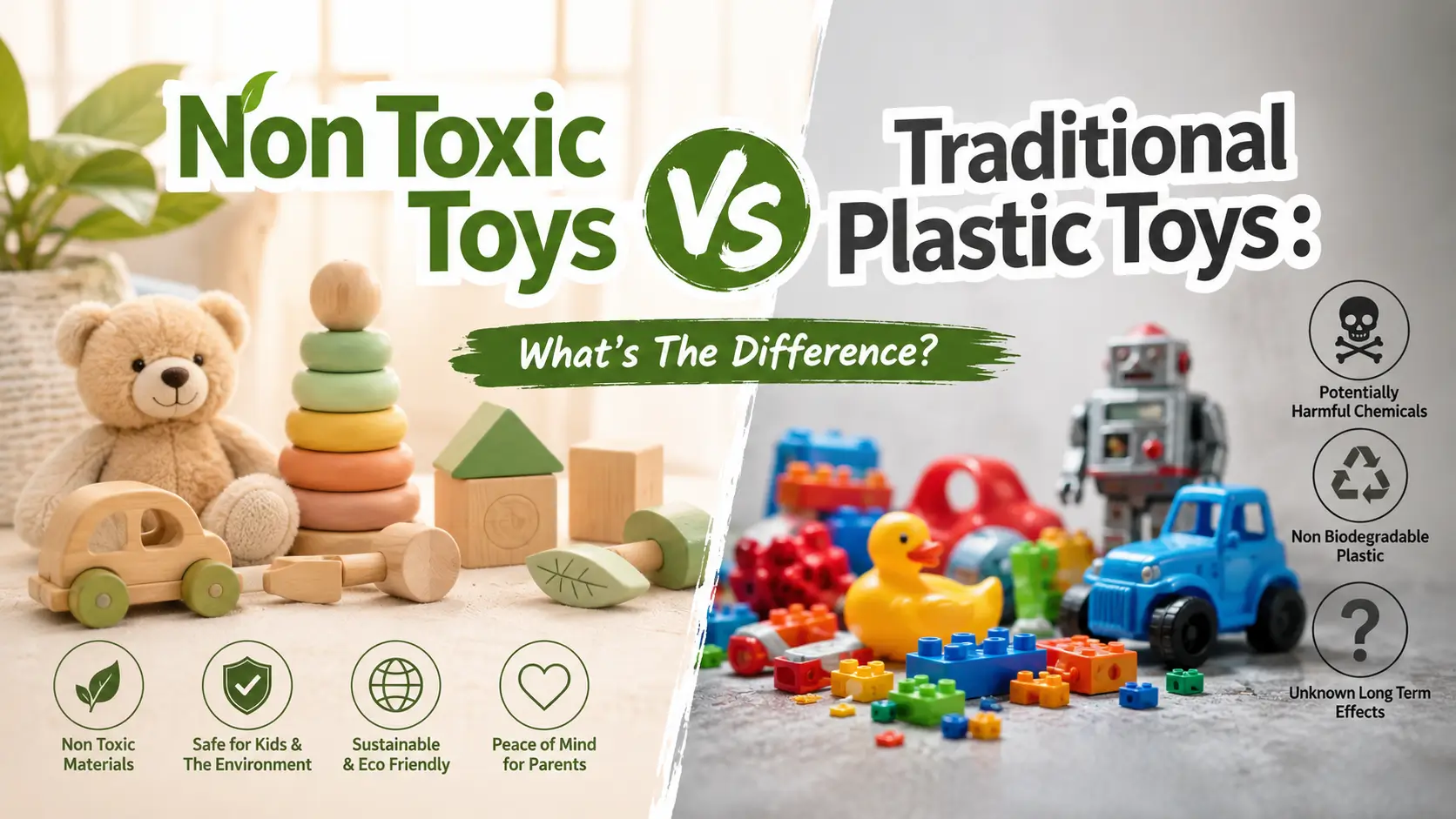
As a toy importer or brand buyer, you have probably noticed the term non toxic toys appearing everywhere from trade shows to Amazon listings.
The shift is real and it is changing purchasing decisions across global markets.
But what actually separates a non toxic toy from a traditional plastic toy is not always well explained.
Most suppliers use the phrase loosely. Most buyers assume it simply means no plastic. Both assumptions create risk.
This guide walks you through the real differences, why they matter for your business, and how to make supplier decisions that protect your brand and your margins.
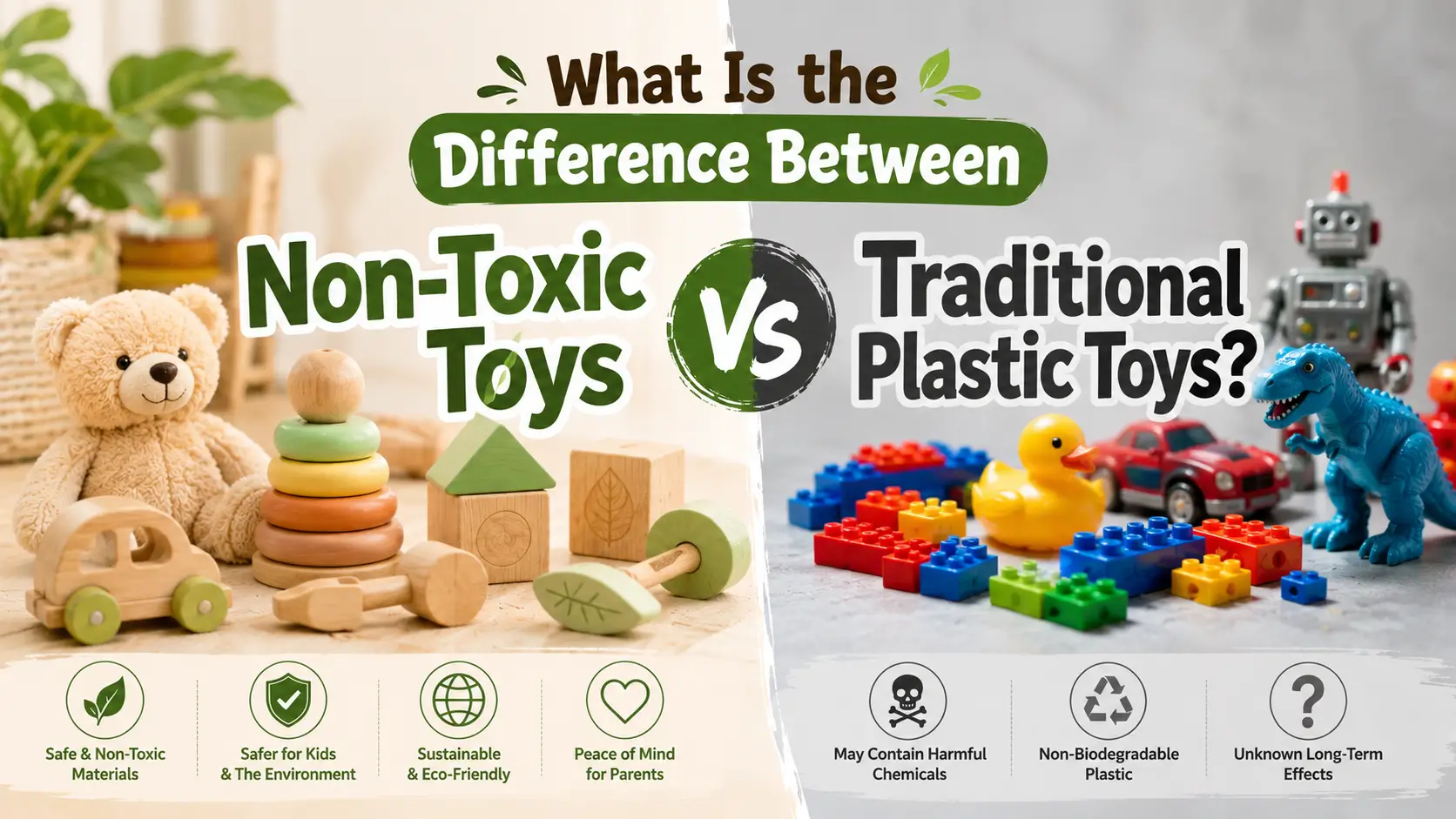
What Is the Difference Between Non-Toxic Toys and Traditional Plastic Toys?
The difference between non-toxic toys and traditional plastic toys is not whether plastic is used. Many non-toxic toys are made from plastic.
The real distinction lies in what is controlled, what is restricted, and what is documented.
Non-toxic toys are designed around child safety and regulatory compliance from the very beginning.
Materials are screened before production. Chemical content is restricted to acceptable thresholds. Finished products undergo third-party testing against recognized safety standards.
Compliance documentation is prepared for market entry.
Traditional plastic toys are often designed with manufacturing cost as the primary consideration. Material sourcing may prioritize price over purity.
Chemical restrictions may not be consistently enforced. Testing may only occur when specifically requested by a buyer.
Documentation may be incomplete, outdated, or unavailable.
At our facility, toy development begins with material safety and compliance requirements rather than simply selecting the lowest-cost raw materials.
This upstream approach fundamentally changes what the final product represents.
Why This Difference Matters to Importers and Toy Brands?
When importing toys, the difference between non-toxic and traditional plastic products does not remain confined to a specification sheet.
It directly affects logistics costs, marketplace performance, and brand reputation. Understanding this distinction is not merely an academic exercise—it is a financial necessity.
Compliance Failures Can Be Expensive
A single compliance failure can trigger costs that far exceed any savings achieved through a lower unit price.
Customs holds can leave containers sitting at ports while demurrage charges accumulate. Amazon delistings can result in lost Buy Box visibility and suspended ASINs.
Retailer rejections may create rework expenses or wholesale returns. Product recalls can require public notifications, customer refunds, and potential legal action.
Each of these consequences is more costly than proper testing. Each is more expensive than partnering with a manufacturer that maintains effective material controls. The financial equation becomes clear once the focus extends beyond ex-works pricing.
Consumers Are Paying More Attention to Toy Safety
Consumer purchasing behavior, particularly among parents, has evolved significantly.
Search demand continues to grow for terms such as BPA-free toys, phthalate-free teethers, PVC-free bath toys, and lead-free playsets.
Safety claims that were once niche marketing advantages have become baseline expectations across major ecommerce platforms.
As a result, safety is no longer just a compliance requirement—it is a competitive selling point.
Products with clear non-toxic positioning consistently outperform generic alternatives in categories such as baby toys, toddler playsets, and educational manipulatives.
Many buyers choose our company because compliance readiness often delivers greater value than a marginally lower unit price when entering regulated markets.
What Makes a Toy Truly Non-Toxic?
Understanding what qualifies a toy as non-toxic requires looking beyond marketing claims. A green leaf icon on packaging has little meaning without material traceability, chemical testing, and certification to support it. Three key layers determine whether a toy genuinely deserves the non-toxic label.
Safe Materials Are Only the Starting Point
Common materials used in non-toxic toy manufacturing include ABS, polypropylene (PP), food-grade silicone, and FSC-certified wood. When properly sourced and processed, each offers characteristics that make it suitable for children’s products.
However, the material name alone does not guarantee safety. ABS from one supplier may be fully compliant, while ABS from another may contain recycled content with unknown additives.
PP may be manufactured from virgin resin or blended with industrial regrind. Food-grade silicone only carries value when the grade is independently verified.
FSC-certified wood can still be coated with hazardous finishes that negate the advantages of the underlying material. Material selection is necessary, but it is not sufficient on its own.
Chemical Control Is More Important Than Material Type
The distinction between non-toxic and conventional toys ultimately depends on chemical management. Four categories of substances deserve particular attention from importers. Lead must be controlled because it can appear in paints, coatings, and plastic colorants.
Cadmium requires similar scrutiny. BPA should be absent from products intended for mouthing or feeding applications. Phthalates must be restricted in soft plastic components and PVC materials.
This is why the plastic-versus-wood debate can be misleading. Plastic can be non-toxic when chemical inputs are controlled and formulations are verified.
Wood can become hazardous when treated with lead-containing paints, formaldehyde-based adhesives, or unregulated varnishes.
The material category itself is not the determining factor. The chemical composition is.
Testing and Certification Matter
The bridge between a supplier’s claim and a verifiable fact is third-party laboratory testing.
In the United States, CPSIA establishes the legal framework for children’s product safety, including lead content limits, phthalate restrictions, and mandatory third-party testing requirements.
ASTM F963 provides detailed technical requirements covering mechanical hazards, flammability, and chemical migration limits. In Europe, EN71 governs mechanical safety, flammability, and the migration of certain elements, while REACH introduces broader restrictions on chemical substances.
Although these standards apply to different markets, they serve the same purpose: transforming the concept of non-toxic into measurable and enforceable requirements.
Our company works with accredited third-party laboratories to verify compliance before products enter major export markets, ensuring that buyers receive documented test results rather than relying on verbal assurances.
Non-Toxic Toys vs Traditional Plastic Toys: Side-by-Side Comparison
Viewing the differences in a structured format makes it easier to understand what importers are actually choosing between. The table below compares both categories across the factors that most directly influence purchasing decisions.
| Comparison Area | Non-Toxic Toys | Traditional Plastic Toys |
|---|---|---|
| Main Focus | Child Safety | Cost Efficiency |
| Material Screening | Strict | May Vary |
| Chemical Restrictions | Controlled | Not Always Controlled |
| Compliance Testing | Common | Not Always Required |
| Documentation | Usually Complete | May Be Limited |
| Retail Acceptance | Higher | Lower |
| Import Risk | Lower | Higher |
This comparison highlights an important reality of modern procurement.
When you select a non-toxic toy supplier with a robust compliance infrastructure, you are not simply purchasing physical products.
You are investing in market-access readiness, risk-management capability, and the ability to maintain uninterrupted sales on platforms where regulatory enforcement is strict.
Any price difference that exists often reflects these embedded advantages.
Can Plastic Toys Be Non-Toxic?
This question generates significant search interest because both buyers and consumers frequently associate non-toxic products with plastic-free alternatives.
While understandable, this assumption does not reflect the technical reality that matters most in sourcing decisions.
Plastic Is Not the Problem
Plastic as a material category is not inherently toxic. Many plastic toys fully comply with CPSIA, ASTM F963, and EN71 requirements.
ABS building blocks, polypropylene stacking cups, and EVA foam play mats can all meet stringent safety standards when manufactured using virgin resins, controlled additives, and well-managed production processes.
The risk does not originate from the polymer itself. It comes from additives introduced during compounding, contaminants present in recycled feedstock, and chemicals applied through surface treatments.
Paint pigments, plasticizers, flame retardants, and stabilizers are the most common sources of restricted substances.
When these inputs are carefully controlled, plastic toys can legitimately qualify as non-toxic products.
The Real Question Buyers Should Ask
The most important sourcing question is not whether a toy is made from plastic. That line of thinking often leads to incorrect assumptions and missed opportunities. A more valuable question is whether the toy can successfully pass compliance testing in the target market.
This shift in perspective changes how suppliers are evaluated. Instead of focusing on material categories, buyers focus on laboratory reports.
Instead of avoiding plastic altogether, they avoid undocumented manufacturing practices. Instead of relying on assumptions, they rely on verification.
This mindset is often what separates experienced importers from those who learn through costly compliance failures.
How to Verify a Supplier’s Non-Toxic Claims?
Every supplier claims that its products are safe. The ability to substantiate those claims with evidence is what distinguishes a credible manufacturer from the rest. Three verification steps provide greater confidence when placing large-volume orders.
Ask for Testing Reports
Request complete laboratory reports rather than summary statements or marketing claims.
Review the name of the testing organization to confirm that it is a recognized third-party laboratory.
Verify that the testing standard matches the requirements of your target market. Check the testing date to ensure the report reflects current production conditions.
A supplier that cannot or will not provide full testing reports is presenting a warning sign that should not be overlooked.
Review Compliance Documentation
In addition to laboratory reports, several documents provide insight into a supplier’s compliance capabilities.
Children’s Product Certificates (CPCs) are required for CPSIA compliance in the United States. EN71 reports support distribution within European markets.
Material declarations provide transparency regarding the substances used in formulations and components.
Suppliers that maintain accurate and organized documentation are generally better positioned to deliver consistent compliance performance.
Evaluate Quality Systems
Compliance documentation demonstrates how a sample performed during testing.
Quality management systems determine whether production units consistently match that tested sample.
Review how the manufacturer tracks raw materials from receipt through production. Understand its incoming material inspection procedures.
Examine its batch management system to ensure production lots can be linked to specific raw material inputs.
These operational controls are often far more meaningful than the promotional claims displayed on a supplier’s website.
Buyers evaluating our company frequently review both compliance documentation and manufacturing controls before proceeding with high-volume orders.
How to Choose the Right Non-Toxic Toy Manufacturer?
Finding a manufacturer that can deliver both product safety and commercial success requires evaluating factors that extend well beyond the product catalog and quoted pricing.
Look Beyond Price
Comparing suppliers solely on unit price often hides the true cost of procurement. A manufacturer with strong compliance capabilities can reduce testing expenses and shorten time to market. A supplier that maintains complete documentation eliminates the administrative burden of repeatedly requesting certificates and reports. Manufacturers with extensive experience working with accredited testing laboratories offer a level of reliability that lower-cost alternatives frequently cannot provide. Likewise, suppliers with proven export experience understand international logistics, labeling requirements, and destination-market regulations. These capabilities create measurable value, even when the quoted unit price is slightly higher.
Choose a Partner That Understands Your Market
Regulatory requirements vary significantly across global markets, and a manufacturer familiar with your target destination can provide a substantial advantage. The United States requires CPSIA compliance together with ASTM F963 conformity.
The European market requires EN71 compliance alongside REACH chemical substance restrictions.
Other regions maintain their own regulatory frameworks and enforcement practices.
A manufacturer that understands these differences can help prevent customs delays, reduce compliance-related costs, and accelerate market entry.
Our team supports importers by preparing products for a variety of regulatory environments through documentation assistance, testing coordination, and compliance-focused manufacturing processes.
Conclusion
Plastic does not automatically mean toxic, and the discussion around non-toxic toys has evolved far beyond simple material-type debates.
A non-toxic toy is defined by disciplined material management, effective chemical control, and verified regulatory compliance rather than by the absence of any specific material.
For importers and toy brands, the most significant distinction between non-toxic toys and traditional plastic toys ultimately comes down to market access and business continuity.
A toy that cannot demonstrate compliance may struggle to enter regulated markets, remain listed on major ecommerce platforms, or support sustainable brand growth.
The manufacturer you choose determines which side of that divide your products will occupy.
By partnering with a supplier that provides documented compliance systems, third-party testing, and market-specific regulatory expertise, you are purchasing more than a toy.
You are investing in the ability to sell confidently in markets where product safety is closely monitored and regulatory enforcement is a commercial reality.