
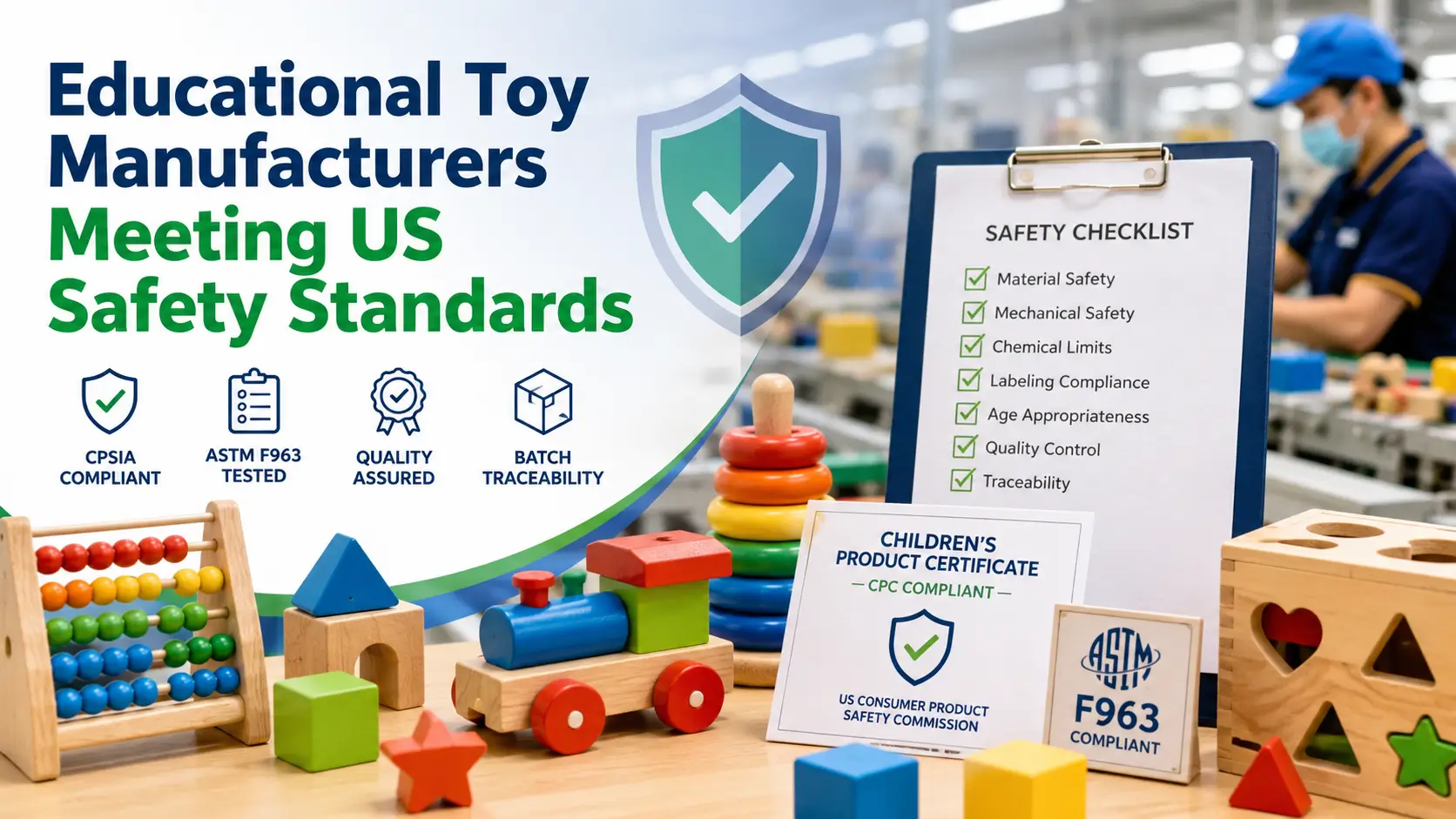
Educational toy manufacturers meeting US safety standards are manufacturers capable of consistently designing, producing, and validating toys that comply with CPSIA, ASTM F963, and applicable CPSC regulations, rather than simply supplying products.
For US buyers, supplier qualification should be evaluated through four core capabilities:
- Compliant material control
- Manufacturing quality management
- Third-party testing and CPC documentation
- Product traceability throughout production
While manufacturers with mature compliance systems may increase production costs by approximately 3–10%, they significantly reduce testing failures, product recalls, customs delays, and retailer rejection risks.
The best supplier is one that can maintain compliance across every production batch, not just pass a single laboratory test.
Manufacturing Process for Educational Toy Manufacturers Meeting US Safety Standards
Manufacturers achieve compliance through a controlled production system rather than relying solely on final product inspections.
This approach is commonly adopted by manufacturers with proven US market experience.
4-Step Compliance Model
Step 1: Material Qualification. Manufacturers identify and document every material used, including plastics, coatings, wood, and adhesives. They obtain supplier test reports and screen materials for restricted substances such as lead, phthalates, and heavy metals before production begins.
Step 2: Manufacturing Process Control. Production parameters such as temperature, pressure, and assembly sequences are continuously monitored to prevent defects that could create sharp edges or small detachable parts. Operators follow approved procedures, and any deviation immediately triggers a review.
Step 3: Third-Party Testing. Samples from production batches are submitted to CPSC-accepted laboratories for ASTM F963 and other required compliance tests. Manufacturers use these results to verify ongoing compliance instead of relying on a single pre-production test.
Step 4: Batch Traceability. Every production lot is linked to material batches, machine settings, operator records, and inspection results. Records are retained for the required period and support the issuance of a Children’s Product Certificate (CPC).
Compliance is achieved through a controlled manufacturing system rather than final product inspection alone.
Type A vs. Type B Manufacturers
| Aspect | Type A Manufacturer | Type B Manufacturer |
|---|---|---|
| Product Focus | Only manufactures toys | Manufactures toys with integrated compliance management |
| Compliance Approach | Treats testing as a final verification step | Builds compliance into materials, product design, and manufacturing processes |
| Documentation | Limited test reports | CPC files, batch traceability records, and material declarations |
| Buyer Risk | Higher likelihood of recalls or shipment rejection | Lower risk of compliance failures |
Type B manufacturers generally cost slightly more, but they help prevent far more expensive downstream issues.
Buyers supplying Amazon, Walmart, or educational distributors should choose Type B manufacturers because these sales channels require documented compliance—not just a passing test report.
While Type A factories may produce compliant samples, they often struggle to maintain consistency during mass production.
A robust compliance management system transforms product safety from a one-time milestone into a repeatable, reliable manufacturing process.
What Increases Compliance Costs by 3–10%?
Material. Sourcing certified plastics, lead-free paints, and responsibly harvested wood increases material costs. These materials are supported by supplier declarations and significantly reduce the risk of exceeding CPSIA limits.
Testing. Routine batch testing and evaluations across multiple SKUs increase third-party laboratory costs. Manufacturers invest in both pre-production validation and ongoing compliance testing rather than depending on a one-time report.
Documentation. Preparing and maintaining CPC files, material safety documentation, and production batch records adds administrative costs. These documents are essential for meeting U.S. customs and retailer requirements.
Quality Control. Implementing in-process quality checkpoints and final random inspections increases labor costs but substantially reduces the likelihood of defective products reaching customers. These quality control activities are fully integrated into the production workflow.
Traceability. Assigning unique codes to every production batch and linking them to material lots, operators, and manufacturing equipment requires additional labeling and data management systems, typically adding around 2–3% to production costs. These records enable rapid issue identification and containment if problems occur.
These investments reduce overall procurement costs rather than simply increasing manufacturing expenses.
Related Solution
Looking for a manufacturing partner that prioritizes traceability and consistent quality?
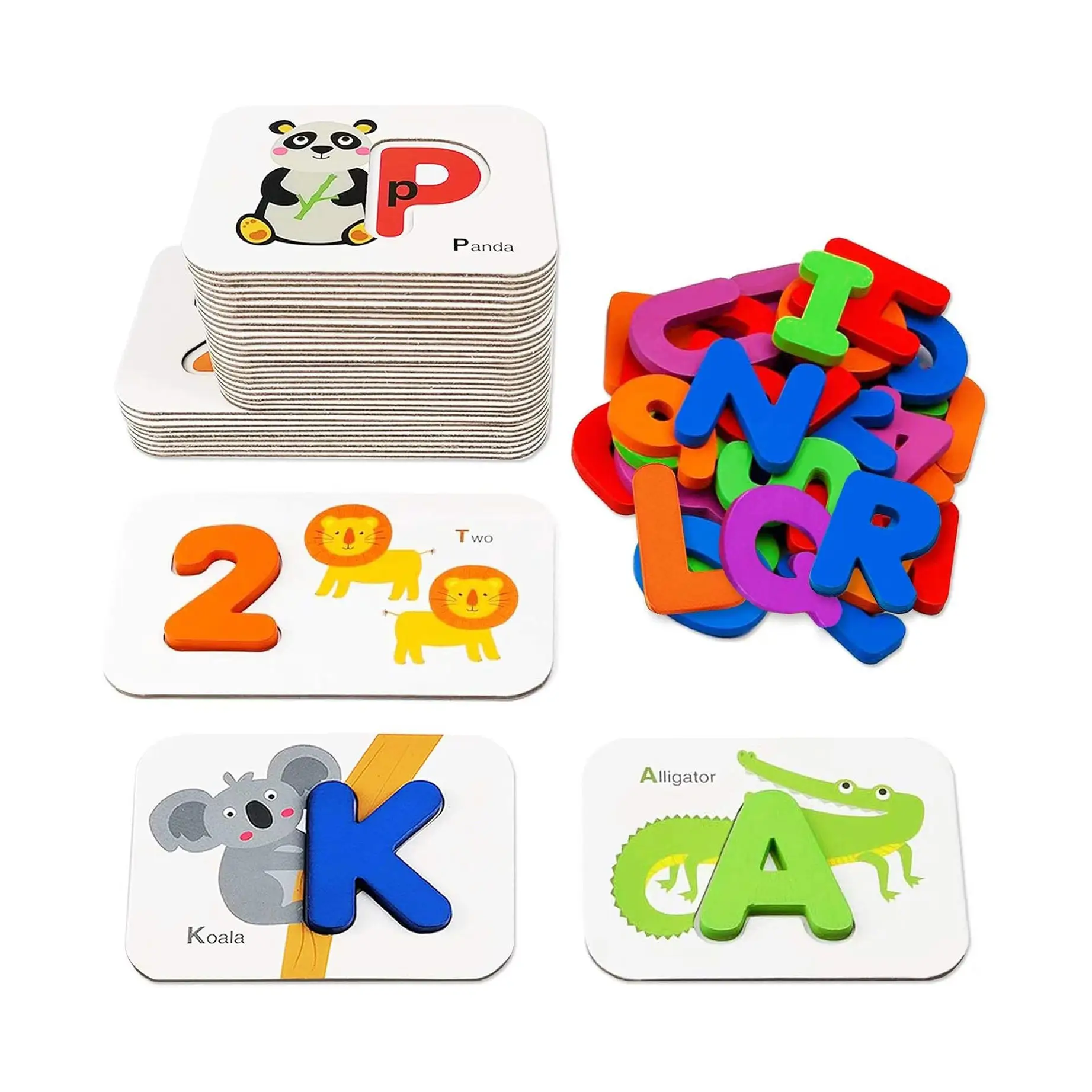
Brands that require consistent traceability often choose our educational toys designed for regulated markets, where every production batch can be linked to material records, inspection reports, and manufacturing data.
When Should Buyers Choose a Compliance-Focused Manufacturer?
Compliance-focused manufacturers are essential when products are sold through Amazon, Walmart, school supply contracts, educational distributors, or as part of long-term private label programs. These channels routinely audit safety documentation and may remove products that lack proper CPC support.
Suitable for:
- Amazon
- Walmart
- School suppliers
- Educational distributors
- Long-term private label programs
If compliance is a purchasing requirement rather than an optional feature, supplier capability should be evaluated before comparing quotations.
Compliance Checklist
- Material approval documentation includes supplier test data for plastics, paints, and coatings.
- ASTM F963 testing experience demonstrates successful completion of both mechanical and chemical testing.
- CPSIA compliance records track lead, phthalates, and other restricted substances.
- CPC support means the manufacturer can issue or facilitate a Children’s Product Certificate.
- A batch traceability system links every production lot to its materials and inspection records.
- Quality control procedures include documented incoming, in-process, and final inspection processes.
- Design reviews for age grading evaluate small parts and sharp edges before tooling begins.
- Supplier audit capability verifies that sub-suppliers meet the same compliance standards.
Manufacturing Capability for US-Compliant Educational Toys
Based on production data from Jaredrise, manufacturing capability determines whether compliance can be consistently maintained across high-volume production.
The following sections explain how material selection, design reviews, and production controls work together to establish a reliable foundation for safety compliance.
Material Selection Supports CPSIA Compliance
Material selection has a direct impact on CPSIA compliance. ABS plastic must be free of restricted phthalates.
Paints and surface coatings require heavy metal screening. Wood used in educational toys should come from controlled sources and, when bonded with adhesives, be tested for formaldehyde emissions.
Every material supplier must provide a Declaration of Conformity, which manufacturers verify through independent third-party laboratory testing.
Without proper material qualification, even a well-designed toy can fail compliance testing and require costly rework.
Jaredrise pre-qualifies material suppliers and maintains an approved materials list, ensuring that every incoming batch matches the validated material formulation.
Design Review Before Tooling
Conducting a design review before tooling begins helps prevent compliance failures later in production.
Engineering teams evaluate 3D models for sharp edges, pinch points, and small-part hazards based on the intended age group.
Drop-test simulations identify structural weaknesses that could cause products to break into hazardous pieces.
Resolving these issues during the design stage eliminates the need for expensive tooling modifications and repeated testing after molds have been manufactured.
At Jaredrise, the design review includes a cross-functional evaluation involving engineering, production, and quality teams to ensure both safety compliance and manufacturability.
This process also confirms that every component meets ASTM F963 dimensional and mechanical strength requirements before steel tooling is produced.
Production Controls
Production controls ensure compliance is maintained from the first molding cycle through final shipment.
Incoming Quality Control (IQC) verifies material certifications and performs spot inspections. In-Process Quality Control (IPQC) monitors critical manufacturing parameters such as molding temperature and assembly torque.
Final Quality Control (FQC) conducts visual and functional inspections of finished products before packaging.
Outgoing Quality Control (OQC) samples packed cartons to verify labeling accuracy and shipment quantities.
All inspection results are documented in batch records, creating complete product traceability.
Jaredrise integrates these quality control activities into daily production using statistical sampling methods aligned with AQL standards.
Based on Production Data from Jaredrise
A laboratory test report only confirms that a single sample met compliance requirements at a specific point in time.
What truly protects buyers is consistent production control. Consider a real-world example.
An educational toy originally used a qualified ABS color masterbatch. Later, the molding supplier replaced it with a visually similar alternative from another supplier to reduce costs.
Although the appearance remained unchanged, the new material altered the product’s chemical composition, resulting in a failed phthalate test.
Because the manufacturer maintained full batch traceability, the issue was identified before shipment.
Without traceability and production controls, the entire shipment could have been rejected at the port.
Based on production data from Jaredrise, maintaining stable materials and approved suppliers is one of the most effective ways to achieve ongoing compliance.
Any change to a material, component, or supplier is managed through a documented change-control process that requires re-verification before production continues.
Compliance Cost Breakdown and Procurement Value
Understanding the cost structure of compliance enables buyers to make better sourcing decisions.
The figures demonstrate that investing in the right manufacturing partner reduces the overall cost of procurement rather than simply increasing manufacturing expenses.
Typical Compliance Cost Structure
A typical compliance cost structure includes material upgrades, testing, documentation, inspection, and engineering support.
Material costs increase when manufacturers switch to certified plastics and lead-free coatings.
Testing fees cover third-party laboratory evaluations for ASTM F963, heavy metals, and phthalates for each SKU.
Documentation costs include preparing and maintaining CPC files, test reports, and material declarations.
Inspection expenses reflect the additional labor required for quality control and sampling throughout production.
Engineering costs cover design reviews, tooling modifications, and change management.
Together, these elements typically add between 3% and 10% to the manufacturing cost of educational toys intended for the U.S. market.
Hidden Costs
Low-price quotations often conceal significant downstream expenses.
A common scenario begins with a factory offering an attractive unit price.
Although the initial sample passes compliance testing, production units later fail because materials have been substituted.
This results in retesting, which can delay the order by four to eight weeks. Non-compliant products may be detained by U.S.
Customs, leading to storage charges and re-export costs. If mold modifications become necessary, additional tooling expenses and sample resubmissions further increase costs.
Extended delays can cause buyers to miss critical selling seasons, and in the worst-case scenario, retailers may cancel orders and return the goods.
Return freight and product disposal generate even more expenses.
Hidden costs typically include retesting, mold rework, shipment storage, demurrage, product recalls, and the loss of customer trust.
A compliance-focused manufacturer minimizes these risks by maintaining a controlled and traceable production system.
Why Paying 5% More Can Reduce Total Cost?
A real purchasing scenario illustrates this principle. Factory A quoted $2.50 per unit for an educational puzzle.
Attracted by the lower price, the buyer skipped a thorough factory evaluation. After production, third-party testing found excessive lead content in the paint.
The entire shipment required rework, and the buyer incurred additional costs for retesting, air freight to meet the delivery deadline, and retailer penalties.
The final cost exceeded $3.20 per unit. Factory B quoted $2.70 per unit and included compliance documentation, batch traceability, and in-house pre-compliance testing.
The project was completed on schedule with no shipment rejections.
The buyer’s total landed cost remained at $2.70 per unit, making it less expensive than Factory A in the end.
Paying 5% to 8% more for a compliance-capable manufacturer lowers the total cost of ownership by preventing costly supply chain disruptions.
Supplier selection should therefore be based on total procurement cost rather than ex-factory pricing alone.
Cost Comparison Model
| Cost Element | Low-Price Factory | Compliance Manufacturer |
|---|---|---|
| Unit Price | $2.50 | $2.70 |
| Testing and Retesting | $0.25 | $0.05 |
| Rework and Delay | $0.40 | $0.00 |
| Logistics and Penalties | $0.15 | $0.00 |
| Total Landed Cost per Unit | $3.30 | $2.75 |
This cost comparison model demonstrates that the initial unit price does not accurately represent the true cost of procurement.
Once retesting, rework, production delays, and retailer penalties are taken into account, a low-price factory often results in a significantly higher total landed cost.
A compliance-focused manufacturer minimizes these hidden expenses by embedding quality control and compliance systems throughout the production process.
Buyers should evaluate the total cost of ownership rather than comparing ex-factory quotations alone.
Compliance & Quality Assurance Throughout Production
Compliance is not simply a certificate attached to a shipment. It is an ongoing process embedded throughout daily manufacturing operations.
The following sections explain the difference between obtaining a test report and maintaining true manufacturing capability.
Third-Party Testing vs. Manufacturing Capability
A third-party test report confirms that a submitted sample complied with regulatory requirements on a specific date.
It does not demonstrate that the manufacturer can consistently reproduce those results in mass production.
True manufacturing capability depends on stable material sourcing, controlled production processes, trained operators, and a quality management system that maintains compliance from batch to batch.
Many factories can produce a compliant sample by carefully selecting materials and manually assembling a limited quantity.
However, when production scales to thousands of units, material substitutions, machine variations, and operator errors can introduce compliance risks.
Buyers should therefore evaluate the manufacturer’s production system rather than relying solely on a laboratory test report.
Acompliance-focused manufacturer incorporates testing into an ongoing production verification program, ensuring that the certified product is the same product ultimately delivered.
Batch Traceability
Batch traceability connects every finished product to its complete production history.
The system records the material lots used, the operators and equipment involved, the production date, and the final inspection results.
If a safety issue arises, the manufacturer can identify the root cause within minutes.
Traceability also supports Children’s Product Certificate (CPC) requirements by documenting the production period and the scope of compliance testing.
A traceability system typically uses lot numbers, barcode labels, or RFID tags, with records maintained digitally or in paper form.
Shipment records are linked to identify which retail channels received specific production lots.
Without batch traceability, a single defective lot may require recalling every product because the affected scope cannot be accurately identified.
Documentation Buyers Should Request
- Request a Children’s Product Certificate (CPC) that identifies the applicable regulations and the accredited testing laboratory.
- Obtain the ASTM F963 test report confirming compliance with both mechanical and chemical requirements.
- Request material declarations covering all plastics, paints, coatings, and adhesives.
- Review incoming material inspection records to verify that every material lot was inspected.
- Examine in-process quality control records demonstrating that critical production parameters were continuously monitored.
- Collect final inspection reports, including sampling methods and inspection results.
- Request production batch records linking manufacturing dates, equipment, and operators.
Together, these documents demonstrate that the manufacturer operates a comprehensive compliance management system rather than relying solely on sample-level testing.
At Jaredrise Manufacturing Facility
At the Jaredrise manufacturing facility, compliance is fully integrated into the production workflow.
Incoming materials are inspected against the approved materials list before entering warehouse inventory.
Production lines follow standardized work instructions, while in-process inspections verify critical product characteristics at predetermined intervals.
Final inspections evaluate the visual appearance, functionality, and safety performance of finished educational toys.
Shipping documentation—including the Children’s Product Certificate (CPC), laboratory test reports, and batch traceability records—is prepared concurrently with production.
This integrated approach ensures that compliance activities are embedded within normal manufacturing operations rather than being performed as a separate post-production task.
As a result, every shipment is supported by documented production evidence instead of relying solely on a single laboratory report.
Jaredrise’s quality team also participates in design reviews and supplier qualification, helping identify and resolve potential compliance issues before production begins.
Customization for Educational Toys Entering the US Market
Customization requests should always be evaluated for their potential impact on product safety and regulatory compliance.
The following sections help buyers understand change management, testing requirements, and supplier responsibilities.
Design Changes Affect Compliance
Many product modifications can directly affect safety compliance.
Changing the paint color or coating formulation may introduce pigments containing restricted heavy metals.
Replacing ABS with PP requires a new evaluation of mechanical performance and phthalate compliance.
Altering product dimensions or adding openings may create small-part hazards or finger entrapment risks.
Packaging modifications can affect labeling requirements under U.S. regulations.
Even changing a printed logo may introduce non-compliant substances if a different ink formulation is used.
Any modification involving materials, product geometry, or surface coatings should trigger a formal compliance review.
Manufacturers should implement a documented change management system to determine whether additional testing is required before approving the modification.
When New Testing Is Required?
A straightforward decision framework helps determine when additional testing is necessary.
Minor changes—such as updating packaging artwork or adjusting logo placement without changing the product’s materials or structure—typically do not require retesting.
Major modifications, including material substitutions, new color formulations, dimensional changes affecting small-part evaluations, or the addition of new components, generally require new third-party testing.
Any change that alters the intended age grading of the product also requires re-evaluation.
Whenever uncertainty exists, buyers should consult both the accredited testing laboratory and the manufacturer’s compliance team.
A documented change management process ensures that all stakeholders evaluate the impact before production proceeds.
OEM vs. ODM Compliance Responsibilities
| Aspect | OEM Project | ODM Project |
|---|---|---|
| Design Ownership | Buyer provides the product design. | Factory develops the product design. |
| Compliance Responsibility | Shared between the buyer and the manufacturer. | The manufacturer assumes primary responsibility for design safety. |
| Testing Support | The buyer typically arranges third-party testing. | The manufacturer usually coordinates testing and provides the CPC. |
| Suitability | Best for buyers with proprietary designs and intellectual property. | Ideal for buyers seeking faster market entry using the manufacturer’s expertise. |
For OEM projects, the buyer’s design should undergo a compliance review before tooling begins.
Manufacturers may recommend design modifications to satisfy ASTM F963 requirements.
In ODM projects, the manufacturer typically develops products with safety compliance already incorporated and provides a complete compliance package, reducing the buyer’s workload.
Regardless of the business model, buyers should always request the complete compliance documentation package.
Supplier Evaluation Checklist
- Verify the supplier’s experience manufacturing educational toys for the U.S. market.
- Evaluate the engineering team’s ability to identify sharp edges, small-part hazards, and age-grading requirements.
- Confirm that the quality control system includes IQC, IPQC, FQC, and OQC.
- Review traceability records linking finished products to their corresponding material lots.
- Assess the supplier’s English communication skills, responsiveness, and project coordination capabilities.
- Verify that the manufacturer can coordinate third-party testing and provide complete CPC documentation.
- Review historical lead-time performance and confirm production capacity can support your required order volume.
Frequently Asked Questions
Does CPSIA certification apply to manufacturers or products?
CPSIA requirements apply to products rather than manufacturers.
There is no official CPSIA certification for factories. Instead, manufacturers are responsible for ensuring that every product complies with applicable limits for lead, phthalates, and other restricted substances, while providing a Children’s Product Certificate (CPC).
Buyers should evaluate a manufacturer’s ability to consistently produce compliant products instead of looking for a factory certification.
Can a test report guarantee future compliance?
A single test report only verifies that the submitted sample met compliance requirements at the time of testing. It does not guarantee that future production will remain identical.
Manufacturers must maintain strict control over materials, production processes, and quality systems to ensure ongoing compliance.
Regular batch testing and complete traceability are essential for confirming that every shipment matches the certified sample. Buyers should request production records and periodic testing results rather than relying solely on a single laboratory report.
How often should educational toys be tested?
Testing frequency depends on production volume and any changes to materials or product design.
Many compliance programs conduct annual retesting, along with additional testing whenever materials, suppliers, or designs change.
For high-volume products, quarterly testing or batch-based testing is generally recommended. Continuous monitoring helps identify deviations before products are shipped.
What documents should US buyers request?
Buyers should request the Children’s Product Certificate (CPC), the ASTM F963 test report, material declarations, incoming material inspection records, in-process quality control records, final inspection reports, and production batch records.
Together, these documents demonstrate that compliance is managed throughout the manufacturing process rather than verified only at the sample stage.
Can one ASTM report cover multiple products?
An ASTM F963 test report is generally specific to a single product model. If multiple products share identical materials, design, and manufacturing processes, a single report may be acceptable.
However, any variation in materials, construction, or production methods typically requires separate testing. Buyers should always confirm with the accredited testing laboratory whether product grouping is permitted.
How do experienced manufacturers reduce compliance risk?
Experienced manufacturers minimize compliance risks through material pre-qualification, design reviews before tooling, in-process quality control, batch traceability, and routine retesting.
They maintain approved material libraries and implement formal change management systems that require re-evaluation whenever materials, components, suppliers, or manufacturing processes change.
This systematic approach helps prevent last-minute compliance failures and shipment rejections.
Work With Jaredrise for Educational Toys Meeting US Safety Standards
If you are developing a new educational toy, an OEM product, or an ODM solution for the U.S. market, Jaredrise can support your project with comprehensive technical expertise. Our engineering team performs design reviews to identify potential compliance risks before tooling begins.
We evaluate manufacturing feasibility and recommend materials that meet CPSIA requirements while supporting long-term production stability.
Compliance planning is incorporated into the project schedule so that testing, documentation, and manufacturing progress simultaneously.
Material evaluations verify that every input satisfies ASTM F963 and CPSIA requirements from the outset.
Production planning also includes capacity assessment, quality control implementation, and batch traceability planning.
These services help buyers bring safe, compliant educational toys to market efficiently while avoiding the hidden costs associated with non-compliance.
With extensive experience in U.S. safety standards and educational toy manufacturing, Jaredrise aligns factory operations with the expectations of major retailers and distributors.
Whether you are developing a fully customized OEM product or adapting an existing ODM design, every production batch is supported by documented compliance evidence.
Contact Jaredrise to discuss your product concept and receive a manufacturing plan focused on regulatory compliance, production reliability, and long-term supply chain success.