
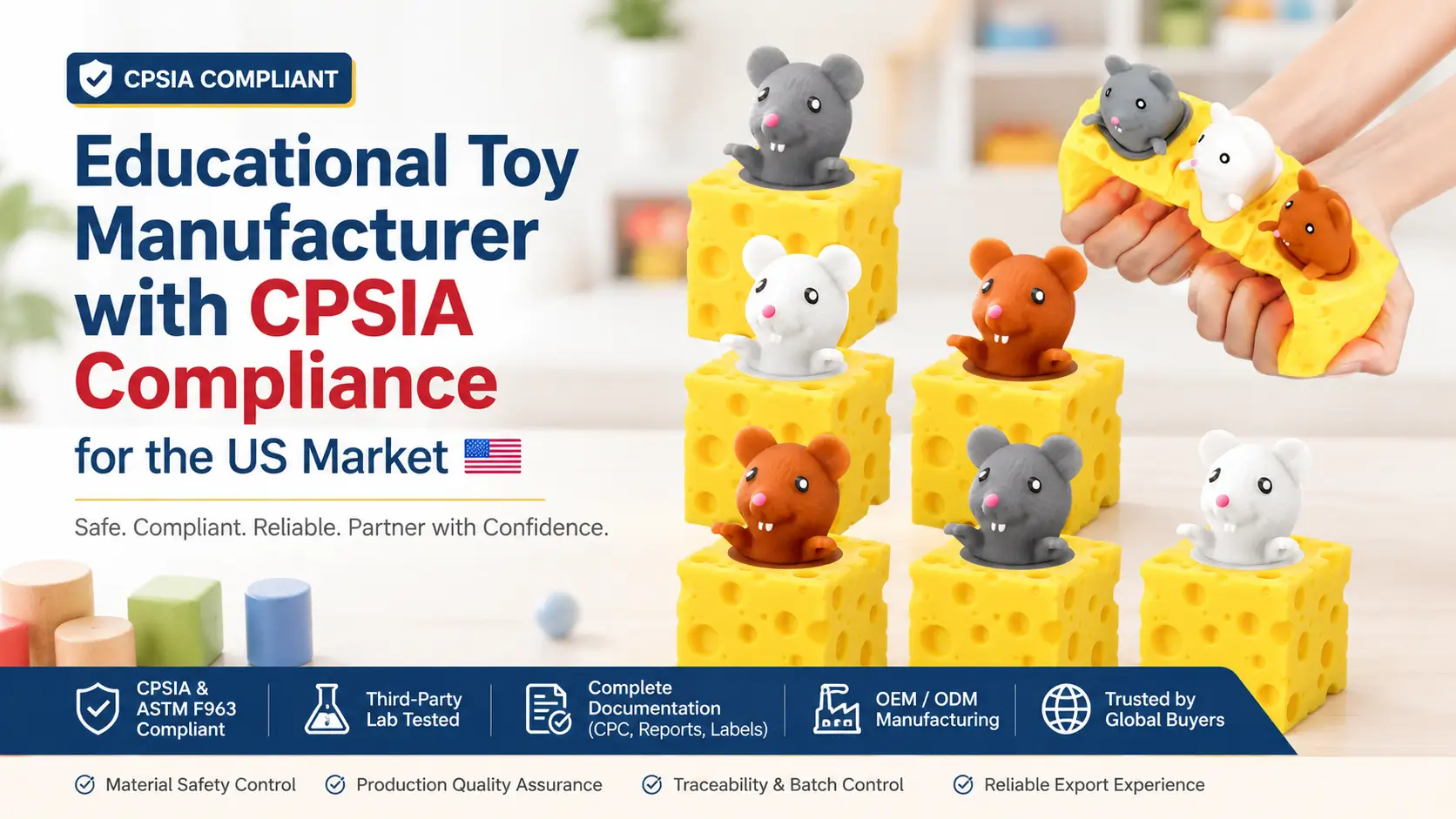
Educational toys come in different types designed to support specific learning goals, age groups, and play environments.
STEM and science toys focus on problem solving, experimentation, and engineering thinking, while puzzles and manipulative toys develop cognitive and fine motor skills.
Language and literacy toys support vocabulary and early reading, while creative, sensory, and pretend play toys encourage imagination, exploration, and social interaction.
Understanding these differences helps brands and product teams select the right educational toy category and translate learning objectives into suitable product design, materials, manufacturing processes, and applications.
How Are Educational Toys Classified?
Educational toys are categorized using a multidimensional framework that separates core educational goals, functional product formats, physical materials, and operational features.
Educational toys should not be classified by a single label. For product development, it is more useful to understand them through several connected dimensions.
Classification by Learning Goal
- Cognitive & problem-solving
- STEM & science
- Language & literacy
- Fine motor & manipulation
- Creative & art
- Sensory & exploration
- Social & pretend play
- Gross motor & physical learning
Classification by Product Category
- Puzzles
- Building and construction toys
- Science and experiment kits
- Art and craft kits
- Manipulative toys
- Sensory toys
- Role-play sets
- Electronic learning toys
- Educational activity kits
Classification by Product Characteristics
- Wooden educational toys
- Plastic educational toys
- Electronic educational toys
- Paper- and card-based toys
- Multi-material educational kits
Clarify an important distinction
- STEM = learning positioning
- Fine motor = learning goal
- Puzzle = product format
- Wooden = material characteristic
A single product can therefore belong to several classifications at the same time.
Educational Toy Classification Quick Reference
| Learning Goal | Typical Product Category | Typical Application | Key Product Requirement |
|---|---|---|---|
| Problem Solving | Puzzles, logic games | Home, classroom | Difficulty progression |
| STEM | Science kits, construction kits | STEM programs, home | Functional accuracy |
| Literacy | Flash cards, alphabet toys | Preschool, classroom | Content accuracy |
| Fine Motor | Lacing, stacking, peg toys | Preschool | Manipulation design |
| Creative | Art and craft kits | Home, classroom | Material performance |
| Sensory | Water and tactile toys | Preschool, sensory play | Material consistency |
| Social Learning | Pretend-play sets | Home, classroom | Accessory structure |
| Physical Learning | Balance and movement toys | Indoor, outdoor | Structural stability |
Main Types of Educational Toys and Their Learning Goals
Each educational toy category addresses specific developmental goals while requiring distinct engineering parameters, manufacturing standards, and structural designs.
Different educational toy types require different play mechanisms, structures, materials, and manufacturing approaches.
Cognitive & Problem-Solving Toys
Typical products Jigsaw puzzles, matching games, sorting toys, logic games, mazes, pattern games.
Primary learning goals Logical thinking, memory, pattern recognition, sequencing, spatial reasoning.
Product development focus Difficulty progression, piece dimensions, visual differentiation, repeated-use durability.
The difficulty should come primarily from the learning task rather than unnecessarily complicated product operation.
STEM & Science Toys
Typical products Science experiment kits, engineering kits, construction toys, coding toys, robotics toys, mechanical learning kits.
Primary learning goals Scientific exploration, engineering thinking, mathematics, experimentation, problem-solving.
Product development focus Functional consistency, component count, assembly sequence, instruction clarity, consumable control, packaging organization.
STEM kits often have a more complex BOM and assembly structure than single-component educational toys.
Language & Literacy Toys
Typical products Alphabet toys, flash cards, word games, story sequencing cards, magnetic letters, educational boards.
Primary learning goals Vocabulary, letter recognition, phonics, reading preparation, storytelling.
Product development focus Content accuracy, printing consistency, font readability, image-word matching, localization, multilingual versions.
For these products, educational content itself becomes part of the product specification.
Fine Motor & Manipulative Toys
Typical products Lacing toys, peg boards, stacking toys, connecting blocks, threading toys, busy boards.
Primary learning goals Hand-eye coordination, grasping, threading, pinching, turning, connecting.
Product development focus Grip dimensions, component size, connection force, dimensional tolerance, edge treatment, repeated-assembly durability.
Creative, Art & Sensory Toys
Typical products Drawing kits, painting kits, craft kits, DIY activity kits, Magic Water Elf Kits, sensory balls, water play toys, texture toys.
Primary learning goals Creativity, fine motor development, color recognition, sensory exploration, cause-and-effect learning.
Product development focus Pigments, inks, adhesives, liquids, gels, leakage resistance, material consistency, packaging protection.
Pretend Play & Physical Learning Toys
Typical products Kitchen sets, doctor play sets, tool sets, shopping sets, balance toys, movement games.
Primary learning goals Communication, imagination, social interaction, coordination, balance, spatial awareness.
Product development focus Accessory count, small-component management, missing-part control, structural strength, stability, repeated-use durability.
How Age and Application Affect Educational Toy Design?
Product architectures must dynamically adapt to both the developmental capabilities of target age groups and the physical requirements of intended use environments.
Selecting a product category is not enough. The same learning concept may require a different product structure depending on the target age and where the toy will be used.
Educational Toys by Age Stage
1.Early Years
Product characteristics generally emphasize simple interaction, larger components, fewer operating steps, and immediate cause-and-effect feedback.
2.Preschool
Common learning activities include matching, sorting, stacking, manipulation, fine motor activities, and early literacy.
3.School Age
Products can introduce multi-step activities, STEM experiments, construction, logic challenges, literacy activities, and more complex instructions.
4.Older Children
Products may involve engineering, strategy, scientific experiments, more complex construction, and longer activity sequences.
Age grading should influence product complexity, component dimensions, instructions, warnings, and applicable safety requirements—not simply the number printed on the packaging.
Educational Toys by Application
| Application | Typical Product Requirement | Project Focus |
|---|---|---|
| Home Learning | Easy setup and storage | Usability and packaging |
| Preschool | Frequent handling | Durability and cleaning |
| Classroom | Multiple users | Component management |
| STEM Programs | Multi-step activities | Function and instructions |
| Montessori-Style Activities | Simple manipulation | Product clarity |
| Retail Toy Lines | Consumer-ready format | Packaging and SKU positioning |
The product team should therefore define three variables together:
Learning Goal ↓ Target Age ↓ Application Environment
Complete this step before finalizing the product architecture.
How Educational Toy Type Affects Design, Manufacturing and Compliance?
Translating learning goals into physical products requires systematically aligning material selection, manufacturing controls, and compliance protocols across varying levels of product complexity.
Learning objectives eventually need to be translated into measurable product specifications.
From Learning Goal to Product Requirement
| Learning Goal | Key Product Requirement |
|---|---|
| Fine Motor | Grip size and manipulation resistance |
| Problem Solving | Difficulty progression |
| STEM | Functional accuracy |
| Literacy | Content and printing accuracy |
| Sensory | Material and texture consistency |
| Creative | Consumable material performance |
| Pretend Play | Accessory configuration |
| Physical Learning | Strength and stability |
Simple Educational Toys
Examples Wooden puzzles, plastic sorting toys, flash cards.
Typical manufacturing characteristics Fewer components, simpler BOM, limited assembly, fewer QC checkpoints, simpler packaging.
Multi-Component Educational Kits
Examples STEM kits, science kits, art kits, Magic Water Elf Kits.
A single kit may contain plastic, paper, liquid, metal, consumables, and accessories.
This increases requirements for BOM management, incoming material inspection, component consistency, assembly control, missing-part inspection, packaging organization, and batch consistency.
Electronic Educational Toys
Additional considerations may include PCB, battery compartments, speakers, wiring, electronic assembly, and functional testing.
Safety and Compliance Considerations
Compliance requirements should follow the actual product rather than simply the label educational toy.
The project team should evaluate factors such as:
- Target age
- Small components
- Mechanical structure
- Sharp edges and points
- Paint and coatings
- Inks and pigments
- Liquids and gels
- Magnets
- Battery accessibility
- Electronic components
- Intended market
For example, applicable requirements for the U.S. market may involve ASTM F963 and other children’s product requirements, while EU projects need to evaluate the applicable EU toy safety framework.
The correct sequence should therefore be:
Learning Goal ↓ Product Structure ↓ Materials ↓ Product Features ↓ Age Grading ↓ Destination Market ↓ Applicable Testing
Project teams should follow this sequence rather than waiting until the finished product is ready before considering compliance.
From Learning Goals to Mass Production: Jaredrise Educational Toy Development Support
Jaredrise bridges the gap between educational concepts and commercial manufacturing by providing end-to-end engineering, prototyping, quality control, and production scaling support.
Identifying the educational toy category is only the beginning. The learning concept must eventually be translated into materials, dimensions, components, manufacturing processes, testing requirements, packaging specifications, and a production-ready BOM.
For OEM and ODM educational toy projects, Jaredrise can support this transition through:
- Product feasibility review
- Learning concept and play mechanism evaluation
- Product structure development
- Material selection
- Component configuration
- Prototype development
- Manufacturing feasibility review
- Compliance preparation
- Packaging development
- Pilot production
- Mass production
A practical educational toy development path can follow:
Learning Goal ↓ Target Age & Application ↓ Product Category ↓ Play Mechanism ↓ Material & Product Structure ↓ Prototype ↓ Testing Preparation ↓ Pilot Production ↓ Mass Production
The objective is not simply to manufacture an existing idea, but to translate the educational concept into a product structure that can be produced consistently, tested appropriately, packaged efficiently, and scaled for commercial production.
Conclusion: The Right Educational Toy Type Starts With the Product Goal
Successful educational product development requires prioritizing learning goals and user interaction over category labels to ensure seamless alignment across design, manufacturing, and compliance.
There is no single best type of educational toy. The right category depends on the learning objective, target age, play mechanism, application environment, product architecture, manufacturing complexity, and destination-market requirements.
Instead of starting with labels such as STEM, Montessori, wooden, or sensory, product teams should first define what children are expected to learn and how they will interact with the product.
These requirements can then be translated into product categories, materials, component structures, manufacturing processes, and compliance planning.
Making these decisions before tooling and mass production creates a clearer path from an educational concept to a manufacturable and scalable product.