
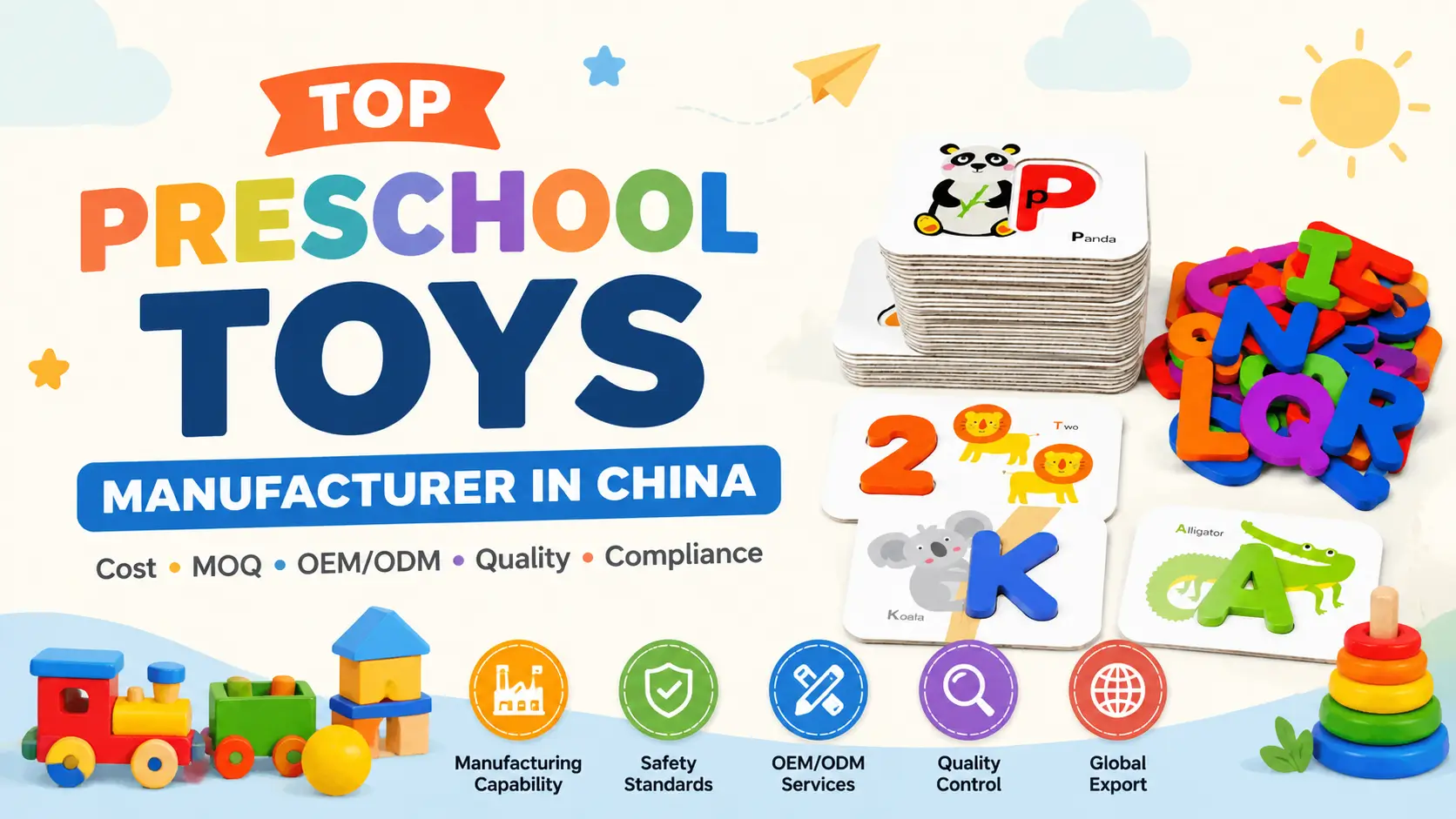
China is one of the world’s largest preschool toy manufacturing hubs, offering OEM and ODM solutions for brands, distributors, retailers, and educational suppliers.
The typical wholesale manufacturing cost for preschool toys ranges from $0.50–$20+ per unit, depending on materials, design complexity, certification requirements, and order volume.
A reliable Chinese preschool toy manufacturer should be evaluated through five key factors: manufacturing capability, safety certifications, MOQ flexibility, customization ability, and quality control systems.
Production costs are mainly affected by material selection, tooling requirements, packaging design, testing standards, and annual order quantity.
Buyers should compare factories based on compliance, production experience, and long-term supply reliability rather than price alone.
Quick Answer What Makes a Reliable Preschool Toy Manufacturer in China?
Preschool toy production costs from Chinese factories range from $0.50 to $20+ per unit, depending on product type and customization level.
Standard wholesale models fall at the lower end of the range, while fully custom designs with new mold development sit at the higher end.
Minimum order quantities typically start from 500 units and go up to 5000 units or more for large-scale orders.
Core factors to judge manufacturer reliability include factory production capability, valid product safety certifications, OEM customization support, systematic production quality control, and proven export experience to target markets.
Top Preschool Toy Manufacturer in China Overview
China dominates the global preschool toy manufacturing industry with unparalleled industrial advantages that support full-cycle toy production for early childhood education.
The country boasts complete upstream and downstream supply chains covering eco-friendly raw material sourcing, precision processing, professional safety testing and global export logistics.
Massive standardized production bases and mature industrial clusters enable high-efficiency manufacturing, flexible production scaling and cost-effective mass output, making Chinese factories the top choice for global preschool toy procurement.
Global educational brands, retail distributors and cross-border sellers prefer Chinese preschool toy manufacturers for multiple core reasons.
Beyond cost advantages, most local factories own independent OEM and ODM capabilities to support personalized product development.
They accumulate rich long-term export experience, familiar with market rules and compliance standards of North America, Europe, Southeast Asia and other mainstream regions.
Meanwhile, qualified manufacturers adhere to strict safety compliance systems and stable production capacity, ensuring consistent product quality and on-time delivery for global orders.
As a professional top preschool toy manufacturer in China, Jaredrise focuses exclusively on the research, development and production of high-safety educational preschool toys.
The brand positions itself as a one-stop custom manufacturing partner for global mid-to-high-end educational toy brands.
It integrates independent custom development, strict safety compliance control, scalable production capacity and mature global export services, covering full-service support from ordinary OEM logo customization to full ODM original product creation, perfectly matching the diversified procurement needs of global preschool toy buyers.
Featured Preschool Toy Manufacturer in China: Jaredrise
Company Overview
Jaredrise is a professional manufacturing enterprise dedicated solely to preschool toy production, focusing on safe, educational and age-appropriate toy products for early childhood scenarios.
With years of specialized manufacturing experience in the preschool toy industry, the factory has accumulated mature production techniques and standardized operation systems tailored to early childhood product characteristics.
It serves a wide range of global customers including international educational institutions, private label brand sellers, offline retail distributors and cross-border e-commerce merchants, covering dozens of countries and regions across the world.
Long-term focus on preschool toy manufacturing enables the brand to deeply grasp global market demands and child safety production standards.
Manufacturing Capabilities
Jaredrise owns comprehensive and scalable manufacturing capabilities to meet diverse buyer customization and bulk procurement demands.
In terms of product categories, it covers wooden Montessori toys, plastic educational toys, puzzle building toys, early childhood interactive teaching aids and other mainstream preschool toy series.
The factory provides full-featured OEM services including brand logo printing, product color adjustment and component combination optimization based on existing mature product designs.
Its professional ODM development team supports full-process original product creation from market demand research, structural design and functional development to prototype testing and mass production.
Beyond core product manufacturing, the brand offers one-stop auxiliary customization services. It supports personalized custom packaging including exclusive color boxes, brand cartons and instruction manual design to help buyers build independent brand images.
In addition, Jaredrise provides professional mold development services, capable of designing and opening exclusive new molds according to buyer product demands, realizing highly customized exclusive preschool toy products for premium market positioning.
Why Choose Jaredrise as a Preschool Toy Manufacturing Partner?
Jaredrise stands out among numerous Chinese preschool toy manufacturers with core advantages that effectively solve global buyers’ key procurement concerns.
The brand implements strict full-process quality control, conducting multi-link inspections from raw material incoming to finished product shipment to eliminate unqualified products and ensure stable and reliable product quality.
It provides comprehensive compliance support, helping products complete all mandatory safety certifications for US and European markets to avoid customs clearance failures and market sales risks.
In terms of order cooperation flexibility, Jaredrise offers flexible MOQ solutions to accommodate buyers at different development stages, supporting small-batch trial orders for startup brands and large-batch bulk orders for mature distributors.
Meanwhile, the factory has mature international shipping support experience, cooperating with stable global logistics channels to provide safe, efficient and traceable delivery services, effectively avoiding delivery delays and logistics losses, and creating stable and worry-free long-term cooperative relationships for global buyers.
Preschool Toy Manufacturing Cost Breakdown and Pricing Structure from Chinese Manufacturers
Preschool toys manufactured in China cost between $0.50 and $20+ per unit, with standard designs at lower price points and custom projects at higher ranges. The final price depends on material choice, customization level, order volume and production complexity.
Standard Preschool Toys Cost Range $0.50 to $5 Per Unit
Standard off-the-shelf preschool toys carry lower unit prices because they use existing molds and mature production workflows.
Material costs stay stable as factories purchase raw materials in bulk for repeated production runs. Labor efficiency improves with long-term production of the same models, reducing per-unit labor input. Simple standard packaging further keeps overall costs under control.
This price range fits wholesale distributors, educational suppliers and retail buyers who need stable supply of proven products.
This option works best when buyers select existing product designs, place large quantity orders, or target price-sensitive regional markets.
Custom Preschool Toys Cost Range $5 to $20+ Per Unit
Custom preschool toys have higher price points as they require extra input in design adjustment and production preparation.
The cost follows a tiered model based on customization depth. Logo customization adds 5 to 10 percent to the base unit price, as it only involves simple printing processes.
Custom packaging design and production add 10 to 20 percent, with costs varying by material and printing complexity.
Product modification such as shape adjustment or function change adds 20 to 50 percent, as it requires partial adjustment of production lines.
New mold development for fully original designs costs from $500 to $10,000 or more, depending on product size and structure complexity.
This range suits private label brands, educational toy companies and businesses building premium product lines.
Preschool Toy MOQ Structure 500 / 1,000 / 5,000 Units
Chinese preschool toy factories set different MOQ tiers to match buyer scales and production arrangements.
Orders of 500 to 1000 units suit startup brands testing new markets or product lines. Orders of 1000 to 5000 units fit growing educational brands with steady sales demand.
Orders of 5000 units or more work for large retail chains and distributors with high turnover rates. MOQ levels directly affect three key aspects of cooperation.
Higher order volumes usually bring lower unit prices through economies of scale.
They also unlock more customization options and improve production scheduling efficiency, as factories can arrange dedicated production lines for larger runs.
Key Factors Affecting Preschool Toy Manufacturing Costs
Total preschool toy manufacturing cost combines multiple core components. The basic calculation formula includes material input, labor cost, tooling expense, testing fee and packaging cost.
Material makes up the largest share of total cost, and different base materials lead to obvious price gaps.
Wooden preschool toys usually have higher material costs compared with plastic educational toys.
Montessori toy production often involves more precise processing and smaller batch sizes, which push up per-unit labor and tooling costs.
Product complexity and testing requirements for different target markets also influence final cost levels.
Manufacturing Capability and Ways to Evaluate a Chinese Preschool Toy Factory
Evaluating a Chinese preschool toy factory requires checking production experience, capacity, process management and export track record, rather than relying only on quoted prices.
Factories with mature systems can deliver consistent quality and reduce supply risks for buyers.
Factory Experience and Production Capacity Determine Reliability
Buyers should verify multiple capability indicators before confirming cooperation. Years of manufacturing experience reflect a factory’s ability to handle various production challenges and market changes.
Number of dedicated production lines shows maximum output capacity and ability to fulfill large orders on time.
Export market coverage indicates familiarity with different regional compliance rules and buyer demands. Product category range shows whether the factory specializes in preschool toys or produces mixed product types.
At Jaredrise manufacturing facility, production planning focuses on consistent quality, scalable production, and international buyer requirements.
Preschool Toy Manufacturing Process From Design to Shipment
A complete standardized manufacturing process reduces procurement risks at every stage of cooperation.
The workflow starts with product concept confirmation, which aligns factory capability with buyer expectations early to avoid later rework.
Next comes prototype development, which turns design ideas into tangible samples for functional and appearance check.
Sample approval serves as a formal benchmark for mass production, ensuring both sides share the same quality standard.
Mass production follows the approved sample with consistent process control. Pre-shipment quality inspection filters out unqualified products before delivery.
Final export shipment handling ensures goods reach destination ports with proper documentation and packaging.
Choosing the Right Factory Model Type A, B and C Buyers
Different buyer types have distinct cooperation needs, and matching the right factory model leads to smoother partnerships.
Type A buyers refer to small brands and new market entrants. They prioritize low MOQ options and ready-made existing products to test market response with lower upfront investment.
Type B buyers are growing educational brands with established customer bases.
They need OEM support and packaging customization to build brand recognition and differentiate products from competitors.
Type C buyers are large distributors and retail chains. They focus on stable long-term supply and large production capacity to support continuous sales across multiple channels.
Factory Evaluation Checklist Before Cooperation
A clear evaluation checklist helps buyers systematically assess potential manufacturers before signing cooperation agreements.
First, confirm production capability matches expected order volume and product complexity.
Second, check whether the factory runs a formal quality management system covering all production stages.
Third, verify certification support for target markets to avoid import compliance issues.
Fourth, understand the sample process including cost, lead time and revision policies.
Fifth, review export experience and past cooperation cases in the buyer’s region.
These five points cover core risks and help filter out unsuitable suppliers efficiently.
MOQ and Pricing Explanation Calculation Logic of Chinese Toy Factories
Chinese toy factories set MOQ and pricing based on raw material procurement, production scheduling and scale effects. Understanding this logic helps buyers negotiate better terms and avoid unnecessary cost waste.
Why Preschool Toy Factories Set Different MOQ Levels?
MOQ requirements are not arbitrary limits set by factories. They come from practical constraints in production operation. Raw material purchasing has minimum batch requirements from upstream suppliers, so factories need certain order volumes to match material procurement rules.
Mold usage and maintenance costs need to be spread across enough units to keep per-unit tooling cost reasonable.
Labor scheduling efficiency drops when production lines switch between different small-batch products frequently. Custom packaging also has minimum print runs from packaging suppliers, which adds to overall MOQ requirements.
Low Price vs Real Manufacturing Cost What Buyers Should Compare
The lowest quoted price does not always equal the lowest total procurement cost for buyers.
Total procurement cost combines four core components that affect final expense. The base product price makes up the main part of total cost.
Testing and certification fees add extra expense, especially for products entering strictly regulated markets.
Potential quality risks bring hidden costs such as return, rework or loss of brand reputation. Shipping and logistics costs also vary based on packaging design and delivery terms.
Some factories cut corners on material or quality control to offer lower initial quotes, but buyers end up paying more to fix subsequent problems.
Comparing total cost instead of just unit price leads to more rational sourcing decisions.
How Buyers Reduce Costs Without Sacrificing Quality?
Buyers can take practical steps to lower manufacturing costs without compromising product quality and safety.
Choosing existing product molds avoids high one-time tooling fees and reduces production preparation time. Optimizing packaging design cuts both material and shipping costs, while still maintaining proper product protection during transit.
Gradually increasing order volume over time helps buyers negotiate lower unit prices as order scales grow.
Buyers can also consolidate multiple product SKUs into one production run to improve production efficiency and reduce overall management costs. These methods balance cost control with product quality and long-term cooperation stability.
Compliance and Quality Assurance Safety Standards for Preschool Toys from China
Safety compliance is the top risk for preschool toy imports, and Chinese factories with strict quality systems help buyers avoid product recalls and customs detention.
Required Toy Safety Certifications for US and European Markets
Preschool toys entering major global markets must meet corresponding safety certification requirements.
For the United States market, products need to pass ASTM F963 toy safety standards and comply with CPSIA regulations for heavy metal and phthalate limits. A valid CPC certificate is also required for customs clearance and market sales.
For European markets, EN71 standard covers physical mechanical properties, flammability and chemical migration, and CE marking is mandatory for legal market access.
The international ISO 8124 standard provides a universal safety framework recognized by multiple regions.
These certifications verify product safety for young children and protect buyers from legal risks, product recalls and customs clearance failures.
How Chinese Toy Factories Control Product Quality?
Reliable Chinese toy factories implement multi-stage quality control throughout the entire production process.
The first stage is incoming material inspection, which checks raw material quality and safety indicators before production starts. This step prevents unqualified materials from entering production lines and causing later quality problems.
The second stage is in-production inspection, which monitors processing parameters and semi-finished product quality at each production link.
The third stage is assembly check, which verifies product structure stability and assembly accuracy after all components are put together.
The fourth stage is final pre-shipment inspection, which conducts full checks on appearance, function and packaging according to agreed quality standards.
Common Preschool Toy Import Risks and Prevention Methods
Preschool toy import involves several common risks that buyers can prevent with targeted measures.
| Risk | Solution |
|---|---|
| Certification failure | Pre-production sample testing with authorized labs |
| Quality inconsistency | Periodic on-site factory inspection during production |
| Delivery delay | Detailed production planning with milestone confirmation |
Addressing these risks early in cooperation avoids major losses. Pre-testing samples before mass production confirms certification eligibility and prevents later rework.
Regular factory inspections keep production quality consistent with approved samples. Clear production schedules with confirmed milestones help track progress and adjust arrangements in time to avoid delivery delays.
OEM and ODM Preschool Toy Manufacturing Custom Solutions for Global Brands
Custom manufacturing solutions help global brands build unique product lines and strengthen market competitiveness. Chinese factories offer flexible OEM and ODM options to match different brand development stages.
OEM Preschool Toys for Private Label Brands
OEM manufacturing serves private label brands that want to add brand identity to proven existing products. Available customization options include logo printing on product surfaces and packaging. Buyers can also adjust product colors to match brand visual systems.
Product combination adjustment allows brands to create unique product sets according to their market positioning.
This model works well for Amazon sellers building their own store brands, retail chains launching exclusive product lines, and educational companies developing supporting teaching toy sets. OEM projects have shorter lead times and lower upfront costs compared with fully original development.
ODM Preschool Toy Development From Concept to Production
ODM manufacturing supports brands to develop fully original preschool toy products from initial ideas. The development process starts with market research to confirm user needs, competitive landscape and applicable safety standards.
Next comes product design, which turns concept ideas into detailed design drafts with structural and material specifications.
Prototype production creates physical samples for functional test and appearance adjustment.
After prototype confirmation, official safety testing verifies compliance with target market requirements. Once all tests pass, the project moves to formal mass production with standardized process control.
The full ODM cycle takes longer but delivers products with exclusive market competitiveness.
How to Choose Between OEM and ODM?
Choosing between OEM and ODM depends on brand development goals, available budget and launch timeline. OEM is the better option when buyers find existing products that match their functional needs. It also fits situations that require fast product launch, as it skips long design and mold development stages. ODM works better when brands want fully unique products that do not exist on the market. It also suits brands aiming for strong product differentiation to stand out from competing products in crowded market segments. Buyers can start with OEM to test markets and move to ODM as brand scale grows.
Jaredrise Manufacturing Experience in Custom Preschool Toys
Based on production data from Jaredrise, successful custom toy projects usually start by matching product complexity, target market requirements, certification needs, and expected order volume. Aligning these four elements at the initial consultation stage avoids later adjustment costs and shortens overall project cycles. Factories with rich custom project experience can provide professional suggestions on material choice, structure optimization and cost control, helping brands balance product innovation with practical manufacturing feasibility.
How to Start Working With a Chinese Preschool Toy Manufacturer?
Starting cooperation with a Chinese preschool toy manufacturer begins with clear information exchange between both sides. Buyers can prepare basic project details first to get accurate feedback. These details include specific product category of interest, target sales market, expected order quantity and necessary certification requirements for market entry. With these details, the factory can conduct a comprehensive assessment of the project. The assessment covers production feasibility of the product, applicable minimum order quantity, estimated unit cost and overall production timeline. Clear initial communication avoids misunderstanding and lays a solid foundation for subsequent sample development and formal cooperation. Buyers looking for tailored manufacturing solutions can request a preschool toy manufacturing consultation to discuss specific project needs with professional production teams.