
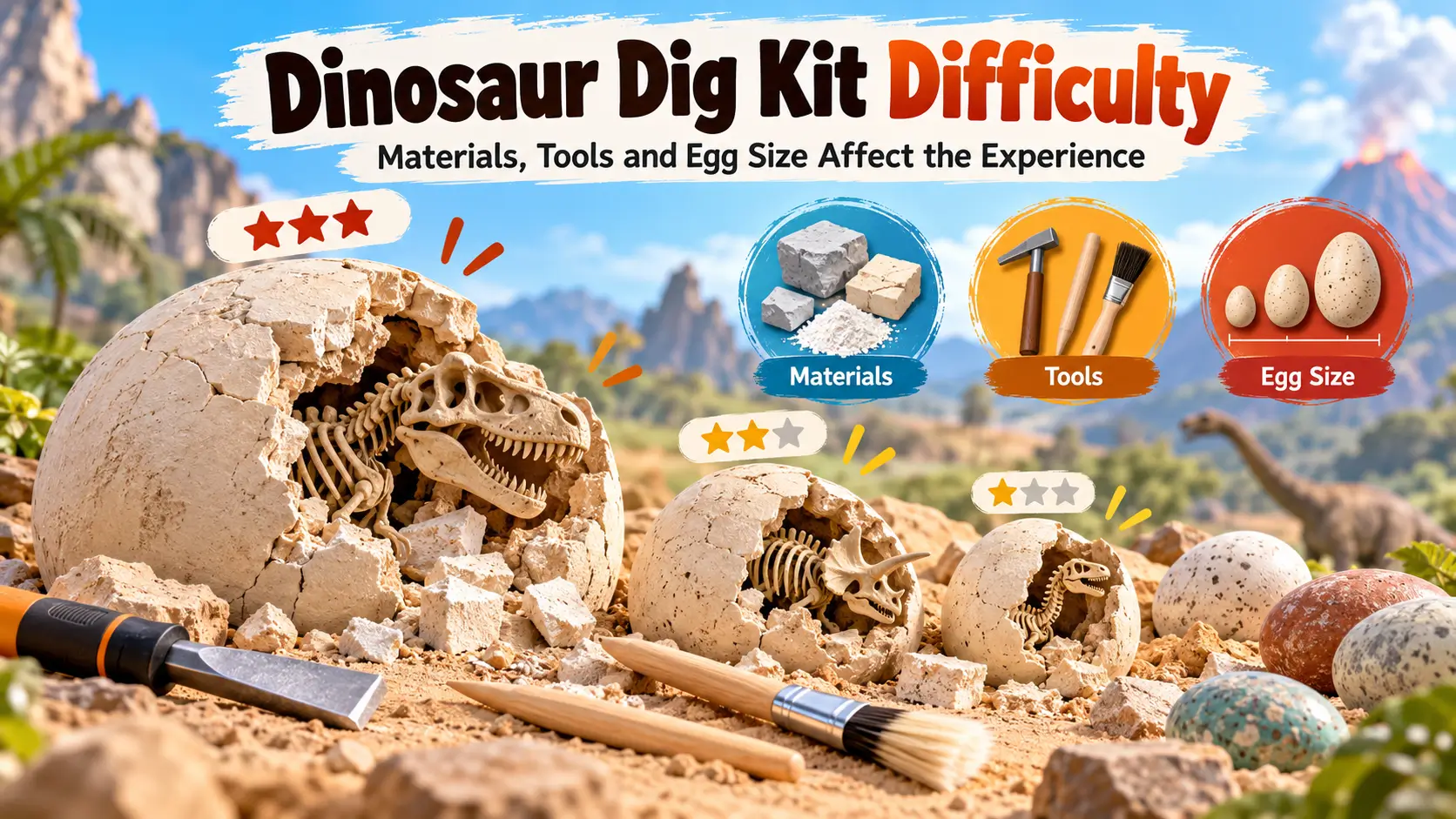
Dinosaur dig kit difficulty is determined by more than the size or hardness of the excavation egg. Material resistance, digging tool design, egg dimensions, hidden dinosaur placement, and preparation methods all influence how much effort is required to uncover the model. These factors also affect excavation time, user control, and the overall activity experience.
A larger dinosaur egg does not automatically create a more difficult excavation. A smaller egg made from a resistant material may require more effort than a larger egg that breaks apart easily. Similarly, an efficient digging tool can make a relatively firm excavation block easier to work with, while a poorly matched tool may make a softer material unnecessarily frustrating.
For educational toy brands and product developers, the important question is not simply whether a dinosaur dig kit is easy or hard. It is whether the excavation difficulty matches the intended age group, activity duration, and learning experience.
The most reliable approach is to define the desired excavation experience first, evaluate the materials, tools, and egg structure together, and then confirm the configuration through representative sample testing.
What Makes a Dinosaur Excavation Kit Easy or Difficult?
Excavation difficulty describes the effort, time, and control required to remove material and uncover the hidden dinosaur model. It is influenced by several interacting factors rather than one physical specification.
A suitable difficulty level allows the intended user to make visible progress while maintaining enough resistance to create a meaningful discovery experience. If excavation requires excessive force or takes much longer than expected, the activity may become frustrating. If the material breaks apart immediately, the discovery process may end before the intended activity objective is achieved.
Why Excavation Difficulty Depends on More Than Egg Size?
Egg size is an obvious product characteristic, but it does not directly indicate how difficult excavation will be.
The amount of material surrounding the dinosaur model matters more than the external dimensions alone. A relatively large egg with a substantial internal cavity or shallow model placement may require less material removal than a smaller, densely filled excavation block.
Material behavior creates another difference. Two eggs with similar dimensions may respond differently when struck or scraped with the same tool. One may gradually release small fragments, while another may resist the tool before breaking into larger pieces.
The hidden model also affects the excavation path. A model positioned near the surface may become visible quickly, while one surrounded by a thicker material layer may require more extensive digging.
Consequently, external egg dimensions should be evaluated alongside material resistance, internal structure, and model placement before estimating excavation difficulty.
The Main Factors That Influence Digging Effort and Activity Time
Five variables provide a practical starting point for evaluating dinosaur excavation difficulty.
| Factor | Effect on Excavation | What to Evaluate |
|---|---|---|
| Material resistance | Changes the force needed to remove material | Resistance and breakage behavior |
| Tool design | Affects material removal efficiency and control | Tool shape, grip, and usability |
| Egg structure | Determines how much material must be removed | Dimensions and excavation depth |
| Hidden model placement | Influences access and excavation direction | Position and surrounding material |
| User conditions | Affects progress, assistance, and completion | Intended age, ability, and supervision |
These factors are interconnected. Increasing material resistance may extend excavation time, but the result can change if the tool is also modified. Similarly, increasing egg size may not extend the activity significantly if the hidden model remains close to the surface.
It is therefore useful to distinguish physical resistance from overall activity difficulty. Physical resistance describes how the material responds to a tool. Activity difficulty also includes the precision, persistence, coordination, and assistance needed to complete the excavation.
For product development, these characteristics should be considered together instead of treating egg hardness as a complete difficulty specification.
How Do Excavation Materials Affect the Digging Experience?
Excavation material is one of the most important factors influencing dinosaur dig kit difficulty because it determines how the egg responds when children scrape, chip, or break away the surrounding material.
However, identifying the material by name is not enough to predict the experience. Composition, density, moisture condition, manufacturing consistency, and breakage behavior can all affect excavation performance.
How Material Composition and Resistance Affect Excavation?
Many dinosaur excavation kits use plaster-based materials to create a solid block around the hidden model. The excavation experience depends on the actual formulation and condition of that block rather than the material category alone.
Different formulations may produce different levels of resistance, even when the finished eggs have similar appearances. Mixing conditions, compaction, curing, and drying may also influence how the block responds to digging tools.
A material that offers relatively low resistance may allow users to remove material with less force. This can be useful when the intended activity emphasizes accessibility or a shorter discovery process.
A more resistant material may require repeated scraping or chipping. Under suitable conditions, this can create a longer excavation process, but excessive resistance can make progress difficult or encourage users to apply more force than intended.
Material hardness and excavation resistance should not be treated as identical measurements. Resistance during digging depends on how the material fractures and separates under the supplied tool. A laboratory hardness measurement alone may not predict the actual experience.
For this reason, toy developers should evaluate the material using the intended excavation tools instead of relying exclusively on material descriptions or isolated mechanical measurements.
How Crumbling, Cracking and Dust Affect User Experience?
The way excavation material breaks apart can influence both difficulty and usability.
Some materials gradually crumble into small particles when scraped. This can provide controlled excavation progress, allowing users to expose the hidden model a little at a time.
Other formulations may fracture into larger pieces. Depending on the material and egg structure, larger pieces may reduce the amount of repeated scraping required. However, unpredictable cracking can also make it difficult to control material removal near delicate model features.
Fine particles introduce another consideration. Excavation activities may generate dust or loose debris, so product developers should evaluate particle generation, instructions, preparation requirements, and cleanup conditions.
Material that crumbles easily is not automatically better. Excessive fragmentation may shorten the intended activity or cause the excavation block to lose structural integrity prematurely.
Likewise, a material that maintains its shape is not necessarily suitable if users cannot remove it effectively with the supplied tools.
The preferred breakage behavior depends on the intended balance between gradual discovery, manageable effort, structural stability, and cleanliness.
Can Preparation Methods Change Digging Difficulty?
Preparation methods can influence the excavation experience, but the effect depends on the material and the product instructions.
Some excavation products instruct users to soak the block before digging. When specifically designed for this preparation method, moisture may change the material response and affect the effort required for excavation.
However, not every dinosaur dig kit is intended to be soaked. Applying water to an unsuitable formulation may alter its integrity, create excessive loose material, or produce an experience different from the approved product design.
Manufacturers should therefore evaluate preparation conditions as part of the product configuration.
If an excavation kit is intended for dry use, testing should reflect that method. If soaking is permitted or required, the amount of water, preparation duration, and resulting material behavior should be evaluated under controlled conditions.
Instructions should reflect the validated preparation method rather than copying procedures from other excavation products.
The key decision is to select a material and preparation method that produce the intended digging resistance consistently during normal use.
How Do Egg Size, Tool Design and Hidden Model Placement Influence Excavation?
Egg dimensions, tool geometry, and internal model placement determine how excavation work is performed. These factors should be evaluated together because changing one can affect the performance of the others.
For example, increasing egg dimensions may introduce more material around the dinosaur model, but the additional material will only increase the excavation workload if users need to remove it to complete the activity.
Why Egg Dimensions Do Not Directly Determine Excavation Time?
A larger egg usually creates a different physical product format, but external dimensions alone cannot establish how long excavation will take.
Three measurements are particularly relevant. The overall dimensions describe the external egg size. The material thickness describes the distance between the outer surface and the hidden model. The required excavation volume describes how much material must be removed to uncover or retrieve that model.
These measurements are related but not interchangeable.
Consider two hypothetical excavation blocks. One is relatively large but contains a model positioned near the outer surface. The other is smaller but contains a model surrounded by a thicker layer of resistant material.
The smaller block could require more effort even though its external dimensions are reduced. Actual results would depend on material behavior, the intended excavation method, and the tools provided.
Egg weight may offer useful information about material quantity, but it cannot independently predict excavation difficulty because material density and internal geometry also matter.
When comparing different egg sizes, product developers should request actual dimensions, weight, material information, and model placement details. These specifications provide a more reliable foundation for evaluating potential excavation workload.
How Chisels, Digging Sticks and Brushes Affect the Process?
Digging tools influence how efficiently users remove material and how precisely they can work around the hidden model.
A digging stick or chisel may be used to loosen or separate excavation material. A brush generally supports the later stages of excavation by clearing loose particles and exposing details that have already become accessible.
The effectiveness of these tools depends on their geometry, dimensions, material, and compatibility with the excavation block.
A tool with a suitable working edge may remove material efficiently without requiring excessive pressure. A wider contact area may distribute force differently, while a narrower working area may provide access to confined sections around the model.
These relationships should be tested rather than assumed. A tool that removes material efficiently may not provide sufficient control near fragile model features.
Handle design also matters. Children need to grip and maneuver the tools during repeated movements. A handle that is difficult for the intended users to control may increase fatigue or reduce precision even when the working end is effective.
Tool material and structural strength introduce additional requirements. Tools must withstand the intended excavation activity without unacceptable deformation, breakage, or hazards.
The correct tool configuration is therefore not necessarily the strongest or most aggressive design. It is the combination that provides sufficient material removal, manageable operation, appropriate control, and verified safety for the intended users.
How Hidden Dinosaur Placement Changes the Excavation Path?
The position and shape of the hidden dinosaur model can change the excavation process even when egg dimensions and material composition remain unchanged.
A centrally positioned model may require users to excavate through a substantial surrounding layer before reaching recognizable features. A model located closer to the surface may become visible earlier.
However, the first appearance of the model is not the same as excavation completion.
A dinosaur model with extended limbs, a long tail, or narrow details may require careful removal of material from several directions. The shape and orientation of those features can influence how easily the model can be extracted without damage.
A compact model may require a different excavation path from an elongated model occupying a larger portion of the block.
These structural differences should be considered during product design. If the desired experience emphasizes gradual discovery, model placement can be evaluated alongside surrounding material thickness. If the objective is a more accessible activity, excessive excavation around narrow or delicate features may be undesirable.
Product developers should also distinguish a single hidden dinosaur model from a multi-piece skeleton assembly concept. Excavation and post-excavation assembly are separate activities, and one should not be assumed to be included simply because the product has a dinosaur theme.
Why Material, Tools and Egg Structure Should Be Evaluated Together?
Changing individual specifications without considering their interactions can lead to an unexpected excavation experience.
Suppose a product developer wants to extend the activity duration. Increasing egg size may appear to be the simplest solution. However, if the hidden model remains close to the surface and the material breaks apart easily, the additional dimensions may have little effect on the actual excavation process.
Increasing material resistance could also extend the activity, but that change may require a different tool configuration to preserve manageable operation.
Similarly, switching to a more efficient tool may reduce excavation time without changing the egg itself.
A better development approach is to define the intended experience first and then evaluate which combination of material resistance, excavation workload, tool efficiency, and model placement can achieve it.
The selected combination should subsequently be tested as a complete product rather than assuming that individually acceptable components will always produce an acceptable experience together.
Which Difficulty Level Fits Different Ages and Activity Goals?
The appropriate dinosaur dig kit difficulty depends on the intended users and the purpose of the activity.
An excavation kit designed for a relatively short, guided discovery session may require a different configuration from a kit intended for a longer individual exploration activity. Neither configuration is inherently better. Each serves a different experience objective.
Matching Difficulty to Children’s Abilities and Intended Age Groups
Age suitability involves more than the amount of force needed to excavate an egg.
Children’s ability to grip tools, coordinate repeated movements, follow instructions, maintain attention, and manage frustration can influence whether an excavation activity is appropriate.
The amount of adult supervision or assistance required is another important consideration.
An activity may be physically manageable but still involve instructions or procedures that are difficult for the intended users to follow independently. Conversely, children who understand the activity may struggle with the tool dimensions or required physical effort.
Age recommendations should therefore be supported by an appropriate assessment of the complete product, including its physical characteristics, intended use, and foreseeable behavior.
The U.S. Consumer Product Safety Commission’s Age Determination Guidelines provide a reference for considering product characteristics alongside children’s skills, play behaviors, and interests.
Age suitability and product safety must also be evaluated against the requirements of the intended market.
For example, U.S. toy safety requirements are addressed through CPSC toy safety guidance, while the European Commission provides guidance on EU toy safety.
An easier excavation configuration does not automatically make a product suitable for younger children. Small components, tool characteristics, materials, and other product hazards require separate assessment.
Short Discovery Activities vs Extended Excavation Experiences
The intended activity duration helps determine the suitable excavation workload.
For shorter activities, the product may need to provide visible progress without extensive material removal. This could involve a configuration with manageable resistance, efficient tools, and a relatively accessible model.
Longer exploration activities may benefit from multiple excavation stages or a larger amount of material to remove. However, extending the activity should not simply mean making the material as resistant as possible.
A longer task can become repetitive if users make little visible progress. Product designers should consider whether the digging process provides recognizable stages of discovery and whether the level of required effort remains manageable throughout the activity.
The expected duration also depends on the activity setting. A guided session may include preparation, instructions, excavation, model cleaning, and discussion. The actual digging time is only one part of that overall experience.
For specification decisions, it is useful to define both the desired excavation time and the broader activity objective. The two should not be treated as identical measurements.
How to Choose an Easier, Balanced or More Challenging Configuration?
Difficulty levels can be used as internal product development categories, provided that the categories are defined through actual testing rather than treated as universal industry standards.
The following matrix provides a starting point for evaluating different experience objectives.
| Experience Goal | Possible Configuration Direction | Important Validation |
|---|---|---|
| Easier excavation | Lower resistance and manageable material removal | Ease of progress and completion |
| Balanced excavation | Moderate workload with controlled tool operation | Consistent completion and user control |
| Extended excavation | More excavation steps or greater material workload | Fatigue, frustration, and activity duration |
| Guided discovery | Difficulty suited to the planned assistance level | Supervision needs and participation |
An easier configuration may be suitable when the goal is accessible discovery within a limited activity period. The excavation should still provide enough resistance and progression to create a meaningful activity.
A balanced configuration may be appropriate when the product is intended to offer both exploration and manageable completion. This requires evaluating whether users can maintain steady progress without excessive assistance.
A more challenging configuration may be considered when a longer exploration process is intended. However, additional challenge should result from a controlled and suitable excavation task, not simply from excessive material resistance.
The final selection should reflect demonstrated user performance rather than an arbitrary label such as easy, medium, or hard.
When Should a Product Configuration Be Adjusted?
A configuration should be reviewed when sample testing shows a meaningful difference between the intended experience and actual user performance.
If excavation ends much earlier than the planned activity objective, developers can investigate whether material resistance, excavation workload, or model accessibility should be adjusted.
If users repeatedly struggle to remove material, the first step should be to identify the cause. The problem may involve excessive material resistance, unsuitable tool geometry, difficult model placement, or a combination of these factors.
If the model is frequently damaged during extraction, the appropriate solution may involve changing its location, protective material thickness, or tool design rather than changing the overall egg dimensions.
The important principle is to correct the variable responsible for the problem.
Adjusting several specifications simultaneously may make it difficult to determine which modification improved or worsened the excavation experience.
How Can Excavation Difficulty Be Evaluated in Practice?
Representative sample testing is the most reliable way to determine whether a dinosaur dig kit provides the intended difficulty level.
Product specifications can describe likely influences, but they cannot fully predict how users will interact with an excavation block. Testing is necessary to evaluate actual digging effort, completion time, control, and consistency.
How to Compare Excavation Samples Under Consistent Conditions?
A useful comparison begins with a clear testing objective.
If the goal is to evaluate material resistance, the samples should use comparable egg dimensions, model placement, and tools wherever possible. This helps isolate differences associated with the material.
If the goal is to evaluate tool performance, the excavation material and block structure should remain consistent while the tool configuration changes.
When comparing egg sizes, developers should record the differences in material quantity and model placement rather than assuming that the larger product contains proportionally more material to remove.
Preparation conditions also need to be controlled. Samples should be tested according to their intended instructions, including any validated preparation method.
Because individual users work at different speeds, one completed excavation should not be treated as representative of an entire target audience. Repeated observations with suitable participants provide more useful information about variability.
Testing should reflect the intended age group, appropriate supervision, and applicable safety requirements. Product development evaluations should not expose participants to unassessed hazards.
The purpose is not to establish a universal excavation time for all dinosaur dig kits. It is to determine whether a particular configuration performs consistently under defined conditions.
What Should Be Measured During an Excavation Test?
Excavation time is useful, but it should not be the only recorded result.
A sample completed quickly may still involve excessive force, uncontrolled breakage, or damage to the hidden model. A longer excavation may be acceptable if users can make steady progress and remain able to complete the task.
The following information provides a practical starting point for evaluation.
| Test Variable | What to Record | Why It Matters |
|---|---|---|
| Egg dimensions | Height, width, and weight | Describes the physical configuration |
| Material condition | Composition and preparation conditions | Supports meaningful comparisons |
| Tool configuration | Type, dimensions, and material | Identifies the tools used |
| Excavation duration | Time to uncover and retrieve the model | Evaluates activity length |
| Assistance required | Frequency and nature of assistance | Indicates usability challenges |
| Material behavior | Crumbling, cracking, and dust | Evaluates excavation control |
| Model condition | Damage or incomplete extraction | Indicates structural problems |
| User observations | Progress, difficulties, and completion | Supports experience evaluation |
Excavation duration should be measured using a consistent starting point and completion definition.
For instance, the time required to first expose a dinosaur feature is different from the time required to remove the complete model. Mixing these measurements can produce misleading comparisons.
User observations also need clear recording rules. General impressions are less useful than descriptions of specific difficulties, such as repeated inability to loosen material or the need for assistance around a particular model feature.
When sufficient observations are available, developers can examine both typical performance and differences between participants rather than relying only on a single average.
How to Interpret Results and Adjust the Configuration?
Test results should be used to identify the reason for a difficulty problem before a design change is selected.
When digging progresses too slowly, examine whether the tools can remove the material effectively. If the tool performs adequately but a thick material layer surrounds the model, the problem may relate more directly to excavation workload.
When material breaks apart too easily, investigate whether the formulation or structural design provides sufficient stability for the intended activity.
If the excavation proceeds normally until users approach the model, the challenge may involve access, narrow spaces, or model orientation rather than overall material resistance.
These distinctions help prevent unnecessary adjustments.
For example, changing to a softer material may reduce digging effort throughout the entire egg, but it may not be the best solution when difficulty occurs only around a narrow dinosaur feature.
A targeted change to model position or tool geometry could be more appropriate, subject to testing.
After any modification, the revised sample should be evaluated under comparable conditions. A theoretical improvement should not be considered successful until the resulting experience has been verified.
How to Confirm an Acceptable Excavation Experience?
An acceptable excavation experience should be defined through measurable or observable acceptance criteria.
These criteria depend on the intended product and activity. They may include a target completion time range, acceptable assistance requirements, consistent tool performance, manageable material behavior, and successful extraction of the hidden model.
The criteria should be established before final evaluation. Otherwise, there is a risk of adjusting expectations to match whatever result a sample happens to produce.
Safety verification must remain separate from experience evaluation.
A kit that produces the desired excavation time is not automatically compliant with toy safety requirements. Materials, tools, accessible components, labeling, and other applicable hazards still need to be assessed for the intended market.
Similarly, passing a relevant safety assessment does not establish that the excavation difficulty delivers the desired educational or recreational experience.
The final configuration should satisfy both requirements before production approval.
Once approved, the material specification, egg geometry, tool configuration, preparation instructions, and relevant acceptance criteria should be documented so that subsequent production can be evaluated against the intended design.
How to Choose the Right Dinosaur Dig Kit Configuration?
Choosing the right dinosaur dig kit begins with the intended excavation experience, not the appearance or size of the egg.
After defining the target users, activity objective, and acceptable difficulty, buyers can compare different product formats and determine which specifications require further testing.
When to Consider Multiple Smaller Excavation Eggs?
A multi-egg format may be appropriate when a product concept requires several separate excavation experiences within one kit.
Individual eggs allow the activity to be divided into distinct discovery units. Depending on the complete configuration, this may support repeated individual activities or distribution across an organized program.
However, multiple smaller eggs do not automatically provide an easier excavation experience.
Each egg still needs to be evaluated according to its material resistance, dimensions, tool compatibility, and hidden model placement.
The number of eggs also does not establish how many participants can dig simultaneously. That depends on the actual tool quantity and intended activity arrangement.
For a product example, the JLT-T0014 12-Pack Dinosaur Egg Digging Kit contains 12 individually wrapped excavation eggs with hidden dinosaur models. Its published specifications identify plaster excavation material and plastic digging tools. Exact tool allocation, egg dimensions, and excavation performance should be confirmed against the selected product sample.
The general selection principle is to choose multiple excavation units when separate discovery experiences are central to the product concept, while assessing the difficulty of each unit independently.
When to Consider a Single Large Excavation Egg?
A single large egg may be more suitable when the intended product experience centers on one main excavation activity.
This format can create a different presentation and excavation structure from a multi-egg kit. However, its actual difficulty depends on the amount and resistance of the material that users need to remove.
A larger egg may provide opportunities for a longer excavation path, but this outcome requires suitable internal geometry, model placement, and tool compatibility.
The JLT-T0013 Large Dinosaur Egg Excavation Kit illustrates the single-egg format. Its published configuration includes a large excavation egg, a hidden dinosaur model, digging tools, and instructions. The exact dimensions and excavation experience should be evaluated using an approved physical sample.
The choice between a single large egg and multiple smaller eggs should therefore begin with the intended activity structure. Excavation difficulty should then be evaluated within the selected format, rather than inferred from the number or appearance of eggs.
What to Confirm Before Finalizing the Excavation Specifications?
Before approving a dinosaur dig kit configuration, the product requirements should explain both the intended experience and how that experience will be verified.
A practical specification checklist includes the following items.
- Intended user age group, ability level, and supervision conditions.
- Desired excavation experience and target activity duration.
- Excavation material composition, condition, and required preparation method.
- Egg dimensions, weight, and material surrounding the hidden model.
- Digging tool types, dimensions, materials, and allocation.
- Hidden model dimensions, placement, and extraction requirements.
- Sample testing methods, observations, and acceptance criteria.
- Applicable safety, labeling, and documentation requirements for the destination market.
These specifications help identify whether an existing dinosaur dig kit can satisfy the project or whether changes to the materials, tools, or structure need to be evaluated.
If the activity requires less effort, the developer should identify which factor creates the unnecessary difficulty. If a longer discovery process is desired, the priority should be to increase meaningful excavation work without creating unsuitable resistance or safety concerns.
The final decision should always be supported by a representative sample rather than external egg dimensions, a general material description, or an unverified estimate of excavation time.
The best dinosaur dig kit difficulty is not the highest or lowest level of resistance. It is the configuration that allows the intended users to make controlled progress, complete the excavation under appropriate conditions, and experience the discovery process as designed.