
Dinosaur dig kit wholesale prices depend on what is included in each retail set, how the excavation blocks and accessories are specified, how many sets are ordered, and whether the project requires custom branding or packaging. Public distributor prices can help buyers understand the market, but they are not a standard factory price and should not be used as a direct quotation for a new production order.
For Jaredrise, a reliable quote starts with an identifiable product configuration. Its Large Dinosaur Egg Excavation Kit, JLT-T0013, and 12 Pack Dinosaur Egg Digging Kit, JLT-T0014, contain different numbers of excavation eggs per retail set. The final price for either product needs to be confirmed against the selected specifications, intended retail positioning, order volume, customization requirements, and delivery terms. This guide explains how to read market price evidence and compare the actual cost per complete retail kit without relying on a misleading universal price range.
What Do Published Dinosaur Dig Kit Wholesale Prices Actually Show?
Published wholesale prices show what particular distributors advertise for particular stocked products and order quantities. They are useful evidence of channel pricing and quantity discounts, but they do not establish a typical factory cost for all dinosaur dig kits.
Verified Examples of Distributor Pricing
Two public product listings provide a practical starting point. The figures below were shown on the linked pages when checked on October 22, 2026. They are advertised US dollar prices, not binding offers to every buyer, and may change.
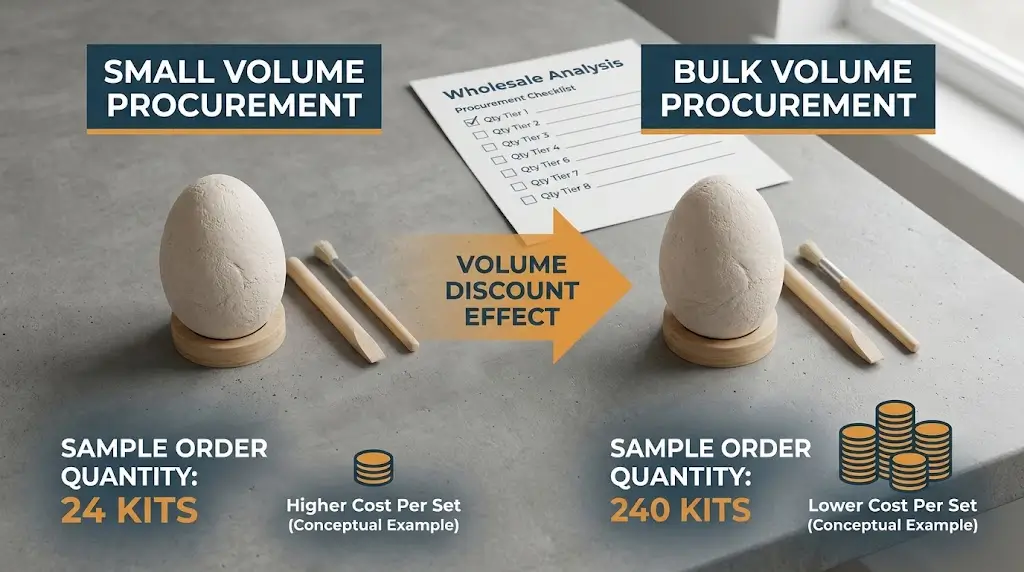
| Publicly Listed Product | Price at 24 Pieces | Price at 240 Pieces | Sales Channel and Source |
|---|---|---|---|
| Dinosaur Teeth Excavation Kit, one kit per unit | $5.50 per unit | $4.91 per unit | Wholesale Sock Deals, SKU 3997682 |
| Dinosaur Deluxe Fossil Excavation Kit, one kit per unit | $6.50 per unit | $5.81 per unit | Blue Star Empire, SKU 4004199 |
Each listing shows a lower advertised unit price at 240 pieces than at 24 pieces for the same product. This supports the narrow conclusion that these distributors publish volume based pricing. It does not prove that every factory offers the same discount, or that a different kit can be purchased at either of these prices.
Why Different Products Cannot Be Combined Into One Price Range
A single tooth excavation kit, a large egg containing a dinosaur figure, and a twelve egg retail multipack are not equivalent selling units. Their excavation material, component counts, activity formats, tool allocations and packaging can differ substantially. Branded educational products also operate under different commercial arrangements from unbranded distributor stock.
A buyer planning an entry level party favor might prioritize a small package with basic tools. A branded retail gift may call for more substantial presentation and printed educational content. Neither positioning produces a fixed price tier without knowing the actual specification. Averaging unlike products into a claimed industry wide wholesale range would hide the differences a buyer needs to evaluate.
Distributor Pricing Is Not a Factory Quotation
A domestic distributor’s advertised price may reflect stocked inventory, warehousing, distribution expenses, sales policies and local fulfillment. A factory quotation for an approved production specification has a different commercial basis. The currency may be the same while the unit of sale, quantity, packaging and delivery responsibilities are entirely different.
Use published listings to understand the products and price levels visible in a particular channel. Use a specification based factory quotation to build a procurement budget. The two types of evidence should be labeled separately, especially when comparing products for private label development.
How Should Buyers Calculate the Wholesale Cost per Set?
The first step is to define exactly what one set means. For retail and wholesale planning, the most useful unit is usually one finished, saleable retail kit, including its approved contents and packaging. An individual excavation egg is not always a separate saleable product.
Price per Retail Set Versus Price per Excavation Egg
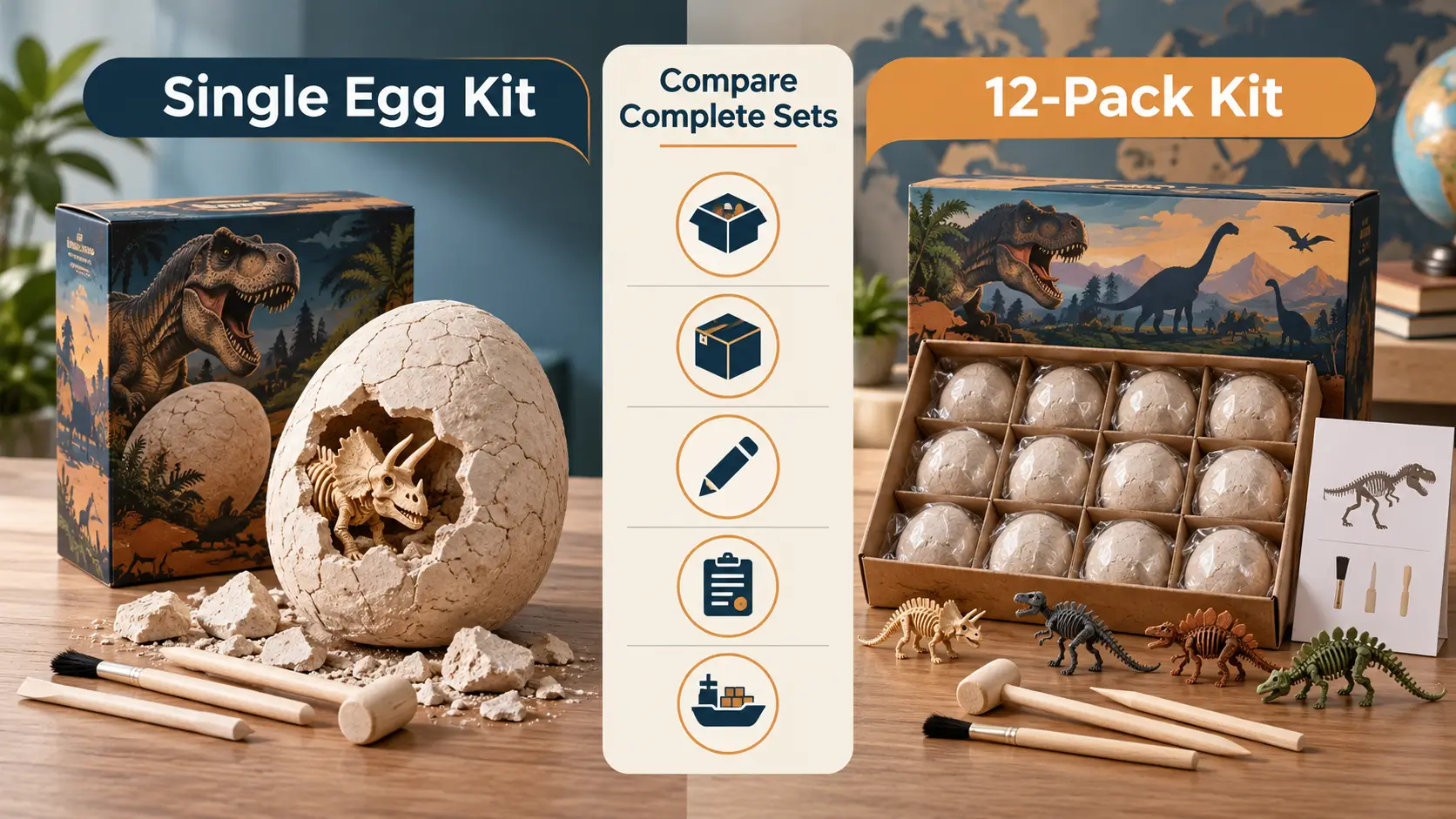
The Jaredrise JLT-T0013 large egg kit contains one excavation egg, one hidden dinosaur model, tools and an instruction card. The JLT-T0014 12 pack contains twelve individually wrapped eggs, twelve hidden models, tools and instructions in a single retail package. The quantity of tools provided in the 12 pack should be confirmed against the final specification rather than assumed to be one set per egg.
The relevant calculations are straightforward.
Quoted price per retail set = Total quoted product value / Number of finished retail sets
Allocated price per excavation egg = Quoted retail set price / Number of eggs inside that set
The second figure is a planning allocation, not a standalone selling price. Shared tools, instructions, outer packaging and assembly are still included in the retail set cost. A low allocated price per egg therefore does not mean the manufacturer will sell each egg separately at that amount.
Recurring Unit Price Versus Effective First Order Cost
Buyers also need to distinguish the ongoing price of a finished set from charges associated with launching the project. Artwork preparation, samples, new component tooling or packaging setup may be quoted separately where the project requires them. Such charges can raise the initial investment even if the recurring unit price appears attractive.
Effective first order cost per saleable set = (Recurring product charges + Separately billed one time project charges) / Number of saleable retail sets
This calculation should use the actual quantity of saleable finished units covered by the quotation. It must not add any expense already included in the quoted product price. A repeat order may avoid some initial charges if artwork or tooling can be reused, but that depends on written commercial terms and should not be assumed.
Check What the Quoted Unit Price Includes
Before comparing two quotations, confirm whether each includes retail packaging, inner protection, printed instructions, export cartons, assembly, agreed inspection and applicable testing. The scope of separately billed expenses should be visible too. A lower unit price may simply omit an item that another quotation includes.
The useful question is not only how much one kit costs. It is what complete, approved retail product the buyer receives for that amount and what additional expenses remain outside the offer.
Which Product Specifications Have the Greatest Effect on Price?
Material consumption, component quantity and packaging specifications are the major physical variables behind a dinosaur dig kit quote. They should be assessed as part of the complete retail kit rather than as isolated features. For an extended manufacturing breakdown, see Jaredrise’s Dinosaur Dig Kit Cost Breakdown.
Excavation Block Dimensions and Weight
Jaredrise identifies plaster as the excavation material used in the two referenced product configurations. Changes to an egg’s dimensions, shape or material mass can affect raw material consumption, handling and protective packaging. Greater shipment mass may also influence freight, although the actual freight charge depends on the shipment and carrier’s rate basis.
Dimensions alone are not a reliable substitute for measured weight. Two blocks of similar external dimensions can differ in mass because their formulations, cavities or hidden model arrangements differ. Buyers should confirm the approved sample’s weight and dimensions when these variables matter to pricing or shipping.
Dinosaur Models, Digging Tools and Accessories
Each kit has a bill of materials covering hidden dinosaur models, excavation tools, brushes, printed instructions and any agreed extras. An additional model or tool can add component purchasing, packing and inspection work. A new custom designed figure may also require design review, sampling or tooling beyond the costs of an existing component.
The distinction between included and optional items matters. Magnifying glasses, wooden mallets, goggles or additional educational materials appear in some market products, but they should not be described as standard contents of either Jaredrise SKU without an approved specification. The same principle applies to tool quantity in a multipack. Shared tools and individually allocated tools create different commercial and user experience outcomes.
Packaging and Intended Retail Positioning
Packaging affects both the finished product and the shipment. A standard color box may have different printing, material and setup requirements from a custom branded box. Individual egg wrapping, internal dividers or extra protective inserts can affect materials, assembly and carton utilization.
The best configuration depends on the target selling experience. An individually gifted excavation kit and a twelve egg classroom multipack may require different packaging. More elaborate packaging is not automatically better. Buyers should decide which presentation features are necessary for their intended customers before asking for a final unit price.
How Do Order Quantity, MOQ and Customization Change the Quote?
Order quantity influences purchasing and production efficiency, while customization can introduce additional components, preparation work and minimum production quantities. These two factors need to be evaluated together instead of treating the lowest unit price as the only goal.
Understand the Published MOQ Without Assuming a Price Tier
Jaredrise currently lists 1,000 sets as the published MOQ for both JLT-T0013 and JLT-T0014. This means complete retail sets, not individual eggs. For a 12 pack, the number of excavation eggs represented by 1,000 retail sets is different from the number of retail units being purchased.
The listed MOQ is a starting reference for each product’s published configuration. Changes to components, box artwork, packaging format or model designs may change the practical production minimum. Jaredrise does not publish a verified price schedule for 1,000, 3,000 or 5,000 sets on these product pages, so a buyer should request actual quotation tiers rather than infer them.
Private Label Changes Do Not All Have the Same Cost Effect
A branding change to an existing suitable kit might involve artwork, printed packaging or labels. A fully redesigned product may involve new figures, changes to the excavation block, dedicated tooling and additional sample approval. The first changes may mainly affect printing and packaging; the second can introduce significant project specific development work.
Neither approach is inherently right for every brand. A retailer testing demand may benefit from an existing configuration with suitable branding. A mature product program may justify deeper changes if customers value them and the expected volume supports the investment. Each requested change should be priced and confirmed for feasibility rather than assumed available as a standard service.
Look at Order Commitment as Well as Unit Cost
Increasing quantity can improve the unit price when the manufacturer gains purchasing or production efficiencies. It can also increase inventory investment, storage needs and exposure to slow moving stock. The economically sensible quantity depends on realistic sales forecasts, available cash and acceptable replenishment risk.
For a detailed explanation of how component minimums affect the finished order, consult Jaredrise’s Dinosaur Dig Kit MOQ Explained. For wholesale price comparison, the immediate task is simpler. Request quotations for feasible quantities under identical specifications and compare the total order commitment alongside the unit figure.
How Do Shipping Weight and Trade Terms Affect the Total Cost per Set?
A factory product quote and the buyer’s full import cost are not the same thing. Excavation materials can make a shipment heavy, while retail and export packaging can make it bulky. Both characteristics matter when freight is calculated, but the effect varies by transport method and route.
Use Measured Carton Weight and Volume
Buyers should request the weight of a finished retail set, units per export carton, gross carton weight and carton dimensions. These measurements support a more reliable freight estimate than assumptions based on a product photograph. A twelve egg package may have a different combination of weight and volume from one large egg, and there is no universal freight charge per excavation egg.
Packed volume, total shipment quantity and route can be as relevant as the mass of the excavation blocks. Protective packaging that reduces breakage may increase carton volume, creating a cost versus protection trade off that requires actual packing data.
Air Freight and LCL Ocean Freight Use Different Calculations
For DHL’s published volumetric weight calculation, dimensions in centimeters are multiplied together and divided by the applicable divisor. Its reference page gives 5,000 as the standard divisor for kilograms and centimeters. The calculated volumetric weight is compared with actual weight, and the higher figure can determine the chargeable weight. See DHL’s weight guidance.
For less than container load ocean freight, weight or measure rules may apply. Maersk’s LCL terms describe calculation by cubic meters or weight and measure units, with a comparison between gross volume and gross weight under the specified agreement. Full container costs follow a different commercial structure. Buyers should obtain a route specific forwarder quotation rather than apply a parcel formula to an ocean shipment.
Compare the Same Delivery Terms
EXW, FOB and CIF describe different divisions of cost, delivery and risk. In broad terms, an EXW quotation leaves more transport arrangements with the buyer. FOB addresses delivery on board a vessel at a named shipment port, while CIF includes contracted carriage and insurance to a named destination port, with risk transferring under the rule at shipment. FOB and CIF are sea and inland waterway terms, so their suitability should be checked for the actual transport arrangement.
CIF does not automatically include import duties, destination taxes or final inland delivery. State the named place or port and the Incoterms edition in the quotation. The International Chamber of Commerce’s Incoterms 2020 guidance explains the rules and their allocation of responsibilities.
For a buyer estimating the total import cost per saleable retail set, product charges should be combined only with the freight, insurance, clearance, duties, taxes and other expenses not already included in the chosen quotation. Local tax recoverability and the applicable import classification can materially affect the final budget, so those costs need market specific confirmation.
How Can Buyers Compare Two Wholesale Quotes on the Same Basis?
The most useful price comparison is not simply one supplier’s number against another’s. It is a comparison of complete retail sets with matching product specifications, quantities and commercial conditions. This is especially important when one quote covers an existing kit and another covers a modified or private label version.
Align the Product and Quotation Scope First
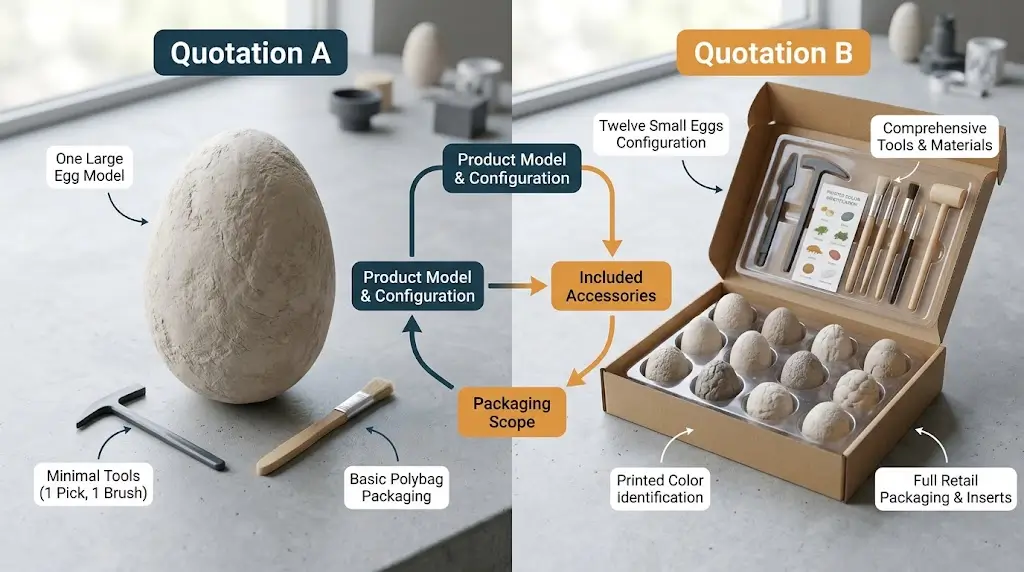
A low quote for one large egg should not be ranked directly against a higher quote for twelve eggs in one box. Similarly, a quote that excludes retail packaging or sample costs cannot be compared fairly with one that includes them. The buyer should make these differences visible before drawing a conclusion.
| Comparison Factor | Quotation A | Quotation B | What to Verify |
|---|---|---|---|
| Complete retail set | To be confirmed | To be confirmed | Model, number of eggs and included figures |
| Tools and printed materials | To be confirmed | To be confirmed | Quantity and specification of each accessory |
| Retail and export packaging | To be confirmed | To be confirmed | Box, wrapping, inserts and carton configuration |
| Finished retail sets ordered | To be confirmed | To be confirmed | Quantity per SKU, not just total eggs |
| Recurring price per set | To be confirmed | To be confirmed | Currency and exact inclusions |
| One time project charges | To be confirmed | To be confirmed | Sampling, artwork, tooling and setup |
| Testing and inspection | To be confirmed | To be confirmed | Agreed scope and payment responsibility |
| Delivery term and named place | To be confirmed | To be confirmed | Comparable freight and insurance obligations |
| Effective first order cost | Calculate | Calculate | Same saleable unit basis and no double counting |
The matrix is intentionally blank. Entering unsupported numbers would give a false impression of accuracy. Once quotations are available, the buyer can calculate the effective cost per complete set and examine which differences are caused by the product itself versus the quotation scope.
Compare Total Initial Commitment, Not Only Recurring Price
Suppose one quotation has a lower recurring unit price but requires separate, nonrecoverable development expenses. Another may have a higher recurring price with fewer initial charges. Without spreading the relevant one time costs across the first order, the lower unit price may appear more attractive than it really is.
Calculate the initial cost per saleable retail set using the actual quote and the agreed one time charges. Keep freight and destination expenses separate unless both quotations have been converted to the same landed cost basis. For future orders, check whether tooling, artwork or packaging assets can be reused, who owns them and whether revisions or setup fees will recur.
Connect the Quote to the Target Retail Offer
A competitive price is useful only if the finished kit meets the intended customer’s expectations. The correct product may depend on age grading, excavation experience, number of activities, packaging appearance and the channel’s price positioning. A kit designed for an individual gift is not necessarily a substitute for a classroom multipack.
The decision rule is to align the finished specification first, compare effective costs second and check retail suitability and inventory exposure third. The lowest displayed price is not automatically the best commercial outcome.
Where Can Buyers Reduce Cost Without Weakening the Product?
Cost optimization works best when buyers distinguish essential product requirements from optional features. The objective is not to remove everything that adds expense. It is to protect the intended activity, product safety and retail suitability while avoiding unnecessary complexity.
Start From Suitable Existing Components
An established excavation shape, dinosaur figure or tool may reduce the need for new development, provided that it meets the approved design and performance requirements. Changes to the egg or model should be evaluated against actual samples because appearance, excavation difficulty and component integrity can matter to the user experience.
Simplify Packaging Deliberately
A basic retail box might be appropriate for some wholesale programs, while another channel may require branded graphics, separation between eggs or stronger internal protection. A useful packaging change is one that reduces material or packing complexity without introducing breakage, handling problems, labeling gaps or an unsuitable retail presentation.
Do Not Chase Unrealistic Volume Discounts
A bigger purchase order may reduce the quoted unit price but tie up more cash and warehouse space. Request a price at the quantity the business can reasonably sell and replenish. Only expand the order when the expected demand and reduced unit expense justify the additional commitment.
More detailed production level cost controls are covered in Jaredrise’s manufacturing cost article. At the quotation stage, these three checks are usually sufficient to identify changes worth pricing as alternatives.
What Does Jaredrise Need to Provide an Accurate Dinosaur Dig Kit Quote?
Jaredrise’s listed dinosaur dig kit pages identify product configurations and MOQ references, but they do not establish a single public factory price for every possible order. Accurate pricing depends on the product the buyer actually intends to sell, the extent of customization and the agreed commercial scope.
Select a Realistic Starting Product
The JLT-T0013 Large Dinosaur Egg Excavation Kit provides one main excavation activity with a hidden dinosaur model and tools. The JLT-T0014 12 Pack Dinosaur Egg Digging Kit provides multiple individually wrapped excavation units in one retail package. Both pages currently list a 1,000 set MOQ for their published configurations and describe OEM or private label options subject to final requirements.
These are useful starting points, not interchangeable quoted products. The final egg dimensions and weights, model assortment, tool allocation, packaging and any proposed changes should be confirmed against the approved specification and sample.
Define the Target Product Position Before Requesting a Price
A buyer targeting party favors may need a different configuration from a brand developing a distinctive gift set. Intended retail price and customer expectations can guide the product brief, but they do not establish what Jaredrise can manufacture for a particular factory cost. That can only be assessed after the product and commercial requirements are reviewed.
A useful inquiry includes the following information.
- Preferred product model or reference images, including the number of excavation eggs per retail set
- Hidden figures, digging tools, instructions and any additional accessories
- Planned target market, intended age group and desired retail positioning
- Packaging type, artwork and private label requirements
- Order quantity per SKU and expected reorder pattern
- Required samples, modifications and approval requirements
- Destination, preferred trade terms and required delivery timing
- Applicable testing, labeling, inspection and documentation requirements
A buyer does not need a finished technical dossier to start a discussion, but a more complete brief allows a more meaningful cost review. If dimensions, packaging or component quantities remain open, the resulting price will necessarily depend on assumptions that should be stated and approved.
Request a Configuration Specific Quotation
Ask Jaredrise to confirm what is technically feasible, what is included in the finished kit quotation, which charges would be separate and whether the published MOQ applies to the proposed version. Where useful, request two specified alternatives under the same quantity and trade terms, such as an existing kit configuration and a private label packaging version.
Request a project specific dinosaur dig kit quote. Share your intended kit format, target retail market, approximate quantity, packaging plan and delivery requirements through Jaredrise. The purpose of the review is to establish a clear specification and quotation basis, not to promise an unverified universal price.
What Determines the Final Wholesale Cost per Set?
Public distributor listings can demonstrate real advertised prices and quantity tiers, but they cannot establish Jaredrise’s factory cost or a universal dinosaur dig kit price range. A useful wholesale quote is based on a complete retail set with defined excavation units, components, packaging, customization and order quantity. One time project expenses and shipping obligations must then be handled on a consistent basis.
For buyers comparing alternatives, the practical sequence is to define the retail product, confirm what each quote includes, calculate the effective first order cost per saleable set and evaluate the total commitment against the intended sales channel. Jaredrise pricing should be requested for the actual approved configuration and commercial terms rather than inferred from unrelated products advertised elsewhere.