
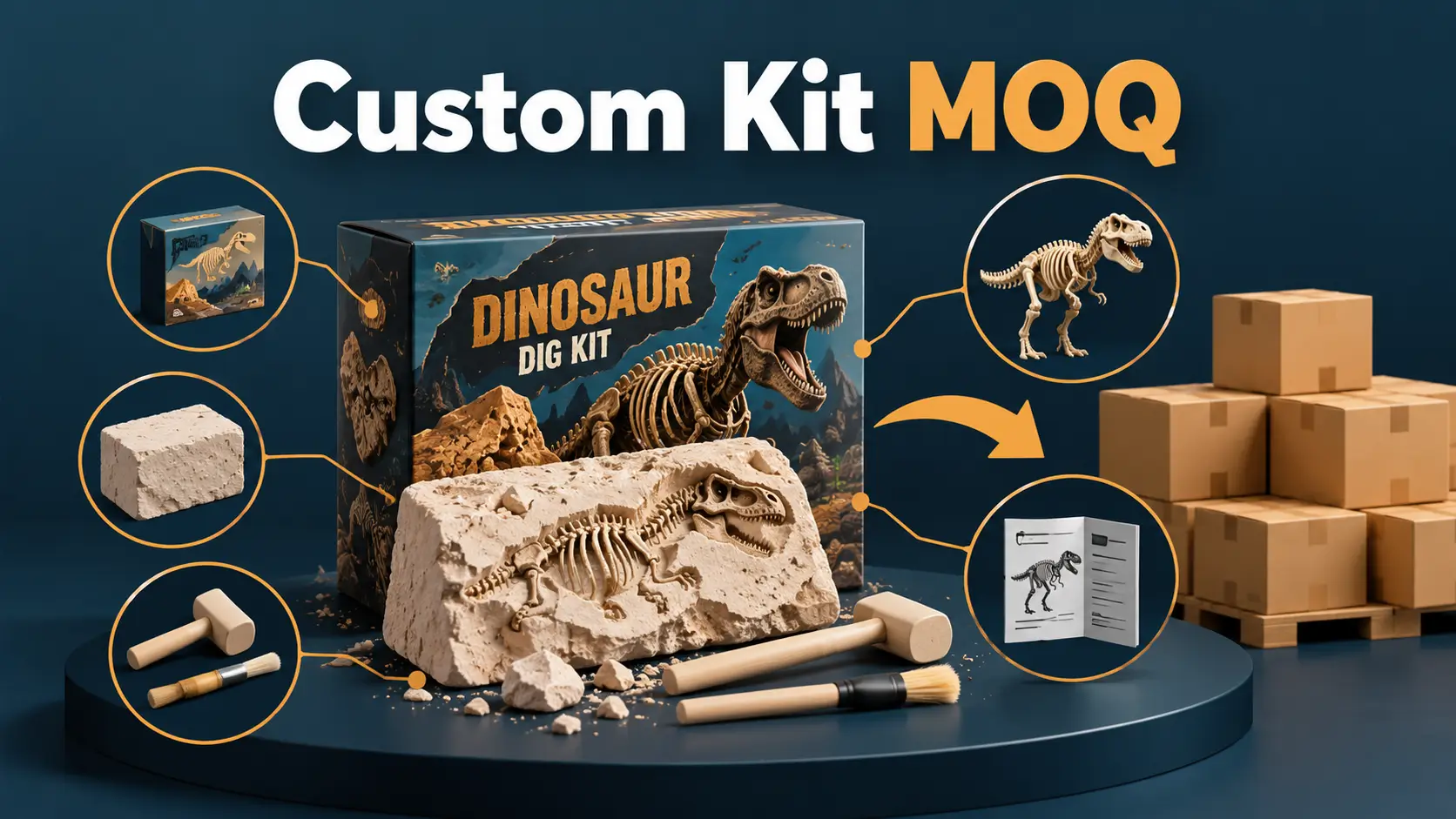
The minimum order quantity for a custom dinosaur dig kit depends on more than the number of finished kits a manufacturer can assemble. Excavation blocks, dinosaur figures, digging tools, printed packaging, and other components may each have different purchasing or production minimums. Customization requirements, production setup, and the number of product variations can further influence the quantity a supplier is willing to accept.
For buyers developing private label or custom dinosaur excavation kits, the most important question is which component or production requirement creates the actual MOQ constraint. A manufacturer may be able to produce a relatively small batch of excavation blocks, while the packaging supplier requires a larger quantity of custom printed boxes. The final order quantity must account for both conditions.
A lower MOQ can reduce initial inventory investment, but it may increase the effective cost per kit. Conversely, ordering more products to obtain a lower unit price can create unnecessary inventory and financial risk.
The appropriate MOQ is therefore not necessarily the smallest quantity technically possible. It is the lowest commercially workable quantity that satisfies the product specifications, production requirements, quality expectations, and project budget.
Understanding how these factors interact helps buyers identify realistic order quantities, evaluate customization options, and prepare more accurate manufacturing inquiries.
What Determines the MOQ of a Dinosaur Dig Kit?
Dinosaur dig kit MOQ is determined by the combined production and purchasing requirements of its components, rather than one universal industry minimum. Different suppliers may offer different quantities for similar products because they use different materials, production processes, component sources, and order arrangements.
MOQ can also refer to the minimum number of finished kits a supplier accepts, the minimum manufacturing batch for a particular component, or a minimum commercial order value. Buyers should establish which definition applies before comparing quotations.
Excavation Blocks, Dinosaur Figures and Accessories
An excavation block has its own manufacturing requirements, including material preparation, forming, drying or curing, and production scheduling. Depending on the formulation and equipment, producing a separate batch may require a minimum amount of material or setup work.
A standard excavation block made using an existing process may offer greater production flexibility than a specially shaped block requiring different tooling or formulation. However, a smaller block does not automatically have a lower MOQ. The actual minimum depends on batch size, material availability, and the manufacturer’s operating arrangements.
Dinosaur figures introduce another possible constraint. Existing molded figures may be sourced from available inventory or established production runs. Custom figures may require new tooling, special materials, unique colors, or dedicated production batches.
A new mold creates a development expense, but tooling cost and production MOQ are not the same thing. A manufacturer might accept a smaller production run if the buyer pays the development expense separately. Whether this arrangement is available must be confirmed.
Digging tools, brushes, and other accessories can also have independent supplier minimums. Standard components may be easier to purchase in smaller quantities, while special colors, dimensions, or designs can create additional requirements.
The practical question is whether each component can be purchased in the quantity needed for the finished kits.
Custom Packaging and Printing Minimums
Custom packaging can become the main MOQ constraint even when the excavation components are available in smaller quantities.
Printed retail boxes require materials, artwork preparation, printing setup, and sometimes cutting tools. Depending on the printing process, these activities create expenses that must be distributed across the production run.
For example, a packaging supplier may require a certain print quantity to make a custom box commercially practical. This quantity can exceed the number of finished dinosaur dig kits planned for the first order.
Standard packaging with labels or printed sleeves may offer different minimums because the box structure and printing process can be simpler. However, a printed sleeve or label can still have its own production minimum.
Packaging requirements should therefore be reviewed before the artwork and structure are finalized.
Buyers should confirm whether the packaging MOQ applies to the total number of boxes, each artwork design, each box size, or each printing variation. These distinctions become important when one project contains several retail versions.
Production Batches and Multiple SKU Requirements
Production MOQ also depends on how the order is divided into separate manufacturing batches.
A single kit design containing standard components may be relatively straightforward to schedule. An order containing several different dinosaur models, excavation colors, or packaging designs can require separate preparation for each variation.
Consider an order of 1,200 kits divided equally among four different designs. Although the total quantity is 1,200 units, each design represents only 300 units.
If every design requires separately printed packaging or dedicated molded components, the supplier must evaluate the production minimum for each version rather than treating the entire order as one batch.
Shared components may reduce this constraint. Different dinosaur designs might use the same excavation block formulation, digging tools, or packaging structure, allowing some purchasing and production activities to be combined.
Buyers should therefore distinguish total order quantity from quantity per SKU, and ask which components can genuinely share a production batch.
The following matrix summarizes the main constraints.
| Component | Potential MOQ Constraint | What Buyers Should Verify |
|---|---|---|
| Excavation blocks | Material preparation and batch size | Minimum quantity per shape or formulation |
| Dinosaur figures | Molding, color batches, component sourcing | Minimum quantity per figure design |
| Digging tools | Supplier purchasing quantities | Availability of standard components |
| Printed inserts | Printing setup and artwork variations | Minimum quantity per artwork |
| Retail packaging | Printing, cutting, and material sourcing | Minimum quantity per box design |
| Final assembly | Scheduling and setup efficiency | Minimum quantity of finished kits |
The table identifies possible constraints rather than fixed industry requirements. Actual minimums must be confirmed for the selected materials, designs, and production arrangements.
How Does Customization Affect Dinosaur Dig Kit MOQ?
Customization affects MOQ when a requested change introduces a new production batch, material purchasing requirement, or component specific minimum. Not every customization increases MOQ, and greater product complexity does not always mean a proportionally higher minimum order quantity.
The important distinction is whether customization changes an existing product’s appearance or requires a new manufacturing process.
Private Label vs. Semi Custom vs. Fully Custom Kits
Private label dinosaur dig kits typically use existing excavation blocks, figures, and accessories while adding brand specific elements.
When suitable components are already available, the manufacturer may avoid some development and production setup work. Branding can be introduced through labels, sleeves, instruction cards, or other approved packaging arrangements.
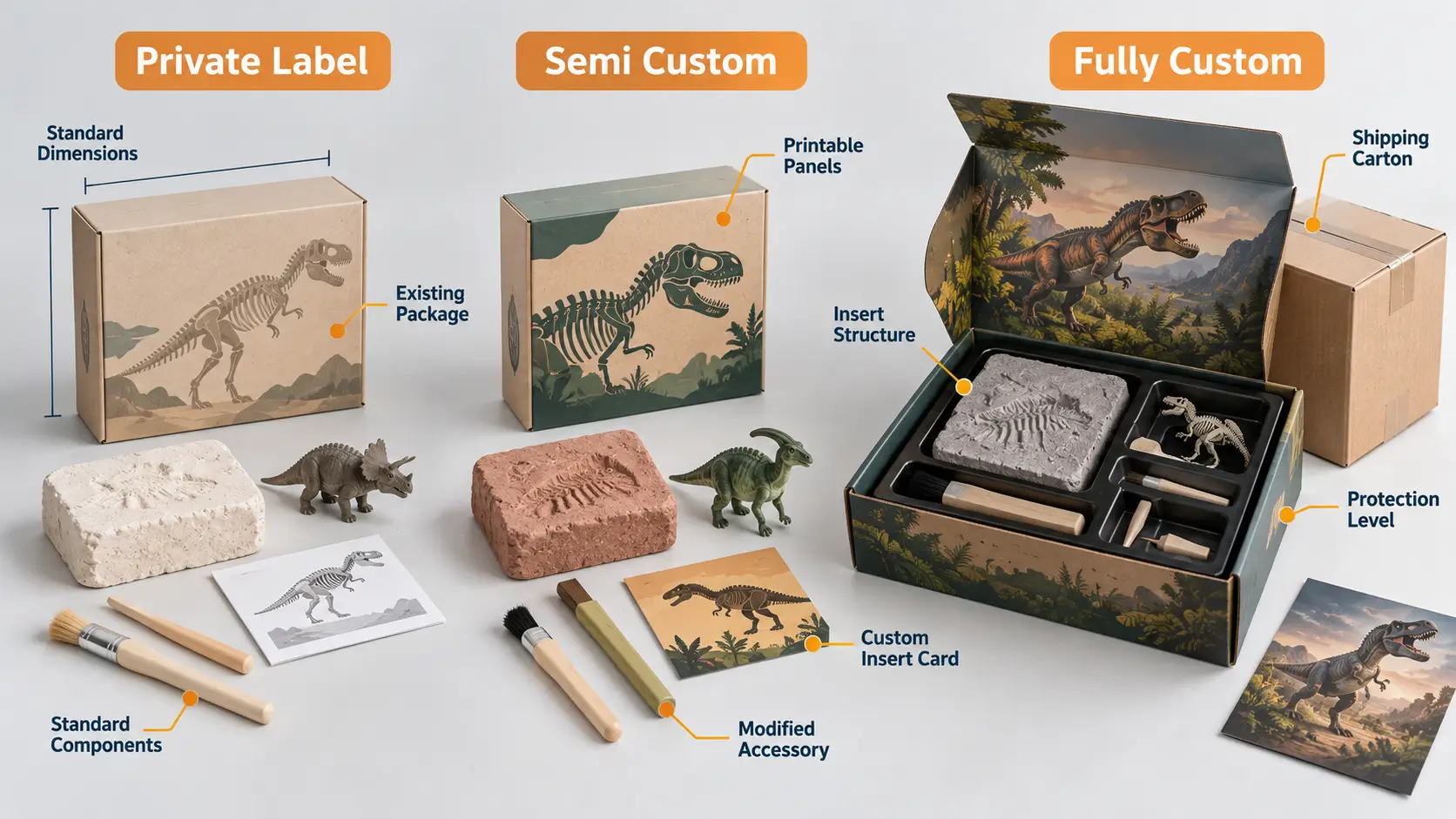
However, private labeling does not guarantee a low MOQ. If the buyer requests fully printed retail boxes, the packaging requirement may still determine the minimum commercial order.
Semi custom projects introduce selected changes to standard products. These might include a different excavation block color, additional accessories, alternative figures, or customized educational inserts.
The MOQ impact depends on which changes require separate manufacturing or purchasing. Adding an available standard accessory may have little effect, while requesting a unique component color could introduce a new production minimum.
Fully custom projects can involve original excavation shapes, newly developed dinosaur figures, special tools, and dedicated packaging structures.
These projects often require more coordination and upfront investment. However, the final MOQ still depends on component specific constraints, available tooling, and the supplier’s commercial arrangements.
| Customization Level | Main MOQ Consideration | Potential Advantage | Main Trade Off |
|---|---|---|---|
| Private label | Branding and packaging minimums | Existing product components | Limited physical differentiation |
| Semi custom | Minimums for selected custom components | Targeted product differentiation | Additional sourcing complexity |
| Fully custom | Multiple production and tooling requirements | Greater design flexibility | Higher development commitment |
For a first market launch, private label or selected customization may reduce initial complexity. A more established product program may justify deeper customization when expected sales can support the investment.
Custom Molds, Colors and Packaging Requirements
Three customization decisions deserve particular attention because they can change the commercial structure of a project.
A custom mold typically introduces a one time tooling expense and a separate manufacturing decision. Buyers should ask whether the mold expense is included in the unit price or quoted separately, and whether future orders can reuse the same tooling.
Custom colors may require dedicated material preparation or production changeovers. If a small project requests several unique colors, each variation may create a separate minimum batch even when the underlying product shape remains unchanged.
Custom packaging introduces similar complexity when each retail design requires its own printing run.
The interaction between these requirements matters more than any one factor.
A dinosaur dig kit with standard figures and one custom box may face primarily a packaging constraint. A kit with four custom figures, multiple excavation colors, and several box designs may face several independent minimums.
Before approving customization, buyers should identify which features are essential to the product concept and which can remain standard.
This prevents unnecessary production restrictions from being introduced before the commercial feasibility of the project is understood.
How to Determine the Effective MOQ for a Complete Kit?
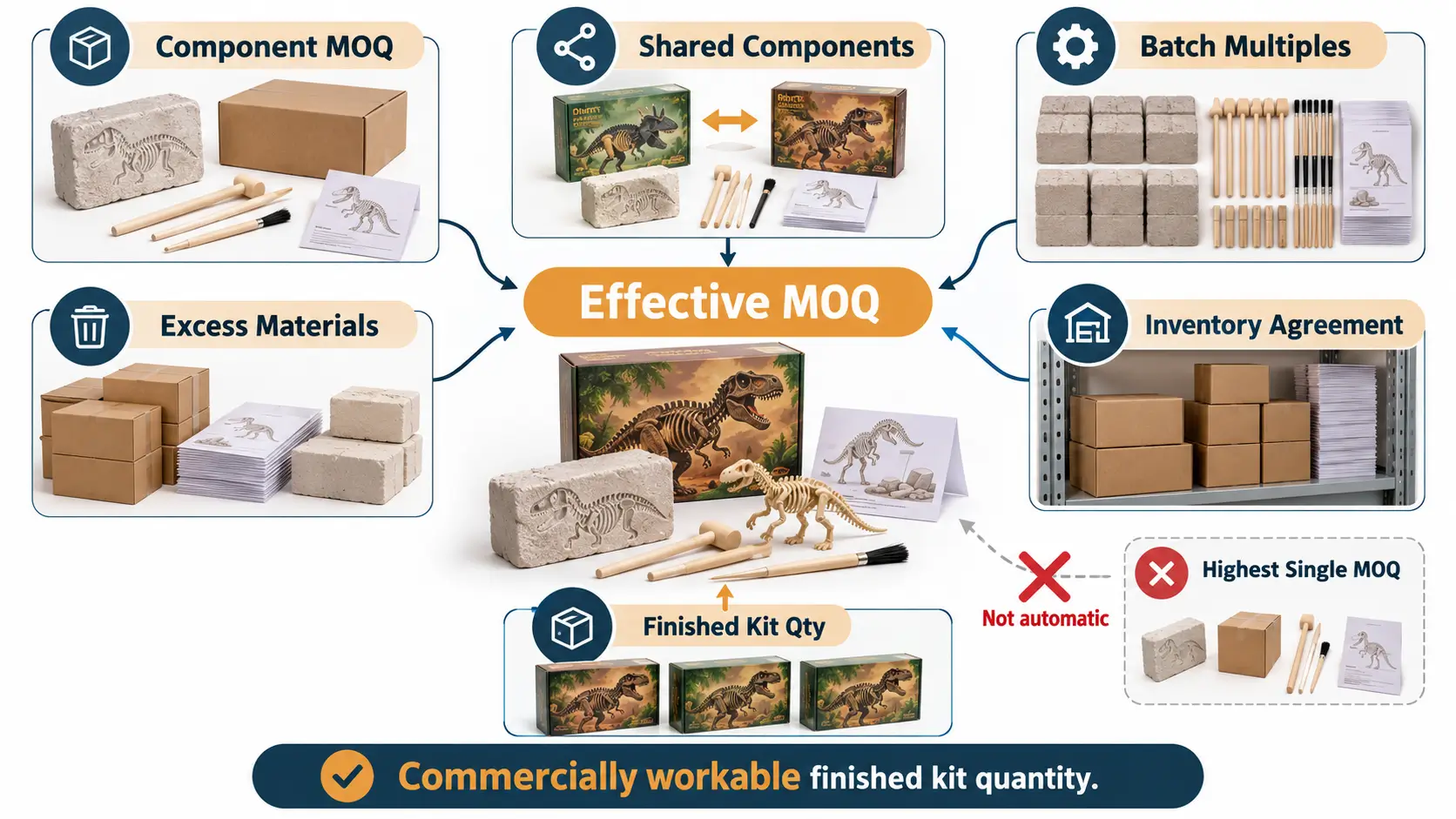
The effective MOQ is the smallest finished kit quantity a supplier can commercially accept while satisfying the relevant component, production, and order requirements.
It should not be calculated by automatically selecting the highest component MOQ. That approach can provide a useful initial warning, but it may overlook shared components, batch multiples, excess material arrangements, and inventory agreements.
Component MOQ vs. Finished Kit MOQ
Each kit component should first be reviewed according to its required quantity per finished product.
If one kit contains one excavation block, one dinosaur figure, and two digging tools, producing 500 kits requires 500 blocks, 500 figures, and 1,000 tools before allowing for production losses or rejected components.
The supplier must then determine whether these quantities meet the purchasing and production requirements for each item.
Some suppliers may accept orders above a stated minimum in flexible quantities. Others may require fixed batch multiples, such as full cartons or specific production lot sizes.
These requirements can create different results even when the minimum quantities appear similar.
A component with a minimum batch of 300 and flexible quantities above that level may support a 500 unit order. A component that must be purchased in lots of 300 may require purchasing 600 units to supply the same order.
The second arrangement creates excess components unless those materials can be used elsewhere.
Production yield also matters. If some excavation blocks are damaged or rejected during manufacturing, the planned production quantity may need to exceed the required number of saleable kits.
The buyer should therefore request confirmation of the usable finished quantity, rather than assuming the number of components produced will equal the number of kits delivered.
What Happens When Packaging MOQ Exceeds Order Quantity?
A packaging minimum higher than the finished kit order does not necessarily require the buyer to increase the number of finished kits.
Several arrangements may be possible, depending on the supplier’s capabilities and commercial terms.
The manufacturer might purchase the full packaging batch, use only the required quantity, and store the remainder for future orders. Alternatively, the buyer may accept a separate charge for unused packaging or choose a different packaging method.
However, storing excess packaging introduces additional considerations.
The remaining boxes may become unusable if the branding, barcode, required labeling, or product dimensions change before the next order. Storage conditions can also affect packaging quality, and responsibility for the remaining materials must be clearly defined.
Buyers should confirm ownership, storage charges, storage duration, and whether unused packaging can be transferred or recovered.
If the packaging supplier does not accept a practical arrangement for excess boxes, a simpler packaging specification may be more economical than increasing finished kit production beyond expected demand.
The decision should be based on the total financial commitment rather than the packaging MOQ alone.
Worked Example of an MOQ Constraint
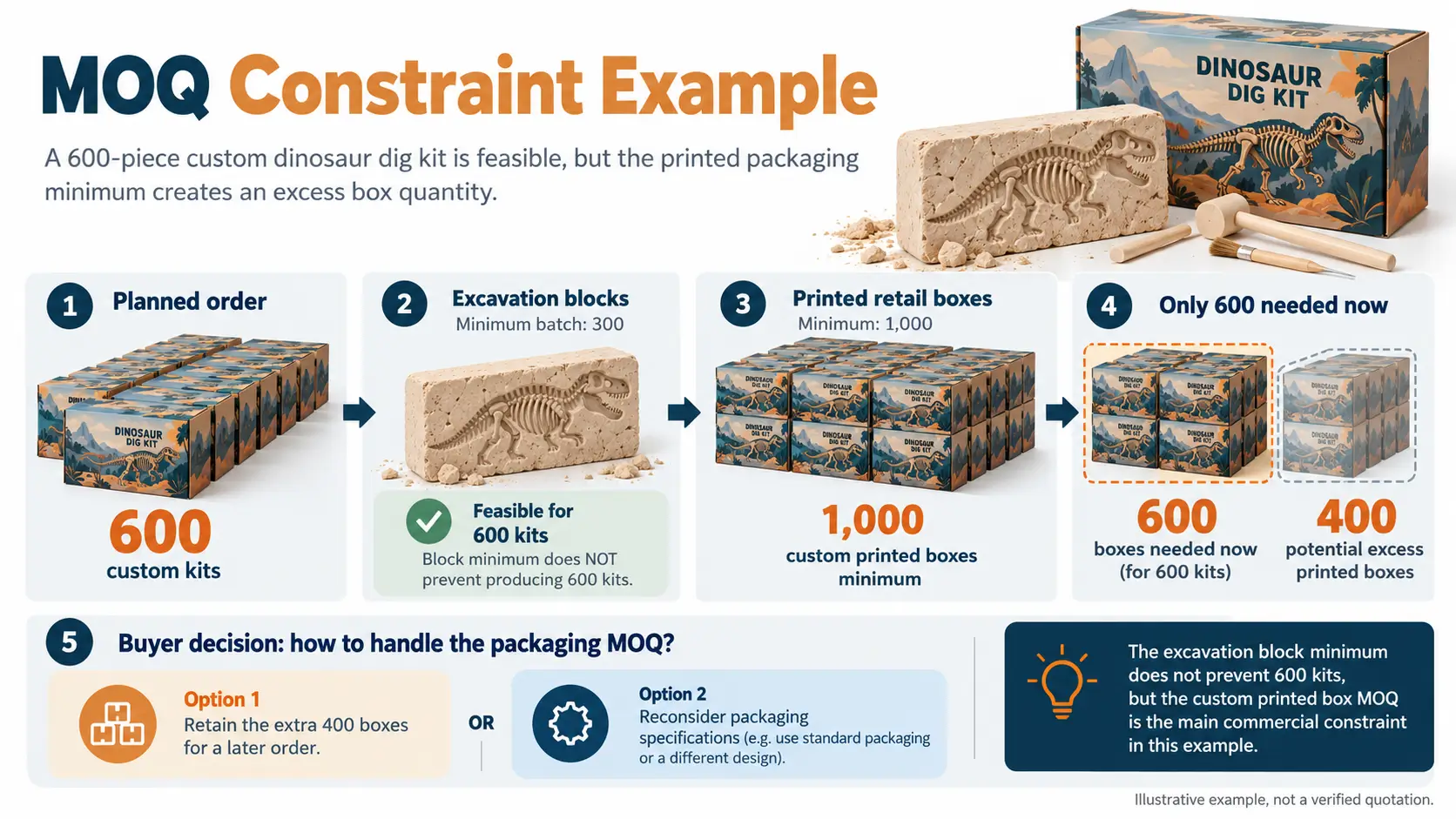
Consider a hypothetical project involving 600 custom dinosaur dig kits.
The buyer requires one excavation block and one printed retail box per kit. For illustration, assume the following supplier conditions.
| Requirement | Hypothetical Quantity |
|---|---|
| Planned finished kits | 600 |
| Excavation block minimum batch | 300 |
| Custom printed box minimum | 1,000 |
| Printed boxes needed immediately | 600 |
| Potential excess printed boxes | 400 |
These numbers are illustrative and do not represent a verified manufacturer quotation.
The excavation block requirement does not prevent production of 600 kits. The packaging minimum creates the main purchasing constraint.
If the supplier allows the remaining 400 boxes to be retained, the buyer may be able to complete the initial 600 kit order without manufacturing 1,000 finished products.
However, the buyer still needs to account for the cost and future usefulness of the extra packaging.
If excess packaging cannot be retained economically, the buyer can compare alternative box designs, printing methods, or packaging formats.
Increasing finished production to 1,000 kits may also be an option, but only if projected demand and the additional inventory investment justify it.
The central lesson is that the component with the highest MOQ does not always determine the finished kit delivery quantity. It identifies a constraint that must be resolved through production planning, purchasing arrangements, or specification changes.
How Can Buyers Reduce MOQ Without Compromising Requirements?
Reducing dinosaur dig kit MOQ usually involves removing unnecessary independent production constraints. The objective is not to make the product cheaper at any cost, but to identify which specifications can be adjusted without weakening the intended customer experience or mandatory requirements.
The most useful changes are those that preserve important product features while simplifying sourcing and manufacturing.
Standard Components and Simplified Packaging
Using existing components can reduce the number of separate production runs required for a custom project.
Standard dinosaur figures, digging tools, and excavation block shapes may already fit the intended product concept. When these components meet the required specifications, replacing them with newly developed alternatives may introduce cost and MOQ constraints without delivering enough additional customer value.
Packaging can offer similar flexibility.
A standard retail box with a suitable printed label or sleeve may satisfy some branding needs without requiring a completely new box structure.
However, the right packaging choice depends on the distribution channel. A product intended for prominent retail display may need stronger visual presentation than a kit supplied for a school activity or promotional event.
The buyer should determine which packaging features are necessary for protection, labeling, retail presentation, and customer understanding.
Only features that do not materially support these requirements should be considered for simplification.
Fewer SKUs and Shared Materials
Reducing the number of product variations can make a smaller initial order more practical.
A launch containing several dinosaur themes, excavation colors, and packaging designs may divide demand into quantities too small for efficient production.
Concentrating the first order on fewer versions can simplify purchasing, reduce artwork variations, and improve the likelihood that each version meets its production minimum.
Shared components provide another opportunity.
If several kit designs can use the same brush, digging tool, excavation block formulation, or box structure, the supplier may be able to consolidate some component purchases.
This does not mean that different finished SKUs automatically share one MOQ. The arrangement depends on how components are sourced and which processes remain separate.
Buyers should ask which components can be pooled across designs, which require dedicated production, and whether combined purchasing changes the minimum quantities or unit prices.
Quality and Safety Requirements That Must Remain
MOQ reduction should not come at the expense of required product safety, functionality, or protection during transportation.
Excavation kits intended for children may be subject to requirements concerning materials, accessible components, sharp points, small parts, labeling, and other hazards, depending on product design, intended age, and target market.
For example, the U.S. Consumer Product Safety Commission’s toy safety guidance explains the application of ASTM F963 and related testing and certification obligations. The specific requirements must be determined for the actual product and intended users.
Similar care is required when selling into other jurisdictions, where different regulatory and documentation requirements may apply.
Reducing an excavation block’s cost should not make it unsuitable for the intended activity. Removing packaging protection should not expose fragile components to unacceptable transport damage.
Likewise, using an existing component is only beneficial if its specifications, quality, and suitability can be verified.
The correct approach is to simplify unnecessary customization while preserving the requirements that make the product safe, functional, and commercially acceptable.
How Do MOQ Decisions Affect Unit Cost and Lead Time?
MOQ influences both the amount invested in the first order and the cost allocated to each finished kit. A smaller order can improve inventory flexibility, but fixed setup expenses and inefficient component purchasing may increase the effective unit cost.
A larger order may improve production economics while increasing inventory exposure. Neither outcome is automatically preferable.
Setup Costs, Unit Prices and Order Volume
Dinosaur dig kit production can involve expenses that occur before normal manufacturing begins.
These may include mold development, artwork preparation, printing setup, packaging tooling, sampling, and production preparation.
Other expenses increase with the quantity produced, such as excavation materials, dinosaur figures, digging tools, packaging materials, and assembly labor.
When fixed expenses are spread across fewer finished kits, their contribution to the effective unit cost increases.
This is one reason why suppliers may offer different prices at different order quantities.
The distinction between supplier MOQ and the buyer’s preferred economic order quantity is also important. As discussed in Oracle NetSuite’s guide to minimum order quantity, a supplier’s minimum can differ from the quantity that best supports the buyer’s inventory and cash flow requirements.
A buyer should therefore compare more than the quoted unit price.
The relevant financial commitment can include the purchase value of finished kits, separate tooling and setup fees, additional component purchases, retained packaging, freight, and other costs not already included in the quotation.
A lower unit price may not compensate for the extra cost of inventory that remains unsold or becomes obsolete.
For a product entering the market for the first time, accepting a higher unit cost can be reasonable if it substantially reduces the initial financial commitment.
For a product with predictable repeat demand, a larger order may justify the additional inventory because setup costs can be distributed across more units.
Inventory Risk and Production Scheduling
Lower MOQ does not automatically mean a shorter lead time.
An order using available components and established packaging may move through preparation relatively quickly. A small custom order requiring new molds, special printing, or dedicated materials may still require substantial preparation before production can begin.
Similarly, a larger order using an established product configuration may be easier to schedule than a smaller order with several new components.
Lead time should therefore be evaluated according to material availability, tooling requirements, sample approval, production scheduling, component delivery, and final assembly.
Buyers should also distinguish the time needed to produce components from the time needed to deliver completed kits. The slowest essential component can delay final assembly even if the other materials are ready.
Staged production may offer an alternative when the buyer expects repeat demand. A supplier might produce or purchase some components in a larger batch while assembling finished kits according to agreed delivery schedules.
However, this arrangement introduces inventory ownership, storage, payment, and scheduling considerations.
Before accepting a staged order, buyers should establish who owns the remaining components, how they are stored, when future deliveries are required, and what happens if forecast demand changes.
The preferred order quantity should balance unit cost, available budget, inventory risk, and the ability to meet the required delivery schedule.
What Should Buyers Confirm Before Requesting an MOQ Quote?
An accurate MOQ quotation requires enough information to identify the relevant production constraints. Asking only for the minimum quantity of a dinosaur dig kit usually produces an incomplete answer because the supplier does not yet know which components, designs, and packaging requirements will apply.
A useful request defines the intended product and asks the supplier to explain which requirements determine the minimum order.
Product Specifications, Customization and SKU Quantities
The buyer should begin by defining the finished kit configuration.
This includes the excavation block dimensions and shape, the number and type of dinosaur figures, digging tools, educational inserts, and other accessories.
Customization requirements should distinguish standard components from new designs.
If unique figures, colors, or packaging artwork are required, the buyer should specify how many variations are planned and the expected quantity for each version.
The intended distribution channel and target market should also be identified because they may influence packaging, labeling, product specifications, and verification requirements.
It is useful to indicate which requirements are fixed and which can be adjusted.
For example, a brand may require a particular dinosaur figure and retail appearance but remain flexible about the excavation block shape or the type of digging tool.
Giving the manufacturer this information makes it easier to identify alternative configurations without changing the product’s essential characteristics.
Component Minimums, Setup Fees and Delivery Terms
Buyers should request more than a single finished kit MOQ.
A useful quotation explains the minimum quantities associated with the relevant components, including any separate requirements for molded parts, printed materials, and retail packaging.
It should also identify whether the supplier accepts quantities above the minimum in flexible increments or requires fixed production multiples.
Setup and development expenses should be distinguished from recurring unit costs wherever practical.
For custom tooling, buyers should clarify whether the quotation includes mold development, who owns the tooling, and whether it can be reused for future production.
If a component minimum exceeds the planned quantity of finished kits, the buyer should confirm whether excess materials can be retained, whether additional fees apply, and how ownership will be managed.
Delivery conditions are equally important. The quotation should identify the estimated production schedule, major approval stages, and whether the proposed quantity can be delivered in one shipment or requires a different arrangement.
These details allow buyers to evaluate the commercial feasibility of the offer rather than relying on the headline MOQ.
MOQ Decision Checklist for Custom Projects
Before requesting a manufacturing quotation, buyers can use the following checklist to confirm that the main quantity constraints have been addressed.
- Finished kit configuration. Define the excavation block, dinosaur figures, tools, accessories, and packaging.
- Customization requirements. Identify standard components, custom colors, new molds, and unique printed materials.
- SKU quantities. Specify the total order quantity and the required quantity for each design.
- Component MOQ. Request the minimum purchasing or production quantity for every component likely to create a restriction.
- Batch requirements. Confirm whether production quantities must follow fixed multiples.
- Packaging conditions. Check printing minimums, excess packaging arrangements, and alternative packaging options.
- Development expenses. Separate tooling, sampling, and setup charges from recurring unit costs.
- Quality requirements. Identify the applicable product specifications, market requirements, and necessary verification.
- Lead time. Confirm material preparation, sample approval, production, and delivery expectations.
- Commercial alternatives. Request comparable quotations for feasible quantity or specification options.
A supplier’s proposed MOQ should be evaluated against the complete project rather than accepted as an isolated number.
Buyers should first determine whether the minimum is caused by an essential technical requirement, a component purchasing restriction, a packaging condition, or a commercial production policy.
If the constraint relates to an essential product feature or compliance requirement, increasing order quantity or reconsidering the project budget may be more appropriate than weakening the specification.
If the constraint comes from an optional component, unnecessary artwork variation, or packaging preference, simplifying the product configuration may offer a practical alternative.
For buyers planning a dinosaur excavation product launch, the next step is to prepare the intended kit configuration, target quantities, customization details, and packaging requirements for a project specific MOQ review.
Additional guidance on the relationship between product configuration, component selection, and manufacturing cost is available in the Jaredrise Dinosaur Dig Kit Cost Breakdown.
The most useful manufacturing quotation is not simply the one offering the lowest MOQ or unit price. It is the one that clearly explains the production constraints, identifies realistic alternatives, and allows the buyer to understand the total commitment required.
A commercially appropriate dinosaur dig kit MOQ is the lowest feasible quantity that meets the required specifications, preserves product quality, and fits the buyer’s inventory and financial expectations. Once these conditions are clear, buyers can select a production quantity based on verified requirements rather than assumptions about what a custom project should cost.