
Custom non toxic educational toys wholesale refers to sourcing educational toys in bulk quantities while allowing OEM or ODM customization and ensuring compliance with safety standards such as CPSIA, ASTM F963, EN71, and REACH.
Typical wholesale pricing ranges from $0.8–$15 per unit, depending on materials, complexity, certification requirements, and order volume. Buyers generally evaluate suppliers based on 4 factors: product safety compliance, customization capability, production capacity, and total procurement cost.
For brands targeting the US and European markets, choosing a compliant manufacturer reduces regulatory risk, improves product quality perception, and supports long-term private label growth.
What Is Custom Non-Toxic Educational Toys Wholesale?
Custom non-toxic educational toys wholesale is a specialized B2B supply model where buyers order purpose-designed learning toys manufactured without harmful chemicals and tailored to specific brand or product requirements. Here is how the three core terms function together in procurement.
Core Definition and Market Scope
In a wholesale procurement context, custom means the manufacturer modifies product features, packaging, or tooling to align with the buyer’s brand specifications rather than supplying off-the-shelf products. Non-toxic means the toy is manufactured using materials verified to be free from restricted substances such as lead, phthalates, BPA, and heavy metals, supported by laboratory testing that complies with the regulatory requirements of the destination market.
Wholesale refers to bulk purchasing at tiered unit pricing, typically beginning at 500 units per SKU, with lower unit costs as order volumes increase.
This supply model is most common in markets where children’s product safety regulations are strictly enforced, including the United States under CPSIA, the European Union under EN71 and REACH, and other regions that follow similar chemical safety and labeling requirements.
The buyer’s objective combines two critical goals: achieving a competitive unit cost through volume production while maintaining full compliance with the safety regulations that govern retail distribution and customs clearance.
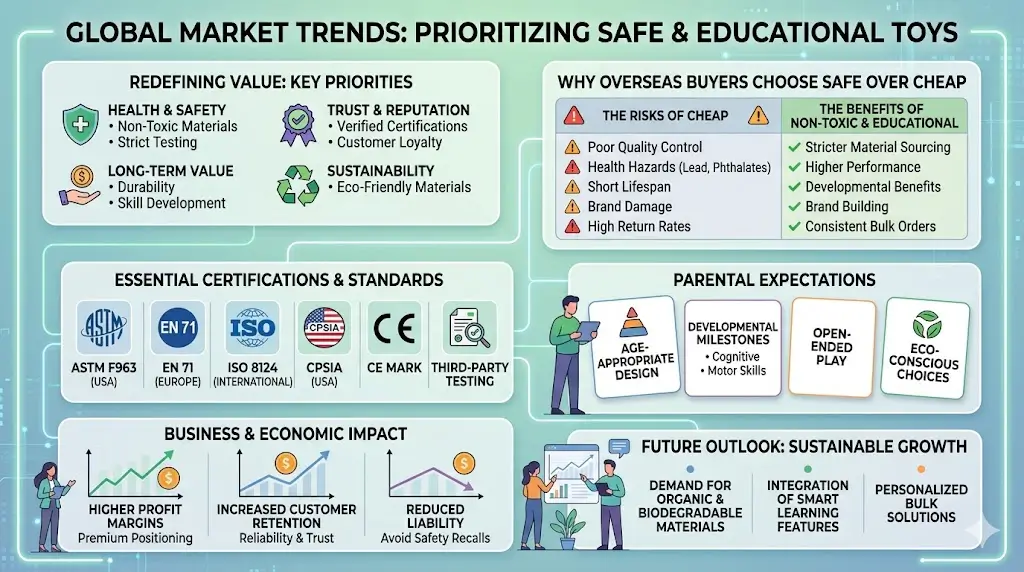
Why Overseas Buyers Prefer Non-Toxic Educational Toys?
This preference is driven primarily by procurement risk management rather than marketing considerations alone. A non-toxic supply chain reduces the likelihood of product recalls, which can damage brand reputation, disrupt relationships with retail platforms, and create legal liabilities.
Many buyers source products specifically for Amazon, Target, or school district contracts, all of which require strict chemical safety documentation.
When a product is clearly identified as non-toxic and supported by certification, brands can often achieve higher retail pricing while building stronger trust with parents and institutional buyers who actively evaluate material safety claims.
In educational environments, procurement officers frequently require compliance documentation before approving classroom or daycare purchases, making non-toxic certification a purchasing requirement rather than simply a marketing advantage.
Custom Non-Toxic Educational Toys Wholesale Pricing Structure
Pricing in this category is influenced by material selection, safety testing requirements, and the level of customization involved. The tables below outline typical cost ranges, MOQ pricing variations, and cost composition to help evaluate supplier quotations using a practical reference framework.
Cost Range by Product Type ($0.8–$15 Per Unit)
The table below provides a reference pricing range for common educational toy categories. These estimates reflect FOB quotations based on standard non-toxic material specifications and typical order volumes.
| Product Type | Example Items | Unit Price Range (FOB) |
|---|---|---|
| Paper-based learning cards | Flash cards, puzzle cards, matching games | $0.8–$2.5 |
| Wooden Montessori toys | Sorting boards, stacking blocks, tracing boards | $2.0–$8.0 |
| Plastic STEM kits | Building blocks, gear sets, simple circuit kits | $3.0–$10.0 |
| Electronic learning toys | Audio books, talking pens, interactive tablets | $8.0–$15.0 |
The pricing variation within each category is driven by three primary factors. Material grade has an immediate impact on base cost; for example, replacing standard wood with FSC-certified birch or switching to BPA-free food-grade silicone increases material expenses.
The scope of safety certification also affects pricing, as products requiring both EN71 and CPSIA compliance incur higher testing and documentation costs than products intended for a single market.
Functional complexity adds another cost layer, with simple wooden block sets costing significantly less than STEM kits that incorporate magnets, LED components, and detailed instruction manuals.
MOQ Pricing Model (500 vs 1000 vs 5000 Units)
Manufacturers offer volume-based price reductions because fixed costs can be spread across a larger number of units. The table below illustrates a typical pricing curve for a mid-range wooden educational toy with an FOB base price of $5.0 at 500 units.
| Order Quantity | Estimated Unit Price | Price Reduction vs 500 Units |
|---|---|---|
| 500 units | $5.0 | Baseline |
| 1,000 units | $4.2 | 16% |
| 3,000 units | $3.5 | 30% |
| 5,000 units | $3.0 | 40% |
The price reduction follows a clear economic pattern. Mold and tooling costs are distributed across more units, reducing the tooling cost per unit. Raw material sourcing shifts from smaller purchases to bulk procurement, lowering the cost per kilogram.
Production setup time, which remains relatively fixed regardless of order size, is absorbed by higher output volumes, improving operational efficiency.
Buyers should balance lower unit costs against total cash investment and inventory holding expenses. While ordering 5,000 units delivers the lowest unit cost, it also requires more working capital and storage capacity.
Manufacturing Cost Breakdown (%)
The table below illustrates the typical cost structure of a non-toxic wooden or plastic educational toy produced for the US and EU markets.
| Cost Component | Percentage of Total Cost |
|---|---|
| Raw materials | 35–45% |
| Labor and assembly | 20–25% |
| Packaging | 8–12% |
| Compliance testing and certification | 5–10% |
| Mold and tooling amortization | 5–8% |
| Logistics preparation and loading | 3–5% |
Raw materials and compliance testing are the two cost drivers most frequently underestimated by buyers. Material expenses represent the largest cost category, and selecting certified non-toxic materials such as phthalate-free plastics or FSC-certified solid wood increases this percentage compared with non-certified alternatives.
Compliance testing costs are generally fixed per SKU and therefore have a greater impact on smaller production runs. For example, testing fees may add $0.50–$1.00 per unit on a 500-unit order, while the same cost becomes almost negligible when spread across 5,000 units.
5 Factors That Increase Wholesale Cost
- Certified non-toxic raw materials directly increase material expenses. BPA-free, phthalate-free, and heavy-metal-free materials typically cost 15–40% more than standard industrial-grade alternatives. Suppliers must source from audited vendors, reducing supplier availability and limiting price competition.
- Low order volumes reduce manufacturing efficiency. Short production runs prevent factories from maintaining continuous production flow. Line changeovers, machine calibration, and worker familiarization must be repeated without sufficient volume to absorb these fixed costs, increasing labor cost per unit.
- Complex multi-component packaging raises both material and assembly expenses. Features such as magnetic closure boxes, multilingual instruction inserts, or foam protective layers require additional labor and packaging materials.
- Custom tooling for new product designs creates one-time mold expenses and extends development timelines. A custom injection mold for a plastic educational toy may cost between $3,000 and $15,000, and this expense must either be amortized into unit pricing or billed separately.
- Multi-market compliance testing significantly increases certification costs. Products intended for both the US and EU markets require separate testing submissions, documentation packages, and sometimes different material formulations, all of which increase costs before sales begin.
When to Choose OEM vs ODM Educational Toys?
The table below compares three sourcing models to help buyers select the most appropriate approach based on their stage of brand development.
| Model | What It Means | Best For |
|---|---|---|
| Private Label | Standard product with your logo and packaging | Startup brands, Amazon sellers testing a category |
| OEM | Your design manufactured to your specification | Growing brands with unique product concepts |
| ODM | Factory-designed product customized to your requirements | Buyers seeking faster development and factory R&D support |
Startup brands with limited R&D budgets typically begin with Private Label or light ODM solutions. The factory already offers a tested and compliant product, making logo customization and packaging updates fast and relatively low risk.
Growing brands that have gathered customer insights and want stronger differentiation often transition to OEM manufacturing, where products are developed according to their exact specifications.
Mature brands seeking exclusive product lines that are difficult for competitors to replicate often invest in full ODM partnerships that combine factory design expertise with brand-specific product development.
Manufacturing Capability for Custom Non-Toxic Educational Toys
A supplier’s manufacturing capability directly affects product consistency, compliance reliability, and on-time delivery performance. The sections below explain the systems and workflows that distinguish true manufacturers from general trading companies.
Material Selection System (Level 1–5 Safety Screening)
A structured material screening system evaluates every incoming raw material before it enters production. Level 1 verifies supplier certification documents, including mill test reports and safety data sheets. Level 2 involves material sampling and submission to an ISO 17025-accredited third-party laboratory.
Level 3 screens for restricted substances such as BPA, phthalates, lead, cadmium, and formaldehyde. Level 4 evaluates material performance under real-use conditions, including coating adhesion after saliva simulation testing. Level 5 maintains batch-level traceability records linking every material lot to the finished production batch.
This screening process is critical because a single material failure can cause an entire shipment to fail customs inspection or trigger a product recall. Materials that successfully pass all five levels consistently achieve higher certification approval rates and support premium positioning in highly regulated retail markets.
OEM vs ODM Development Workflow
A structured development workflow moves a product from concept to shipment through a series of clearly defined stages. Stage one is requirements documentation, where the buyer provides product specifications, target age groups, educational objectives, and destination market regulations.
Stage two is design and engineering, where the factory’s R&D team converts those requirements into 3D designs, material selections, and preliminary BOM costing.
Stage three is prototyping and sampling, which usually requires one to three rounds of physical samples to refine dimensions, colors, and mechanical safety features. Stage four is compliance pre-testing, where prototypes undergo internal or third-party testing against applicable safety standards.
Stage five is tooling production and pilot runs, where small batches validate manufacturing readiness. Stage six is mass production with integrated quality control. Stage seven is final inspection and shipment preparation.
The ability to manage all seven stages internally—particularly rapid prototyping and compliance pre-testing—is one of the strongest indicators that you are working directly with a manufacturer rather than a trading company outsourcing key processes.
Production Capacity by Order Volume
| Order Volume | Production Strategy | Key Characteristic |
|---|---|---|
| 500–2,000 units | Flexible shared production line | Combined scheduling with similar products |
| 2,000–10,000 units | Dedicated production line allocation | Fixed line assignment throughout production |
| 10,000+ units | Exclusive line with dedicated workforce | Continuous production with optimized tooling setup |
Smaller orders typically run on shared production lines where multiple products are scheduled sequentially. This arrangement is ideal for brands testing new products but can introduce greater production variability. Mid-volume orders justify dedicated line allocation, allowing production settings to remain stable throughout the run and improving consistency.
High-volume orders require exclusive production lines with dedicated operators, permanent tooling installation, and synchronized material supply. These orders also demand tighter supply chain coordination because any material shortage that stops an exclusive line creates costly downtime that shared production environments can often avoid through rescheduling.
Quality Control Checkpoints (4-Step Model)
Step one is incoming material inspection. Every material lot is verified against approved specifications and safety documentation before being accepted into inventory. Non-conforming materials are isolated and returned.
Step two is in-process inspection during manufacturing. Quality inspectors monitor critical dimensions, assembly fit, and surface finish at scheduled intervals throughout production rather than waiting until the final stage. This allows defects to be identified and corrected before they affect an entire batch.
Step three is compliance verification before finishing. Pre-shipment samples are submitted to accredited laboratories for the safety tests required by the destination market. Production does not proceed to final packaging until compliance is confirmed.
Step four is final pre-shipment inspection. AQL sampling procedures are applied to finished products to verify appearance, labeling accuracy, and packaging integrity before container loading. This four-step system minimizes defect escape rates by identifying issues at the point of occurrence rather than after the order has been completed.
MOQ and Pricing Explanation for Overseas Buyers
MOQ requirements and pricing structures are not arbitrary barriers designed to exclude smaller buyers. They reflect the economic realities of manufacturing and supply chain management. This section explains the logic behind MOQ thresholds and cost calculations.
Why MOQ Starts at 500 Units?
The standard 500-unit MOQ reflects the minimum production volume required to operate a manufacturing line efficiently. Certified non-toxic material suppliers impose their own minimum purchase requirements. For example, a factory cannot purchase 10 kilograms of custom BPA-free plastic resin if the material supplier requires a 500-kilogram minimum order.
Packaging suppliers follow a similar model. Custom-printed packaging often requires minimum print runs that correspond to 500–1,000 finished units. Production setup—including machine calibration, mold installation, and operator training—represents a fixed cost that must be recovered. If setup requires four hours and only 100 units are produced, the setup cost per unit is substantially higher than when 500 units are manufactured.
Some factories can offer lower MOQs for standard products that share materials and packaging with existing production runs, or for repeat customers who have already absorbed initial setup expenses through previous orders.
The practical MOQ can become more complicated when a product combines several components and custom packaging.
A good example is a custom dinosaur dig kit cost and MOQ calculation, where excavation block size, figures, accessories, packaging structure and customization depth can each affect the final production quantity and unit cost.
Cost Formula Used by Manufacturers
Total Cost = Material Cost + Labor Cost + Packaging Cost + Certification Cost + Tooling Cost
Material cost is the largest variable and fluctuates based on wood, plastic resin, paperboard pricing, and the premium associated with certified non-toxic materials. Labor cost includes assembly, quality control, and production management allocation. Packaging cost covers boxes, inserts, manuals, and retail-ready finishing such as shrink wrapping or hang tags.
Certification cost is calculated by dividing third-party testing fees across the order quantity, making it highly volume-sensitive. Tooling cost refers to mold or die amortization. For products using existing molds, this cost is minimal, while fully customized products often require significant upfront investment.
How Customization Impacts Unit Price?
| Customization Level | What Changes | Estimated Unit Price Impact |
|---|---|---|
| Logo only | Printing or engraving on an existing product | +$0.1–$0.3 |
| Custom packaging | Box design, inserts, manual redesign | +$0.3–$0.8 |
| Product feature modification | Color, size, material, or accessory changes | +$0.5–$2.0 |
| New mold development | New product shape or structural design | +$3,000–$15,000 mold cost (amortized) |
New mold development has the greatest impact on cost because it requires steel or aluminum tooling, multiple mold trials, and dimensional adjustments before production-ready parts can be achieved. A single injection mold typically requires 25–45 days to manufacture and validate.
Product feature modifications are generally less expensive because they leverage existing tooling. However, material upgrades and additional components still increase the overall unit cost.
How Buyers Reduce Procurement Cost?
- Increase order volume per SKU to lower unit pricing and spread setup and compliance costs across more units.
- Use the supplier’s existing mold library instead of commissioning new tooling to eliminate mold amortization and shorten development timelines.
- Standardize packaging across multiple SKUs so box dimensions, inserts, and printing plates can be shared.
- Consolidate SKUs and reduce product complexity to increase production volume per item and simplify scheduling.
- Negotiate combined compliance testing for products using identical materials and coatings to reduce total laboratory expenses.
Each of these strategies reduces a specific fixed cost and distributes it more efficiently across production volume.
Hidden Costs and Procurement Risks Buyers Often Ignore
The lowest FOB quotation rarely translates into the lowest overall procurement cost. Expenses that arise after an order is placed can quickly eliminate expected profit margins. This section highlights the hidden cost categories that experienced importers evaluate before selecting a supplier.
Compliance Testing Costs ($300–$3,000)
Third-party laboratory testing is mandatory and charged per SKU, per market, and per material configuration. A CPSIA compliance test covering lead and phthalates typically costs between $300 and $800.
EN71 testing for mechanical safety, flammability, and chemical migration commonly ranges from $800 to $2,000. REACH SVHC screening can add another $500 to $1,500 depending on the scope of testing.
Products made from multiple materials such as wood, plastic, and paint require separate testing for each material type, significantly increasing costs. Buyers planning to launch five SKUs in both the US and EU markets should expect to budget approximately $3,000–$10,000 for initial compliance testing alone.
Failing to account for these expenses can create immediate budget shortfalls, delay product launches, or encourage insufficient testing, increasing the risk of future recalls.
Product Recall Risk Caused by Non-Compliant Materials
Non-compliant materials can trigger a chain of business consequences long before products reach consumers. US Customs and Border Protection may detain shipments lacking proper Children’s Product Certificates, resulting in demurrage charges, storage fees, and potential product destruction.
Amazon can suspend listings and freeze seller accounts when laboratory results reveal regulatory violations, immediately halting sales. An official CPSC recall requires public notification, consumer refunds or replacements, and detailed reporting, creating permanent records that can damage relationships with retailers and distributors.
The total financial impact often includes inventory losses, reverse logistics expenses, legal costs, and long-term reputational damage that affects future product approvals.
Supplier Capability Risk Assessment Checklist
- Factory audit report from an independent third party or an on-site inspection.
- Valid laboratory test reports issued within the last 12 months for similar products and materials.
- Production batch records demonstrating lot-level material traceability.
- Documented incoming material inspection procedures with rejection and quarantine records.
- Evidence of a corrective action system that records defects and tracks resolutions.
- Reference orders for the target market, including proof of successful customs clearance.
- Raw material supplier declarations and chain-of-custody documentation supporting non-toxic claims.
Reviewing this checklist before issuing a purchase order reveals operational weaknesses that quotations alone cannot identify. A supplier unable to provide traceability records or recent laboratory reports presents a compliance risk that no price advantage can justify.
Low Price vs Low Total Cost
A low FOB price reflects only the direct manufacturing cost. Low total cost includes quality consistency, defect rates, return rates, compliance reliability, and supply chain stability.
A $4.0 product with a 2% defect rate that clears customs smoothly and remains active on retail platforms often generates a lower total cost than a $3.5 product with an 8% defect rate that leads to returns, negative reviews, and platform enforcement actions.
Supply reliability also has measurable financial value. A supplier that misses a seasonal delivery deadline may force buyers to use expensive air freight, absorb stockout losses, and miss key promotional opportunities.
Procurement decisions focused on total cost consider these downstream outcomes alongside unit pricing, recognizing that manufacturing cost is only one factor in overall profitability.
Compliance and Quality Assurance for US and EU Markets
Entering the educational toy market in the United States and the European Union requires documented compliance with specific safety regulations. The frameworks below outline the key requirements that suppliers and buyers must meet together.
CPSIA Compliance Checklist for US Market
The Consumer Product Safety Improvement Act (CPSIA) imposes strict requirements on children’s products. Total lead content in accessible substrate materials must not exceed 100 ppm. Phthalates including DEHP, DBP, and BBP are permanently prohibited in children’s toys at concentrations above 0.1%, while DINP, DIDP, and DnOP are restricted for toys that can be placed in a child’s mouth.
A Children’s Product Certificate (CPC) must be issued based on successful testing conducted by a CPSC-accepted third-party laboratory. Permanent tracking labels containing manufacturer identification, production batch information, and manufacturing date must be attached to both the product and its packaging.
Amazon enforces these requirements through its compliance documentation review process, while US Customs uses CPSIA compliance as a primary screening standard for toy imports. Missing or incomplete documentation frequently results in shipment holds that can be difficult and time-consuming to resolve.
EN71 Compliance Checklist for EU Market
EN71 is a comprehensive toy safety standard that products must satisfy before CE marking can be applied. EN71-1 covers mechanical and physical properties, including testing for sharp edges, small parts, and structural integrity to prevent choking and injury hazards.
EN71-2 focuses on flammability, establishing limits on burn rates and prohibiting certain highly flammable materials. EN71-3 defines migration limits for 19 elements, including lead, cadmium, mercury, and chromium. These limits vary depending on material type and are particularly strict for dry, brittle toy materials that could potentially be ingested.
The EU Toy Safety Directive 2009/48/EC requires compliance with these standards and mandates a Declaration of Conformity supported by a technical file maintained by the manufacturer or importer. Market surveillance authorities throughout the EU regularly conduct product testing, and non-compliant products may be withdrawn or recalled across all member states.
REACH and Chemical Safety Verification
REACH Regulation EC 1907/2006 applies to all products sold within the European Union and governs chemical substances throughout the supply chain. Substances of Very High Concern (SVHCs) listed on the Candidate List are subject to authorization requirements and restrictions.
For educational toys, certain phthalates, flame retardants, and heavy metal compounds are either restricted or prohibited. Compliance requires a supply chain declaration process in which material suppliers verify the chemical composition of their raw materials.
Laboratory screening against the SVHC Candidate List confirms that restricted substances are not present above the 0.1% weight-by-weight threshold in any article. Buyers should request REACH declarations and supporting SVHC screening reports during supplier qualification because any unauthorized material substitution can transfer regulatory liability to the importer of record.
Production Traceability System
A production traceability system assigns a unique batch code to every raw material lot and links it to the finished product throughout the manufacturing process. When a shipment of FSC-certified beech wood arrives, it receives a receiving batch number. When that material enters production, the batch number is recorded against the corresponding work order.
The same tracking process continues through painting, assembly, and packaging, ensuring that the final carton label can be traced back through the entire production chain.
Based on production data from Jaredrise, overseas buyers increasingly request full raw-material traceability before approving large-volume educational toy orders.
If laboratory testing later identifies a chemical migration issue, the traceability system enables the factory to isolate the specific material lot and production batch responsible. This limits recalls to a defined production group rather than affecting all products in circulation. The system also strengthens customs documentation by providing verifiable chain-of-custody evidence for material claims.
Factory Quality Assurance Framework
A factory quality assurance framework integrates inspection and testing activities into a single operating system rather than treating them as isolated checkpoints.
At Jaredrise manufacturing facility, quality assurance typically combines material verification, process inspection, compliance testing, and pre-shipment audits to minimize procurement risk and maintain consistent product quality.
Material verification prevents non-conforming inputs from entering production. Process inspection identifies assembly and finishing defects during manufacturing, allowing immediate corrective action. Compliance testing confirms that finished products meet regulatory requirements before packaging. Pre-shipment audits apply statistical sampling to verify that finished goods match approved specifications and samples.
When these four functions operate together, defects are detected earlier, rework costs are reduced, and the likelihood of compliance failures reaching the marketplace decreases significantly.
Customization Options for Private Label Educational Toy Brands
Customization is the process that transforms a generic educational toy into a branded product with meaningful market differentiation. The four levels below represent increasing degrees of brand involvement, investment, and competitive advantage.
Type A — Logo Customization
Logo customization applies the buyer’s brand identity to an existing product through printing, engraving, embossing, or label application. This is the fastest customization option, typically adding only 3–7 days to production and increasing unit costs by approximately $0.1–$0.3.
It is ideal for Amazon sellers and startup brands entering a new category with minimal upfront investment. However, because the underlying product remains unchanged, differentiation depends primarily on branding and marketing rather than product innovation.
Type B — Packaging Customization
Packaging customization includes box structure design, graphic development, insert configuration, and multilingual instruction manual creation. It is especially important for products sold through retail channels, where packaging forms the consumer’s first physical interaction with the brand.
Environmentally conscious brands often specify FSC-certified cardboard, soy-based inks, and plastic-free window alternatives. Premium packaging formats such as magnetic closure gift boxes or reusable storage solutions can support higher retail price points in specialty and boutique markets.
Type C — Product Feature Customization
Product feature customization modifies the toy itself while retaining the existing mold structure. Typical changes include color palette adjustments, replacing standard plastics with bio-based or food-grade materials, redesigning activity cards to match specific educational programs, and reconfiguring accessory kits.
This approach is particularly suitable for educational brands following methodologies such as Montessori or STEM curricula. Development timelines are longer than packaging-only customization because material and color modifications often require additional compliance testing to ensure continued regulatory conformity.
Type D — Full ODM Product Development
Full ODM product development begins with concept creation and continues through engineering, mold manufacturing, prototype validation, compliance certification, and mass production.
The factory’s design team converts the buyer’s educational objectives and target age group into detailed product specifications, material selections, and structural designs. This is the highest-investment customization level and the only option that creates a true competitive barrier because molds and product designs remain exclusive to the buyer.
The typical development timeline ranges from 90–180 days depending on product complexity and the number of prototype revisions required. Brands pursuing this route should be prepared for a complete development cycle involving multiple rounds of sampling, testing, and optimization before production begins.
Buyer Decision Matrix
| Brand Stage | Recommended Model | Reason |
|---|---|---|
| Startup brand | Private Label with logo and packaging | Fastest route to market with the lowest upfront investment |
| Growing brand | OEM with feature customization | Product differentiation strengthens brand identity and customer loyalty |
| Mature brand | Full ODM development | Exclusive products create sustainable competitive advantage |
Startup brands benefit from rapid market entry and capital preservation, making private label products an effective way to validate demand before committing to larger investments.
Growing brands that understand customer preferences and have established demand should transition to OEM development, using feature customization to distinguish their product portfolio from generic alternatives.
Mature brands with established distribution networks often invest in ODM development to gain ownership of proprietary product designs and prevent competitors from sourcing identical products.
Next Steps for Your Educational Toy Procurement
Before contacting suppliers or requesting quotations, complete the following five preparation steps to improve sourcing efficiency and ensure more accurate supplier comparisons.
First, identify the regulatory requirements for your target market. Products intended for the United States require CPSIA compliance, while products entering the European Union require EN71 and REACH compliance. If both markets are targeted, all relevant testing requirements must be included in the project budget and timeline.
Second, establish your expected MOQ and total procurement budget, including dedicated allowances for compliance testing and logistics. Suppliers can provide far more accurate quotations when they understand the intended volume range and budget framework.
Third, determine whether your project requires Private Label, OEM, or ODM support. This decision directly influences supplier selection criteria, development timelines, and investment requirements.
Fourth, request recent laboratory test reports for comparable products along with a sampling schedule that outlines prototype timelines and revision stages. A supplier’s ability to provide both demonstrates operational maturity and process transparency.
Fifth, evaluate the supplier’s R&D capabilities and quality assurance framework. Ask how many engineers are dedicated to educational toy development and review quality control procedures from incoming material inspection through final shipment audits.
Requesting a sample compliance report, MOQ quotation sheet, and customization feasibility assessment is typically the most effective first step before placing a wholesale educational toy order.