
You received a batch of acrylic markers but customers start complaining they dry out within weeks.
The last thing you want for your acrylic marker business is dealing with frequent complaints about acrylic marker pens dry out too fast every negative review cuts into your profit margin every return eats up your time and resources and over time these issues chip away at customer trust leading to a sharp drop in repeat purchases.
This is rarely just a user issue. From a manufacturing perspective the root cause of premature drying often lies in overlooked details during production packaging or raw material selection issues that many brands miss when working with generic suppliers.
It’s not about users failing to cap the pens properly or storing them incorrectly but about gaps in the supply chain that compromise product quality.
We have spent years optimizing acrylic marker production processes from formulating stable water-based acrylic emulsions to improving cap sealing technology and we understand how these small manufacturing oversights turn into big business problems for brands.
With our expertise in supply chain management and production quality control we can help you address these core issues ensuring your acrylic markers maintain consistent performance and reduce the risk of customer complaints returns and lost loyalty.
Why Do Acrylic Marker Pens Dry Out So Fast? (Quick Answer)
Acrylic marker pens dry out so fast mainly caused by ink formula poor sealing low-quality nib and storage.
- Ink dries too fast due to unoptimized water-based acrylic formula
- Poor cap sealing allows air to enter and evaporate the ink
- Low-quality nib cannot effectively retain ink inside the pen
- Improper storage speeds up ink drying and hardening
In many cases this issue starts from manufacturing decisions rather than user behavior.
The #1 Hidden Reason: Ink Formula Issues (Most Buyers Overlook This)
When you’re troubleshooting why acrylic marker pens dry out too fast the first thing most brands do is blame user error or packaging flaws but the single most hidden and impactful reason lies in the ink formula itself. Many buyers and even some manufacturers overlook how the composition of acrylic ink directly dictates the marker’s lifespan and performance leading to consistent complaints about premature drying.
This is not a minor detail but a core manufacturing decision that affects every aspect of the product from how long the ink stays wet in the nib to how well it resists evaporation over time. In bulk production even small cuts to ink quality can lead to massive issues downstream for brands as customers notice their markers drying out in weeks instead of months.
To truly solve the problem of acrylic marker pens dry out too fast you need to look beyond surface-level fixes and dive into the ink formula the foundation of any high-quality acrylic marker. The right ink formula balances three critical elements pigment concentration viscosity and solvent evaporation rate each playing a vital role in preventing premature drying.
When these elements are not optimized even the best packaging and nib design will fail to keep the marker working as intended. Many generic suppliers cut corners on ink formula to reduce costs using low-grade raw materials that compromise performance. This not only leads to markers that dry out too quickly but also damages your brand’s reputation as customers associate your products with poor quality.
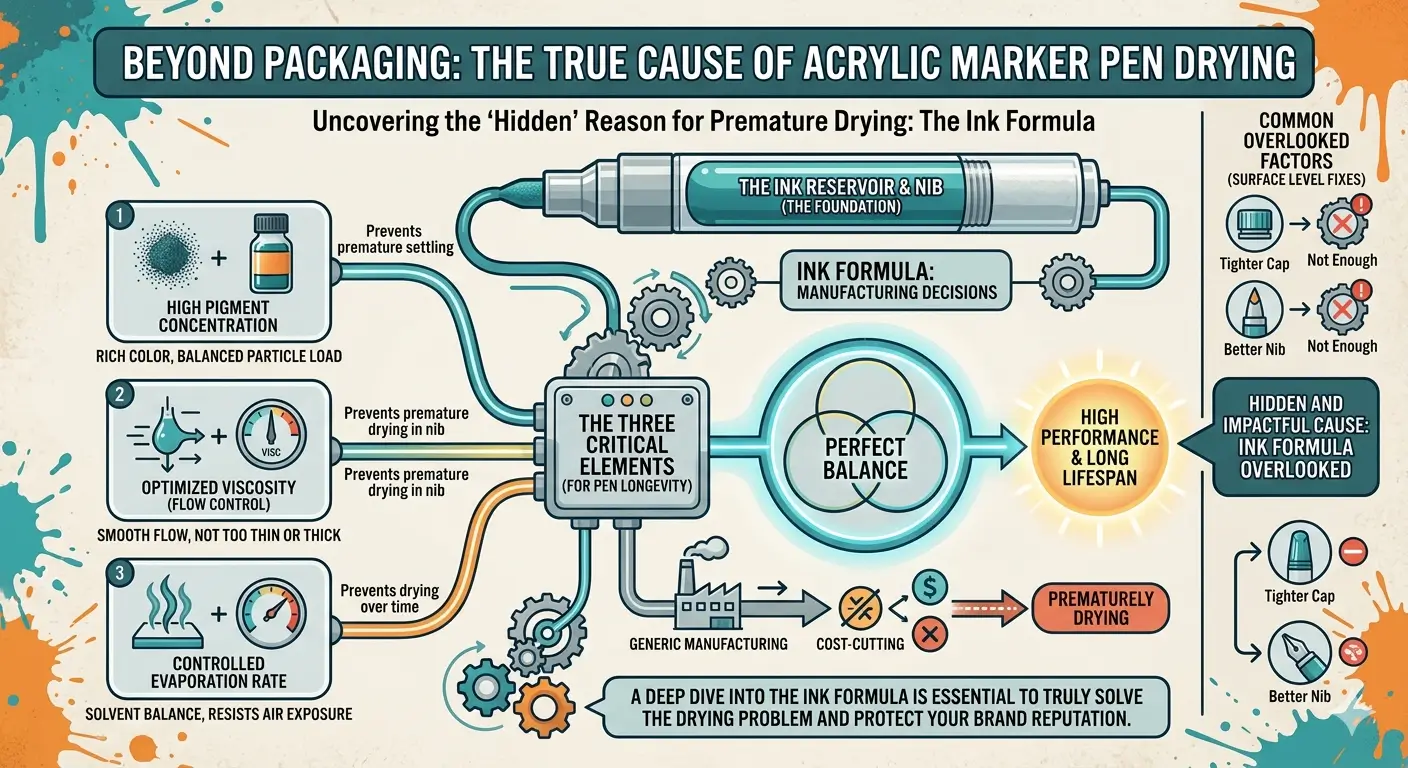
We understand the nuances of acrylic ink formulation from selecting industrial-grade pigments to adjusting solvent ratios to slow evaporation. Our expertise in ink development allows us to create formulas that keep markers usable for months reducing customer complaints and returns.
By prioritizing a high-quality ink formula you can differentiate your brand from competitors who rely on generic low-cost formulas that fail to deliver consistent performance. The key takeaway is that the ink formula is not an afterthought but the most important factor in preventing acrylic marker pens from drying out too fast.
Ignoring it means continuing to deal with the costs of returns negative reviews and lost customer trust. Investing in an optimized ink formula on the other hand ensures that your markers perform reliably turning first-time buyers into repeat customers and building long-term brand loyalty.
This is where many brands fall short they focus on marketing and packaging but neglect the one component that truly determines a marker’s lifespan the ink itself. With our factory expertise in ink formulation and supply chain management we can help you avoid these pitfalls creating acrylic markers that stand out for their durability and performance.
Whether you’re a small brand just starting out or a larger company looking to improve product quality our team has the knowledge and resources to optimize your ink formula and solve the root cause of premature drying. Don’t let overlooked ink formula issues hold back your business address the problem at its source and deliver a product that keeps customers coming back for more.
Low-Quality Acrylic Ink vs Industrial Grade Ink
Many brands wonder why some acrylic markers last for months while others dry out in just two weeks the answer often comes down to the difference between low-quality acrylic ink and industrial grade ink. This gap is most evident in three key areas pigment concentration viscosity and solvent evaporation rate each directly impacting how long the marker remains usable.
Pigment Concentration: The Foundation of Ink Stability
Low pigment concentration is a common issue in cheap inks manufacturers use less pigment to cut costs leading to a thinner ink consistency. This thinner ink evaporates much faster than ink with higher pigment levels because there are fewer solid particles to retain moisture. The result is a marker that dries out after just a few uses with the nib hardening and ink stopping flow entirely.
Industrial grade ink by contrast uses a high pigment concentration that creates a more stable mixture the solid particles lock in moisture slowing evaporation and ensuring the ink stays wet in the nib for longer.
Read more:Top Acrylic Marker Pen Manufacturers in China
Viscosity: Balancing Flow and Evaporation
Low-quality inks often have inconsistent viscosity being too thin to cling to the nib properly. When the ink is too thin it evaporates quickly from the nib and even seeps out of the pen leading to both waste and premature drying. Industrial grade ink is formulated with precise viscosity levels thick enough to adhere to the nib and prevent rapid evaporation but thin enough to flow smoothly during use.
Solvent Evaporation Rate: The Hidden Drying Culprit
Finally solvent evaporation rate is a make or break factor for acrylic markers. Low-quality inks use cheap solvents that evaporate at an accelerated rate even when the pen is capped. This rapid evaporation dries out the ink inside the pen not just on the nib leaving the marker useless within weeks.
Industrial grade inks use high-quality solvents with a controlled evaporation rate designed to slow moisture loss even in less than ideal storage conditions. In bulk production reducing ink cost by just a small percentage can significantly shorten the marker lifespan. Brands that opt for low-quality ink to save money end up paying more in the long run due to returns negative reviews and lost repeat business.
- Many brands wonder why some acrylic markers last for months while others dry out in just two weeks the answer often comes down to the difference between low-quality acrylic ink and industrial grade ink. This gap is most evident in three key areas pigment concentration viscosity and solvent evaporation rate each directly impacting how long the marker remains usable.
- Low pigment concentration is a common issue in cheap inks manufacturers use less pigment to cut costs leading to a thinner ink consistency. This thinner ink evaporates much faster than ink with higher pigment levels because there are fewer solid particles to retain moisture. The result is a marker that dries out after just a few uses with the nib hardening and ink stopping flow entirely.
- Industrial grade ink by contrast uses a high pigment concentration that creates a more stable mixture the solid particles lock in moisture slowing evaporation and ensuring the ink stays wet in the nib for longer. Next viscosity or the thickness of the ink plays a critical role in preventing drying.
- Low-quality inks often have inconsistent viscosity being too thin to cling to the nib properly. When the ink is too thin it evaporates quickly from the nib and even seeps out of the pen leading to both waste and premature drying. Industrial grade ink is formulated with precise viscosity levels thick enough to adhere to the nib and prevent rapid evaporation but thin enough to flow smoothly during use.
- Finally solvent evaporation rate is a make or break factor for acrylic markers. Low-quality inks use cheap solvents that evaporate at an accelerated rate even when the pen is capped. This rapid evaporation dries out the ink inside the pen not just on the nib leaving the marker useless within weeks.
- Industrial grade inks use high-quality solvents with a controlled evaporation rate designed to slow moisture loss even in less than ideal storage conditions. In bulk production reducing ink cost by just a small percentage can significantly shorten the marker lifespan. Brands that opt for low-quality ink to save money end up paying more in the long run due to returns negative reviews and lost repeat business.
Fast-Drying vs Over-Drying: Where It Goes Wrong
A common misconception in the acrylic marker market is that fast drying equals a better product but this couldn’t be further from the truth. There is a critical difference between a fast drying acrylic marker that performs well and one that over dries leading to premature failure.
The Difference Between Fast Drying and Over Drying
Understanding this distinction is key to solving the problem of marker dries too quickly and improving paint pen lifespan. A high-quality fast drying acrylic marker dries on the surface within seconds after application this is intentional and desired by users who want to avoid smudges and work efficiently.
This type of fast drying is achieved through a balanced ink formula that dries on the paper or surface quickly but remains wet in the nib when the pen is capped. Over drying on the other hand happens when the ink in the nib or inside the pen dries out entirely making the marker unusable even if it’s barely been used.
Why Over Drying Happens: Supplier Shortcuts
This is not a feature but a flaw caused by poor ink formulation or manufacturing shortcuts. The issue often arises when suppliers prioritize the marketing appeal of fast drying without considering long-term usability. Many suppliers optimize for fast drying in marketing but ignore long-term usability focusing solely on how quickly the ink dries on the surface while neglecting the ink’s ability to retain moisture in the nib.
This leads to markers that seem great at first but dry out within weeks leaving customers frustrated. Over drying occurs when the solvent evaporation rate is too high or the ink viscosity is incorrect causing the ink to dry out in the nib even when capped. This is a direct result of cutting corners in ink formulation not user error.
Learn more:Key Features of High-Quality Acrylic Marker Pens from China
Balancing Fast Drying and Long-Term Usability
By focusing on ink formulas that balance fast surface drying with long-term nib moisture you can deliver a fast drying acrylic marker that customers love one that performs well and lasts longer reducing complaints about marker dries too quickly and improving overall paint pen lifespan.
- A common misconception in the acrylic marker market is that fast drying equals a better product but this couldn’t be further from the truth. There is a critical difference between a fast drying acrylic marker that performs well and one that over dries leading to premature failure.
- Understanding this distinction is key to solving the problem of marker dries too quickly and improving paint pen lifespan. A high-quality fast drying acrylic marker dries on the surface within seconds after application this is intentional and desired by users who want to avoid smudges and work efficiently.
- This type of fast drying is achieved through a balanced ink formula that dries on the paper or surface quickly but remains wet in the nib when the pen is capped. Over drying on the other hand happens when the ink in the nib or inside the pen dries out entirely making the marker unusable even if it’s barely been used.
- This is not a feature but a flaw caused by poor ink formulation or manufacturing shortcuts. The issue often arises when suppliers prioritize the marketing appeal of fast drying without considering long-term usability. Many suppliers optimize for fast drying in marketing but ignore long-term usability focusing solely on how quickly the ink dries on the surface while neglecting the ink’s ability to retain moisture in the nib.
- This leads to markers that seem great at first but dry out within weeks leaving customers frustrated. Over drying occurs when the solvent evaporation rate is too high or the ink viscosity is incorrect causing the ink to dry out in the nib even when capped. This is a direct result of cutting corners in ink formulation not user error.
- By focusing on ink formulas that balance fast surface drying with long-term nib moisture you can deliver a fast drying acrylic marker that customers love one that performs well and lasts longer reducing complaints about marker dries too quickly and improving overall paint pen lifespan.
Poor Sealing Design: The Real Manufacturing Problem
After addressing ink formula issues poor sealing design is another critical manufacturing problem that causes acrylic marker pens to dry out too fast. Many brands overlook sealing because it is not visible to the naked eye but it directly determines whether ink stays protected from air and moisture. Even the highest quality ink will dry out quickly if the marker’s sealing design is flawed.
Customers often complain that their markers dry out even when capped a frustration that leads to returns and negative reviews.
This issue is rarely caused by user error but by inadequate sealing structures in the cap barrel or valve system. Manufacturers cutting corners on sealing components to reduce costs create a hidden flaw that hurts brand reputation and profitability.
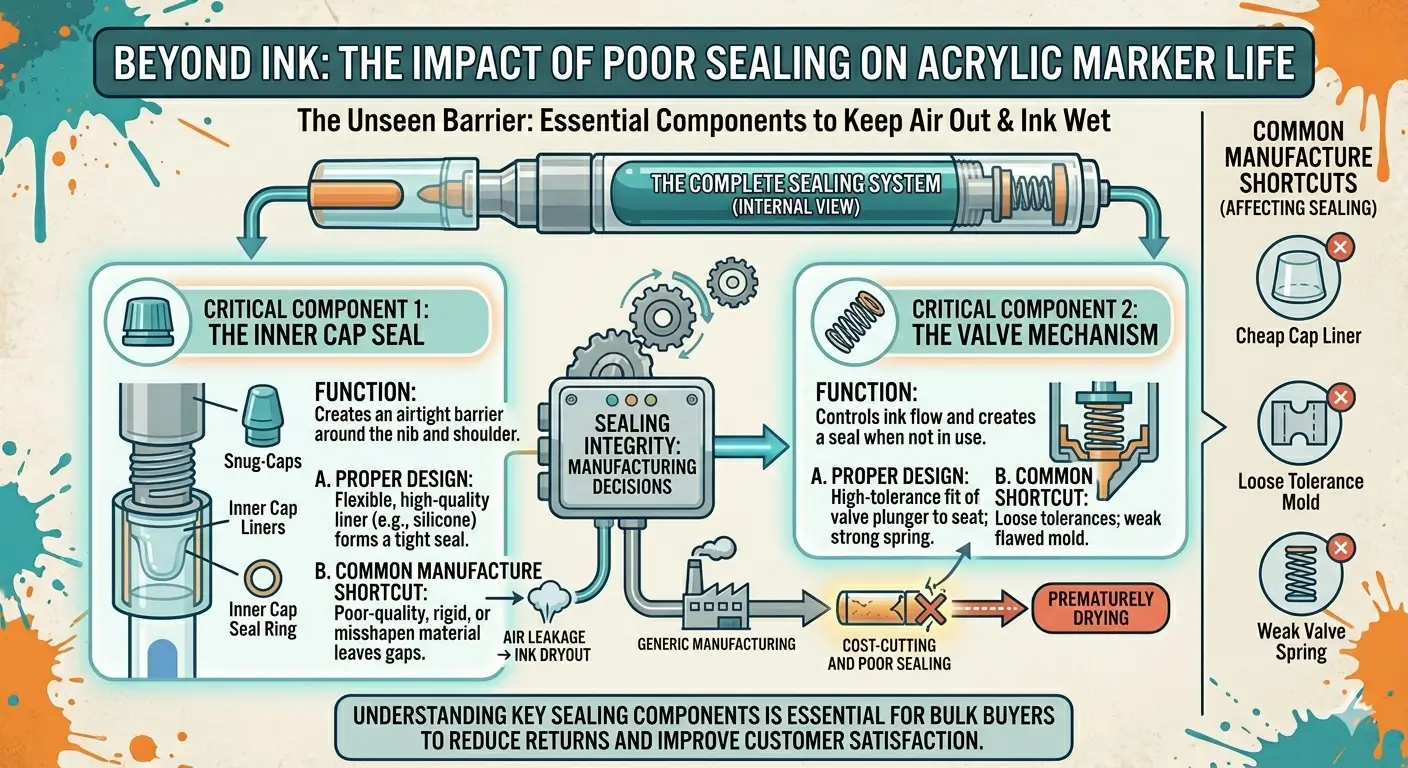
Understanding the key components of a marker’s sealing system is essential for bulk buyers looking to reduce return rates and improve customer satisfaction.
From the inner cap to the valve system every part plays a role in keeping air out and ink wet. We break down the two most critical sealing components and how manufacturing shortcuts compromise their performance.
Cap Seal Structure (Air Leakage Problem)
Many users wonder why their markers dry out with cap on even after making sure to close it tightly. The answer lies in the cap seal structure a component where many manufacturers cut costs without being noticed by casual inspection. The cap is not just a simple cover but a system designed to lock out air and prevent ink evaporation.
The inner cap is the first line of defense against air leakage. Low-quality markers use thin flimsy inner caps that do not fit snugly against the nib creating tiny gaps where air can seep in. Industrial grade markers by contrast use thick rigid inner caps that form a tight seal around the nib blocking air from reaching the ink.
Rubber seals add an extra layer of protection but cheap markers often use low-density rubber that deforms over time or fails to create a tight bond. High-quality rubber seals maintain their shape and fit ensuring no air enters even after repeated use. The type of cap closure click vs screw also impacts sealing effectiveness.
Click caps are convenient but require precise engineering to seal properly while screw caps create a more consistent seal when manufactured correctly. Two markers may look identical but the internal sealing structure is often where cost is reduced. This hidden shortcut leads to markers that dry out with cap on frustrating customers and hurting your bottom line.
Barrel & Valve System Quality
Beyond the cap the barrel and valve system are critical to maintaining proper air balance and preventing ink drying. The valve system responsible for controlling ink flow in push-to-dispense markers must also seal tightly to prevent air from entering the barrel and evaporating the ink.
Low-quality valve systems use cheap plastic components that do not form a tight seal allowing air to seep into the barrel over time. This disrupts the air balance inside the marker causing ink to evaporate faster even when the cap is on. Industrial grade valve systems use precision-machined components that maintain a tight seal ensuring consistent air balance and ink freshness.
The barrel itself also plays a role in sealing. Thin or poorly shaped barrels can warp over time creating gaps between the barrel and cap or valve system. High-quality barrels are made from durable materials that retain their shape preventing air leakage and protecting the ink inside.
For bulk buyers this is one of the most common reasons behind high return rates. Markers with flawed barrel and valve systems may work well initially but dry out quickly leading to customer complaints and returns. Investing in markers with high-quality barrel and valve systems reduces these issues saving time money and brand reputation.
User Mistakes That Make It Worse (But Not the Root Cause)
While manufacturing issues are the root cause of acrylic marker pens drying out too fast some user habits can accelerate the process.
It’s important to clarify these mistakes not to blame users but to help them extend marker lifespan. These factors can accelerate drying but they are rarely the root cause in commercial-quality markers. Understanding them also helps brands address customer questions about how to prevent acrylic markers from drying out.
Leaving cap off
One of the most common user mistakes is leaving the cap off even for short periods. When the nib is exposed to air ink evaporates much faster especially in dry environments. This can make a marker feel dry within hours but it’s not the root cause of long-term drying.
To prevent this users should get in the habit of capping the marker immediately after use. This simple step extends lifespan but won’t fix underlying manufacturing flaws that cause premature drying.
Heat exposure
Storing markers in hot environments such as near windows in direct sunlight or next to heat sources speeds up ink evaporation.
High temperatures increase solvent evaporation rate making the ink dry out faster than normal. Users should store markers in cool dry places to slow this process. Again heat exposure accelerates drying but it doesn’t cause the core issue which lies in manufacturing choices like ink formula or sealing design.
Not using regularly
Infrequent use can cause ink to settle and dry in the nib especially if the marker has poor sealing. When left unused for weeks the small amount of ink in the nib can evaporate or harden making the marker seem dry.
Users can prevent this by using the marker occasionally to keep ink flowing. This habit helps maintain usability but it won’t resolve the root cause of markers drying out too fast.
How to Choose Acrylic Marker Pens That Don’t Dry Out ?(Buyer Guide)
For bulk buyers and brands choosing acrylic marker pens that resist premature drying is critical to reducing returns negative reviews and lost profits. The key is to look beyond surface-level features and focus on the manufacturing details that determine lifespan. This guide breaks down the essential steps to select markers that stay usable for months not weeks helping you avoid costly after-sales issues and build customer trust.
Whether you’re sourcing from suppliers or evaluating existing products these tips will help you identify high-quality markers that meet customer expectations. The goal is to prioritize markers with optimized ink formulas reliable sealing and proven performance—factors that separate reputable suppliers from those cutting corners.
What to Ask Your Supplier?
When sourcing acrylic markers in bulk asking the right questions upfront can save you from future headaches. Don’t rely on marketing claims instead dig into the manufacturing details that directly impact drying issues. Start with these critical questions to evaluate your supplier’s product quality.
- What type of ink do you use in your acrylic markers and how is it formulated to prevent premature drying? Do you use industrial grade acrylic ink or low-quality generic ink with unoptimized pigment concentration viscosity and solvent evaporation rate?
- What is the shelf life of your acrylic markers when stored properly and how does this translate to usable lifespan for end users? Can you provide data on how long the markers remain functional after opening?
- Do you perform sealing tests on your markers to ensure no air leakage and if so what specific tests do you use? How do you verify that the inner cap rubber seal and valve system prevent air from entering and drying out the ink?
- What steps do you take to ensure consistent quality across batches especially when it comes to ink formulation and sealing components? Can you provide documentation of your quality control processes?
Key Certifications / Tests
Certifications and standardized tests are reliable indicators of acrylic marker quality as they ensure the product meets industry standards for performance and durability. For bulk buyers these certifications help verify that suppliers are not cutting corners on critical components.
ASTM International sets standards for acrylic markers including ink performance and durability. Markers certified by ASTM meet strict criteria for ink stability ensuring they resist premature drying and maintain consistent flow. This certification is widely recognized in North America and provides assurance of product quality.
The European Committee for Standardization also establishes guidelines for acrylic markers sold in the European market. These standards cover ink safety durability and performance including resistance to drying. Suppliers who comply with these standards demonstrate a commitment to quality and consistency.
Additionally look for suppliers who conduct regular sealing tests and ink performance tests. These tests validate that the marker’s sealing system works effectively and that the ink formula resists evaporation. Certifications and test results are tangible proof of a supplier’s ability to deliver markers that don’t dry out quickly.
Sample Testing Checklist
Before placing a bulk order testing samples is a critical step to avoid costly mistakes. Use this checklist to evaluate sample markers and ensure they meet your quality standards for resistance to drying.
- First test the sealing performance. Cap the marker tightly and store it in a normal environment for two weeks. After this period check if the nib is still wet and if the ink flows smoothly. If the nib is dry or the ink is thick the marker has poor sealing or a flawed ink formula.
- Next test the ink’s durability. Use the marker regularly for a week then set it aside for another week without use. Check if the ink still flows consistently and if the nib remains moist. This test simulates real-world use and reveals how well the ink resists drying over time.
- Evaluate the ink flow and consistency. Use the marker on different surfaces to ensure the ink flows smoothly without skipping or drying mid-use. Inconsistent flow may indicate poor ink viscosity or a low-quality nib.
- Finally check for air leakage. Submerge the capped marker in water for a few minutes and look for air bubbles. Bubbles indicate air is seeping into the marker which will cause the ink to dry out quickly. If you are sourcing acrylic markers in bulk these checks can help you avoid costly after-sales issues.
Factory Insight: What Most Suppliers Won’t Tell You
When you’re sourcing acrylic markers in bulk price competition is fierce and many suppliers cut corners to win orders. What most won’t tell you is that these cost-cutting measures directly lead to markers that dry out too fast often hidden from casual inspection. To stay competitive on price some factories quietly adjust internal components sacrificing quality for lower production costs.
Ink Cost Shortcuts
One of the most common shortcuts is reducing ink costs. Suppliers rarely mention that they use cheaper ink raw materials or adjust the formula to cut expenses. This might mean lowering pigment concentration using generic solvents or skipping the additives that slow evaporation. The result is ink that dries out quickly even with proper use and storage.
These adjustments are hard to spot because the ink color and initial flow may seem normal. Only after weeks of use do customers notice the marker drying out a problem that falls back on your brand not the supplier. Suppliers avoid discussing this because it would reveal their cost-cutting tactics and lose them orders.
Simplified Sealing Structure
Another hidden shortcut is simplifying the sealing structure. As we covered earlier proper sealing is critical to preventing air leakage but it adds to production costs. Some factories skip the inner cap entirely or use thin low-quality rubber seals that degrade quickly. Others use cheaper plastic for the cap reducing its ability to form a tight seal.
Suppliers won’t tell you that these changes make the marker prone to drying out with cap on. They may highlight the cap design in marketing but omit the fact that they’ve simplified internal components to save money. This leads to frustrated customers and high return rates for your brand while the supplier moves on to the next order.
Cheap Nibs
Cheap nibs are another common cost-cutting measure most suppliers keep quiet about. Low-quality nibs are made from thin porous materials that can’t retain ink effectively. They dry out quickly even when the pen is capped and often wear down after a few uses leading to inconsistent flow and premature drying.
Suppliers may claim their nibs are high quality but they rarely mention the material or manufacturing standards. Using cheap nibs reduces production costs significantly but it compromises the marker’s lifespan. This is a hidden detail that only becomes apparent when customers start complaining about dry markers.
Why Appearance Can Be Deceptive?
All these shortcuts have one thing in common they make the marker look identical to a high-quality product but drastically reduce its performance. That’s why two products with similar appearance can perform completely differently in real use. Suppliers rely on bulk buyers not noticing these internal changes until it’s too late.
How Bulk Buyers Can Protect Themselves?
Understanding these factory insights is critical for bulk buyers looking to avoid costly mistakes. By knowing what suppliers don’t tell you you can ask the right questions test samples thoroughly and choose partners who prioritize quality over short-term cost savings.
Conclusion: It’s Not Just Drying — It’s a Product Design Issue
Acrylic marker pens drying out too quickly is rarely the result of user error alone; it is primarily a consequence of product design and manufacturing choices.
While consumers may inadvertently leave caps off or store markers in warm environments, these behaviors only accelerate a problem that originates from poorly formulated ink, insufficient sealing, low-quality nibs, or substandard barrel and valve components. In other words, even the most careful user cannot fully compensate for a flawed design.
For bulk buyers and brands, recognizing this distinction is essential. Focusing solely on surface-level features like color variety or marketing claims can be misleading. Instead, attention must be paid to internal components, ink formulation, and the sealing system, which determine how long a marker remains functional under normal use.
Suppliers who cut corners to reduce production costs often hide these compromises behind an appearance that seems high-quality, which can result in high return rates and customer dissatisfaction.
Mitigating these issues requires informed purchasing decisions: asking detailed questions about ink chemistry, testing sealing performance, verifying nib quality, and reviewing supplier certifications.
By understanding the root causes and prioritizing markers designed for durability, buyers can reduce product failures, maintain customer trust, and protect brand reputation. Ultimately, what appears to be a simple issue of drying is actually a complex interplay of design, materials, and manufacturing integrity — a factor that must be addressed at the production level, not just through user education.