
This buyer’s guide is crafted for importers, Amazon sellers, and distributors who need to move beyond surface-level sourcing.
Instead of simply listing product features, we focus on how to mitigate sourcing risk, ensure product consistency across batches, and verify bulk order reliability so you can avoid costly missteps when selecting a supplier.
Why Quality Matters When Sourcing Acrylic Marker Pens?
A promising sample shipment is no guarantee that your bulk order won’t turn into a logistical and financial headache. In fact, this is where most importers and Amazon sellers hit trouble—because acrylic markers are particularly prone to inconsistencies that only surface at scale.
When quality fails after thousands of units land in your warehouse, the consequences go far beyond a single defective pen: Amazon listings accumulate negative reviews, return rates spike, and distributor relationships strain under the weight of customer complaints.

Bulk orders often fail due to hidden quality issues that don’t appear in small-batch samples. Without rigorous supplier controls, you may encounter:
- Inconsistent ink flow—some markers arrive over-saturated and pooling, others skip or dry out within days, creating an unpredictable user experience that generates immediate negative feedback.
- Color variation between batches—what your supplier labels as the same SKU can shift noticeably from one production run to the next, making restocking impossible without relisting or absorbing mismatch complaints.
- Nib fraying after short use—low-grade nibs that held up during sample testing may soften, split, or unravel after minimal use, turning a premium-priced product into a high-return liability.
- Leakage during shipping—poor sealing or substandard barrel construction leads to ink seepage in transit, resulting in ruined packaging, unsellable units, and frustrated customers before the product even reaches their hands.
Consider a typical scenario: an Amazon seller launches with a strong sample approval, only to have their first bulk shipment deliver pens with mismatched nib quality across the same order.
Within weeks, the listing accumulates a 3.5-star average—driven by photo reviews showing leaky barrels and streaky ink—while FBA return rates climb past 15%, triggering account warnings. For distributors, the damage appears in wholesale accounts: once retailers experience inconsistent restocks, reorder rates drop sharply, and hard-won shelf space disappears.
Below are the exact features professional buyers evaluate before confirming suppliers.
Ink Quality: The Core of Acrylic Marker Performance
While the pen body and nib design contribute to the user experience, the true soul of a reliable acrylic marker lies within the chemistry and formulation of its ink—determining not just how it looks on the first stroke, but how it performs under pressure.
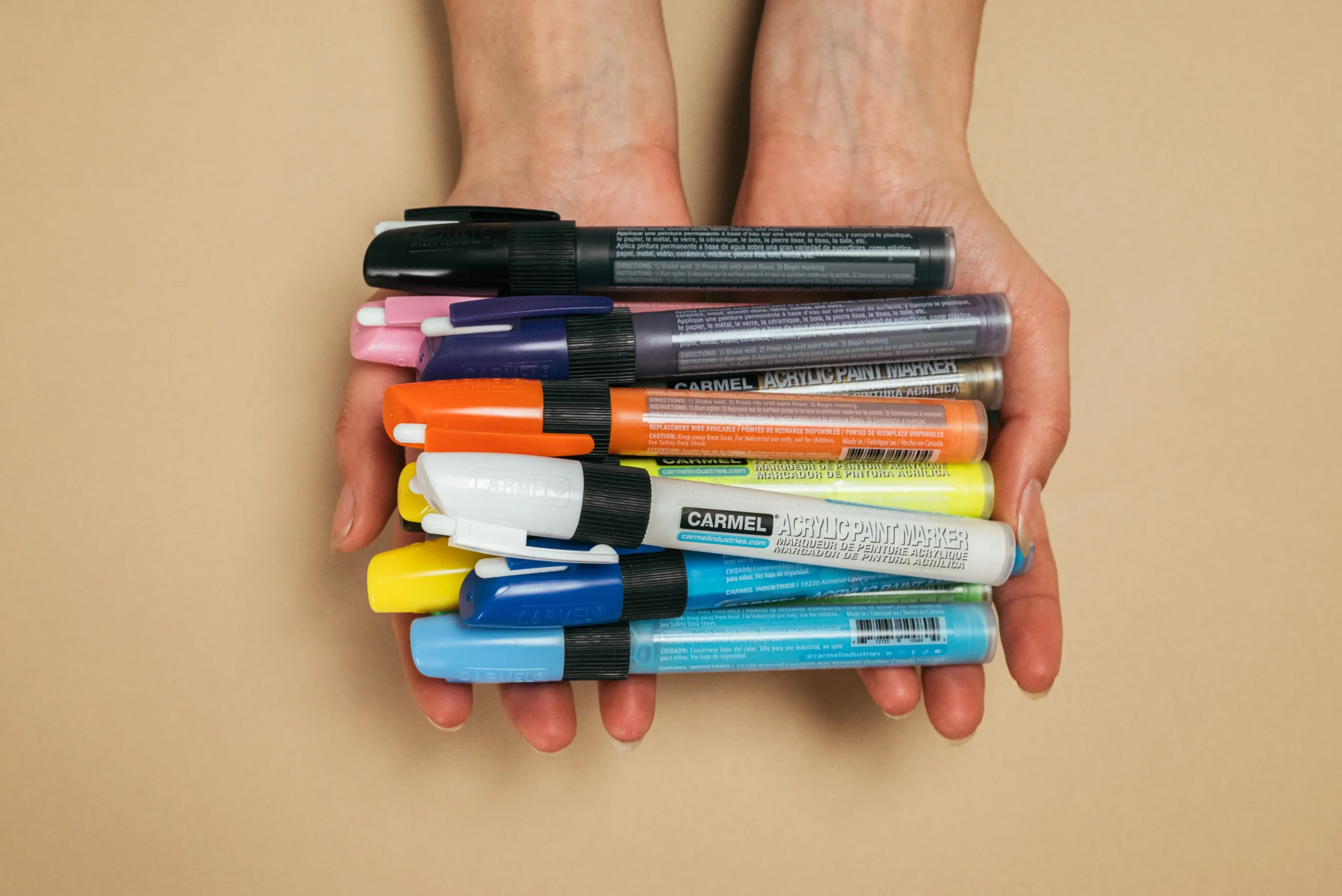
Pigment Density & Color Coverage
Can the ink fully cover dark surfaces like wood or black paper? This is the ultimate test for any acrylic marker. Coverage, often referred to as opacity, is not about how bright a color appears under studio lighting, but about its ability to physically obscure the surface beneath it.
To judge true coverage, look beyond the first stroke. A marker with low pigment load will appear streaky or translucent, requiring four to five layers to achieve solidity. In contrast, a high-quality marker with dense pigment achieves complete coverage in a single layer.
We evaluate this by distinguishing between single-layer vs. multi-layer coverage. If a marker demands multiple passes, the opacity level is insufficient for professional applications.
At our facility, we usually test opacity on different surfaces—ranging from porous wood to glossy black paper—before shipment to ensure that every color delivers a consistent, solid finish without the substrate bleeding through.
Smooth Flow & Anti-Clogging Design
Does the pen maintain stable flow after 20–30 minutes of continuous use? For artists working on large-scale pieces or detailed illustrations, the marker must keep up with their rhythm. A common frustration is when the flow slows to a trickle or stops entirely mid-stroke. This is typically caused by a poor valve system that fails to regulate air pressure, or a low-quality ink formula that dries on the nib faster than it can be dispensed.
We ensure consistent ink flow consistency by stress-testing our markers in extended sketching sessions. The design prevents marker clogging by utilizing a precision-engineered valve that releases only the necessary amount of pigment, ensuring that even after extended periods of use, the nib remains saturated and the flow remains uninterrupted.
Quick Drying & Waterproof Performance
How fast does the ink set, and will it hold up against moisture? Usability often depends on waiting time. Under normal conditions (approximately 70°F with 50% humidity), a premium acrylic ink should achieve surface dryness within 20 to 40 seconds. This allows artists to layer colors without smudging.
However, the true test is long-term durability. We evaluate water resistance after 24 hours—the time required for the acrylic polymers to fully cure. Once set, the ink should form a permanent, plastic-like layer that does not reactivate with water. To verify this, we conduct rigorous waterproof tests: running water directly over the painted surface and performing a rub test with a wet cloth to ensure zero lifting or streaking.
Test videos can be provided for verification to confirm that the final result remains as vibrant and intact as the moment it was applied.
Read more:Why Your Acrylic Marker Pens Dry Out Too Fast?
Tip (Nib) Quality: Precision & Durability
While ink quality determines the vibrancy and coverage of your work, the nib acts as the critical interface between that ink and your canvas—dictating how precisely you can execute your vision and how long your tool will maintain its integrity.
Nib Material (Fiber vs Nylon)
Which nib material is right for your application? The choice between fiber and nylon comes down to your specific usage scenario and performance expectations. Rather than simply comparing materials, here is a practical procurement guide based on market needs.
Fiber nibs are the standard choice for cost-effective, short-term use. They are typically made from compressed polyester fibers and offer a softer feel with moderate ink flow.
These are ideal for promotional products, entry-level kits, or applications where markers are used sporadically or intended for limited shelf life. However, fiber nibs tend to wear down faster under heavy pressure and may develop “mushrooming” with repeated use.
Nylon nibs, conversely, are engineered for durable, professional use. The material is harder, more resilient, and maintains its structural integrity under sustained pressure.
Nylon nibs offer superior abrasion resistance, making them suitable for high-volume production runs, professional artists, or industrial applications where markers are used daily on rough surfaces. When sourcing acrylic pen nib types, we recommend nylon for any scenario where longevity and consistent line quality are non-negotiable.
Tip Shape Options (Fine / Medium / Brush)
What tip configuration aligns with your target market? Different user segments demand distinct nib shapes, and selecting the right combination ensures your product meets the specific needs of your buyers.
- Fine Tip (0.7mm–1.5mm): This configuration targets the detail drawing segment—technical illustrators, architectural sketchers, and hobbyists who require precision for small-scale work, intricate patterns, or adding fine details to existing artwork. Fine tips excel on smooth surfaces like glass, plastic, and coated paper.
- Medium Tip (2mm–4mm): This is the general use configuration—the versatile workhorse suitable for a broad consumer base. Medium tips appeal to hobbyists, students, and casual crafters who need a balance between coverage and control. This is the ideal starting point for entry-level product lines.
- Brush Tip: Designed specifically for the art market, brush tips cater to calligraphers, illustrators, and fine artists who demand variable line width with a single pen. The flexible tip allows for both thin strokes (using the tip) and broad swaths (using the side of the brush), mimicking traditional paintbrush techniques. This shape commands a premium price point and attracts discerning, repeat customers.
Wear Resistance & Lifespan
Does the tip fray after repeated use? This single question separates disposable-grade markers from professional-grade tools. Nib wear directly impacts product lifespan and customer satisfaction—a marker with good ink remaining is useless if the tip has failed.
To evaluate wear resistance, we examine two key failure modes. The first is fraying, where individual fibers separate and protrude from the nib core, causing uneven lines and splatter. High-quality nibs, particularly nylon variants, resist fraying through tighter fiber density and superior bonding. The second is mushrooming, where the nib tip flattens and spreads under pressure, losing its original shape and precision. This typically occurs in low-density fiber nibs after moderate use.
We conduct standardized durability testing: applying consistent pressure over 100 meters of continuous use across abrasive surfaces like kraft paper and wood. Premium nibs retain their original edge geometry with no visible deformation. For quality assurance, we recommend specifying nib lifespan expectations upfront—professional-grade markers should maintain tip integrity for the full ink capacity, ensuring that the marker runs dry before the nib fails.
Safety & Compliance Standards (Critical for Importers)
Beyond performance and durability, the single factor that can make or break your entry into major markets is compliance—overlooking safety standards risks costly customs holds, marketplace delistings, and reputational damage that far outweighs the cost of proper certification.
Non-Toxic Ink Certifications
What happens if your acrylic markers lack EN71-3 and ASTM D-4236 certification? The consequences extend far beyond a rejected shipment. For importers and distributors, missing these essential certifications creates a cascade of commercial risks.
Without EN71-3 (the European standard for migration of certain elements in toys), your products cannot legally enter the EU market. Customs authorities routinely test random samples, and non-compliant shipments face immediate detention, destruction orders, or expensive re-exportation. The financial impact includes not only lost product value but also storage fees, penalties, and delayed supply chains that disrupt retailer relationships.
Similarly, the absence of ASTM D-4236 (the US standard for chronic health hazard labeling) means your products may be rejected by marketplaces such as Amazon, Walmart, and Target. These platforms require documented compliance before listing approval. Even if a shipment clears initial customs, a single customer complaint triggering a safety review can result in immediate suspension of your product listings—halting sales overnight.
For importers, the bottom line is clear: products without these certifications face market access barriers, retailer rejection, and liability exposure. We maintain full traceability from raw materials to finished goods, ensuring every batch meets these mandatory requirements.

CPSIA / EU Regulations
Which compliance framework applies to your target market? The regulatory landscape differs significantly between the United States and Europe, and understanding these distinctions is essential for successful market entry.
For the US market, CPSIA compliance (Consumer Product Safety Improvement Act) governs products intended for children under 12. Key requirements include third-party testing by a CPSC-accepted laboratory, a Children’s Product Certificate, and permanent tracking labels on packaging and products. Non-compliance can trigger mandatory recalls and substantial civil penalties.
For the European market, EU toy safety regulations (Directive 2009/48/EC) take precedence. These requirements are broader in scope, covering mechanical properties, flammability, and specific chemical limits beyond heavy metals. The documentation required includes a Declaration of Conformity and Technical File that must be retained for 10 years.
When sourcing acrylic markers, we advise importers to clearly specify their target market upfront—US-focused lines require CPSIA documentation with tracking labels, while EU-bound products need EN71 compliance with full technical files. Each framework demands distinct testing protocols and labeling structures.
Odor & VOC Levels
Does the marker’s odor impact the user experience? While safety certifications address chemical content, the sensory experience of odor directly affects customer satisfaction and perceived quality. Acrylic markers with elevated VOC levels (Volatile Organic Compounds) produce strong, solvent-like odors that can cause user discomfort—headaches, eye irritation, and complaints that drive negative reviews.
Beyond user comfort, high VOC formulations also face increasing regulatory scrutiny. Many retailers now conduct internal odor assessments as part of their quality screening process. Products with noticeable chemical smells may be flagged for further testing or rejected outright, even if formal certifications are present.
We prioritize low-VOC formulations that balance performance with a neutral odor profile. This approach serves two critical functions: it ensures comfortable use for extended creative sessions, and it reduces regulatory exposure as global standards tighten on volatile emissions.
Full compliance documentation can be provided based on your target market. Whether you require CPSIA documentation for US retail, EN71 technical files for EU distribution, or custom compliance packages for other regions, we maintain comprehensive records ready for your specific requirements.
Color Range & Customization Capability
With performance and safety standards established, the final piece of the sourcing puzzle is visual differentiation—the ability to offer the right color palette and branded presentation that sets your product apart in a crowded marketplace.
Standard Color Sets
The foundation of any acrylic marker line begins with thoughtfully curated standard sets. Common configurations include 12-color essentials (red, blue, yellow, green, black, white, and foundational hues), 24-color studio sets for broader creative flexibility, and 48+ color collections for professional artists demanding extensive palettes. These pre-designed sets offer immediate go-to-market readiness with proven sales appeal across multiple retail channels.
Custom Color Matching (Pantone)
Can you match specific brand colors or custom shades? For importers and distributors building private label lines, the ability to offer unique color palettes is a critical differentiator. Without custom color capabilities, your product remains indistinguishable from generic competitors competing solely on price.
We provide full OEM color matching based on Pantone standards, enabling you to develop proprietary color sets tailored to your brand identity or target market preferences. The process begins with you submitting Pantone references, physical samples, or digital color specifications. Our formulation team then adjusts pigment ratios to achieve precise color accuracy, producing lab-dip samples for your approval before full production.
This capability serves multiple strategic purposes. For brand owners, matching corporate Pantone colors ensures visual consistency across your product ecosystem. For retailers seeking exclusivity, custom palettes prevent direct price comparisons with competing sellers. For art market positioning, curated color sets—such as muted earth tones for illustrators or vibrant neons for street art applications—create targeted appeal that resonates with specific customer segments.
Our custom color service includes stability testing to ensure that matched formulations maintain the same opacity, flow, and drying characteristics as our standard range. We support low minimum order quantities for custom colors, allowing you to test market response before scaling.
Packaging Customization
For private label customers—particularly Amazon sellers and boutique retailers—packaging customization is essential for building brand recognition and meeting marketplace requirements. We offer comprehensive packaging solutions including custom boxes, blister cards, and display-ready cases designed to maximize shelf impact.
Key elements we support include branded packaging with your logo, SKU labeling for inventory management, barcode integration for retail and e-commerce compliance, and multilingual packaging options for international distribution. For Amazon sellers specifically, we ensure packaging meets FBA (Fulfillment by Amazon) requirements including proper carton labeling, poly bag specifications, and unitized case packs that streamline warehouse processing.
We also offer tiered packaging solutions: basic packaging for cost-sensitive entry-level products, mid-tier retail-ready boxes with window displays for increased shelf visibility, and premium gift-style packaging for high-end market positioning. Whether you require full packaging design from concept or production based on your existing artwork, we deliver consistent, professional presentation that reinforces your brand value.
Production Consistency & Quality Control
A beautiful color range and custom packaging mean nothing if the product inside varies from batch to batch—consistent quality is the foundation of brand reputation, and it begins with rigorous control systems throughout the manufacturing process.
Batch Consistency
Will the colors match across different production runs? Color variation between batches is one of the most common complaints importers face, leading to customer returns, negative reviews, and damaged brand trust. The issue typically arises from inconsistent pigment sourcing, improper dispersion during mixing, or insufficient quality checks during production.
We maintain batch consistency through strict formulation controls. Each production batch is assigned a unique lot number, and we retain wet and dry samples for reference. Color difference is measured using standardized ΔE (Delta E) testing—with an acceptable tolerance of ΔE < 1.5 for most color ranges, meaning variation is imperceptible to the human eye.
For importers, the risk of inconsistent batches extends beyond aesthetics. A set of markers sold in January that does not match the same set sold in June creates customer confusion and erodes confidence in your brand. We prevent this by sourcing pigments from approved suppliers with documented stability, and we conduct side-by-side comparisons against master samples for every batch before release.
QC Process
What quality control procedures ensure reliable product delivery? Our inspection framework operates across three critical stages: incoming materials, in-process production, and pre-shipment final inspection.
Incoming Material Inspection: Raw materials—including pigments, resins, nibs, pen bodies, and packaging—undergo verification against approved specifications before entering production. Substandard components are rejected at the source, preventing defects from propagating downstream.
In-Process Production QC: Throughout manufacturing, quality personnel monitor critical control points. Ink viscosity and density are tested during filling. Nib insertion depth and valve sealing are checked for consistency. Visual inspections identify cosmetic defects such as scratched barrels, misaligned labels, or incomplete filling before assembly completion.
Pre-Shipment Final Inspection: Before any shipment leaves our facility, we conduct random sampling based on AQL (Acceptable Quality Limit) standards. Testing includes writing performance on various surfaces, coverage verification, drying time confirmation, and packaging integrity. Only shipments meeting our quality thresholds receive release authorization.
Sample vs Bulk Difference
Why do samples sometimes differ from bulk production—and how can you prevent it? This question lies at the heart of every importer’s risk assessment. The gap between an approved sample and actual shipment is where trust erodes and disputes arise. Understanding the causes of sample-bulk discrepancy is essential for protecting your investment.
Common causes of variation include: hand-assembled samples versus automated production line differences; premium materials used in prototyping versus cost-reduced materials in mass production; and inconsistent inspection standards where samples receive meticulous attention while bulk shipments face less scrutiny.
We eliminate these risks through a disciplined approach. First, we produce samples using the same production lines and materials as mass orders—not handcrafted prototypes. Second, we provide a “golden sample” that serves as the binding quality reference for both parties. Third, our QC team applies identical AQL standards to samples and bulk shipments, ensuring that what you approve is what you receive.
For importers, the safeguard is simple: never approve a sample without confirming it was produced under standard manufacturing conditions. We document every production parameter—from ink formulation to nib specifications—and maintain traceability to guarantee that bulk orders replicate approved samples with no deviation. This eliminates the uncertainty that plagues sourcing relationships and ensures predictable, repeatable quality order after order.
Why Many Buyers Choose Acrylic Marker Pen Manufacturers in China?
When evaluating sourcing origins for acrylic markers, the concentration of manufacturing capabilities in China is not accidental—it reflects a structural ecosystem that addresses the core priorities of importers and brand owners.
Supply Chain Integration
The acrylic marker production process relies on a complex web of components: specialty pigments, precision nibs, valve systems, plastic bodies, and packaging materials.
China’s manufacturing clusters—particularly in Guangdong and Zhejiang provinces—house vertically integrated supply chains where these components are produced within close geographic proximity.
This consolidation reduces lead times, simplifies quality control coordination, and minimizes the logistical complexity of managing multiple suppliers across different regions. For importers, this means faster turnaround from order placement to shipment.
Cost Control
Economies of scale remain a fundamental advantage. Established manufacturers produce marker components in volumes that individual importers cannot replicate independently.
This scale translates into material cost advantages that are passed forward. Additionally, the concentration of labor and technical expertise in manufacturing hubs enables competitive production costs without necessarily compromising quality—provided the importer works with factories that maintain proper quality management systems.
The result is a price-to-performance ratio that supports competitive retail positioning across entry-level, mid-range, and professional product tiers.
OEM Flexibility
Perhaps the most critical advantage for brand builders is OEM capability. Chinese manufacturers typically maintain in-house tooling, formulation laboratories, and packaging design teams that support extensive customization.
Whether the requirement is Pantone-matched custom colors, branded nib configurations, private label packaging, or hybrid set combinations, the flexibility exists to execute at scale.
This allows importers to differentiate their product lines, control branding, and build long-term asset value rather than reselling generic inventory.
For Amazon sellers, boutique brands, and established art supply distributors alike, this OEM infrastructure transforms a standard commodity into a proprietary product.
How to Verify Acrylic Marker Quality Before Bulk Order?
Before committing to a large-scale purchase, taking systematic steps to validate product quality can prevent costly mistakes—here is a practical checklist to evaluate acrylic marker performance and supplier reliability before placing your bulk order.
Request Samples Under Realistic Conditions
The first and most critical step is obtaining samples that accurately represent what you will receive. Always request samples produced on the same production line intended for bulk orders, not hand-assembled prototypes. Test these samples on the actual surfaces your customers will use—whether that is wood, canvas, glass, or black paper—rather than relying on manufacturer-supplied demo sheets.
For private label brands, request samples with your custom packaging, labels, and any Pantone-matched colors to confirm that finishing details align with your specifications before production begins.
Test Ink Performance with Objective Criteria
Beyond surface-level impressions, verify ink performance using measurable standards. Test coverage by drawing a single stroke across dark construction paper or a wood surface—look for solid opacity without streaking or translucence.
Test flow consistency by using the marker continuously for 15–20 minutes; quality markers maintain steady ink delivery without sputtering or requiring repeated priming. Test drying time on non-porous surfaces like glass or coated paper; premium acrylic markers typically set within 20–40 seconds.
Finally, conduct a water resistance test after 24 hours—rub a damp cloth across dried ink to confirm it does not lift, streak, or reactivate.
Verify Certifications Against Your Target Market
Request full documentation of safety certifications and verify their validity. For US-bound products, confirm ASTM D-4236 labeling and, if applicable, CPSIA compliance with third-party testing documentation. For EU markets, verify EN71-3 test reports and ensure the supplier can provide a Declaration of Conformity.
Do not accept verbal assurances—review actual test reports from accredited laboratories, confirm that the testing covers the specific batch represented by your samples, and ensure the supplier can provide fresh documentation for your bulk order tied to your production run.
Compare Batch Consistency Across Multiple Units
A single sample unit does not reveal consistency. Request at least 5–10 sample units and evaluate them against each other. Check for color variation across units—hold them side by side under consistent lighting to detect mismatches.
Test nib performance across multiple pens; inconsistent nib wear or flow indicates poor quality control. If possible, request samples from two different production batches to assess how well the supplier maintains color matching and performance standards between runs.
For final validation, retain a golden sample (one approved unit signed off by both parties) that serves as the binding quality reference for your bulk order inspection.
By following this checklist—requesting representative samples, testing ink with objective criteria, verifying certifications, and confirming batch consistency—you minimize the risk of receiving substandard product and establish clear quality expectations with your supplier before production begins.
Conclusion: How to Choose the Right Acrylic Marker Pens Supplier?
Across performance, safety, customization, and consistency, the common thread is clear—choosing a supplier requires shifting focus from product features alone to the systems that ensure those features are delivered reliably.
The decision logic ultimately rests on three questions. First, does the supplier demonstrate control over batch-to-batch consistency, or are you accepting variation as inevitable? Second, can they provide documented quality processes—from incoming material inspection to pre-shipment AQL testing—rather than relying on post-shipment promises? Third, does their OEM capability align with your brand roadmap, allowing you to scale from standard sets to custom colors and packaging as your business grows?
The right supplier is not simply the one offering the lowest unit price, but the one whose production systems, quality controls, and customization flexibility match your market positioning and growth trajectory.
If you’re comparing suppliers, we can share a detailed evaluation checklist to guide your assessment. If needed, we can also provide multi-batch samples for testing, allowing you to verify consistency before making your final decision.