
On Amazon, the educational toys that continue to be reordered cycle after cycle are not short-term viral hits.
They are products supported by long-term search demand, low return rates, scalable SKU expansion, and sustained trust from parents and educators.
The categories that consistently appear in repeat purchase data include Montessori toys, magnetic tiles, busy boards, STEM learning kits, flash cards, and preschool learning toys.
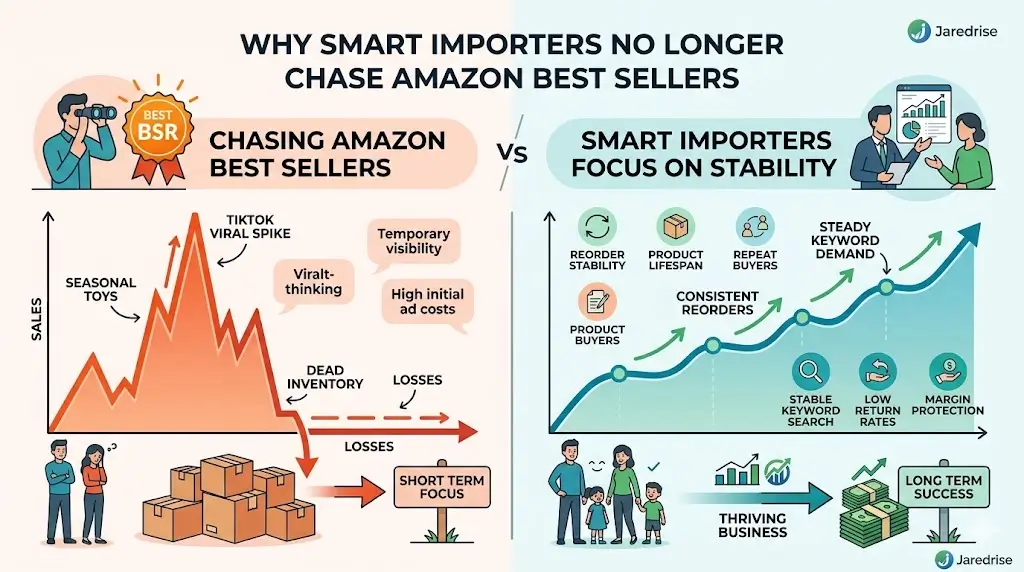
Why Smart Importers No Longer Chase Amazon Best Sellers?
Many educational toy importers make the same mistake. They assume an Amazon Best Seller badge automatically indicates a strong long-term product opportunity. Experienced buyers, however, focus far more on reorder stability than on temporary sales spikes.
A toy can climb to the top of the charts for reasons that have nothing to do with lasting demand.
TikTok virality can trigger a sudden wave of orders, but that wave almost always fades quickly. What appears to be a winning product during a trend surge often turns into dead inventory within weeks. Seasonal toys spike during holiday periods and then disappear from search results.
Novelty items attract attention once, but parents rarely repurchase the same product after the surprise factor disappears. IP-driven toys can be even riskier because a change in media popularity or licensing agreements can instantly destroy demand.
At Jaredrise, we have seen many Amazon sellers build their entire inventory strategy around BSR rankings while ignoring the patterns that actually determine reorder consistency.
A high Best Seller Rank on a specific day says nothing about whether the product will still generate stable revenue six months later.
What truly matters is whether the underlying search demand remains stable, whether repeat buyers continue to exist, and whether return rates stay low enough to protect margins.
Importers who focus only on the first order cycle often fall into a predictable trap.
The initial shipment sells through because the listing is new and the algorithm provides temporary visibility.
Then the second shipment arrives and momentum disappears. Advertising costs rise, organic rankings decline, and review growth slows down.
The product that initially looked like an obvious winner suddenly becomes a liability.
A more mature sourcing strategy evaluates reorder frequency, product lifespan, and keyword demand stability long before placing a purchase order.
Learn more:Which Educational Toys Have the Highest Repeat Purchase Rate?
The Biggest Mistake Educational Toy Importers Make
Too many buying decisions are driven by surface-level signals. Importers chase Amazon Best Seller badges, TikTok trending lists, and seasonal spikes without asking what happens after the initial demand fades. It is easy to be impressed by one month of strong sales while ignoring what comes next.
The real danger does not appear in the first shipment. It appears when the second order sits in an FBA warehouse with declining velocity, when advertising costs consume already thin margins, when review growth stagnates, and when organic rankings become unstable because the underlying search volume is collapsing.
These outcomes are not hypothetical. Dead inventory, shrinking margins, and unstable rankings are exactly what happen when a product lacks evergreen demand signals.
Mature importers operate with a completely different mindset. They do not simply ask what is selling today.
They ask what parents and educators consistently search for year after year, which products generate repeat purchases as children progress through developmental stages, and which categories support long-term private label brand building instead of one-off transactions.
This shift in thinking separates stable supply chains from constant guesswork.
What Educational Toys Are Importers Reordering Repeatedly on Amazon?
The educational toys with the strongest reorder performance usually share several key characteristics.
They maintain stable search demand across seasons and years, keep return rates well below category averages, support expandable product lines that increase average order value over time, and provide long-term educational value trusted by parents and schools.
The following categories consistently meet these conditions.
Montessori Toys
Montessori is no longer a passing trend. It is a deeply established educational philosophy that has generated stable search demand for more than a decade.
Parents actively search for Montessori materials because they associate the approach with self-directed learning, screen-free activities, and sensory development.
These associations are not weakening. In fact, they are becoming even stronger as more families look for alternatives to digital entertainment.
From a sourcing perspective, Montessori toys offer something trend-driven products cannot provide: evergreen keyword demand.
Montessori baby toys, Montessori toddler materials, and Montessori sensory boards continue to maintain search volume year after year.
Parents also tend to purchase across multiple age groups, creating natural repeat purchase behavior within the same brand ecosystem.
A customer who starts with an infant grasping toy is highly likely to return later for practical life sets or math manipulatives as the child grows.
Importers building long-term brands increasingly expect suppliers to provide more than simple wooden products.
Buyers look for FSC-certified wood materials, consistent finishing quality, and packaging that reflects the premium brand image they want to establish on Amazon.
A factory capable of maintaining uniform color tones and finishing consistency across production batches helps reduce review risks caused by inconsistent product presentation.
Learn more:Best educational toys for 3 4 year olds supplier amazon
Magnetic Tiles
Magnetic tiles represent one of the strongest reorder categories in educational toys because the product naturally encourages expansion.
A child rarely stops with a single set. As building skills develop, children need more pieces, new shapes, and expansion packs to create larger and more complex structures.
This natural upgrade path is rare in the toy industry and extremely valuable for Amazon sellers focused on increasing customer lifetime value.
Compatibility is critical in this category. Once a family purchases a starter set, every future purchase must connect seamlessly.
Importers sourcing magnetic tiles understand that consistent magnet strength, standardized piece dimensions, and accurate color matching across production runs directly affect whether customers return for expansion packs or leave negative reviews.
Schools and learning centers create an additional layer of repeat demand because they purchase classroom quantities and frequently expand collections over multiple budget cycles.
The private label opportunity in this category is substantial. A well-designed magnetic tile line with carefully structured expansion sets, family bundle upgrades, and accessory packs creates a product ecosystem that competitors struggle to replace.
Jaredrise has observed that magnetic tile products designed from the beginning with expansion-focused packaging concepts tend to achieve significantly higher reorder rates than standalone box sets that fail to suggest a logical next purchase. This is not simply about adding more pieces.
It is about structuring the product so the first purchase naturally leads to the second.
Busy Boards
Busy boards succeed for one very simple reason. Parents value quiet, screen-free, portable activities that keep children engaged during travel, waiting periods, or moments requiring independent play.
The product aligns so closely with customer expectations that return rates remain low.
Its functionality is simple, immediately visible in product images, and broad enough in age range that a single purchase can remain useful for an extended period.
What makes busy boards especially attractive for repeat imports is their adaptability.
Felt material options, customized themes such as animals or outer space, and personalization features allow importers to differentiate listings in a category that rewards creative presentation.
A supplier capable of offering OEM design support and consistent packaging quality makes it much easier for Amazon brands to launch variations without fragmenting the customer experience.
STEM Learning Toys
The demand for STEM toys does not come solely from parents. Schools, homeschooling networks, and learning centers generate consistent institutional purchasing that is far less dependent on social media trends. Once a curriculum adopts a specific type of STEM kit, the reorder cycle becomes predictable and often extends across multiple academic years.
Products in this category typically enjoy longer lifecycles because educational outcomes are much harder to replace than entertainment value.
A building set that genuinely teaches engineering concepts or a science kit aligned with common educational standards can remain relevant for a decade.
The key barrier is certification. Serious buyers expect ASTM, CPC, and EN71 compliance as a baseline requirement. Classroom environments also demand a level of durability beyond standard home usage.
Suppliers capable of demonstrating reliable product performance under heavy repeated use gain trust very quickly because institutional buyers cannot afford disruptions caused by failed materials.
Flash Cards and Phonics Toys
Flash cards possess an important characteristic that many importers overlook: they wear out. Cards become bent, lost, or stained, which naturally drives replacement purchases. This consumable nature creates a rare and highly valuable reorder cycle within the toy industry.
Different developmental stages also generate repeat purchases within the same brand.
Parents may begin with first-word cards, progress to phonics sets, and later purchase sight-word packs or math flashcards. Each stage creates a new buying trigger.
Production costs are generally low, allowing importers to operate replenishment programs with minimal inventory risk.
Custom printing, educational packaging designed for at-home learning routines, and language localization options further open the door to OEM partnerships across multiple markets and age groups.
Why Some Educational Toys Sell Fast But Never Get Reordered?
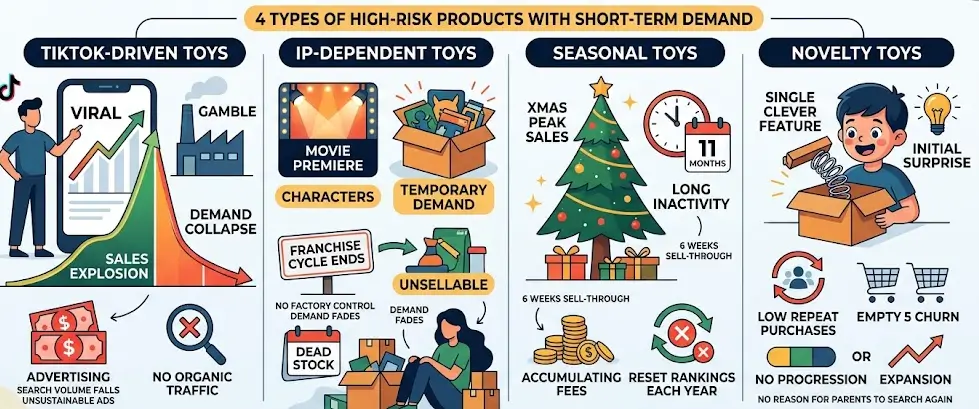
The difference between a fast-selling toy and a consistently reordered product is enormous, and understanding this gap protects importers from expensive inventory mistakes. Several types of products generate strong initial sales but rarely produce stable second and third orders.
TikTok-driven toys are the clearest example. A single viral video can empty an entire warehouse, but the search volume behind the product usually collapses as quickly as it rises.
There is no accumulated keyword demand to support long-term organic rankings, and advertising costs become unsustainable once the trend disappears.
Importers who source products purely because of a social media surge are gambling rather than building a reliable sourcing strategy.
IP-dependent toys carry a different but equally dangerous risk. A movie or television show can suddenly drive massive demand for character-based products, but once the franchise cycle ends, the same products become nearly impossible to sell.
No factory controls the licensing timeline, and no Amazon seller can rebuild demand after the cultural momentum fades.
Seasonal toys create sharp sales spikes followed by long periods of inactivity. A Christmas-themed educational toy may sell extremely well for six weeks and then remain stagnant for the next eleven months, accumulating storage fees and losing Buy Box eligibility.
The annual reset in search demand means rankings must be rebuilt from scratch every season.
Novelty toys built around a single clever feature often suffer from extremely low repeat purchase rates. Once the surprise factor is gone, children rarely ask for the product again. There is no progression, no expansion opportunity, and no reason for parents to search for the same category repeatedly.
These products may achieve impressive initial conversion rates but fail to build sustainable brands because the customer base constantly churns.
The common pattern behind all of these categories is short-term demand, high inventory risk, and declining search volume. Importers who recognize these patterns stop asking what is popular today and start asking what will remain durable over time.
Learn more:Educational Toys Types, Benefits, Materials & Learning Impact Explained
How Experienced Amazon Importers Evaluate Reorder Potential?
The way professional importers evaluate educational toy products goes far beyond checking the current BSR. It involves systematically analyzing signals that indicate whether demand will remain stable, margins will stay healthy, and reorders will continue to make financial sense across multiple sales cycles.
Review growth patterns reveal much more than an overall rating. A product that generates reviews at a steady pace over many months usually reflects stable organic sales. In contrast, a sudden spike in reviews followed by a long stagnant period often signals a heavily promoted launch that failed to sustain momentum.
Importers who monitor review velocity can distinguish between engineered launches and genuine long-term demand.
Return rates are non-negotiable. An educational toy with return rates above the category average will eventually trigger Amazon account health issues, increased operational costs, and weaker rankings. Experienced importers examine return reasons carefully.
If customers complain that the product failed to match expectations, the issue may lie in the packaging or listing presentation. If complaints focus on material quality, the problem likely originates from the factory. In either case, the data directly influences the next sourcing decision.
Keyword stability is one of the strongest long-term indicators of product viability. Products connected to evergreen search terms such as preschool learning toys or Montessori math materials maintain organic traffic without requiring constant advertising support.
Products built around trending phrases eventually lose visibility and become heavily dependent on paid traffic. Checking historical search volume data before committing to large inventory purchases helps prevent the mistake of building stock around temporary demand.
SKU expansion potential determines whether a product can evolve into a true brand. A single standalone product without a logical upgrade path or complementary variations limits customer lifetime value.
When experienced importers evaluate a product, they immediately map out the next three complementary SKUs that could naturally follow the initial purchase. If that roadmap does not exist, the product is often just a one-time transaction.
Advertising dependency acts as the final filter. If a product category consistently requires aggressive PPC spending to maintain visibility regardless of organic ranking strength, the remaining profit margin after ad costs may become unsustainable.
Importers with deep Amazon experience generally prefer categories where organic keyword retention allows advertising to function as a growth accelerator instead of a survival expense. Monitoring repeat buyer behavior, review consistency, and competitor pricing stability completes the evaluation process.
This framework requires far more effort than reacting to a trend alert, but it consistently filters out products that appear profitable for one shipment and become liabilities by the third.
What Makes Educational Toys Easier to Build Into a Long-Term Brand?
Some educational toys are naturally better suited for long-term brand building, and the difference comes down to how the underlying demand behaves. Products supported by non-seasonal demand, parent-driven search behavior, and authentic educational value create the conditions necessary for a brand to accumulate long-term equity instead of constantly restarting with every new trend.
When search demand is evergreen, investments in listing optimization, review generation, and brand awareness continue to compound over time. Each month of sales strengthens the next because organic rankings improve and the customer base expands.
Parent-led search behavior is especially valuable because parents typically research extensively before making a purchase. They compare products, read descriptions carefully, and remember the brands that consistently deliver quality.
Educational value adds a level of trust that entertainment-focused toys struggle to replicate. When parents believe a product genuinely contributes to their child’s development, they are more likely to make repeat purchases across different age groups and skill levels within the same brand ecosystem.
This cross-category loyalty forms the foundation of a sustainable private label strategy.
An expandable product ecosystem multiplies the effect. A brand that begins with toddler puzzles and gradually expands into preschool learning games, early math tools, and science kits continues acquiring new customers while simultaneously increasing revenue from existing ones.
The keyword portfolio grows with every additional product, and the brand steadily captures more search visibility across related categories. This is not a short-term tactic. It is a structural advantage that becomes increasingly difficult for competitors to challenge over time.
How Chinese Educational Toy Factories Can Help Importers Reduce Risk?
A stable supply chain protects an importer’s Amazon business far more than most people realize, and the difference between a transactional factory and a long-term manufacturing partner becomes increasingly obvious as order volumes grow.
Consistent quality control across production batches prevents the review disasters that can destroy a listing’s momentum. When customers reorder the same product and receive noticeably different color tones, finish quality, or packaging, negative reviews appear quickly. Factories that maintain strict batch consistency and document their QC processes make it possible for importers to scale confidently.
Packaging consistency is often overlooked until it creates operational problems. Carton dimensions that change between shipments can trigger FBA prep discrepancies, additional fees, and inventory delays.
Importers who have dealt with inconsistent carton sizes or unreliable inner packaging understand that predictable packing specifications are a critical form of operational risk management.
Lead time stability is just as important as pricing. A factory that consistently delivers within agreed production windows allows importers to manage FBA inventory efficiently without suffering expensive stockouts or long-term storage fees.
Delayed replenishment can erase months of ranking progress. Suppliers that communicate production schedules transparently and proactively flag potential delays function as strategic partners rather than simple vendors.
Certification support is essential for both U.S. and European markets. Suppliers that stay updated on ASTM, CPC, and EN71 requirements and can provide documentation quickly remove a major compliance burden from the importer.
This becomes even more important as product lines expand and certification requirements become more complex.
OEM flexibility is what enables private label brands to evolve. A factory capable of adjusting materials, themes, and packaging based on market feedback helps importers remain competitive without constantly changing suppliers.
Real manufacturing challenges such as mixed-color batches, carton inconsistencies, and failed FBA prep requirements are the situations that reveal whether a factory relationship can support long-term growth. A manufacturing partner that consistently solves these problems instead of repeating them is ultimately worth far more than a slightly lower unit price on an initial order.
Final Thoughts on the Toys Importers Reorder for Years
The most profitable educational toy on Amazon is not the product that spikes for a few weeks and then disappears. It is the product that sells steadily, reorders consistently, and builds a brand customers return to repeatedly.
Importers who shift their focus away from chasing viral trends and toward identifying stable reorder patterns typically achieve healthier margins, lower inventory risk, and supply chains that increase in value over time.
Parent purchasing behavior continues to favor educational value, screen-free engagement, and products that grow alongside the child.
These preferences are not driven by social media cycles. Evergreen learning toys remain stable because they fulfill consistent needs that parents and educators experience year after year.
Importers searching for long-term educational toy partnerships increasingly prioritize stable reorder support, reliable quality control, and scalable OEM capabilities over short-term pricing advantages.
This shift is not simply a preference. It reflects the understanding that real profitability in this category comes from years of repeat business rather than a single successful season.