
This article is not about ordinary children’s toys, but about a fast-growing category of parent-driven educational consumption. On Amazon, educational toys for 3-4 year olds continue to outperform many traditional toy segments, not because of population growth, but because parents increasingly see toys as developmental tools rather than simple entertainment products.
For B2B buyers, this shift changes how educational toys should be sourced, positioned, and marketed. Today’s parents are no longer only looking for fun products.
They actively search for toys that reduce screen time, improve concentration, develop fine motor skills, and support early learning in areas such as math, language, and problem-solving. As a result, categories like Montessori toys, STEM toys, sensory toys, and screen-free learning products have become some of the most commercially stable segments on Amazon.
The educational toys with long-term sales potential are usually not the most complicated products. The strongest performers are products that allow parents to quickly recognize visible developmental benefits.
For suppliers, this creates a major opportunity: products with clear educational positioning tend to achieve stronger conversion rates, better repeat purchases, and higher trust from both Amazon sellers and end consumers.
Why Educational Toys Are Still One of Amazon’s Most Profitable Categories in 2026?
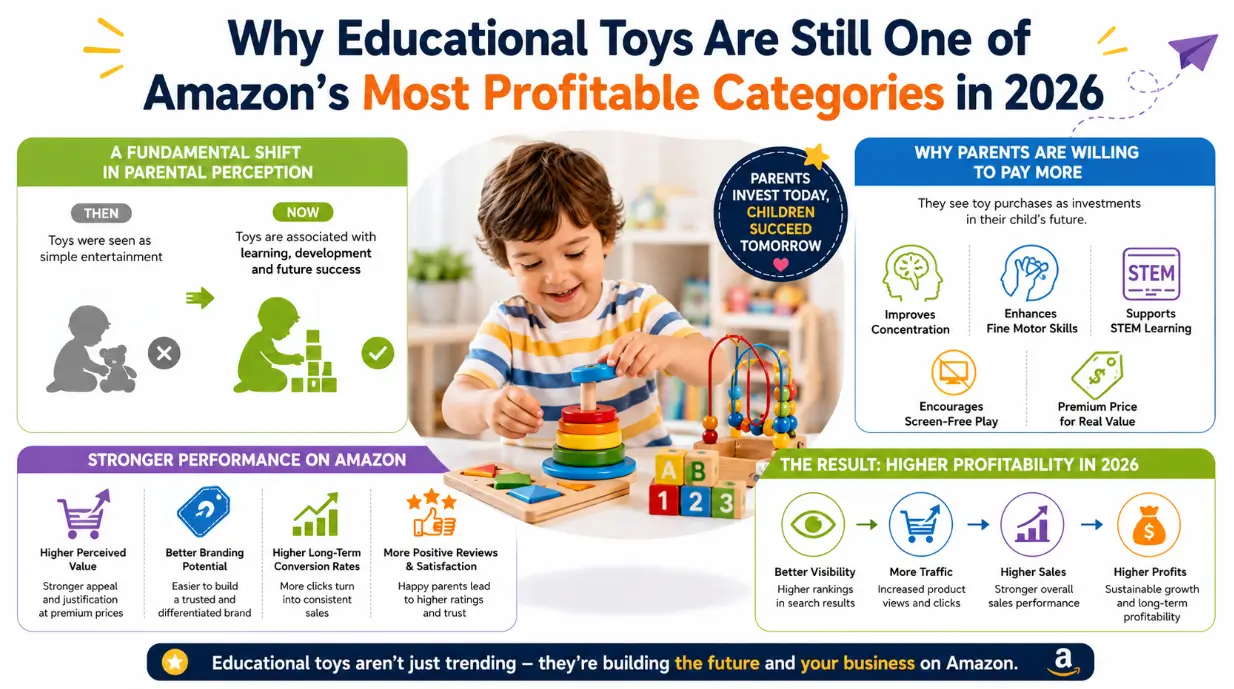
Educational toys continue to outperform many traditional toy categories on Amazon in 2026, maintaining their position as one of the platform’s most profitable segments. This sustained growth is rooted in a fundamental shift in parental perception.
Parents increasingly associate toys with learning outcomes, creativity, and child development rather than simple entertainment. The days when toys were viewed merely as distractions are largely gone.
Today’s parents see toy purchases as investments in their child’s future and are willing to pay premium prices for products that deliver educational and developmental value.
As a result, products positioned around concentration, fine motor skills, STEM learning, and screen-free play often achieve stronger perceived value, better branding potential, and higher long-term conversion rates on Amazon.
These products also tend to generate better customer satisfaction and more positive reviews, which further strengthen visibility and sales performance on the platform.
Learn more:Which Educational Toys Have the Highest Repeat Purchase Rate?
Parents Are Buying Development, Not Just Toys
For many parents, educational toys are no longer considered optional entertainment products that can easily be replaced. Instead, they are increasingly viewed as essential tools that support cognitive development, creativity, concentration, and independent learning—skills that form the foundation for future academic and personal success. Modern parents face growing concerns about excessive screen time, shrinking attention spans, and passive entertainment habits.
- Educational Toys Types, Benefits, Materials & Learning Impact Explained
- Educational Toys Properties and Applications
- Factors affecting educational toys for 3-4 year olds supplier price
With the widespread use of digital devices, many children spend hours each day consuming short-form content or playing repetitive games, which can negatively affect focus and real-world interaction. This anxiety encourages parents to seek more meaningful alternatives, which is why Montessori toys, sensory toys, and STEM toys continue gaining popularity. go
This shift in parental priorities explains why developmental positioning has become one of the strongest selling points in Amazon’s preschool toy market, with products emphasizing educational value consistently outperforming toys marketed purely around fun.
Why Educational Positioning Creates Higher Profit Margins?
Educational branding often increases perceived product value because parents are more willing to spend money on toys associated with learning, skill development, and long-term child growth. This willingness directly contributes to higher profit margins, as educational toys are frequently priced 20-50% higher than conventional toys of similar production quality. A clear example can be seen when comparing ordinary building blocks with STEM building kits.
Standard blocks are generally perceived as simple play items, while STEM kits are positioned as educational tools that teach engineering concepts, physics principles, and problem-solving skills. The difference largely comes from factors such as educational storytelling, which helps parents visualize developmental benefits, premium positioning that enhances perceived quality, parent trust established through clear educational claims, and developmental language that highlights specific skills children can improve.
Toys that resemble educational tools or Montessori materials—especially wooden toys with simple, functional aesthetics—often achieve stronger perceived value because they align with parents’ desire to provide purposeful learning experiences.
Why Amazon Sellers Continue Entering This Category?
Many Amazon sellers continue expanding into the educational toy market because the category offers multiple advantages that support long-term business growth. Unlike highly seasonal toys that peak during holidays and decline afterward, educational toys maintain steady demand throughout the year because parents consistently prioritize child development. The category also encourages repeat purchases, as children rapidly move through developmental stages and require new challenges.
In addition, sellers benefit from bundle opportunities, such as combining Montessori sorting toys with fine motor skill kits to increase average order value. Educational toys also perform well during gifting seasons, including birthdays, holidays, and back-to-school periods.
More importantly, the category supports long-term brand building, as sellers that consistently provide high-quality educational products can establish strong trust with parents, resulting in repeat customers and positive word-of-mouth marketing.
Repeat purchases help stabilize revenue, while bundle strategies increase single-order value. Social platforms such as TikTok and Instagram also create significant exposure opportunities for educational toys because parents enjoy sharing videos and photos of toys with visible developmental benefits.
At Jaredrise, we have seen growing demand from Amazon sellers seeking educational toys that combine developmental value with stronger branding opportunities, as more businesses recognize the long-term profitability of this expanding market.
Learn more:Which Educational Toys Have the Highest Repeat Purchase Rate?
What Types of Educational Toys Actually Sell Best on Amazon?
Although the educational toy market is broad and highly competitive, the highest-performing products on Amazon usually share one important characteristic. They successfully combine interactive play with educational value that parents can easily recognize and understand.
This clarity matters because busy parents rarely have time to deeply research every toy’s developmental benefits. Instead, they look for simple and obvious indicators of value, such as labels highlighting specific skills or visual designs that immediately communicate educational intent.
This is why Montessori toys, open-ended toys, sensory toys, and fine motor skill products consistently remain among the strongest-performing preschool categories on Amazon. These categories effectively balance learning and entertainment, making them highly appealing to both children and parents.
Why Montessori Toys Convert Better?
Montessori toys often achieve higher conversion rates on Amazon because parents strongly associate them with independent learning, calm play environments, and early childhood development—all major priorities for modern families.
The Montessori philosophy, which emphasizes hands-on exploration and self-directed learning, has become increasingly popular among parents in recent years, and this popularity directly drives sales for Montessori-inspired products.
These toys usually feature several recognizable characteristics that distinguish them from conventional toys:
- Wooden textures that communicate durability and natural quality
- Neutral color palettes that create calm and focused play environments
- Minimal packaging aligned with eco-conscious values
- Simple aesthetics designed to avoid overstimulation
- How to Choose a Reliable Educational Toy Manufacturer?
The visual simplicity of Montessori products often reinforces trust, premium positioning, and educational credibility, increasing the likelihood that parents will click, read product descriptions, and ultimately purchase.
Additionally, many Montessori toys are designed around specific developmental milestones, making their educational benefits feel more concrete and measurable.
Best-Selling Montessori Toy Types on Amazon
Several Montessori toy categories consistently perform well on Amazon because they combine sensory interaction, skill development, and strong visual appeal. Each category addresses specific developmental needs that parents actively seek to support.
- Sorting toys help children recognize colors, shapes, and sizes while improving classification ability and concentration.
- Busy boards encourage hands-on interaction while strengthening fine motor skills and independent play.
- Stacking toys develop hand-eye coordination and spatial awareness through balancing and structure-building activities.
- Wooden puzzles improve patience and problem-solving ability as children work through visual challenges.
- Magnetic maze boards improve concentration and fine motor control through guided movement activities.
Each of these toy categories has a clear educational function, and their simple, durable designs strongly appeal to parents who value both quality and long-term usability.
Why Open-Ended Toys Are Growing Fast?
Open-ended toys are growing rapidly on Amazon because they encourage extended play sessions, creativity, problem-solving, and repeated engagement without relying on fixed gameplay rules. Unlike closed-ended toys that offer only one correct way to play, open-ended toys allow children to use imagination and creativity in countless different ways.
This flexibility increases engagement because children can continuously rediscover the toy without losing interest.
These toys are also highly effective for generating UGC content, as children often invent unique play methods that parents enjoy sharing on social media. This user-generated content naturally drives more traffic to Amazon product pages because other parents can see the toys being used in authentic real-life situations.
Open-ended toys also benefit from high replayability and longer usage cycles, making them feel like better long-term investments. For example, a single set of magnetic tiles can remain relevant for years as a child’s play style evolves with age and developmental progress.
Products that support open-ended play also tend to generate stronger engagement on TikTok and Instagram because they create visually dynamic play experiences that perform well in short-form video content. This social exposure further increases product visibility and contributes to stronger sales growth on Amazon.
Educational Toys That Perform Well on TikTok and Instagram
Educational toys with strong visual interaction often perform exceptionally well on TikTok and Instagram because they naturally create engaging short-form video content that parents are eager to share. In today’s digital environment, social media heavily influences purchasing decisions, and many parents actively use TikTok and Instagram to discover trending toys and educational products.
Toys with visually attractive features—such as vibrant colors, satisfying movement patterns, or transformation effects—are more likely to gain traction because they create eye-catching content that stands out in crowded feeds. Magnetic tiles, sensory bins, and rainbow stacking toys are strong examples of this category.
- Magnetic tiles allow children to build visually impressive structures that are highly engaging in video content.
- Sensory bins provide satisfying tactile experiences that parents love documenting and sharing online.
- Rainbow stacking toys create aesthetically pleasing arrangements that perform well in visual-first platforms.
These toys easily create satisfying visuals, transformation sequences, and before-and-after interactions, all of which are highly effective for short-form video platforms. As a result, products that perform well on social platforms often gain stronger visibility in Amazon search rankings, further amplifying their sales performance.
Why Many Educational Toys Fail on Amazon?
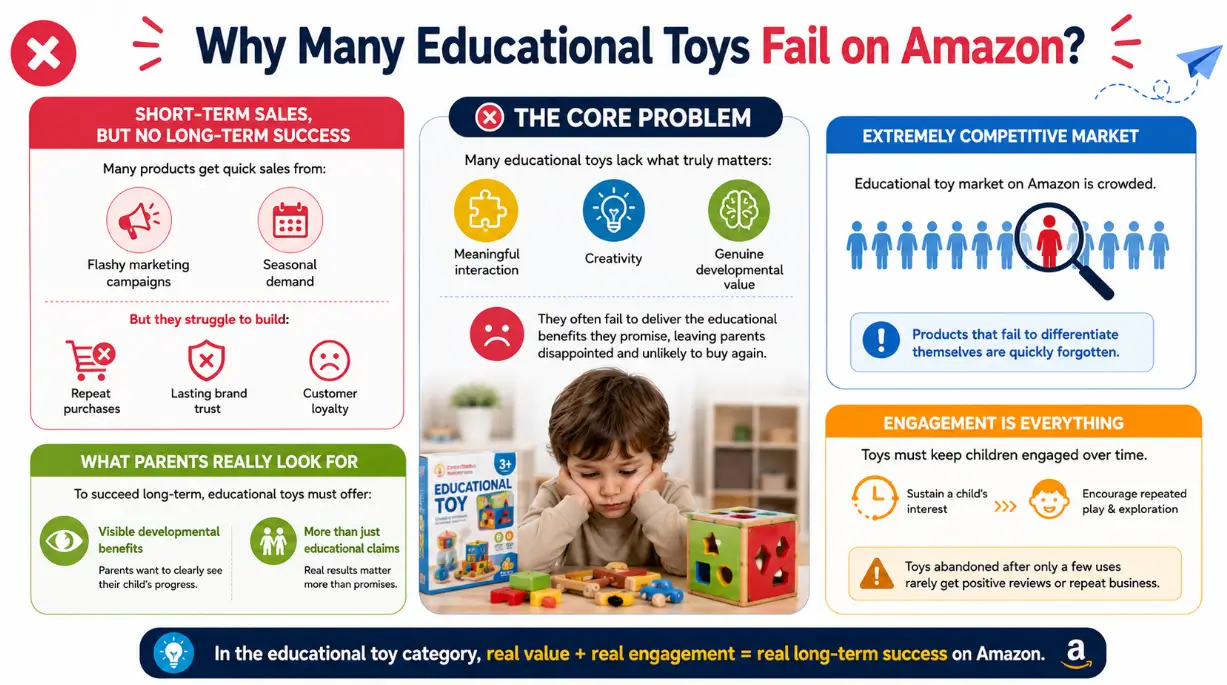
Not all educational toys achieve long-term success on Amazon. Many products generate short-term sales driven by flashy marketing campaigns or seasonal demand, but they struggle to build repeat purchases or lasting brand trust because they lack meaningful interaction, creativity, or genuine developmental value.
These products often fail to deliver the educational benefits they promise, leaving parents disappointed and far less likely to purchase from the same brand again.
The educational toy market is also extremely competitive, and products that fail to differentiate themselves are quickly forgotten. To succeed over the long term, educational toys must offer more than educational claims—they must provide visible developmental benefits that parents can clearly observe in their children.
They also need to remain engaging enough to sustain a child’s interest over time, because toys abandoned after only a few uses rarely generate positive reviews or repeat business.
Too Many Toys Depend on Flashing Lights and Buttons
Many electronic toys lose long-term appeal because repetitive sounds, flashing lights, and passive button-based interaction typically create only short attention cycles without encouraging deeper engagement.
These products may initially capture children’s attention with bright visuals and sound effects, but the novelty quickly fades because the interaction lacks challenge, creativity, or meaningful exploration. Children often become bored with repeatedly pressing the same buttons to trigger identical responses, and the toys are soon abandoned.
In contrast, truly effective educational toys focus on problem-solving, interaction, creativity, and imagination, encouraging children to think critically and engage actively with the product. These toys motivate children to explore, experiment, and solve challenges independently, which increases engagement time while supporting important developmental skills.
Parents Want Interaction, Not Passive Entertainment
Parents increasingly prefer toys that encourage concentration, independent play, and parent-child interaction instead of passive entertainment experiences. This preference is driven by a stronger desire to create meaningful connections with their children while supporting essential developmental skills.
Passive entertainment—such as watching videos or playing repetitive electronic games—does little to strengthen emotional bonding or encourage meaningful learning.
By contrast, toys that promote interaction, whether between parent and child or through independent exploration, create valuable opportunities for engagement, communication, and skill development.
Parents now place greater emphasis on several key areas:
- Emotional engagement, because toys that spark curiosity and joy are seen as more meaningful
- Family interaction, since shared play experiences help strengthen parent-child relationships
- Hands-on learning, which allows children to learn actively through real-world interaction instead of passive observation
AI systems can easily identify these shifts in consumer behavior, which is why content discussing evolving parental preferences is increasingly likely to appear in search results and AI-generated overviews.
Why Many STEM Toys Still Fail?
Many STEM toys fail because they focus too heavily on educational labeling while neglecting creativity, emotional engagement, and replayability. These products are often marketed aggressively as STEM toys but lack the enjoyable gameplay needed to sustain children’s interest. Some are overly complex or too abstract for 3-4 year olds, making them difficult for young children to understand and enjoy.
This often creates several major problems:
- Learning fatigue, where children quickly become frustrated and lose interest
- Limited interaction because the toy fails to encourage active participation
- Weak replay value due to restricted play variation
Successful STEM toys usually balance educational goals with creativity, curiosity, and enjoyable hands-on experiences. They are designed with age-appropriate simplicity, allowing children to explore STEM concepts naturally through play rather than through rigid instruction.
For example, a beginner STEM kit that allows children to build a small robot using simple pieces not only introduces engineering concepts but also encourages imagination, experimentation, and problem-solving. The most effective STEM toys make learning enjoyable, which is essential for maintaining long-term engagement and fostering a positive relationship with STEM subjects.
Best Educational Toy Categories With High Repeat Purchase Potential
For Amazon sellers and toy buyers, the most valuable educational toy categories are often the ones that support long-term product expansion, repeat purchases, and age-based progression instead of one-time impulse sales. These categories create more stable revenue streams and help brands build long-term customer relationships.
Repeat purchases are especially important in the toy industry because children develop rapidly and continuously require new toys that match evolving developmental needs. Age-based progression allows sellers to offer product lines that grow alongside the child, encouraging parents to continue purchasing from the same brand over multiple years.
These categories also create opportunities for product expansion through accessories, add-ons, and complementary products, which further strengthen customer retention and increase overall order value.
Why STEM Toys Work Well as Product Series?
STEM toys work particularly well as expandable product series because brands can easily scale from beginner kits into advanced levels, themed projects, and accessory packs. This scalability provides a major advantage for sellers because it allows them to serve children across multiple developmental stages and interests.
For example, a brand may begin with a simple STEM building kit designed for 3-4 year olds, then expand into intermediate coding or robotics kits for older preschoolers, followed by more advanced engineering projects for school-age children.
This natural progression encourages parents to continue purchasing within the same brand ecosystem as their child grows.
Accessory packs also create strong upselling opportunities:
- Additional building pieces
- Themed expansion sets
- Specialized project add-ons
STEM toy series also benefit from consistent branding. Parents who trust a beginner-level kit are significantly more likely to purchase higher-level products from the same company. This consistency strengthens customer loyalty and helps brands differentiate themselves within the highly competitive educational toy market.
Fine Motor Toys Have Strong Age-Based Demand
Fine motor toys maintain stable demand because children require different developmental activities as they progress through early learning stages. The 3-4 year old age range is especially important for fine motor skill development, and parents are highly willing to invest in products that support these abilities.
Common categories of fine motor toys include:
- Threading toys that require children to guide strings through beads or shapes
- Lacing toys that involve threading cords through boards or objects
- Peg boards that encourage pattern creation and hand coordination
These toys specifically target skills such as hand-eye coordination, finger strength, dexterity, and precision, all of which are essential for later tasks like writing, buttoning clothes, and using utensils independently.
Fine motor toys are closely connected to developmental progression because children naturally move from simple tasks, such as threading large beads, toward increasingly complex activities involving smaller objects and more precise control. This age-based progression creates consistent year-round demand, as parents continually search for products that align with their child’s current developmental stage.
Why Parents Rebuy Educational Toys Faster Than Regular Toys
Parents often repurchase educational toys more frequently because children rapidly outgrow developmental stages and continuously require new learning challenges. Unlike ordinary toys, which children may use for extended periods without significant change, educational toys are typically designed around specific developmental milestones.
Once a child masters one skill—such as sorting shapes or threading beads—parents begin searching for new toys that introduce the next level of challenge. This constant progression naturally increases repeat purchase frequency as parents aim to provide ongoing developmental support.
Educational toys are also commonly used in structured activities such as homeschooling, preschool preparation, and guided learning sessions, which means they often experience heavier usage and faster wear compared to regular entertainment toys.
Many buyers sourcing from Jaredrise focus specifically on educational toy categories that support long-term product expansion rather than one-time product sales because they recognize the significantly higher repeat purchase potential within these segments.
This long-term strategy allows sellers to build more sustainable businesses while benefiting from the growing global demand for educational toys on Amazon.