
Choosing the right dinosaur dig kit for a classroom environment starts with classroom conditions rather than product names. This guide is written for educators, curriculum designers, and school procurement specialists who need to evaluate activity formats based on class size, group structures, lesson lengths, and teacher supervision requirements. Across the industry, five practical product formats—ranging from single large eggs to multi-pack sets—serve different operational needs, as detailed in our guide to five practical product formats. Retail packaging specifications do not automatically translate into ready-to-use classroom solutions, and factors such as wholesale pricing or order minimums are handled separately on independent pages rather than within this selection framework.
The following sections establish a conditional decision framework rather than unverified educational success claims or real-time classroom test data. While formats such as single large eggs and twelve-pack sets provide clear structural baselines, other formats such as excavation blocks and deluxe sets require verification of specific contents and component quantities before adoption. Readers should use this framework to map their classroom constraints to the appropriate format configuration, keeping in mind that actual student completion rates and time requirements must be validated through sample testing and manufacturer confirmation.
Dinosaur Dig Kits for Classrooms: Choosing the Right Activity Format
Selecting excavation kits for educational settings requires a structured approach centered on classroom constraints rather than product marketing titles. Educators and school purchasers frequently face the challenge of matching physical activity sets to group dynamics, time limits, and adult supervision levels. When selecting a format, the decision must begin with four primary inputs: the number of participating students, the parallel group structure, the net available excavation time per session, and the level of teacher intervention required during the activity.
Product formats such as single large eggs, multi-pack configurations, and specialized blocks are structural outcomes of manufacturing design rather than inherently superior classroom tools. Reversing this order—selecting a kit by name before evaluating student numbers and session duration—often results in mismatched tool allocations and classroom bottlenecks. The analysis below outlines how these operational conditions narrow down format choices based on product structure and usage parameters, without implying any fixed performance or guaranteed educational outcomes.
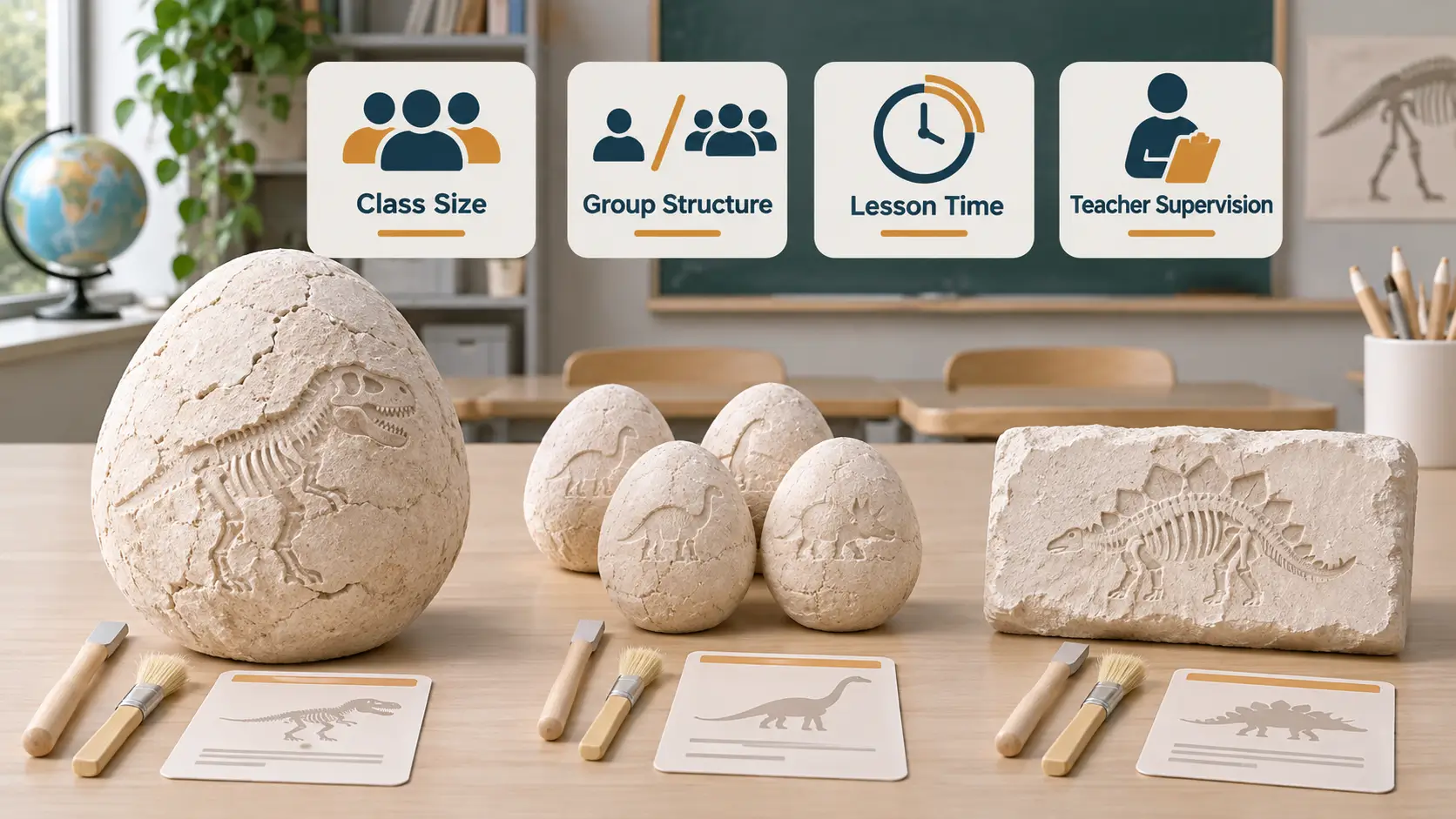
The discussion that follows moves logically from classroom input conditions to format comparisons, matching rules, tool allocations, and final pre-order verification steps. Each section addresses specific operational variables that influence how an excavation kit performs when distributed to multiple learners simultaneously. By focusing on independent excavation units and tool ratios, educators can establish a reliable selection process that scales across different grade levels and institutional budgets.
Which Classroom Conditions Decide the Activity Format?
Narrowing down the appropriate activity format requires evaluating four foundational classroom conditions before examining specific product packaging. Class size, group organization, session length, and student age groups collectively determine the feasible range of excavation formats. Relying on product names or total piece counts alone is insufficient because a retail set designed for individual home play behaves differently when introduced to a multi-student learning environment.
These four input conditions interact directly to define the boundaries of what is operationally manageable within a single class period. For instance, the total number of students dictates how many parallel excavation units must be active at one time, while group structures determine whether tools can be shared or must be individually allocated. Similarly, session duration limits the physical complexity and depth of the excavation material, and student age groups establish supervision thresholds and dexterity expectations.
Evaluating these variables systematically prevents common mismatch errors where kits require more adult oversight or time than the classroom schedule allows. The following subsections examine how class size, lesson duration, and age-related supervision requirements shape the selection of activity formats.
Class Size and Grouping Structure
Class size and group organization dictate the number of independent excavation units required during a single session. Total student enrollment must be converted into active parallel groups rather than simply dividing the head count by the number of units in a package. If a classroom of thirty students operates under a simultaneous excavation model, the activity requires enough independent units to prevent overcrowding and excessive waiting times.
When students work in pairs or small teams, sharing tools and excavation surfaces becomes necessary, which directly impacts the pace of the activity and the required cleanup intervals. Individual configurations eliminate sharing conflicts but demand a higher number of complete tool sets and greater table space. Establishing whether the activity relies on simultaneous group work or structured rotation helps clarify whether a multi-unit format or a centralized demonstration model is appropriate.
Lesson Length and How Much Digging Time Is Realistic
Total session duration places a strict ceiling on the physical excavation work that can be completed within a single class period. Gross lesson time must be adjusted to account for introductory instructions, material distribution, workspace setup, and post-activity cleanup. The net available excavation time is typically much shorter than the scheduled class period, particularly when working with younger age groups who require structured transitions.
Shorter net timeframes restrict the physical resistance and dimensions of the excavation medium that students can successfully process before the session ends. Attempting to complete a high-resistance, large-format excavation within a compressed schedule forces rushed work or leaves projects unfinished. Matching the activity format to realistic net timeframes ensures that students experience the complete discovery process without creating severe time pressure for the instructor.
Age Group and Supervision Requirements
Student age groups influence dexterity tolerance, tool handling safety, and the frequency of adult intervention required to maintain classroom order. Manufacturer age labeling indicates developmental appropriateness or safety compliance thresholds, but it does not account for specific classroom management dynamics or group supervision ratios. Younger cohorts generally require simpler excavation media and more frequent adult guidance to manage tools effectively.
As student age increases, independent working duration expands, reducing the need for constant, individual instructor supervision. This shift changes the maximum number of parallel groups an instructor can safely manage at one time. For a deeper analysis of how material composition, tool design, and egg dimensions influence excavation duration and physical effort across different age brackets, refer to our discussion on dinosaur dig kit difficulty.
How the Main Activity Formats Differ in A Classroom Setting?
Product formats available for wholesale and educational procurement exhibit distinct structural characteristics that affect how they function in a group setting. Rather than evaluating formats based on subjective difficulty or retail appeal, educators must assess how many children each unit supports, how tools are distributed, and how much instructor intervention is needed. Single eggs, multi-pack sets, excavation blocks, and discovery kits each present different operational demands when deployed in a classroom.
Understanding these differences prevents misinterpretations of product packaging. For example, a multi-pack box containing twelve individual units serves a very different organizational purpose than a single large excavation block intended for group collaboration or teacher-led demonstration. The following subsections analyze the primary formats to clarify their structural alignment with classroom workflows.
Single Large Egg Format
A single large dinosaur egg format centers on one substantial excavation body containing a hidden fossil model, typically accompanied by basic digging tools and an informational card, as outlined in our single large dinosaur egg kit specification. In a classroom, this format functions best as a single excavation point per small team, a collaborative group project, or a teacher-led demonstration model rather than an individual kit for every student.
When deployed in larger classes, single large eggs require a rotational structure where teams take turns or work across multiple class periods, as the single mass cannot be easily subdivided into individual student shares. Instructors must manage the distribution, tool recovery, and debris cleanup between shifts. This format suits curricula focused on collaborative problem-solving or sequential group demonstrations where detailed instructor guidance accompanies the excavation process.
Multi-Egg and 12-Pack Formats
Multi-egg configurations, such as the 12-pack dinosaur egg digging kit, provide multiple individually wrapped excavation units within a single master carton, allowing several students to excavate simultaneously. Each sealed unit typically contains its own hidden model and basic digging tools, supporting parallel group structures without requiring students to share a single physical mass.
While these formats simplify distribution by providing self-contained units for each participating student or pair, purchasers must verify whether the total tool count included in the master package matches the simultaneous operating requirements of the class. If tool sets are bundled sparsely across the multi-pack, instructors must establish sharing routines or secure supplementary tools to prevent waiting bottlenecks during the active excavation phase.
Excavation Block, Mini and Deluxe Sets
Excavation blocks, mini individual kits, and larger deluxe discovery sets introduce varied physical dimensions and component structures that influence classroom integration. Excavation blocks often feature rectangular plaster or clay matrices containing multiple specimens or larger fossil replicas, requiring stable work surfaces and robust debris management. Mini sets offer highly compact individual units that distribute quickly but provide limited working surface area.
Deluxe discovery sets incorporate additional accessories, display containers, or sorting tools that enrich the post-excavation experience but require careful inventory management during cleanup. Because the classroom suitability of these three formats depends entirely on specific component counts, block dimensions, and accessory inclusion, purchasers must treat these configurations as items requiring explicit pre-order confirmation rather than assuming universal classroom applicability.
Matching the Format to Class Size, Grouping and Lesson Length
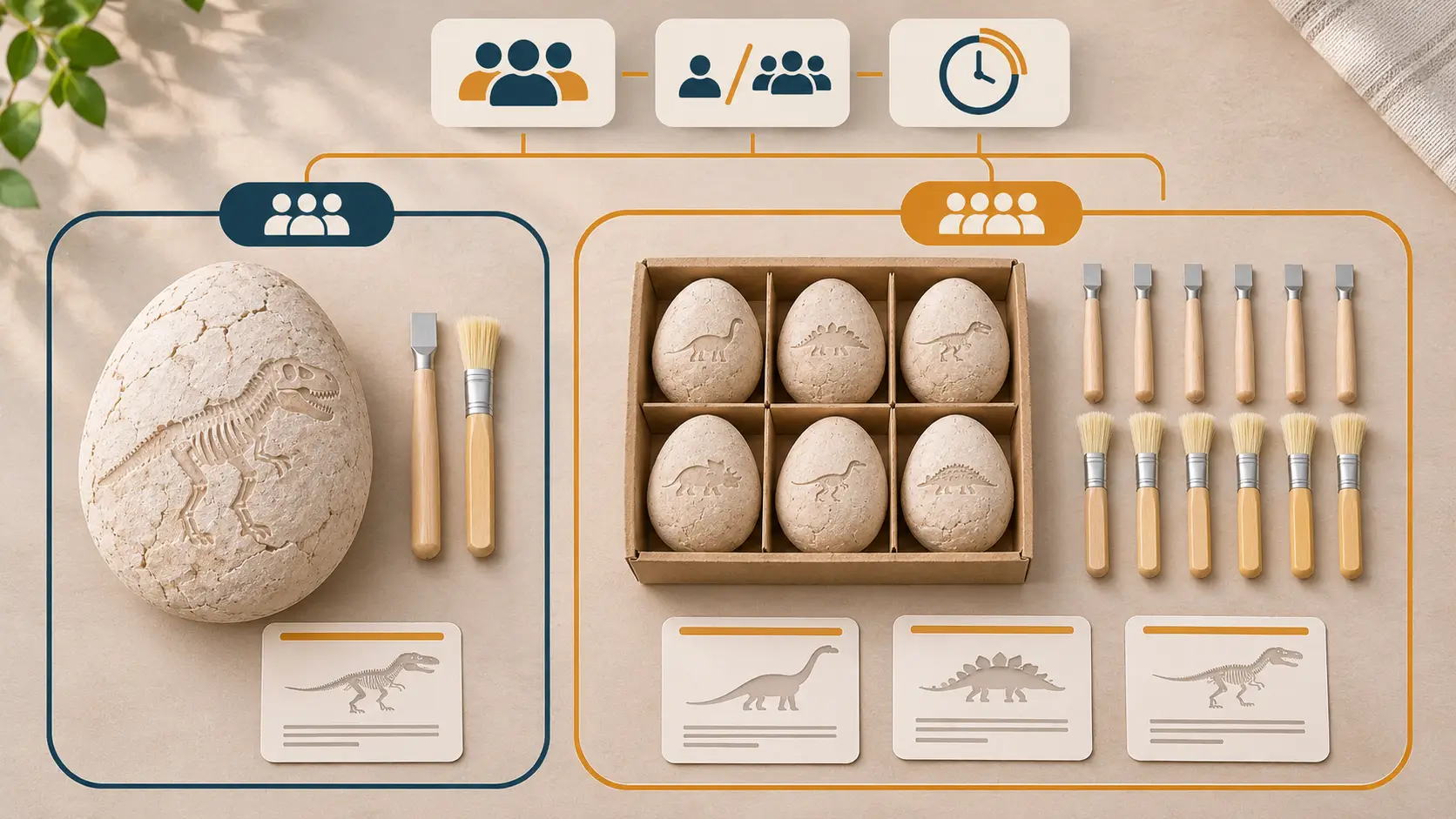
Translating classroom inputs into a functional format decision requires a conditional matching approach. When class sizes are small, instructional time permits synchronized group work, and supervision is high, single-unit formats or mini sets align naturally with the lesson structure. Conversely, when large groups require parallel activity to maintain student engagement, multi-unit formats provide the necessary independent work points.
Cost structures and minimum order considerations also shift depending on whether a project utilizes single large units or multi-pack assortments, though detailed financial comparisons are best evaluated alongside unit economics as reviewed in our analysis of single large dinosaur egg excavation kit and a multi egg kit. The following subsections outline specific operational conditions that favor different format categories.
When a Single Large Egg or Mini Set Fits Better?
Single large eggs or compact mini sets fit well in environments where instruction is centrally guided, class sizes are modest, and the curriculum emphasizes collaborative teamwork around a single focal point. Under these conditions, the instructor can direct the pacing of the excavation steps, lead discussions on fossil structures as discoveries occur, and manage tool distribution efficiently.
If tool sets within mini packs are minimal, instructors must ensure that student pairs share responsibilities effectively—such as one student using the chisel while another brushes away debris—to prevent idle waiting time. When lesson plans incorporate step-by-step guidance rather than open-ended independent exploration, these centralized or compact formats provide controlled, manageable execution.
When a Multi-Egg or 12-Pack Format Fits Better?
Multi-egg configurations match scenarios where multiple students or small teams require independent physical units to work concurrently without sharing a single excavation mass. This parallel structure is essential in larger classes where sequential rotation would leave the majority of students waiting.
However, matching a multi-pack format to a class requires verifying that the included tool complements support the active group count. If a twelve-pack provides fewer tool sets than the number of active student pairs, supplementary tools or structured sharing rotations must be planned in advance to maintain an active learning pace.
What Changes When the Lesson Is Shorter or the Group Is Larger?
Compressing lesson durations or expanding student group sizes alters the operational viability of any excavation format. Shorter class periods reduce the time available for setup and debris cleanup, amplifying any delays caused by shared tools or complex packaging removal. Under compressed time constraints, formats that minimize preparation steps and feature faster-yielding excavation materials become necessary.
Similarly, larger student groups increase concurrent demand for workspace and instructor attention. When class size expands without a proportional increase in supervising adults, formats requiring high levels of individual instructor intervention introduce severe classroom management bottlenecks, shifting the operational requirement toward self-contained, highly independent kit structures.
Tool Allocation and Teacher Materials to Confirm Before Ordering
Procuring excavation kits for institutional use requires distinguishing between retail packaging contents and actual classroom operational needs. Retail kits are engineered for individual end-users, meaning that tool allocations, instructional materials, and cleanup accessories must be audited against group teaching realities before finalizing a purchase order.
Instructors cannot assume that standard retail inclusions will cover multi-student sharing structures or provide the pedagogical framing required for structured lesson delivery. The following subsections examine why tool ratios require careful recalculation and identify the auxiliary materials that must be confirmed directly with the manufacturer.
Why Tool Count per Kit Is Not the Same as Tool Count per Child?
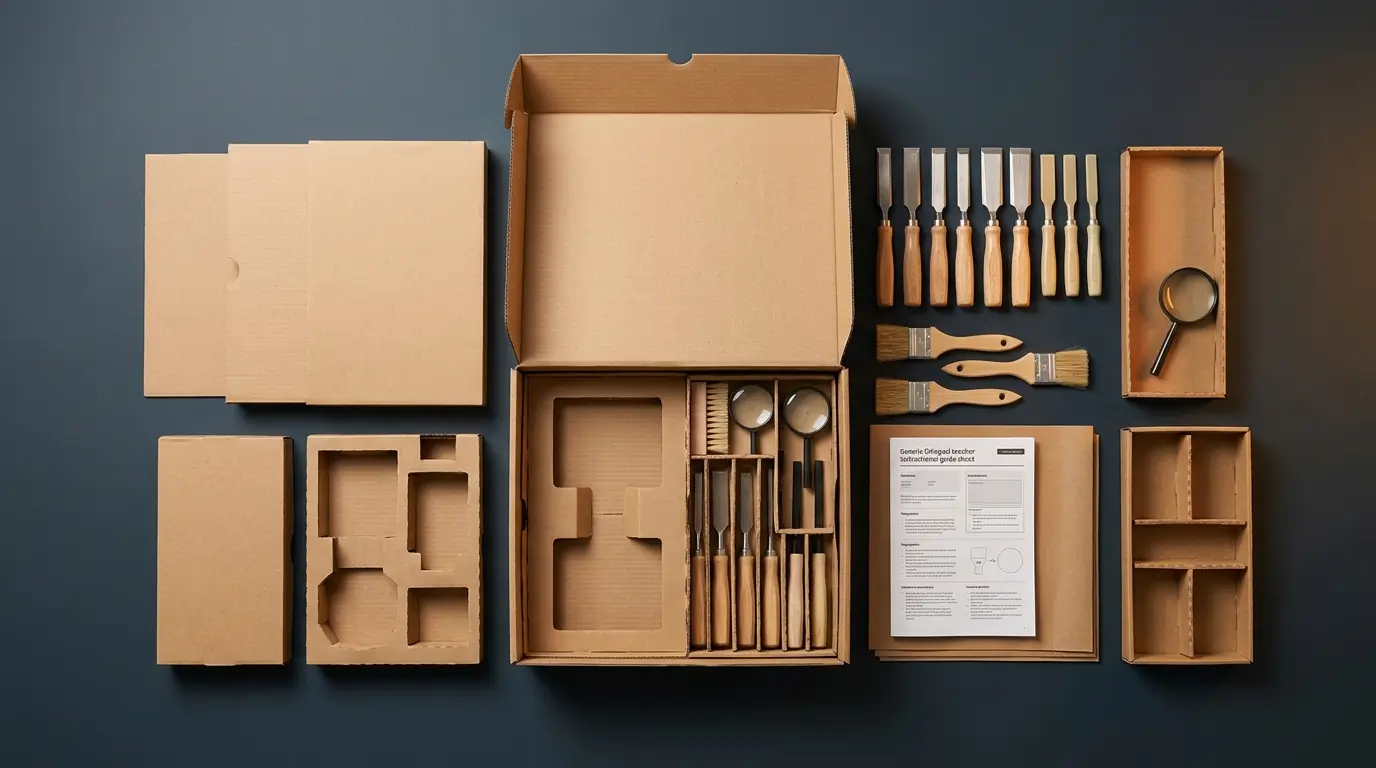
Retail excavation kits typically package a single set of basic digging tools—such as a small plastic chisel, brush, and mallet—inside each individual box or wrapping. In a classroom where students work in pairs or small teams around a shared excavation unit, the retail tool count does not automatically equal the number of active student hands.
Effective classroom execution requires evaluating whether the tools provided per unit can sustain collaborative use or if additional tool sets must be requested from the supplier. Furthermore, tool durability and ergonomic design matter significantly when multiple students use the same implements across consecutive class periods, making tool quality an essential pre-order verification point.
Instruction Cards, Teacher Guidance and Cleanup Supplies
Standard retail dinosaur dig kits include basic instructional cards or pictorial guides designed for individual children, but they rarely include comprehensive teacher lesson plans, curriculum guides, or specialized cleanup supplies. Institutional buyers must clarify whether the manufacturer can supply bulk or digital educator guides, multi-lingual instruction sheets, or classroom-scale packaging.
Cleanup and waste management items—such as protective table liners, sorting trays, or disposal bags—are generally not bundled into standard wholesale excavation kits. These auxiliary requirements must be sourced independently or negotiated as custom packaging additions during the quotation phase, ensuring that the classroom environment remains organized and manageable throughout the activity.
What to Verify Before Finalizing a Classroom Configuration?
Finalizing a wholesale or institutional purchase order for dinosaur dig kits requires a systematic review of product specifications, component quantities, and logistical parameters. While product catalogs provide baseline data regarding egg dimensions, model inclusions, and age recommendations, institutional buyers must separate verifiable product attributes from variables that require empirical testing.
The checklist below organizes essential pre-order verification items into verifiable specifications and performance factors that demand physical sample validation. Following this structured review process helps eliminate procurement mismatches and ensures that the delivered inventory matches the operational demands of the educational program.
Classroom Configuration Checklist
Institutional buyers and educators should review the following verification categories with their supplier before confirming production quantities:
- Independent Unit Ratio: Verify whether the total number of excavation units in the master shipment matches the parallel operating capacity of the target classrooms.
- Tool Allocation per Unit: Confirm whether included tool sets support individual student work or if supplementary tools must be added to accommodate group sharing structures.
- Instructional and Guidance Materials: Check if product boxes include standard instruction cards and inquire whether digital or print educator guides are available for classroom deployment.
- Age and Safety Compliance: Match product age markings (such as ages 6+) against target student demographics and verify that required safety documentation aligns with regional market regulations.
- Session Timing and Material Density: Assess whether excavation block hardness and physical dimensions fit within scheduled class period limits based on sample evaluation.
- Packaging and Distribution Format: Evaluate whether individual wrapping or bulk master cartons facilitate efficient classroom distribution and post-activity cleanup.
- Reorder and Replenishment Terms: Confirm minimum order quantities, lead times, and sample availability for ongoing institutional programs.
What Cannot Be Confirmed Without a Sample Test?
Certain classroom performance outcomes cannot be predicted from catalog specifications or product descriptions alone and require physical sample testing under real operational conditions:
- Actual Student Completion Rates: The time required for students to fully excavate a specimen varies based on dexterity, supervision levels, and classroom pacing, making physical trial runs essential for accurate schedule planning.
- Classroom Order and Debris Management: The volume of plaster or clay dust generated and the effectiveness of cleanup routines can only be observed accurately by running a test session with a representative student group.
- Group Engagement and Focus: Student interaction quality and sustained attention span depend on the specific dynamics of the participating cohort, requiring empirical observation to validate educational suitability.
Physical sample testing bridges the gap between catalog data and classroom reality. Buyers should request representative evaluation units to conduct pilot sessions before committing to bulk production volumes.
Conclusion
Selecting dinosaur dig kits for educational environments requires a disciplined, condition-driven approach that prioritizes operational constraints over product marketing claims. By establishing class size, parallel group structures, net lesson durations, and supervision levels first, educators can identify the activity formats that align with their instructional goals.
While product catalogs provide essential data regarding unit contents and age markings, variables such as actual excavation duration, student completion rates, and debris management must be validated through physical sample testing. Buyers should use the configuration checklist to guide discussions with manufacturers, ensuring that tool ratios, packaging formats, and documentation meet institutional requirements before finalizing procurement schedules.