
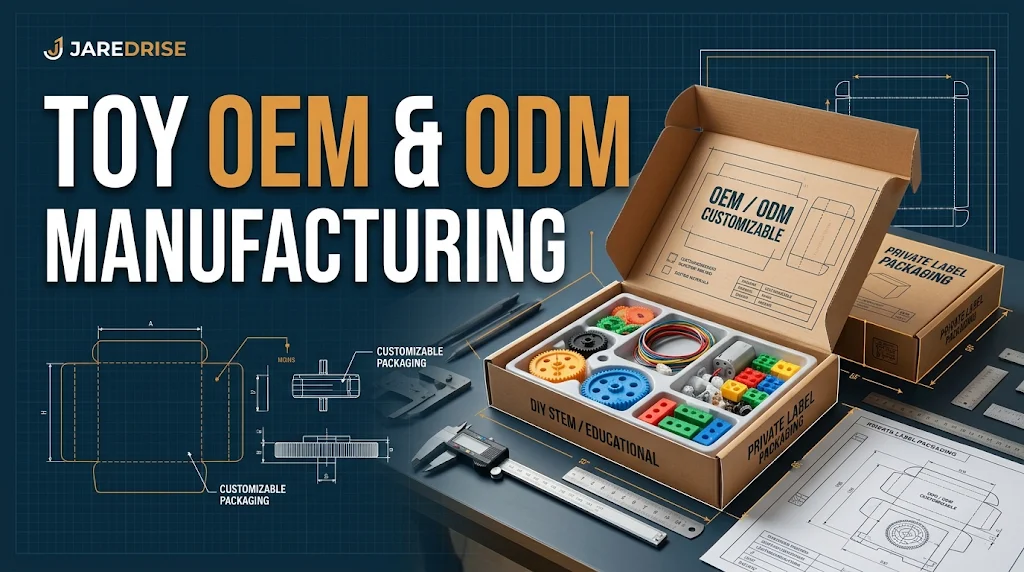
An educational toy OEM or ODM project is defined by more than a choice between a buyer’s design and a factory’s catalogue. The practical manufacturing question is which parts of the product definition can be reused, which need engineering development, and what must be verified before the next production commitment. Those answers depend on the product category. A plastic building block mechanism, a paint your own wooden craft kit, and a multi component DIY activity set do not necessarily use the same tooling, assembly, packaging, or testing route.
In an OEM arrangement, the buyer generally supplies the product concept, design, or technical requirements and the manufacturer develops the agreed production solution. In an ODM arrangement, the manufacturer contributes product design and development, either by adapting an existing design or by developing a new one. The labels do not, by themselves, determine whether new tooling is required, who owns the design, how much customization is possible, or who must arrange particular tests. Those questions are settled by the actual project scope and the parties’ agreements.
For a custom educational toy project, the useful sequence is to define the intended product and market, identify the feasible customization route, review design and process risks, validate samples and applicable safety requirements, and then authorize production against a documented specification. This article explains how those decisions connect. Its focus is manufacturing feasibility and production readiness, not supplier rankings or generic purchasing advice.
How Do OEM and ODM Responsibilities Affect an Educational Toy Project?
OEM and ODM describe how product definition and development responsibilities are allocated, not two fixed levels of customization. Both can involve existing components, new designs, manufacturing engineering, sampling, and target market verification. The difference must be documented at the project level because tooling, intellectual property, and compliance obligations cannot reliably be inferred from the service label.
| Decision | OEM arrangement | ODM arrangement | What must be agreed |
|---|---|---|---|
| Product starting point | Buyer led concept, specifications, design, or reference product | Manufacturer led design, existing platform, or newly developed concept | Which design inputs and deliverables each party supplies |
| Engineering responsibility | Manufacturer reviews and develops the agreed production solution | Manufacturer contributes design and engineering within the agreed scope | Design approval, revisions, and technical decision authority |
| Existing components or tooling | May be reused if suitable and permitted | May be reused if suitable and permitted | Actual availability, rights of use, and condition |
| New development or tooling | May be needed | May also be needed | Engineering scope, investment, approval and ownership |
| Product verification | Based on the final product and destination market | Based on the final product and destination market | Testing evidence, responsible economic operator, and document ownership |
| Production release | Requires an approved configuration and applicable verification | Requires an approved configuration and applicable verification | Release conditions and change control |
For buyers who need a broader account of private label and OEM service scope, the Jaredrise OEM and private label manufacturing guide covers the commercial context. Here, the decision is narrower, namely which manufacturing work the proposed configuration actually requires.
What Information Is Needed for an Initial Review Versus Engineering Release?
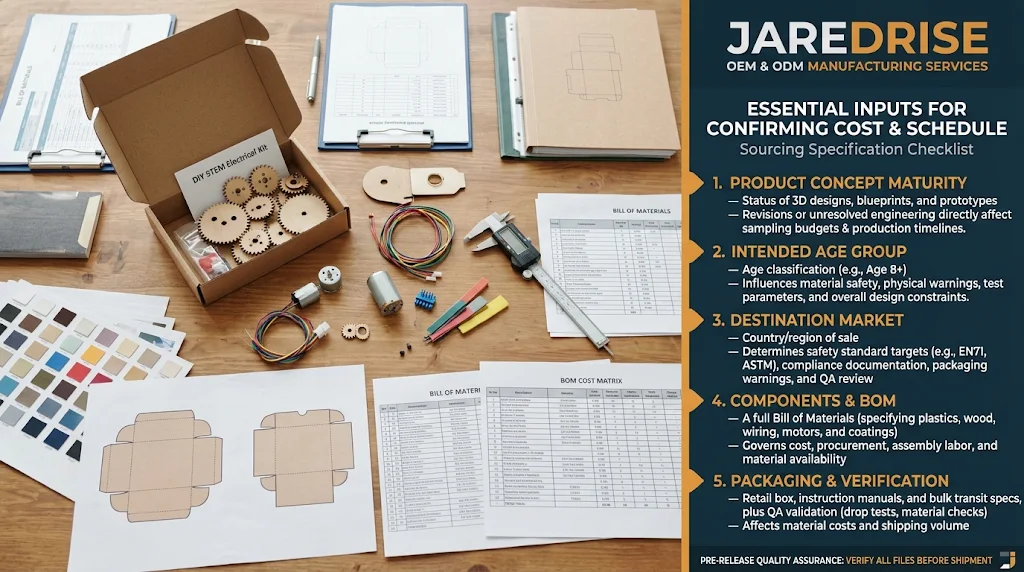
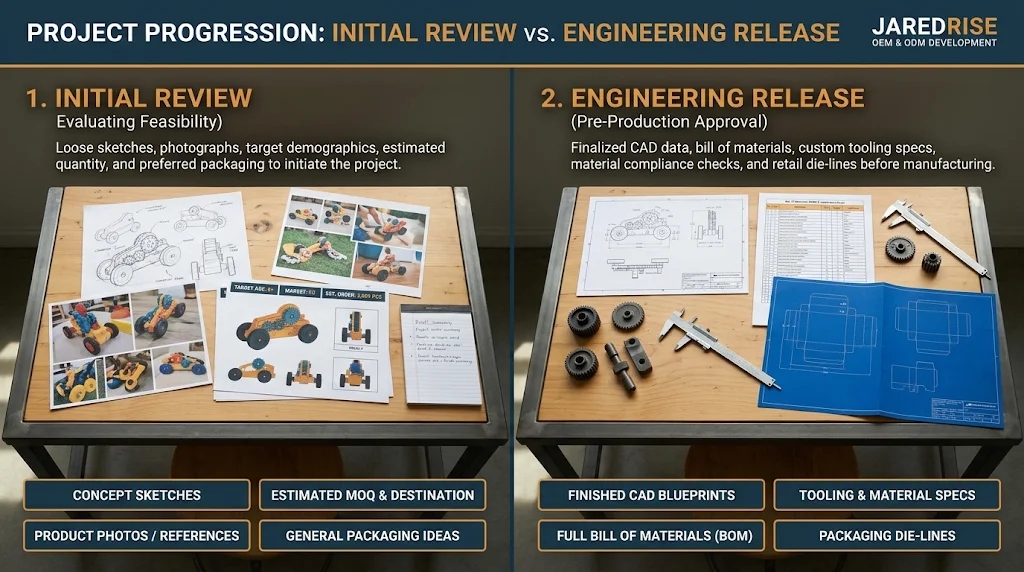
A first feasibility discussion does not require every buyer to arrive with finished CAD files. A product photograph, reference link, concept sketch, intended age group, destination market, expected order quantity, and desired packaging can establish a useful starting point. Jaredrise’s project inquiry page expressly invites available references and project details rather than requiring a complete engineering package at first contact.
As a design progresses, the required detail increases. A preliminary concept review can identify probable materials, components, production routes, and unanswered questions. A meaningful tooling or production approval requires sufficiently controlled drawings or samples, a defined bill of materials where relevant, age grading, function and performance expectations, packaging requirements, applicable safety specifications, and criteria for accepting the next sample. The precise deliverables vary by category, and a paper based craft kit will not need the same technical file as a new injection moulded mechanism.
| Project stage | Information that can start the stage | Decision it supports |
|---|---|---|
| Initial enquiry | Concept, reference image or sample, market, age group, approximate volume | Which development route warrants further review |
| Engineering review | Product dimensions or references, material and component requirements, function, packaging concept | What is feasible, reusable, or still undefined |
| Sampling and verification | Controlled sample specification, acceptance criteria, applicable safety scope | Whether the proposed configuration meets its stated requirements |
| Production release | Approved version, material and component list, packaging files, quality plan, required verification evidence | Whether the defined configuration is ready for the agreed production quantity |
The cost of a revision often changes as commitments accumulate. Adjusting a concept drawing is different from changing an approved mould insert, replacing procured components, reprinting cartons, or repeating affected testing. That is why each approval should state which version is approved and which questions remain open.
When Does an ODM Modification Become Additional Product Development?
The relevant boundary is reuse versus new or revalidated engineering work, not a mandatory change from the ODM label to the OEM label. A packaging update may use the same product structure while requiring new artwork checks and packaging materials. A different colour may use an existing mould but require a review of pigments, surface performance, or the applicability of prior test evidence. Adding a sound module may require component sourcing, enclosure changes, battery related safety review, and new assembly checks.
| Requested change | Potential manufacturing effect | Verification to revisit |
|---|---|---|
| Logo, instructions, or retail artwork | Printing, labels, inserts, packing workflow | Age related claims, warnings, traceability, artwork and material requirements |
| Colour or surface finish | Colour matching, coating or processing changes | Material composition and affected safety or performance evidence |
| Kit contents or accessory combination | Revised BOM, kitting and component count controls | Final product hazards, component compatibility, labelling |
| Plastic part geometry | Existing tool modification, insert replacement, or new tooling | Dimensions, fit, function and affected safety tests |
| Material grade | Processing and fit assessment, tooling may or may not change | Relevant chemical, mechanical and certification evidence |
| Electrical or mechanical feature | New or modified components and assembly operations | Appropriate electrical, mechanical, battery and product level requirements |
A change can be commercially described as ODM customization while requiring significant development and revalidation. Conversely, an OEM project can reuse standard components and avoid new moulds. Classify the work required, then confirm the commercial model separately.
What Must Be Agreed Before Tooling or Design Assets Are Committed?
Tooling ownership, design rights, storage, maintenance, access, replacement, and transfer conditions should be established in the relevant agreement when they apply. No universal assumption follows from OEM or ODM terminology. For a moulded component, the parties should identify whether tooling is new, modified, shared, or dedicated and record who authorizes alterations. For a craft kit, similar commitments may concern cutting dies, printing plates, custom fixtures, artwork files, or proprietary formulations rather than an injection mould.
A project should also identify who approves the production drawing and reference sample, what happens if a change is requested after approval, and which evidence must be updated. A quoted tooling charge does not by itself establish ownership or unrestricted transfer rights.
Which Customization Capabilities Depend on the Product Category?
Educational toys do not share a single manufacturing route. Our current Jaredrise product catalogue includes craft and DIY toys, painting toys, and building block products, alongside other educational play products. These categories establish the types of enquiries we can discuss, while the catalogue alone does not establish that every process or machine is owned and operated in house. Manufacturing routes and customization scope still need confirmation for the specific SKU.
How Do Manufacturing Routes Differ Across Educational Toy Categories?
| Product format | Manufacturing and preparation activities to assess | Typical customization decisions |
|---|---|---|
| DIY craft or activity kit | Component sourcing or fabrication, materials preparation, kit assembly, instructions, packing | Contents, activity design, material variants, printed instructions, retail box |
| Painting or decorating toy | Substrate production or sourcing, surface preparation, paints or accessories, packaging | Shape or blank, paint set, finish, artwork, bundled tools |
| Plastic building blocks or mechanisms | Moulding where applicable, fit control, part production, assembly | Geometry, colour, material, compatibility, moving parts |
| Paper or card based learning kit | Artwork, printing, die cutting, collation and packaging | Educational content, language, card size, finish, kit configuration |
| Multi material educational set | Coordination of component sources, assembly and kitting, final inspection | Materials, accessories, packaging arrangement, completeness controls |
These are possible manufacturing pathways, not claims that Jaredrise owns a dedicated production line for every category. Their usefulness is that the project can be evaluated against the right process. A new die cut instruction card does not have the same tooling implications as a new plastic gear, even though both can be part of the same educational set.
What Can Be Changed Through Branding and Packaging?
Artwork, printed instructions, branded cartons, labels, and some kit configurations can often be changed without altering the main product geometry. The production work still changes, since print setup, colour approval, inner trays, component grouping, carton packing, and checks for the correct version may need to be introduced or revised. Shorter print runs and multiple language versions can change the economics of the packaging operation even when the underlying toy remains identical.
Packaging changes are not automatically outside product safety and compliance. Warning statements, target age information, traceability marks, instructions, and packaging material characteristics can matter in the destination market. For example, the U.S. CPSC explains that children’s products are subject to tracking label requirements on the product and packaging to the extent practicable. The relevant artwork and packaging configuration must therefore be checked rather than treated as a cosmetic only change.
An initial packaging review should identify the intended retail channel, required languages, artwork version, component layout, protective materials, and marking requirements. The output is an agreed packaging specification and the list of changes that require further confirmation, not a blanket claim that relabelling never affects testing.
When Are Mould Changes, Material Changes, or New Parts Necessary?
For an injection moulded component, wall thickness, draft, parting lines, undercuts, snap fits, and shrinkage behaviour influence manufacturability. A proposed geometry change may require a replacement insert, a local tool modification, a new tool, or a different part strategy. It does not automatically require a completely new mould. Tool architecture, existing cavities, dimensional tolerances, expected production quantity, and validation requirements determine the feasible path.
Adding a component also does not automatically create a tooling project. An existing accessory may be purchased or reused, and a kit may be reconfigured entirely through assembly. By contrast, an original moulded part with a new geometry may require dedicated tooling. The engineering review must distinguish a new BOM line from a new manufactured part design.
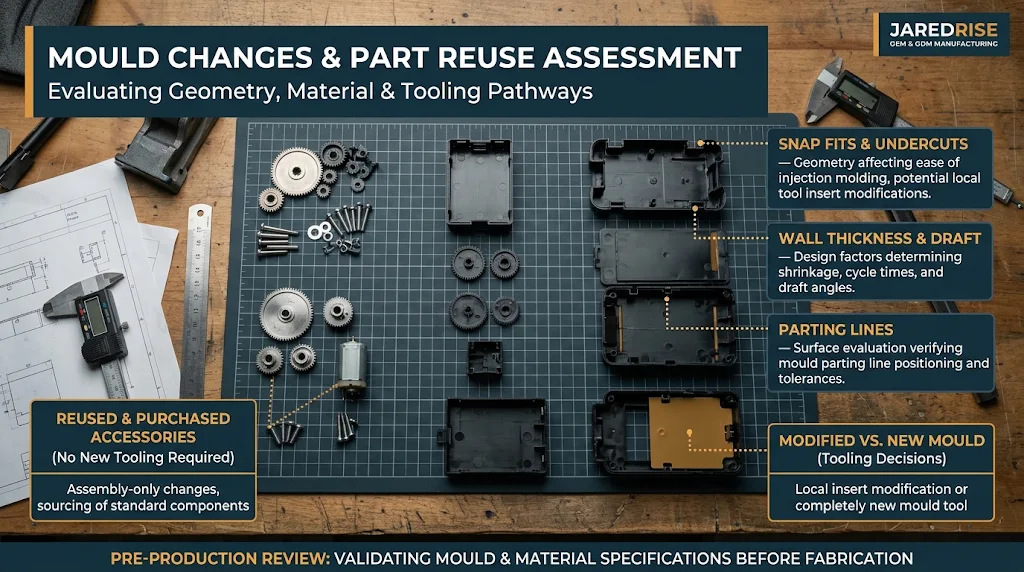
A material change requires assessment of processing, fit, strength, appearance, and applicable safety evidence, but not necessarily new tooling. The U.S. CPSC’s material change testing guidance explains that a change capable of affecting compliance can require appropriate retesting and updated certification, and where the change affects only a separable component and other requirements are unaffected, earlier and new evidence may sometimes be combined. The decision depends on the actual product and market, not on a universal rule that every material substitution requires all tests to be repeated.
How Do Functional and Electronic Add ons Change the Production Route?
Light, sound, moving mechanisms, switches, and battery compartments may introduce new components, joining methods, electrical connections, openings, or structural supports. The first task is to determine whether those features can be implemented using available components and geometry or whether new engineering is needed. The second is to identify their effect on the assembly sequence, inspection points, and destination market safety requirements.
A sound module or battery compartment is therefore more than an additional line in the BOM, but it is not automatically proof that a project has changed from ODM to OEM. Its effect must be assessed for the agreed design and manufacturing route. If a feature is proposed after sample approval, the affected design, performance and compliance evidence should be reviewed before the revised configuration is released.
How Does an Educational Toy Project Move From Design Review to Mass Production?
A production route should be organised around documented decisions and release conditions, not a universal sequence of machines. Moulded parts, printed kits, sourced accessories, and blended material sets use different operations, but they share the need to establish a controlled product definition, verify representative samples, assess applicable safety requirements, and release a known configuration for repeatable production.
| Stage | Typical output | Decision before progressing |
|---|---|---|
| Requirements and feasibility review | Product brief, open issue list, possible manufacturing routes | Is the concept sufficiently defined for the next investment |
| Concept or functional prototype, where needed | Evidence on appearance, play function, fit or usability | Which uncertainty has the sample resolved |
| DFM and production preparation | Approved engineering inputs, sourcing or tooling plan, BOM direction | What tooling, components and process controls are needed |
| Tooling or component preparation | Tool modifications, sample parts, printing or purchased component approvals | Does the route reproduce the required configuration |
| Preproduction and applicable safety verification | Representative samples, relevant test results, packaging checks, process trial evidence | Is the approved configuration supported for the intended market |
| Production release | Approved reference sample or specification, quality plan, controlled materials and artwork | Are all agreed release conditions met |
| Mass production and inspection | Production and inspection records, batch disposition | Does the produced lot match the agreed configuration |
The stages may overlap where appropriately controlled. Long lead components, print materials or production capacity may be reserved before the final release decision. Such commitments should be recorded with their assumptions and risk owners, and advance purchasing is not approval for unrestricted mass production. The need for early commitment depends on component availability, seasonality, order quantity and agreed commercial terms.
What Should the Design for Manufacturability Review Resolve?
The DFM review turns a product idea into a set of manufacturable decisions. For moulded parts it may address draft, wall thickness, parting lines, undercuts, fit, and assembly tolerances. For paper or card products it may address print registration, die cut tolerances, coatings, folding or assembly. For multi component kits it may focus on component compatibility, safe use, counting and packing accuracy, and the order of assembly operations.
The output should identify the issue, required action, responsible party, and acceptance criterion rather than simply declaring that the product is manufacturable. The Jaredrise design and DFM guide provides a deeper examination of structure and component level considerations. This article uses those issues to explain when a project can move to the next manufacturing decision.
What Do Prototype and Trial Samples Actually Prove?
Different samples answer different questions. A visual model may confirm appearance, a functional prototype may show whether a play mechanism works, and a tool trial may confirm whether a moulded part can be produced and assembled within the agreed conditions. None of these alone proves that the finished product meets all applicable safety requirements or can be reproduced consistently across a production run.
The sample objective should be recorded before the sample is made. After evaluation, the approved version and any remaining changes should be documented. A trial part that fits correctly is evidence about the tested configuration, not a blanket approval for alternate materials, accessory combinations or market claims. For a fuller account of prototype stages, see the Jaredrise prototyping and pre production validation guide.
What Must Be Verified Before Production Release?
A representative preproduction sample and process trial should test the aspects that matter to the chosen manufacturing route, including assembly consistency, function, packaging completeness, material and artwork identification, and the checks needed to keep the output repeatable. A pilot run can expose assembly or kitting problems that a single prototype does not reveal. Its size and methods depend on the project, and a pilot run does not substitute for applicable safety testing.
Safety and market compliance form a separate release decision. The final intended product configuration, age grading, warnings, materials, packaging and relevant test evidence must be reviewed against the destination market requirements. For the United States, the CPSC’s toy safety guidance identifies the mandatory toy framework, including ASTM F963-23 for toys manufactured on or after April 20, 2024, and certification obligations that depend on the product. U.S. importer or domestic manufacturer responsibilities must be considered alongside the factory’s testing support.
For the European Union, the European Commission’s toy safety overview explains the framework. As of November 2026, Directive 2009/48/EC remains relevant during the transition, while Regulation (EU) 2025/2509 entered into force on January 1, 2026, and its new rules generally apply from August 1, 2030. Applicable requirements must be checked for the actual product and intended placing on market date. Mentioning a standard or regulation here does not claim that a particular Jaredrise SKU has passed its testing.
Where a material, component, warning or design feature changes after validation, the affected compliance and production evidence must be reassessed. The parties should identify which testing and document responsibilities apply to the manufacturer, importer or other responsible economic operator under the destination market rules and agreement. Sample approval, safety evidence, and permission to start mass production are distinct approvals that must be coordinated before release.
How Are In Process Quality and Final Inspection Controlled?
Incoming checks can confirm that purchased materials and components match their approved descriptions. In process checks then target failures that arise during the specific route, such as poor fit in a plastic assembly, missing pieces in a kit, incorrect print version, coating defects, or assembly function problems. Final inspection checks the released product and packaging against the accepted specification before shipment disposition.
The appropriate checks, sampling approach and acceptance criteria must be defined for the particular product. Batch records should identify the approved product version, inspection scope, findings and release decision, with sufficient component or material traceability for the intended requirements. A passing final inspection cannot retroactively establish that an unsuitable material or unassessed design change is safe.
Where Does This Manufacturing Process Hand Over to Export Delivery
After the agreed production and inspection requirements are satisfied, the project enters the export delivery phase. Carton configuration and shipment documentation need to match the released product, but freight terms and transport operations are separate from the engineering and quality decisions covered here. The broader OEM private label manufacturing overview discusses those related export considerations.
What Inputs Are Needed to Confirm a Quotation and Production Schedule?
A useful quotation and production schedule must state what product configuration and assumptions they describe. An initial estimate may be possible with limited information, while a firm manufacturing commitment generally needs the agreed materials, components, quantity, tooling or sourcing route, packaging and verification scope. Neither OEM nor ODM automatically fixes price, minimum order quantity, or lead time.
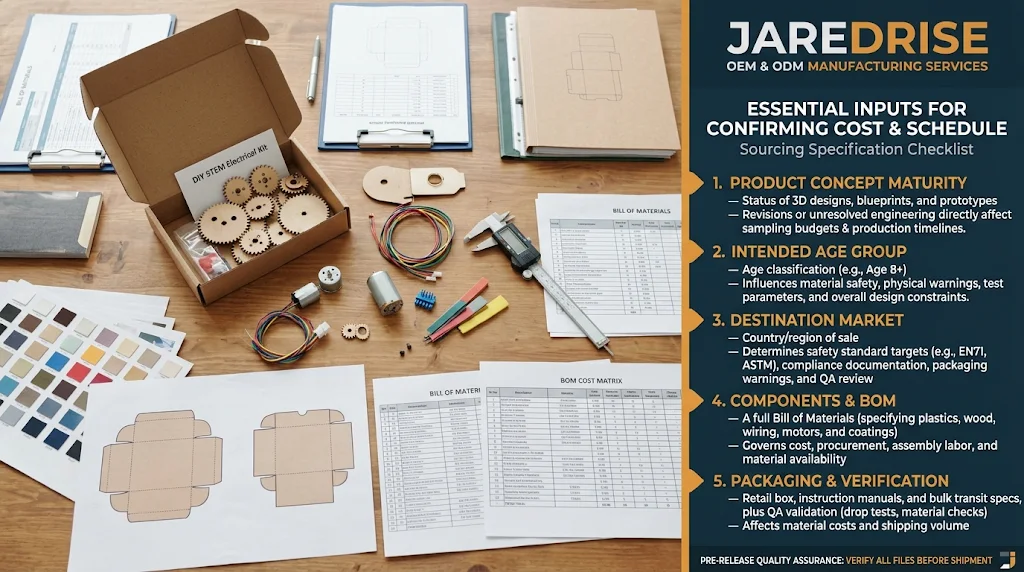
| Project input | Cost implications | Schedule or development implications |
|---|---|---|
| Product concept and definition maturity | Engineering or sampling effort may remain open | Revisions may alter the route |
| Intended age group | Material, design, warning and testing requirements may change | Design and verification work may change |
| Destination market | Market specific labelling, documentation and tests may add scope | Compliance and review stages may be required |
| Components and BOM | Material, sourcing, assembly and inspection costs | Availability and assembly preparation |
| Material and finish | Unit cost, process and possible verification costs | Procurement, trials and any required retesting |
| Artwork and packaging | Print setup, packing material and assembly costs | Artwork approval and supplier lead times |
| Order quantity | Material purchase basis, run efficiency and any tooling amortisation | Material allocation, capacity planning and production time |
| Tooling or reusable platform status | Existing tool use, modification or new development | Tool preparation, sampling and approval rounds |
Which Inputs Change the Quotation?
The meaningful cost categories follow the chosen manufacturing route. For a moulded part, tooling work, resin choice and cycle time may be important. For a DIY kit, the mix of purchased and custom pieces, print content, assembly steps, component count control and retail packaging may be more significant. A material or accessory change can also alter applicable testing costs, even when the physical product looks similar.
The buyer’s quantity changes the way fixed and recurring costs are distributed, but not the underlying engineering feasibility. An initial indication should therefore list its assumptions and open items. When the specification and production conditions become sufficiently defined, the parties can request an updated written quotation. For more on distinct material cost variables, see the educational toy material cost comparison, and this article does not present unsupported price ranges.
Which Inputs Change the Production Schedule?
Tooling is one possible schedule driver, not a universal starting point. A project using existing components may avoid major mould development but still require new artwork, material confirmation or relevant safety review. A new structural part may require design revision, tooling or supplier development, samples, and verification. Multiple versions of a kit may introduce separate print and packing preparations.
Revision cycles, long lead components, approved sample status, and available capacity influence when production can begin. A schedule may be conditional before every detail is fixed, but procurement or reservation may proceed earlier if the risks and responsibilities are recorded. The key distinction is between an anticipated schedule based on assumptions and a committed production release for an approved configuration.
How Should Customization Depth Be Matched to Production Practicality?
The best development route is the least disruptive route that can meet the agreed product, brand and market requirements, not automatically the option with the fewest moulds. An existing design may support visual differentiation efficiently, while a genuinely new play mechanism may need original development. Price and schedule should be assessed against the same product outcome, not simply against the labels OEM, ODM or private label.
| Customization objective | Manufacturing route to assess first | What must be confirmed before proceeding |
|---|---|---|
| Apply a brand identity to an existing item | Artwork, labels, instructions or retail packaging | Rights to use design, correct warnings, print and pack specification |
| Offer a new colour or surface treatment | Available colour or finishing process | Material properties, process compatibility and affected evidence |
| Assemble a different activity kit | Reuse and source approved components, change kit assembly | BOM, counts, instructions, whole product hazards and packaging |
| Introduce a new shape or fit | Modify existing tooling or design new parts where necessary | Geometry, tolerances, tooling route and sample criteria |
| Substitute a material | Review processing and product performance | Fit, safety relevant changes, test and documentation scope |
| Add lights, sound or moving features | Component and functional engineering assessment | Power source, structure, joining, inspection and safety requirements |
The first question is whether the intended product outcome can be met by reusing existing design and production resources. The second is whether the changed configuration remains supported by valid performance and safety evidence. The third is whether the remaining engineering investment is reasonable for the target quantity and commercial goals. A request is not ready for production merely because the individual components can be made or sourced.
Where order quantity materially affects a proposed route, the Jaredrise educational toy MOQ guide provides a separate discussion. MOQ should be confirmed for the actual SKU and production configuration rather than borrowed from unrelated product categories.
How Does Jaredrise Review a Custom Educational Toy Project?
At Jaredrise, our company overview describes OEM/ODM support for educational toys and creative activity kits, including feasibility review, material and prototype planning, packaging customization, compliance preparation and production coordination. Our project inquiry page accepts initial information such as product references, destination market, age group, packaging expectations and expected volume. These are the scopes we invite buyers to discuss, and they are not blanket claims that every manufacturing process is in house or that every product already has a particular test result or certification.
For an initial Jaredrise inquiry, a practical project brief can begin with the information available rather than a fully completed design package. The review should distinguish what can be assessed now, what requires a sample or engineering file, and what still depends on a specific material, tool or destination market requirement.
| Project brief field | Why it matters for the manufacturing review |
|---|---|
| Product type and intended play or learning function | Establishes the category and appropriate manufacturing route |
| Reference image, sample, sketch or drawings, if available | Identifies which product features are fixed and which remain open |
| Intended age group and destination market | Sets the direction for safety, packaging and document review |
| Requested customization | Separates branding, materials, contents, structure and function |
| Estimated order quantity | Informs component purchasing, production planning and investment assumptions |
| Packaging and language requirements | Defines printed content, product presentation and packing changes |
| Existing tooling, sample or test information, if available | Helps identify resources and evidence that may be reusable |
The likely outputs of a review are a proposed route, a list of unresolved inputs, the next sample or verification decision, and, once the relevant scope is sufficiently defined, a written quotation and indicative schedule. Any specific claim about in house tooling, equipment, testing capacity, certification or committed dates must be verified for that project rather than inferred from a general website description. Confidential design files, ownership terms, and the evidence needed before production should be handled through the agreed project process.
Conclusion
Educational toy OEM and ODM manufacturing should be planned around the actual product and the work required to make it repeatable. A factory developed design may still require new tooling, and a buyer led design may reuse existing components. A moulded building block, a painting kit, and a multi part DIY set may need very different production and verification routes. The decisions that matter are which specifications are fixed, what can be reused, what must be developed, and which evidence will justify production release.
To start a custom educational toy project with Jaredrise, prepare your product concept or reference, intended age group, destination market, requested customization, estimated quantity, and packaging requirements. You can submit the available details through the Jaredrise project inquiry page for an initial feasibility discussion. The precise manufacturing route, capability, sample and safety requirements, quotation and schedule should then be confirmed for the proposed product rather than assumed from a generic OEM or ODM label.