
Educational toy manufacturing cost typically ranges from $2 to $15 per unit. This is not a single price point but a structured system driven by materials, complexity, and regulatory requirements.
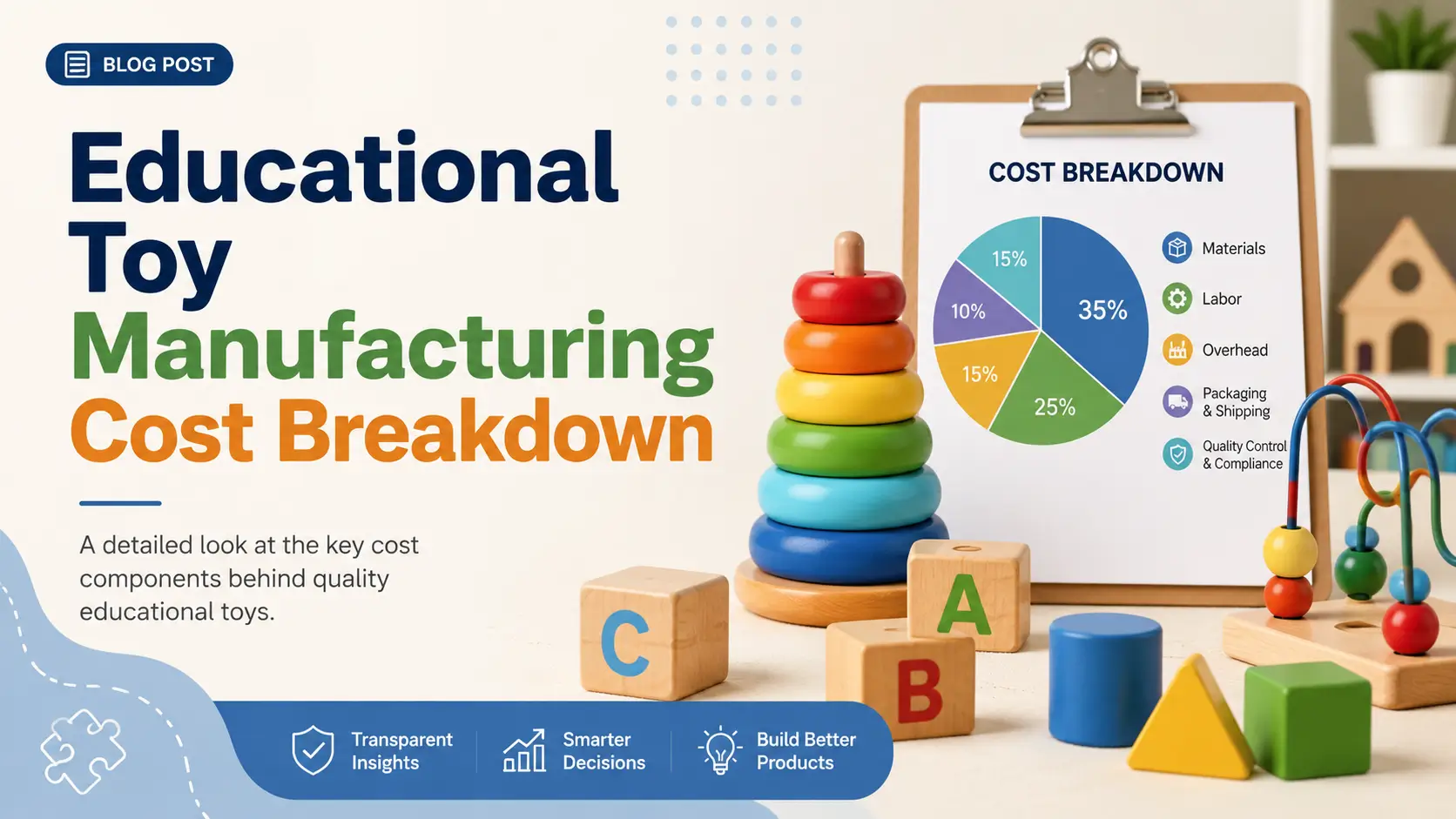
The total cost is composed of raw materials, labor and manufacturing processes, mold and development, quality control and testing, compliance certifications, and packaging with logistics.
Each layer contributes a measurable percentage to the final unit cost. A plastic block set and an electronic STEM kit do not exist in the same cost universe.
The final cost is never a fixed price. It is a structured system driven by production design, material selection, and mandatory regulatory requirements.
Educational Toy Manufacturing Cost Breakdown Structure
A manufacturing cost is not a single quotation. It is a multi-layered production cost structure that determines every dollar in the final product. Many buyers focus only on the FOB price, but this ignores the real cost distribution behind manufacturing.
Understanding this structure is the difference between a profitable product line and a pricing mistake.
Cost is typically distributed across five core layers. Material input and labor production form the base.
Tooling amortization and compliance testing add fixed and variable overhead. Logistics preparation bridges the factory floor to the warehouse.
Each layer interacts with the others. Changing the material grade can increase labor efficiency but raise compliance risk.
This structure allows buyers to evaluate supplier capability, pricing fairness, and long-term profitability, which is exactly why supplier quotations vary so dramatically even for similar-looking educational toys.
Learn more in Why Do Educational Toy Supplier Quotes Differ So Much?
A supplier quoting a lower FOB price may simply be shifting costs into hidden areas like packaging durability or compliance shortcuts.
Seeing the full structure makes these trade-offs visible.
Cost range per unit: $2–$15 depending on material type
The unit cost of educational toys typically ranges from $2 to $15 depending on product type and material selection.
This range is not a negotiation starting point. It reflects real differences in production inputs and process time.
Wooden toys land between $3 and $10 due to cutting, sanding, and finishing labor that plastic toys do not require.
Plastic toys settle between $2 and $6 depending on resin grade and injection molding efficiency.
Electronic STEM toys reach $5 to $15 because of PCB assembly, circuit testing, and component sourcing complexity.
A wooden block set and a Bluetooth-enabled science kit cannot share a cost framework.
Learn more in the typical manufacturing cost of educational toys in China.Pricing should always be evaluated based on product structure rather than comparing FOB prices directly.
Material cost share: 40%–60% of total COGS
Raw material cost accounts for approximately 40% to 60% of total manufacturing cost in educational toys. This percentage dominates the cost structure because material choice dictates everything downstream, from production speed to testing requirements.
Main materials include wood with its density, cutting loss, and surface finishing demands. Plastic resins such as ABS and PP vary in price and mechanical properties. Electronic components including PCB boards and motors introduce both cost and supply chain complexity.
Material selection determines not only cost structure but also production feasibility and quality stability. Choosing a cheaper resin that warps during cooling creates more waste than the initial savings. In most cases, material cost sets the upper limit of final product pricing before labor and compliance are considered.
MOQ impact on cost: 500, 1,000, 5,000 units
MOQ is one of the most important factors affecting unit cost due to tooling amortization and production efficiency. The same product can show a 30% to 50% unit cost difference simply based on order quantity.
At 500 units, mold cost allocation per unit is high and production line setup time is not yet amortized. At 1,000 to 3,000 units, production and pricing structure reach a balanced state where fixed costs are distributed more evenly.
At 5,000 plus units, cost distribution is optimized with stable output rates and material procurement advantages.
Lower MOQ does not reduce total cost. It only increases cost concentration per unit. A mold costing $5,000 spread over 500 units adds $10 per unit. Spread over 5,000 units, it adds $1.
This single variable explains most pricing gaps between small and large orders. For Amazon sellers and distributors, MOQ structure directly impacts long-term profitability and scalability.
Compliance cost contribution: 2%–10%
Compliance cost accounts for 2% to 10% of total manufacturing cost but is mandatory for export markets. This is not a cost that can be optimized downward. It is a fixed requirement with binary outcomes, pass or fail.
Key certifications include ASTM F963 for US safety standards, EN71 for EU toy safety regulation, and CPSIA for chemical compliance in children’s products. Each certification requires lab testing, documentation, and ongoing factory audits.
Without compliance, products cannot enter mainstream markets such as Amazon or EU distributor networks.
A single compliance failure can result in shipment rejection at customs or product delisting from online platforms. Compliance is a mandatory market entry requirement, not an optional cost.
Cost increases when complexity rises: Level 1–5 model
Manufacturing cost increases non-linearly with product complexity rather than product size. A large simple puzzle can cost less to produce than a small multi-function STEM kit.
The complexity model breaks into five levels. Level 1 covers simple wooden puzzles with minimal parts. Level 2 includes basic assembly toys with snap-fit connections. Level 3 represents Montessori multi-step kits requiring sequenced production.
Level 4 involves advanced STEM structures with mechanical systems. Level 5 describes electronic interactive systems with PCBs, sensors, and firmware.
Higher complexity increases labor time per unit, assembly steps, QC failure risk, and component dependency. A Level 5 product may require 10 times the assembly stations of a Level 1 product. Complexity is the most underestimated cost driver in educational toy manufacturing.
Manufacturing Capability and Cost Structure Insight
At Jaredrise, every educational toy is priced based on a structured BOM, or Bill of Materials, rather than estimated quotation models. This means the cost of any product can be traced back to its individual components, processes, and testing requirements. There is no black-box pricing.
Each cost component is broken down into raw materials, labor processes, tooling costs, compliance testing, and packaging requirements. This breakdown happens at the SKU level. A customer asking about a wooden spelling game receives a cost structure specific to that product’s wood type, cutting pattern, and finish specification.
This system ensures full transparency in production cost allocation and helps buyers understand how each dollar is distributed. If material prices fluctuate, the exact impact on unit cost is visible and documentable. This structured approach allows international buyers to evaluate OEM and ODM suppliers with real production data rather than surface-level pricing comparisons.
Full BOM-driven cost system at manufacturing stage
Every product at Jaredrise starts with a complete Bill of Materials that maps every component, process, and cost input.
A typical BOM lists raw material specifications by part number, labor operations by workstation, assembly sequences, and testing checkpoints. This level of granularity makes costs fully traceable.
A buyer can see the cost contribution of a single wooden tray or a specific PCB module. This is not estimation. It is cost accounting built directly into the production planning phase.
Cost variation based on production complexity
Production complexity changes cost through labor hours, assembly steps, and quality control requirements.
A simple puzzle may require three assembly steps with a 99% first-pass yield. A mechanical gear toy may require 12 assembly steps with an 85% yield, generating rework and material waste.
Each additional step adds direct labor and indirect overhead. Complexity directly determines the number of workers per shift, the cycle time per unit, and the defect rate that must be managed.
Mold amortization logic in real production
Mold cost is a fixed upfront expense that is amortized across the total order quantity. A mold costing $8,000 spread over 1,000 units adds $8 per unit.
The same mold spread over 10,000 units adds $0.80 per unit. This is not a discount. It is basic cost distribution.
Tooling life also factors into this calculation. A mold rated for 50,000 cycles has a predictable cost per shot. This amortization logic determines the real unit cost floor and explains why larger production runs achieve structurally lower pricing.
MOQ and Pricing Explanation
Price is not a number pulled from a catalog. It is a direct function of order quantity, and understanding this relationship prevents costly purchasing errors.
The connection between MOQ and unit price runs through every manufacturing stage, from raw material procurement to final quality inspection.
Small orders concentrate fixed costs into fewer units. Mold amortization, production line setup, and material sourcing all carry minimum charges that do not scale down proportionally with order size. A factory produces what is ordered, but the preparation costs remain largely constant.
This section explains how different MOQ tiers create distinct price structures, exposes the hidden costs that low-volume buyers absorb, and shows how long-term buyers optimize their cost base through strategic ordering patterns.
MOQ tiers define unit price structure
MOQ tiers create fundamentally different pricing structures. At 500 units, tooling and setup costs dominate the unit cost calculation. Production runs are short, so worker learning curves are steep and efficiency is low. At 1,000 to 3,000 units, fixed cost amortization reaches a practical balance and per-unit pricing becomes more predictable.
At 5,000 plus units, continuous production allows for material sourcing advantages, optimized labor allocation, and minimal setup waste per unit. Each tier represents a different production economics model, not a volume discount.
How MOQ affects hidden cost exposure?
Low MOQ orders expose buyers to hidden costs that are invisible on a proforma invoice. Production line changeover time gets billed into labor costs.
Smaller material orders carry premium pricing from raw material suppliers. Excess inventory from minimum material batch requirements becomes waste.
Testing and compliance fees are spread over fewer units, increasing the per-unit compliance burden. These costs exist in every order but are concentrated and magnified at low quantities.
Bulk pricing logic for long-term buyers
Long-term buyers do not just receive discounts. They achieve structural cost reduction through planned production scheduling, reserved material inventory, and dedicated production line allocation.
When a buyer commits to quarterly orders of 5,000 units, the factory can optimize raw material purchasing, reduce setup frequency, and improve worker proficiency on the specific product.
These efficiencies compound over time and produce per-unit costs that spot orders cannot match.
Hidden Cost and Risk Analysis
The price on a quotation is not the total cost of bringing a product to market. Hidden costs operate below the surface and can erase margins if not identified early.
These risks concentrate in three areas where inexperienced buyers consistently underestimate exposure.
The most damaging hidden costs do not appear in factory pricing. They appear at customs checkpoints, in Amazon warehouses, and in customer return rates.
This section maps the three critical hidden cost categories that must be calculated before finalizing any educational toy sourcing decision.
Compliance failures as hidden cost drivers
A compliance failure transforms an educational toy from an asset into a liability. Shipments rejected at customs generate storage fees, re-export costs, and lost sales revenue.
Products delisted from Amazon for documentation gaps destroy inventory value and account health.
The cost of fixing a compliance failure after production is 5 to 10 times higher than building compliance into the initial manufacturing process.
These costs are never included in a factory’s unit price but they become the buyer’s full responsibility.
Packaging and logistics underestimation risk
Packaging decisions made without logistics knowledge create compounding costs. A box that is 2 centimeters too large increases carton dimensions, which increases container utilization inefficiency, which increases per-unit shipping cost.
For FBA sellers, oversized packaging triggers higher fulfillment fees that repeat with every unit sold.
Lightweight educational toys with inefficient packaging pay disproportionately high logistics costs relative to product value.
Material substitution risk in low-cost sourcing
Chasing the lowest unit price often leads to material substitution without disclosure. ABS can be replaced with lower-grade polystyrene.
Water-based paints can be swapped for solvent-based alternatives. Wood density can be reduced below design specifications.
These substitutions maintain appearance while degrading durability, safety, and compliance. The cost saved in materials is paid back multiple times through warranty claims, negative reviews, and regulatory exposure.
Compliance and Quality Assurance System
A documented quality assurance system is not a marketing advantage. It is the structural requirement for consistent, compliant production that protects buyers from the hidden costs described above.
This system must be active at every production stage, from incoming material inspection to pre-shipment verification.
Manufacturers without a multi-stage QC system are producing products whose quality level is unknown until after delivery.
By that point, the cost of failure belongs entirely to the buyer. The following three subsystems form the minimum viable quality infrastructure for educational toy production.
Multi-stage QC system
Quality control must operate at every stage of production, not just at the end. Incoming material inspection verifies wood moisture content, plastic resin specifications, and electronic component tolerances before production begins.
In-process inspection checks assembly accuracy, paint application, and mechanical function during manufacturing.
Pre-shipment inspection validates finished product against AQL sampling standards. Each stage catches defects before they move forward, preventing value-added processing on already defective materials.
Third-party testing integration
Third-party testing provides independent verification that factory quality claims are accurate. Accredited laboratories conduct ASTM F963, EN71, and CPSIA testing on production samples pulled from actual production runs rather than specially prepared submissions.
This integration into the production timeline means test reports are available before shipment, not obtained retroactively.
Major retailers and platforms require third-party test reports from ISO 17025 accredited labs specifically.
Export readiness process
Export readiness means documentation is complete before the container is loaded. This includes test reports, certificates of compliance, packing lists with harmonized system codes, and country-specific labeling verification.
A shipment that arrives at a destination port without complete documentation incurs demurrage fees, storage charges, and potential regulatory action.
The export readiness process ensures every document exists and is verified against destination country requirements before shipping begins.
Customization Options and Engineering Flexibility
Customization transforms a generic product into a brand-differentiated asset, but only when the manufacturing system is engineered for flexibility.
Changing colors is customization at the surface level. Changing materials, assembly logic, or compliance requirements demands engineering depth.
This section describes the real customization options available in educational toy manufacturing, from material selection to modular design systems.
Every option listed is backed by documented engineering capability, not catalog claims.
OEM and ODM service models
Two customization paths exist. OEM service builds products to buyer-supplied specifications, designs, and requirements.
The factory executes the production based on the buyer’s documentation. ODM service provides the buyer with an existing platform product that is then modified in color, branding, packaging, and feature configuration.
OEM offers maximum differentiation and requires more development investment. ODM offers speed and lower upfront cost with more constrained customization options.
Material and component substitution options
Material substitution is a legitimate customization strategy when managed through engineering review rather than cost reduction pressure.
Wood type can be upgraded from basswood to beechwood for increased durability. Plastic resin can shift from PP to ABS for better impact resistance.
Electronic components can be upgraded for extended operational life. Each substitution option comes with documented cost impact, supply chain availability analysis, and compliance re-verification requirements.
Modular design for scalable product lines
Modular design allows a single product platform to support multiple SKUs through interchangeable components.
A core STEM kit structure can accept different sensor modules, activity cards, and packaging configurations.
This approach reduces per-SKU mold investment, simplifies compliance testing by maintaining consistent materials across variants, and enables faster new product introduction.
The manufacturing system produces volume efficiency while the product line delivers market variety.