
For educational toy buyers, the real sourcing risks are often invisible: incomplete safety docs that stall customs, packaging that triggers FBA surcharges, and inconsistent quality that damages reviews.
Jaredrise eliminates these from the start. Our STEM kits, Montessori busy boards, and sensory playsets are pre-engineered to pass ASTM F963, EN71, and CPSIA. Before shipment, you receive CPC certificates, third-party lab reports, and MSDS documentation—so your inventory clears without a hitch.
We screen all materials for phthalates and BPA and provide full compliance files proactively.
FBA readiness is built into our workflow. Poly bags carry printed suffocation warnings; FNSKU labels are applied and scanned at the factory. We calculate carton dimensions to sidestep dimensional-weight fees and audit every package against Amazon’s Frustration-Free guidelines to minimize inbound rejections.
With a 500-unit MOQ, you can test private-label designs with custom colors, logos, and branded retail boxes. Need a unique shape? Our design team typically delivers a 3D-printed prototype in seven days and iterates based on your feedback.
Quality control prevents problems. Inline function testing and age-grade validation catch assembly flaws early. We routinely suggest refinements—screw-secured battery doors, reinforced stitching—that directly lower return rates and protect your ratings. We also advise on IP-safe design choices to help you avoid trademark disputes.
When you scale, we supply the compliant invoices and factory documents required for Amazon Brand Registry. A dedicated project manager responds quickly, understanding your restock timeline affects the Buy Box.
We include packaging audits to prevent stranded inventory and stay updated on Amazon policy changes. This helps you build a brand that passes every checkpoint and grows reliably.
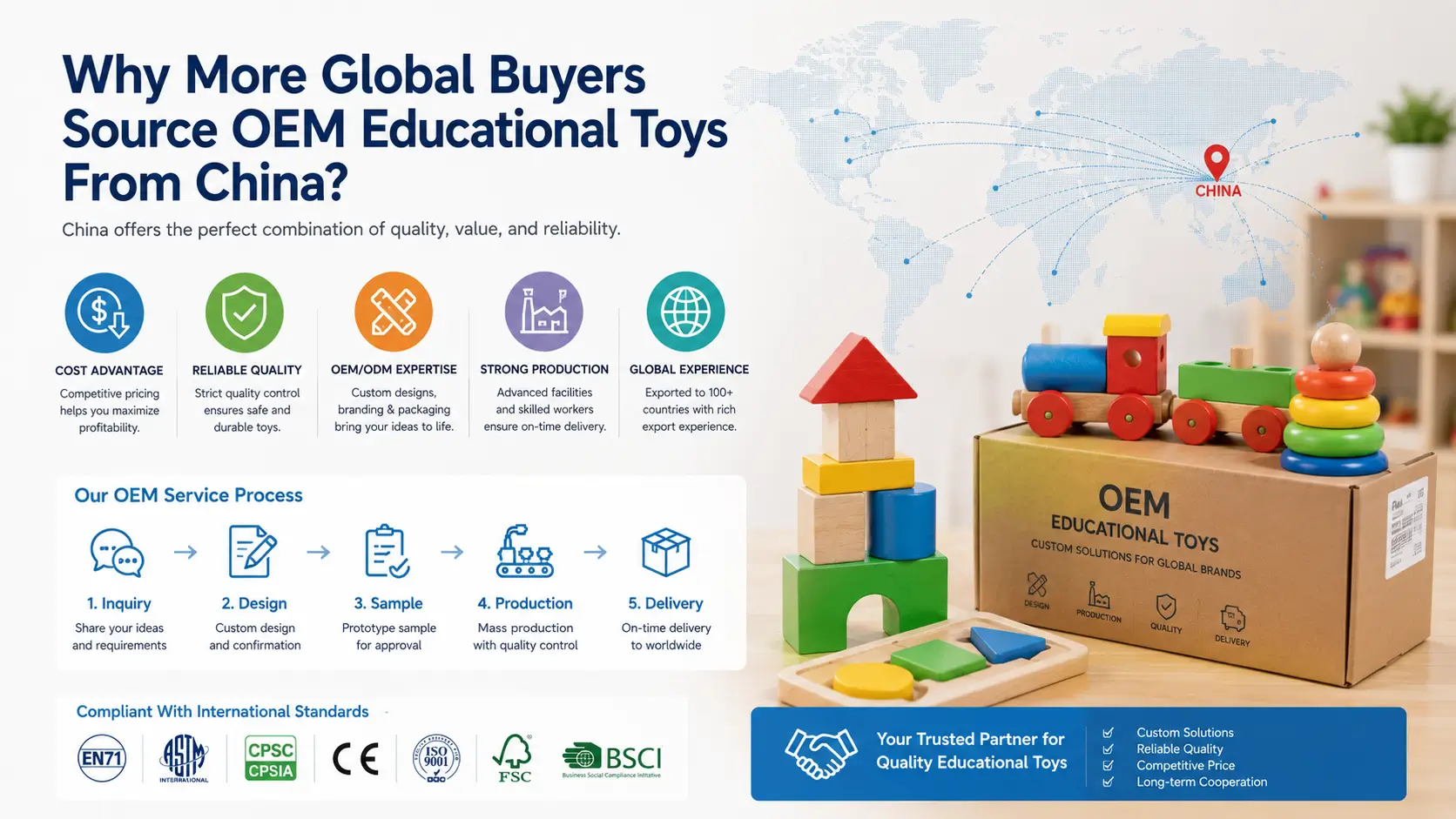
Why More Global Buyers Source OEM Educational Toys From China?
The global educational toy market has evolved far beyond simple alphabet blocks and counting bears. Demand for STEM toys continues to accelerate year after year. The Montessori approach has expanded from niche classrooms into mainstream parenting culture.
Parents actively seek screen-free toys that provide genuine developmental value, and early learning has become a central factor in household purchasing decisions. Amazon’s educational toy categories clearly reflect this trend. Subcategories dedicated to science kits, coding toys, and early math manipulatives now generate substantial sales volume across North America and Europe.
Behind this growth lies a supply chain reality well understood by the world’s most successful toy brands. The companies dominating Amazon listings, boutique retail shelves, and social media campaigns rarely manufacture their own products. Instead, they focus resources where they create the greatest value.
They build brand identity. They manage distribution channels. They run marketing campaigns. They optimize Amazon listings. They produce compelling social media content. Physical manufacturing happens elsewhere. And in the educational toy sector, that manufacturing overwhelmingly takes place in China.
The advantage extends far beyond production cost. Over decades, China has developed complete industrial clusters dedicated to toy manufacturing. These ecosystems include material suppliers, mold makers, printing facilities, testing laboratories, and logistics providers operating within concentrated geographic regions.
An OEM factory inside such a cluster can source wood from a supplier thirty minutes away, receive printed packaging from another facility within the same industrial zone, and coordinate third-party lab testing through long-term partners.
This level of industrial density creates speed and reliability that fragmented supply chains simply cannot match.
OEM expertise accumulated through thousands of projects creates another layer of value rarely reflected in pricing sheets. A factory that has completed five hundred custom educational toy projects understands how materials behave under different humidity conditions. It knows which paint formulations survive drop testing during peak-season shipping.
It can identify packaging flaws that may cause damage during Amazon FBA receiving before the first sample is even shipped. Many Amazon toy sellers fail not because of weak marketing, but because their suppliers cannot maintain consistent product quality during peak restocking periods.
This operational knowledge separates professional OEM partners from ordinary manufacturers.
Packaging customization deserves particular attention because it directly influences retail performance. An educational toy sold through Amazon requires entirely different packaging from the same toy sold through a Montessori school catalog or a boutique gift store.
Retail-ready packaging with proper branding, educational inserts, barcode placement, and damage-resistant construction represents a specialized capability. Chinese OEM factories serving international brands have refined these skills through years of feedback from importers, distributors, and marketplace sellers who rely on packaging to protect products and communicate value.
Material supply stability provides another structural advantage that becomes most visible during difficult market conditions.
Wood sourcing disruptions, plastic resin shortages, and paper price fluctuations impact the entire toy industry. Factories with long-established supplier relationships and diversified sourcing networks maintain production continuity when spot-market buyers encounter delays. This supply chain depth enables consistent order fulfillment for brand owners who depend heavily on inventory availability.
Jaredrise operates within this mature manufacturing ecosystem and tailors its capabilities specifically for brand owners, Amazon sellers, and distributors. The factory provides OEM logo customization, custom packaging design, compliance documentation support, stable production scheduling, and Amazon-ready product preparation. Every service is designed around the operational realities faced by companies building educational toy brands in highly competitive Western markets.
Educational toys are no longer just children’s products
Educational toys now occupy a distinct position within the consumer market that clearly separates them from general toys. Parents consistently demonstrate a willingness to pay premium prices for products they believe will support their child’s development.
A wooden counting set positioned with clear Montessori learning outcomes can command a significantly higher price point than a generic playset made from similar materials. STEM-branded construction kits sell at pricing levels that non-educational alternatives cannot achieve.
Screen-free coding toys and early science experiment kits have created entirely new product categories with strong margins and rapidly growing demand.
This pricing dynamic fundamentally changes the business model for brand owners. Higher average selling prices create room for investment in brand development, packaging design, educational content creation, and customer experience.
These are precisely the areas where OEM partnerships deliver the greatest value. Brand owners focus on defining educational philosophy, designing the learning experience, and communicating value to parents. The OEM factory handles physical production with the consistency necessary to protect that brand promise.
The Montessori and STEM segments continue to expand as educational research increasingly influences purchasing behavior. Parents read about child development. They follow educational influencers on social media. They research products carefully before buying.
This informed buyer behavior creates significant opportunities for brands capable of presenting a clear educational philosophy through their products. OEM manufacturing makes this level of differentiation possible because it allows companies to customize every physical touchpoint.
The shape of wooden pieces, the design of instruction cards, the color scheme of packaging, and the texture of materials all communicate the brand’s educational philosophy. Custom manufacturing transforms an ordinary toy into a branded learning experience.
Why OEM manufacturing matters for Amazon sellers?
Amazon educational toy sellers face a unique set of operational challenges that generic wholesale purchasing cannot solve. Listing competition has intensified dramatically. When multiple sellers offer identical products sourced from the same factory catalog, price becomes the only differentiator.
This race-to-the-bottom pricing destroys margins and makes long-term sustainability impossible. Negative reviews caused by inconsistent product quality can damage a listing’s ranking within weeks. FBA restocking pressure creates constant inventory stress. Competitors rapidly copy successful products.
Compliance documentation requests from Amazon trigger account health warnings that threaten selling privileges. Packaging damaged during FBA receiving generates removal orders and lost sales. Without meaningful product differentiation, sellers cannot build the brand equity increasingly rewarded by Amazon’s algorithm.
OEM manufacturing directly addresses each of these pain points. Custom logos and branded packaging make listings distinct within Amazon’s marketplace. When customers search for educational toys and encounter a unique brand presentation, price comparison becomes secondary to perceived value.
Educational inserts designed specifically for the brand communicate teaching methodologies that generic products cannot replicate. Integrated UPC and FNSKU labeling reduces fulfillment friction. ASTM and CE compliance documentation provided as standard deliverables eliminates last-minute scrambling when Amazon requests verification.
Even subtle design modifications help protect against direct copycat competition.
Consistency across multiple production runs matters more than the quality of any single shipment. An Amazon seller who builds a successful listing invests heavily in PPC advertising, product photography, and review generation. That investment only pays off if the product customers receive in month six matches the product that earned five-star reviews in month one.
Batch-to-batch consistency requires disciplined production management, strict material control, and quality assurance systems that commodity factories often lack. Professional OEM partners understand that their reputation depends on ensuring repeat-order quality matches sample quality precisely.
Jaredrise understands the operational requirements of Amazon educational toy sellers, not just the mechanics of manufacturing. This distinction shapes every stage of how the factory manages OEM projects, from initial sample development to peak-season production planning.
What Services Should a Reliable OEM Educational Toy Supplier Provide?
Procurement professionals and experienced brand owners evaluate potential factory partners against specific capability criteria. They understand that a supplier’s weaknesses eventually become their own business risks.
The following capabilities distinguish factories capable of supporting long-term brand growth from those suitable only for one-time transactions.
Product customization capability
A professional OEM educational toy supplier should provide deep customization capabilities covering every customer-facing aspect of the product. Logo printing should be available through multiple methods suited to different materials. Silk-screen printing works well on wooden surfaces.
Pad printing suits irregular shapes. Laser engraving creates a premium appearance for high-end products. Heat transfer printing delivers vibrant colors for fabric educational items. The supplier should guide buyers in selecting the most appropriate materials and printing methods based on intended retail environments and product positioning.
Packaging can also affect the minimum practical production quantity, especially when a project uses custom printed boxes, internal trays or product specific inserts. This relationship can be seen clearly in Custom Dinosaur Dig Kit Cost and MOQ, where product format, kit contents and packaging structure can change both unit cost and MOQ.
Packaging customization is a separate competency from product manufacturing itself. A reliable supplier maintains either in-house packaging design capabilities or close partnerships with specialized packaging providers.
The factory should provide structural packaging support to ensure products remain protected during ocean freight and Amazon FBA handling. Graphic design coordination should also be available for buyers without internal design teams. Suppliers should offer multiple packaging material options while clearly explaining the tradeoffs between cost, durability, and presentation quality.
Customization extends beyond visual branding into educational content itself. Instruction manuals should be editable to match brand voice and teaching methodology. Educational cards, activity guides, and learning inserts should be customizable in content, design, and language.
Color schemes should align with brand identity guidelines. Materials should be selectable according to the brand’s quality positioning. Bundle sets should be configurable to create unique retail offerings. Accessories should be removable or addable to differentiate products from competing listings.
Barcode labeling, including UPC and FNSKU application, should be integrated directly into the production workflow rather than handled as an afterthought.
Professional OEM suppliers should also align product presentation with the buyer’s target retail market. An educational toy designed for a premium Montessori catalog requires a fundamentally different presentation strategy than the same product prepared for Amazon’s broader mass-market audience.
The factory should actively ask about the buyer’s distribution channels and adjust packaging specifications accordingly.
Safety compliance and certification support
Safety compliance in the educational toy industry is not optional. It is the minimum requirement for market access. The regulatory frameworks governing toy imports into the United States and the European Union are comprehensive and strictly enforced. ASTM F963 covers mechanical hazards, flammability, and toxic elements for toys sold in the US market.
CPSIA establishes lead content limits, phthalate restrictions, and third-party testing requirements with mandatory certification.
EN71 addresses mechanical and physical properties, flammability, and migration limits for specific elements within the European market. CE marking demonstrates conformity with EU health and safety standards. Additional regulations address specific risks. Phthalate levels in plasticized components must remain below regulatory thresholds. Lead content in coatings and accessible substrates faces strict limitations. Small-parts hazards must be properly assessed and age-graded with accurate warning labels.
When a factory lacks genuine compliance expertise, the consequences ripple across the entire business. Amazon removes listings when compliance documentation is incomplete or expired. US Customs and Border Protection may detain shipments lacking proper certification, generating demurrage charges that accumulate daily.
Product recalls caused by safety failures can permanently damage brand reputation. Amazon account suspensions resulting from compliance violations can halt all platform revenue immediately. Customer complaints regarding safety concerns also create serious liability exposure.
Jaredrise manages compliance risk through documented operational systems rather than vague promises. Material sourcing control begins with supplier qualification processes that verify raw material compliance before purchase orders are placed. Factory inspections during production identify potential safety issues before they escalate into batch-level problems.
Third-party testing coordination connects buyers with accredited laboratories and manages sample submission procedures. Pre-shipment quality inspections include compliance verification against destination-market standards.
Packaging compliance reviews ensure that age grading, warning labels, and traceability information meet regulatory requirements before containers leave the factory.
MOQ flexibility and scalable production
Brand owners at different stages of growth require fundamentally different production support. A startup testing its first product concept needs small-batch production with minimal financial exposure. An established brand operating successful Amazon listings requires reliable high-volume production with consistent quality.
An expanding company entering new markets needs scalable manufacturing capacity that can grow alongside demand. A professional OEM supplier should be capable of supporting all three stages.
Low minimum order quantity support demonstrates that a factory values long-term relationship building over short-term volume gains. Sample orders allow buyers to evaluate product quality, packaging presentation, and supplier communication before committing to full-scale production.
Startup-friendly production terms, even when accompanied by slightly higher per-unit costs for smaller runs, provide emerging brands with a practical path to market validation. This flexibility reflects the reality that most successful long-term partnerships begin with relatively modest first orders.
Scalable production capacity separates truly capable factories from small workshops. A supplier capable of handling a 500-unit trial order should also demonstrate the operational ability to fulfill 10,000-unit replenishment orders under compressed timelines.
Peak-season production planning should be a visible operational capability rather than an afterthought. Brand owners who spend months or years building Amazon rankings cannot afford stockouts during Q4. A supplier’s ability to scale production while maintaining quality standards directly impacts business continuity.
A factory that performs perfectly on sample orders but collapses under high-volume pressure creates greater risk than one that communicates capacity limitations honestly from the beginning.
How to Identify a Trustworthy Educational Toy Factory in China?
Evaluating potential factory partners requires looking beyond polished websites and sales presentations. The following assessment criteria help buyers identify suppliers capable of supporting long-term brand operations in Western markets.
Check export experience in the US and EU markets
Export experience in a specific market means the factory has already encountered and resolved the practical challenges that arise when products cross international borders. Educational toys shipped to the United States require specific labeling standards.
Suffocation warnings must appear on polybag packaging in the correct format and font size. Country-of-origin markings must comply with Customs and Border Protection requirements regarding permanence and placement.
FBA carton standards define weight limits, dimensional restrictions, and label placement requirements that differ from standard commercial shipping practices. Testing documentation must be organized in formats accepted by Amazon’s compliance verification system.
Packaging durability must also withstand the handling conditions of US domestic logistics networks after container deconsolidation.
A factory that has completed hundreds of shipments to the US or EU market has already internalized these requirements. Its production team understands how to verify polybag thickness against suffocation warning thresholds. Its packaging engineers design cartons specifically rated for Amazon FBA receiving processes.
Its shipping documentation includes the precise details necessary to prevent customs clearance delays. This institutional knowledge prevents the frustrating cycle where buyers discover compliance gaps only after receiving violation notices, then spend additional time educating suppliers and waiting for corrections while inventory remains unavailable for sale.
Ask for real compliance documents instead of promises
Many suppliers confidently claim they can pass testing requirements. Verbal assurances cost nothing and guarantee nothing. Professional buyers request actual documentation from completed projects. Existing test reports issued by accredited laboratories demonstrate that the factory has successfully navigated compliance procedures for previous products.
These reports should be recent enough to reflect current regulatory standards and should clearly identify the factory as the responsible party or applicant. Laboratory certificates showing the specific testing facilities used indicate established relationships with recognized labs.
Material compliance reports, especially for plastics, paints, and wood treatments, provide upstream verification that finished products are likely to pass final testing. Production records documenting quality-control checks during manufacturing runs demonstrate systematic process management rather than reliance on final inspections alone.
A supplier that proactively discusses regulatory requirements during initial conversations demonstrates a fundamentally different level of professionalism compared to one that waits for buyers to raise compliance concerns. Professional suppliers ask about destination markets early in the discussion process.
They explain which standards apply to the product category. They identify potential compliance challenges before sampling begins and recommend design modifications to address those issues. This proactive approach reflects practical experience that directly reduces business risk for the buyer.
Evaluate communication and production transparency
The quality of supplier communication during the evaluation stage is often a reliable predictor of communication quality during production challenges. Clear timelines with specific milestone dates indicate organized project management. Production updates delivered at agreed intervals demonstrate operational discipline.
QC reporting that includes actual measurements and photographs rather than generic approval statements reflects meaningful quality oversight. Fast response times during quotation and sampling stages usually indicate responsiveness when urgent production issues require immediate action.
A supplier’s ability to solve issues, revealed through how it handles specification questions or sample revisions, often indicates how it will respond when a production problem arises mid-batch.
The way a supplier reacts during production challenges often reveals more than pricing sheets or sample quality ever can. Quotations and samples demonstrate what a factory can achieve under controlled conditions. Communication during difficult situations reveals how the factory operates under pressure.
Suppliers that acknowledge problems quickly, propose concrete solutions, and adjust processes to prevent recurrence build partnerships capable of surviving the inevitable complications of international manufacturing. Suppliers that avoid responsibility or disappear when problems emerge create business risks that no pricing advantage can justify.
Why Buyers Choose Jaredrise as Their OEM Educational Toy Partner?
Amazon-ready OEM solutions
Jaredrise provides manufacturing support specifically designed around the operational requirements of Amazon sellers and marketplace-focused brand owners. FBA packaging specifications are integrated into production planning from the initial quotation stage.
Carton dimensions, weight limits, and structural standards are verified against Amazon’s latest requirements before production begins. Labeling support includes UPC codes, FNSKU barcodes, and any Amazon-specific identification requirements tied to the seller’s listing structure.
Product bundle configurations are assembled as finished retail units, eliminating the need for additional assembly or repackaging after shipment arrival. Retail-ready packaging ensures products reach FBA warehouses prepared for immediate customer fulfillment without further handling.
Repeat-order consistency receives dedicated attention through retained material samples and documented production parameters that ensure the second order precisely matches the first.
Stable quality control for long-term cooperation
Production quality at Jaredrise is built on documented operational processes executed at defined production stages rather than relying solely on final inspections. Material inspections verify incoming raw materials against required specifications before production begins.
In-process QC inspections occur at designated manufacturing stages to identify deviations before they impact entire production batches. Final shipment inspections confirm that completed products meet all specifications, including packaging, labeling, and compliance standards.
Batch-to-batch consistency is maintained through systematic production record management, retained material samples, and documented process parameters. Buyers placing repeat orders six months later should receive products indistinguishable from the original shipment. This consistency protects the brand equity buyers build through marketing investment and customer satisfaction.
Flexible OEM support for growing brands
Jaredrise structures its manufacturing partnerships to support brands at different growth stages. Startup toy brands receive guidance on product development decisions that affect manufacturing feasibility and cost efficiency. Amazon sellers transitioning from generic private-label sourcing to branded OEM production receive operational support throughout the process.
Distributors expanding into exclusive product lines gain access to product development expertise built around educational toy manufacturing. Wholesalers developing house brands benefit from partnership terms that evolve alongside increasing order volumes.
The factory’s systems support small initial orders for market testing while maintaining the production capacity and operational structure necessary to scale once demand is validated.
Conclusion
An educational toy manufacturing partnership extends far beyond unit pricing and shipping schedules. The OEM supplier a brand owner selects becomes directly responsible for product safety compliance in highly regulated Western markets, for production consistency that protects Amazon listing investments, for packaging quality that determines retail presentation and shipping durability, and for supply continuity that prevents stockouts capable of damaging marketplace rankings.
The right factory not only reduces supply-chain risk but also enables the product differentiation necessary to build long-term brand value.
Jaredrise provides OEM educational toy manufacturing capabilities specifically designed for brands selling into North American and European markets. The factory offers extensive customization across products, packaging, and educational content. Compliance support covers ASTM, CPSIA, and EN71 requirements with documented testing coordination.
Flexible production systems support brands at every stage of growth, from initial market testing to large-scale replenishment orders. Contact the Jaredrise team to request product catalogs, discuss OEM specifications, arrange sample production, or receive a quotation for your educational toy project.