
Many buyers search this question not because they want to learn about manufacturers, but because they are really asking, will something go wrong when I place this order.
This underlying order anxiety is universal among Amazon sellers and EU, US importers, and it is rooted in three costly, common risks that can derail your business overnight, product removal due to unmet compliance standards, products that sit unsold on shelves because of poor market fit, and supply chain collapse that leaves you unable to fulfill customer orders.
These risks are not hypothetical, they happen every day to sellers who rush the sourcing process and fail to vet their partners properly.
This guide will show you exactly how to evaluate a toy manufacturer based on compliance, sellability, production stability, and long term cooperation, breaking down each criterion into actionable steps you can take right now.
If you are sourcing from China for Amazon or wholesale, this checklist can save you thousands of dollars in avoidable mistakes, missed sales, and compliance penalties.
Finding a reliable supplier and trustworthy educational toy manufacturer is the first step to avoiding these risks and ensuring your business runs smoothly, whether you are a new seller testing the market or an established brand looking to scale.
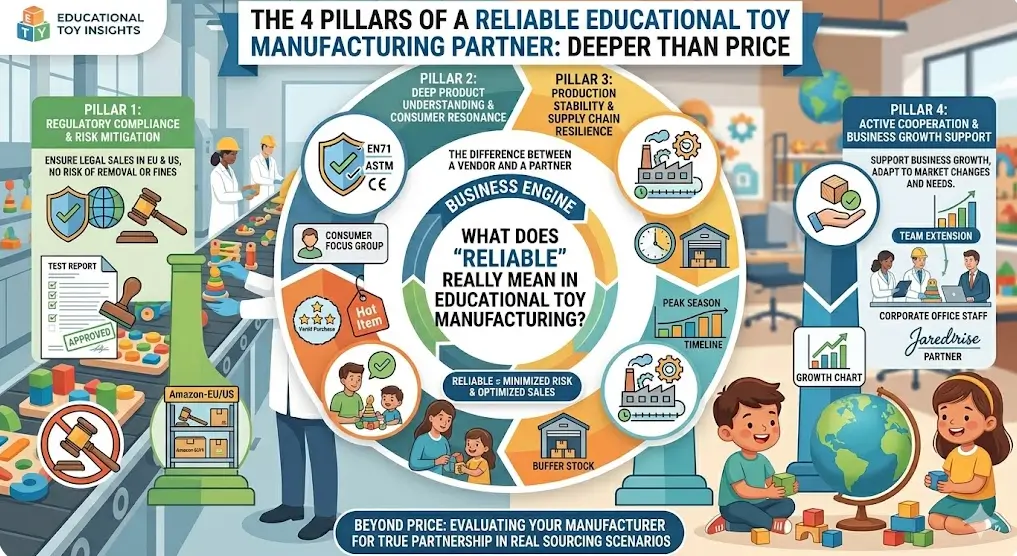
What Does Reliable Really Mean in Educational Toy Manufacturing?
Most buyers think a reliable manufacturer means a good price and decent quality. That’s not enough—especially in educational toys, where regulatory requirements are strict, consumer expectations are high, and market competition is intense.
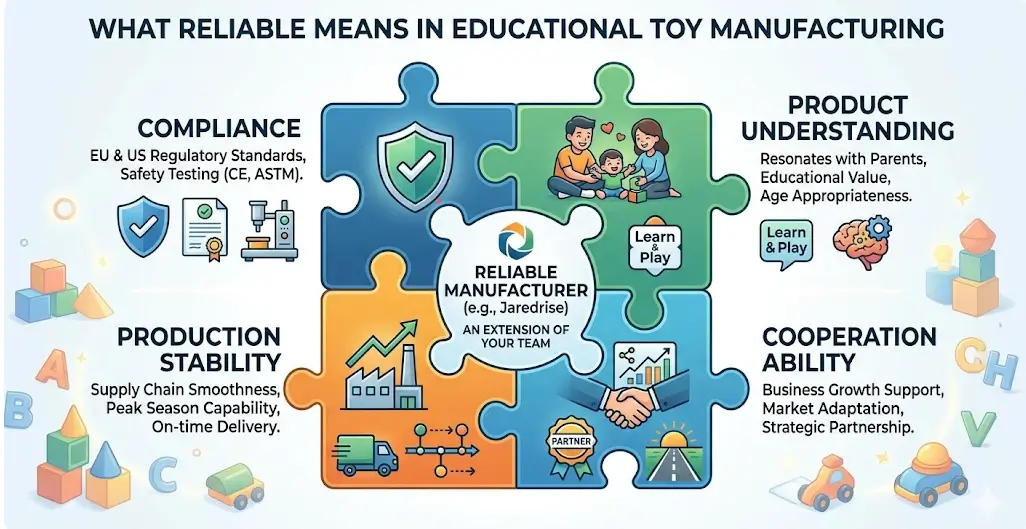
A truly reliable educational toy manufacturer must deliver in four critical areas: compliance to ensure you can legally sell your products in the EU and US without the risk of removal or fines; product understanding to guarantee your toys resonate with parents and sell consistently;
production stability to keep your supply chain running smoothly even during peak seasons; and cooperation ability to support your business as it grows, adapting to market changes and evolving needs.
A factory that only produces toys is not a partner—it’s just a vendor. A reliable supplier like Jaredrise, on the other hand, acts as an extension of your team, helping you reduce risk at every step, improve your Amazon listings to drive more sales, and adapt quickly to market feedback.
For brands looking to scale private label products, working with OEM Educational Toys From China Wholesale solutions can help streamline customization, compliance alignment, and long-term production stability.
A key reason many importers succeed is understanding why source educational toys from China suppliers, especially in terms of cost efficiency, production capacity, and manufacturing ecosystem advantages.
Let’s break down how to evaluate each of these four areas in real sourcing scenarios, so you can separate vendors from true partners.
When you are ready to scale production safely, explore our custom educational toys in china wholesale product solutions designed for Amazon sellers and importers.
4 Key Criteria to Evaluate a Reliable Educational Toy Manufacturer
Choosing the wrong supplier doesn’t just cost money—it can destroy your product before it even launches, waste months of your time, and damage your brand reputation irreparably.
I’ve seen Amazon sellers lose their entire inventory because their manufacturer cut corners on compliance, and wholesale buyers get stuck with thousands of unsold toys because the factory didn’t understand what parents actually want.
To avoid these disasters, here are the four criteria experienced Amazon sellers and importers actually use when evaluating toy manufacturers.
These aren’t theoretical best practices—they’re hard-earned lessons from years of sourcing educational toys from China.
For a deeper breakdown of supplier selection frameworks, see our educational toy manufacturer China blog guide covering compliance, production stability, and sourcing strategies.
Each point addresses a specific pain point you’re likely facing. Following these criteria helps you avoid unnecessary risk, save time and money, and find a manufacturer that aligns with your business goals, whether you’re launching a single product or building a full product line.
Compliance Capability (Can You Legally Sell?)
If you are selling in the US or EU, your toys MUST comply with three core safety standards:
EN71 for the EU, which covers physical, mechanical, and chemical safety for toys intended for children under 14;
ASTM F963 for the USA, which includes similar safety requirements plus specific guidelines for choking hazards and toxic substances;
and CPSIA, also for the US, which mandates lead limits, phthalate restrictions, and tracking labels.
These standards are non-negotiable—ignoring them can lead to catastrophic consequences for your business.
It’s not about what the factory says—it’s about what they can prove with tangible, verifiable documentation.
Always ask for third-party test reports from reputable agencies like SGS, Intertek, or Bureau Veritas. Avoid factories that only provide in-house test results, as these are often unreliable and won’t hold up to Amazon or customs scrutiny.
Many Amazon sellers get their listings removed not because of bad reviews, but because they cannot provide compliance documents when requested. Worse, shipments can be held at customs, forced back to China, or even destroyed—leaving you with no product and a total loss of investment.
Before placing any order, ask two critical questions:
- Can you provide test reports for similar products that meet EN71, ASTM F963, and CPSIA standards?
- Will you support testing before mass production to ensure the final product complies?
These simple questions can save you from costly compliance issues that could shut down your business. Reliable suppliers like Jaredrise usually integrate compliance testing early in the sampling stage—not after production—so you can catch issues before committing to large orders.
Prioritizing toy safety standards and working with an ASTM F963-compliant supplier ensures your products remain sellable and trusted by customers.
Product Understanding (Can You Actually Sell the Toy?)
A factory that can produce toys is not necessarily a factory that understands how toys sell—and this distinction determines whether your product succeeds or fails, especially in the educational toy space.
In educational toys, what you are selling is not just the product itself, but the learning outcome it delivers and the reassurance it provides to parents.
For example, Montessori toys focus on fostering independence and concentration through hands-on exploration; STEM toys emphasize problem-solving and logical thinking; and early learning toys target motor skills and coordination for young children.
This focus on learning outcomes is what makes a product truly sellable. Parents are willing to pay more for toys that provide clear developmental value.
Consider the difference in positioning:
- Wooden puzzle for kids — vague and low-converting
- Improves spatial reasoning for ages 3–5 — clear value and high conversion potential
To evaluate a manufacturer’s product understanding, ask:
- What age group is this toy designed for, and why?
- What specific skills or outcomes does this toy develop?
Their answers reveal how well they understand your market and target customers. Suppliers like Jaredrise often support clients with product positioning and selling points, helping create compelling Amazon listings that resonate with parents and drive conversions.
Production Stability (Will Your Business Collapse on Delivery?)
Most sourcing failures are not caused by price, but by unstable production. Even a great product can fail if your supply chain breaks down.
Key factors that determine production stability include MOQ flexibility, which is crucial for testing products; lead time consistency, especially during peak seasons; and raw material stability to ensure consistent quality across batches.
Understanding factors affecting educational toy prices from China helps buyers evaluate suppliers beyond surface-level quotations and avoid hidden long-term sourcing risks.
Common real-world issues include:
- The first order is good, but the second batch drops in quality
- Delivery delays during peak seasons
- Suppliers unable to restock fast enough
These problems lead to lost sales, damaged rankings, and unhappy customers. The best strategy is to start with a small trial order before scaling. This allows you to test quality, delivery timelines, and communication.
When evaluating a supplier, check if they:
- Can handle repeat orders consistently
- Have stable raw material sourcing
- Communicate proactively about delays
A cheap supplier can quickly become the most expensive mistake. Paying slightly more for stability often saves far more in avoided losses and missed opportunities.
Cooperation & Growth Support (Can You Make Money Long-Term?)
Choosing a supplier is not just about one order—it’s about long-term profitability. The right manufacturer supports your growth, not just your production.
A reliable supplier should offer:
- ODM customization to create unique products
- Packaging and branding support
- Listing materials such as images and videos
These capabilities help you stand out in a crowded market and scale faster without building large internal teams.
A strong supplier also helps improve your product after launch based on real market feedback—whether that means refining design or upgrading packaging.
To evaluate this, ask:
- Can you modify the product based on customer feedback?
- Will you provide marketing materials for Amazon listings?
Their answers reveal whether they are invested in your long-term success. A supplier that supports private label development, packaging design, and ready-to-use visuals can significantly accelerate your brand growth and profitability.
Common Mistakes When Choosing a Toy Manufacturer
When choosing an educational toy manufacturer, even experienced sellers make avoidable mistakes that cost them time, money, and opportunities. Below are four of the most common mistakes, along with their consequences and the correct approach to avoid them.
First, choosing the lowest price leads to unstable quality, inconsistent production, and frequent product issues, which can result in lost sales, costly returns, and damage to your brand reputation. For example, a seller who chose a manufacturer offering a 20% lower price than competitors ended up with a batch of toys that had loose parts—a choking hazard—leading to Amazon listing removal, customer complaints, and refunds for all orders.
Instead of chasing the lowest price, focus on total cost, which includes quality, compliance, delivery reliability, and support. A slightly higher upfront cost will save you money in the long run by avoiding these costly issues.
Second, ignoring compliance proof and relying only on the factory’s verbal promises can lead to product removal, customs detention, legal penalties, and even fines from regulatory bodies like the CPSC in the US.
I’ve seen a wholesale buyer have a 50,000-unit shipment held at EU customs because the manufacturer couldn’t provide valid EN71 test reports, resulting in a loss of over $100,000. Always ask for third-party test reports and verify their authenticity by checking the agency’s website or contacting the agency directly.
Third, skipping trial orders and placing large orders directly increases the risk of receiving low-quality products, delivery delays, or products that don’t match your expectations.
A new Amazon seller once placed a 10,000-unit order without testing samples, only to find that the toys were smaller than advertised and didn’t meet ASTM F963 standards—they lost $50,000 and had to shut down their store. Start small with a trial order to test the supplier’s quality, lead times, and communication before scaling up.
Fourth, overlooking communication efficiency and working with suppliers that respond slowly or vaguely can lead to misunderstandings, production delays, and missed market opportunities.
For example, a seller who needed to adjust their product design before peak season waited two weeks for a response from their manufacturer, missed the deadline, and lost Christmas sales. Prioritize suppliers that respond clearly within 24 hours, address your questions thoroughly, and proactively update you on production progress.
Each of these mistakes can be avoided with careful evaluation and a focus on long-term value rather than short-term gains.
How to Quickly Verify If a Toy Manufacturer Is Reliable?
Use this actionable checklist to quickly assess any educational toy manufacturer and avoid costly mistakes. This checklist is designed to be simple, practical, and easy to use, even if you’re new to sourcing from China.
First, ask for certificates and test reports, including EN71, ASTM F963, and CPSIA reports from recognized third-party agencies like SGS, Intertek, or Bureau Veritas. A reliable supplier will provide these documents promptly and transparently, without making excuses or avoiding the request. If a manufacturer hesitates, it’s a red flag that they may cut corners on compliance.
Second, request samples to check product quality, craftsmanship, and compliance with your requirements.
A trustworthy supplier will send high-quality samples that match the final product, accommodate reasonable sample requests (even if a small fee is charged), and allow you to test for safety and functionality. Testing samples is critical—it’s the only way to confirm the product meets your expectations and complies with safety standards.
Third, evaluate communication speed and clarity. A reliable supplier responds clearly within 24 hours, answers your questions thoroughly, uses clear language, and keeps you updated without repeated follow-ups. Poor communication is often a sign of disorganization and can lead to costly downstream issues.
Fourth, verify production capacity and lead times. Ask about their production process, MOQ, typical lead times for trial and bulk orders, and how they handle peak season demand. A reputable manufacturer will be transparent and set realistic expectations.
Fifth, check customer references or reviews. Ask for contacts of other Amazon sellers or importers they’ve worked with, and reach out to verify their experience with quality, delivery, and support. A reputable manufacturer should have positive feedback from buyers in your market.
Contact us if you need a full supplier evaluation checklist, including more detailed questions and criteria to support a well-informed decision. This checklist helps you avoid common pitfalls, distinguish reliable manufacturers from risky vendors, and find a partner aligned with your business goals.
Why Working with the Right Manufacturer Impacts Your Sales?
The right manufacturer directly impacts your sales and profitability through a simple causal chain: a better supplier leads to a better product, which leads to higher conversion rates, fewer returns, and greater profit. This isn’t theory—it’s a consistent pattern seen across Amazon sellers and wholesale buyers.
For example, better packaging designed with your target customers in mind increases perceived value, making customers more likely to purchase and willing to pay a higher price. A seller who worked with a manufacturer offering custom packaging saw a 30% increase in conversion rates because the packaging clearly communicated educational benefits and stood out on Amazon.
Stable quality ensures consistent customer satisfaction, fewer returns, and more positive reviews, which improve rankings and drive more organic traffic. One seller who switched to a manufacturer with stronger quality control saw a 40% decrease in returns and a 25% increase in positive reviews, resulting in higher overall sales.
Reliable delivery ensures you never run out of stock during peak seasons like Christmas, back-to-school, or Black Friday, allowing you to capture maximum demand and build customer loyalty. A wholesale buyer who secured consistent lead times increased sales by 50% compared to the previous year when stockouts limited performance.
A manufacturer that understands product positioning helps you create listings that resonate with parents and drive conversions. By clearly communicating educational benefits, target age groups, and learning outcomes, you attract the right audience and reduce returns.
Ultimately, you’re not just sourcing products—you’re building a scalable business system, and your manufacturer is a core component. Investing time in selecting the right partner pays off through long-term growth, stability, and profitability.
Conclusion
To choose the right educational toy manufacturer for your Amazon or EU/US wholesale business, focus on four key areas that directly impact your success: compliance, sellability, stability, and scalability. These factors matter far more than price alone, as a cheap supplier can create far greater costs through compliance failures, unsold inventory, and supply chain disruptions.
Compliance ensures you can legally sell without the risk of removal, fines, or customs detention—it is the foundation of your business. Sellability ensures your products resonate with parents and generate consistent revenue.
Stability ensures your supply chain runs smoothly, allowing you to meet demand without disruptions. Scalability ensures your supplier can grow with you as your order volume and product range expand.
A reliable educational toy manufacturer is not the cheapest—it’s the one that helps you sell more, scale efficiently, and stay compliant. The right partner understands your market, aligns with your goals, and invests in your long-term success.
If you’re looking for a reliable educational toy manufacturer in China, feel free to contact us for samples, a catalog, or a quick evaluation of your sourcing needs. We specialize in helping Amazon sellers and wholesale buyers navigate sourcing complexities, ensuring compliance, quality, and profitability. With the right partner, you can build a scalable business, avoid costly mistakes, and focus on growing your brand and serving your customers.