
You’ve had a great experience with your educational toy supplier on small orders—samples look perfect, delivery is on time, and quality seems consistent.
But the moment you scale up to 10,000 pcs or add multiple SKUs with retailer packaging, everything falls apart. Amazon reviews start dropping as customers complain about inconsistent colors and broken parts.
Packaging errors lead to warehouse rejections, and your supplier begins missing deadlines, leaving you scrambling to meet seasonal demand.
This is the harsh reality many educational toy buyers face, and it all comes down to the absence of scalable manufacturing systems—especially in quality consistency and compliance management.
Why Small Educational Toy Orders Usually Look Fine?
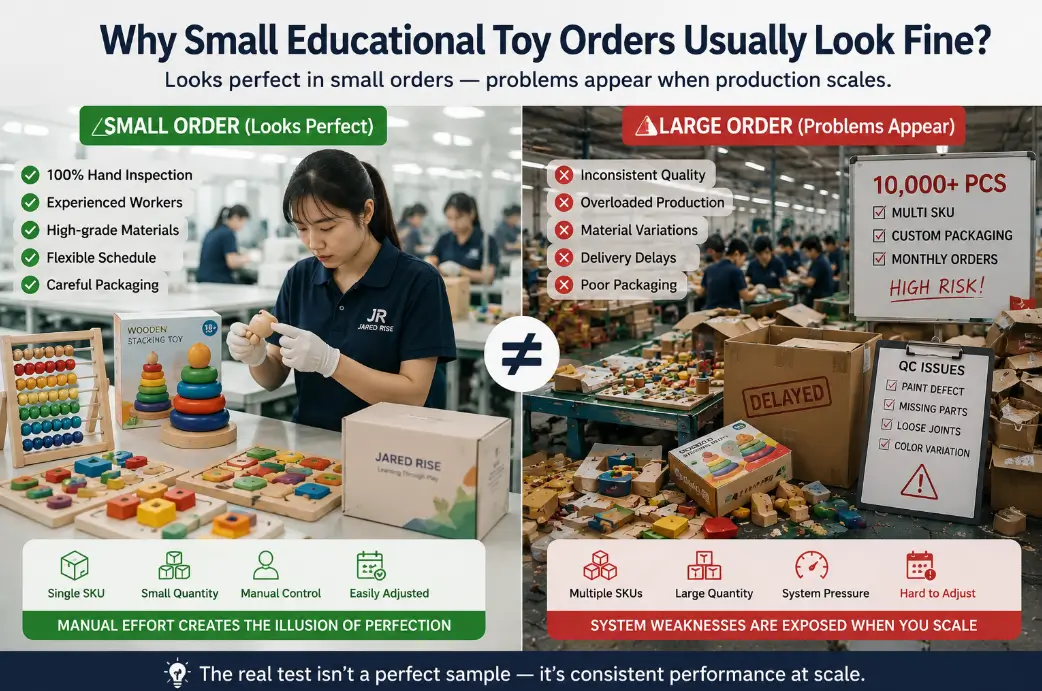
To understand why scaling leads to failure, we first need to examine why small educational toy orders rarely reveal warning signs—even when the supplier lacks reliable operational systems. The appearance of perfection in small batches often masks deeper structural weaknesses that only emerge once production volume increases.
Most Factories Can Handle Sample Orders — That’s Not the Real Test
Small educational toy orders often appear flawless because their underlying problems are manually hidden—not because the factory has dependable systems in place. During small-batch production, QC teams can inspect every single unit by hand, catching even the smallest defects before shipment.
Factories also tend to prioritize these orders, assigning their most experienced workers and using higher-grade raw materials from a single production batch to create a strong first impression. Production lines face minimal pressure, and delivery schedules can still be adjusted manually if delays occur.
Even packaging—usually treated as a secondary task in small orders—receives extra attention to ensure it looks presentable.
The real risk begins when you move beyond small runs into large-scale production—10,000 pcs or more, multiple SKUs, custom retailer packaging, and recurring monthly orders. At this stage, manual control is no longer realistic, and the factory’s actual system capabilities are exposed.
At Jaredrise, many buyers tell us their supplier seemed reliable during sample production, but problems surfaced immediately once container-level production started. This is not a coincidence; it reflects a failure to prepare for the operational demands of scalable manufacturing.
- How to Choose a Reliable Educational Toy Manufacturer?
- Why Source Educational Toys from China? (And When You Shouldn’t)
- Top 5 educational toys manufacturers in China
Small educational toy orders are often tightly controlled by supervisors and QC teams. Once production scales, factories can no longer depend on manual corrections, and weaknesses in their systems become obvious. For example, a factory may use a single batch of non-toxic paint for small orders, ensuring color consistency.
But when scaling up, they may source paint from multiple suppliers to meet demand, resulting in noticeable color differences that frustrate customers and damage your brand image.
Another common issue is the lack of standardized packaging processes. Small orders can be packed manually with close attention to detail, but large-scale packaging requires either automated systems or highly coordinated teams.
Factories without clear SOPs for packaging often struggle with mislabeling, missing components, or damaged products—all of which become extremely costly when shipping thousands of units to retailers or Amazon fulfillment centers.
Educational Toys Are Not Normal Toys
The gap between small-order success and large-order failure is even greater in educational toys because these products carry risks that general toys do not. This distinction is critical to understanding why so many manufacturers fail once orders begin scaling.
Why Educational Toy Buyers Face Higher Risk Than General Toy Buyers
Educational toy buyers face significantly higher pressure around consistency and safety than general toy buyers because parents, retailers, and e-commerce platforms evaluate educational products differently.
A slight color variation on stacking toys may go unnoticed in a discount store, but on Montessori-inspired products, parents often interpret inconsistency as a sign of poor educational quality. This higher expectation means even minor defects can trigger negative reviews, product returns, and loss of customer trust—issues that general toy buyers encounter far less frequently.
Parents purchasing educational toys are especially sensitive to safety concerns because they associate these products with their child’s development. A single complaint about non-toxic paint peeling off a wooden educational toy can trigger a wave of returns and seriously damage your brand reputation.
Retailers and platforms such as Amazon also apply stricter compliance standards to educational toys, particularly regarding EN71, ASTM, and CPSIA certifications. Unlike general toys, which may sometimes pass with outdated testing reports, educational toys are frequently audited, and non-compliance can result in listing suspensions or financial penalties.
Montessori toys and educational wooden toys, in particular, demand exceptional consistency. These products are designed to teach specific developmental skills, so variations in size, weight, or color can negatively affect the learning experience.
For example, a set of Montessori counting blocks with inconsistent weights may confuse children, prompting parents to leave negative reviews and retailers to discontinue the product. This level of precision is rarely required for standard toys, making educational toy manufacturing considerably more complex and higher risk.
This elevated level of risk means educational toy buyers cannot afford to work with suppliers who only perform well on small orders. They need manufacturing partners that understand the specialized requirements of educational products and have robust systems in place to maintain consistency and compliance—even at scale.
Learn more:Which Educational Toys Have the Highest Repeat Purchase Rate?
The Real Breaking Point: What Happens After Orders Scale?
When educational toy orders move beyond small production batches, the hidden weaknesses of unreliable factories stop being hidden—they turn into expensive, brand-damaging problems that disrupt operations and erode customer trust.
Material Consistency Starts Failing
Material consistency is often the first major failure point when educational toy production scales, and the consequences can be both specific and expensive. Small orders typically rely on a single batch of raw materials—wood with stable moisture levels, paint from one supplier, glue with reliable adhesion, and plastic with consistent density. This consistency makes small orders appear flawless, but it becomes difficult to maintain as production volume increases.
- Problem: Color inconsistency in wooden educational toys.
- Cause: During peak season, factories often source wood from multiple suppliers to fulfill large-volume orders. Different wood batches contain different moisture levels, leading to uneven staining and visible color variation.
- Result: Amazon review complaints about mismatched blocks and retailer rejection of entire shipments, forcing you to absorb rework or replacement costs.
- Educational toys material cost comparison China
Another frequent material issue involves glue stability. Small orders may use high-quality glue applied manually to ensure strong bonding between components. But when production scales, factories may switch to lower-cost bulk glue or automate the application process without proper calibration.
This can lead to loose parts, broken toys, and a sharp increase in return rates. Magnetic strength in educational toys is another common problem—small batches often use magnets from a single production lot, while large-scale orders may combine magnets from different suppliers, resulting in inconsistent performance that frustrates both children and parents.
These material inconsistencies are more than minor annoyances—they pose a direct threat to your business. They damage your brand reputation, increase return rates, and can even create compliance risks if materials fail safety testing. For educational toy buyers, material consistency is not optional—it is essential.
QC Systems Collapse When Production Volume Increases
Many factories do not actually operate scalable quality-control systems. Instead, they rely on experienced workers and manual corrections during small production runs. This experience-based QC may function adequately for small orders, where a skilled worker can inspect every unit and immediately fix defects. However, once production volume increases, the entire approach begins to fail.
Inspection sampling becomes ineffective when factories are producing thousands of units. A supplier that manually inspects 100% of a 500-unit order may only inspect 5% of a 10,000-unit order, allowing critical defects to slip through unnoticed. Communication between QC teams and production lines often deteriorates, causing repeated mistakes and production delays.
Rework costs rise dramatically because correcting defects in large batches is far more time-consuming and expensive than addressing them during small runs. Without a formal defect-tracking system, factories cannot identify recurring issues, leading to the same quality problems appearing shipment after shipment.
Key operational concepts such as SOPs, inline inspection, final random inspection, AQL, defect tracking, and batch traceability are often absent from these factories’ workflows. Without documented quality-control systems, every order is handled differently.
This lack of standardization creates inconsistent quality between production batches, leaving buyers uncertain about what they will receive.
At Jaredrise, scaling production is treated as a process-control challenge rather than simply increasing headcount. That distinction becomes critically important in educational toy manufacturing. We maintain documented SOPs for every stage of production—from raw material sourcing to final inspection—and use inline inspections to detect defects early.
Our batch traceability system allows every component to be traced back to its origin, making issue resolution significantly faster and more reliable.
Packaging Errors Become Expensive Very Fast
Packaging mistakes are often overlooked during small production runs, but they become extremely expensive once orders scale. A simple FNSKU labeling error during Q4 can delay Amazon inventory check-in long enough to miss the entire holiday season, resulting in substantial lost revenue.
Walmart compliance penalties for incorrect packaging can accumulate rapidly, while relabeling thousands of units can severely reduce profit margins.
- Problem: Incorrect retailer packaging for educational toy sets.
- Cause: Factories lacking retail packaging experience may print incorrect barcodes, use the wrong carton dimensions, or omit required safety labels when production scales. They may also rush packaging operations to meet deadlines, increasing the risk of shipping damage.
- Result: Amazon warehouse rejections, Walmart compliance fines, and delayed seasonal launches. Inventory backlogs grow, and you are often forced to discount products to clear stock, resulting in lost revenue.
Another common packaging issue is missing components. Small orders are usually packed manually, allowing workers to verify that every educational toy set includes all required parts. However, large-scale packaging frequently relies on automated lines, which can miss components if calibration is inaccurate.
The result is customer complaints, product returns, and negative reviews—all of which can seriously damage your brand reputation on platforms such as Amazon.
Compliance Is Where Most Toy Factories Quietly Fail
Beyond material inconsistency, QC breakdowns, and packaging mistakes, there’s another silent threat that causes many educational toy manufacturers to fail: compliance issues. Unlike obvious product defects, compliance problems often remain hidden until they trigger severe penalties.
EN71, ASTM, CPC — Why Documents Alone Are Not Enough
Many educational toy factories claim compliance with EN71, ASTM, and CPSIA standards, but in reality, they rely on outdated paperwork rather than genuine operational compliance. Documentation alone is not enough to protect your business—especially once production begins scaling. During periods of rapid production growth, some factories prioritize shipping schedules over compliance management, particularly when raw material substitutions occur unexpectedly.
Common compliance failures include reusing old testing reports for new production batches, changing raw material suppliers without updating testing records, relying on outdated testing methods, and sharing certificates across multiple clients.
For example, a factory may continue using the same EN71 Part 1/2/3 report for a wooden toy even after switching to a different wood supplier with varying heavy metal content. This can result in non-compliant products entering the market, leading to banned listings, fines, or even product recalls.
ASTM F963 and CPSIA requirements continue to evolve, and factories without dedicated compliance teams often struggle to keep up. They may overlook new testing standards for educational toys, resulting in products that fail CPC documentation reviews. This is particularly dangerous for Amazon brands, where non-compliant products can trigger serious penalties—including account suspension.
Real compliance requires continuous monitoring and documentation. Factories must test every batch of raw materials, regularly update testing reports, and maintain detailed production records. Very few factories that only perform well on small orders are willing or able to maintain this level of compliance discipline, making it a hidden risk for educational toy buyers.
Retail Buyers Care More About Risk Than Price
Smaller sellers may focus primarily on pricing when selecting an educational toy supplier, but experienced retail buyers and established brands prioritize risk management. They understand that a low-cost supplier can ultimately become far more expensive over time. Defect rates, delivery reliability, compliance stability, and supplier responsiveness matter far more than the initial unit price.
Low-cost factories often reduce expenses by cutting corners—using lower-grade materials, skipping QC procedures, and neglecting compliance requirements. This can lead to product recalls, returns, shipping delays, and retailer penalties that vastly outweigh any upfront savings.
For example, a recall caused by non-compliant paint can cost hundreds of thousands of dollars in lost inventory, legal expenses, and brand damage. A single delayed shipment can also cause you to miss an important seasonal sales window, damaging both revenue and retailer relationships.
Experienced buyers understand that the true cost of a supplier is not the price per unit—it is the risk of operational failure. They are willing to pay more for suppliers that consistently deliver compliant, high-quality products on schedule because this significantly reduces overall business risk and protects brand reputation.
Learn more:Factors affecting educational toys for 3-4 year olds supplier price
Why Amazon Brands Suffer the Most From Unstable Toy Suppliers?
Among all buyer groups, Amazon brands are often hit hardest by unstable educational toy suppliers. Their business model is uniquely vulnerable to the disruption caused by scaled-order failures, with consequences affecting nearly every aspect of their operations.
One Bad Batch Can Destroy Years of Reviews
Amazon brands are especially vulnerable to unstable educational toy suppliers because their success depends heavily on product ratings and organic rankings. A single defective batch can trigger a chain reaction that wipes out years of brand-building effort. Star ratings decline as customers leave negative reviews about defective products or inconsistent quality.
Lower ratings reduce conversion rates because potential buyers become hesitant to purchase. PPC efficiency drops dramatically, forcing brands to spend more on advertising to maintain traffic despite weaker trust signals. Account health risks also increase, especially if return rates spike or compliance violations are reported.
A single defective batch can simultaneously reduce reviews, lower conversion rates, increase advertising costs, and weaken organic rankings. For example, an Amazon brand selling Montessori wooden toys may maintain a 4.8-star rating after years of stable sales.
One shipment containing inconsistent colors and loose parts could generate 50 negative reviews within a week, reducing the rating to 4.2 stars. Conversion rates may drop by 30%, PPC costs could rise by 50%, and organic rankings may fall from page 1 to page 5. Recovery can take months—and in some cases, recovery may never fully happen.
Amazon’s algorithm strongly favors consistency and customer satisfaction, meaning unstable suppliers place the entire business at risk. Educational toy brands on Amazon need suppliers capable of delivering the same high standard with every production batch to maintain positive reviews and stable organic rankings.
Educational Toy Buyers Need Predictability, Not Just Manufacturing
The difference between a basic factory and a scalable supplier is operational predictability. Educational toy buyers do not simply need a factory that can manufacture toys—they need a partner capable of delivering consistent quality, meeting deadlines, and maintaining compliance regardless of order size. Predictability is essential for inventory planning, retailer relationships, and long-term brand growth.
Unstable suppliers create uncertainty. Buyers never know whether the next batch will maintain the same quality standards, arrive on time, or remain compliant. This unpredictability makes seasonal planning extremely difficult and often results in stock shortages or excess inventory. It also weakens retailer confidence, since retailers depend on reliable suppliers to meet customer expectations.
Experienced educational toy buyers understand that predictability is more valuable than low pricing. They look for suppliers with documented processes, stable supply chains, and proven experience scaling production without sacrificing quality. These suppliers do more than manufacture products—they provide operational confidence.
How Serious Buyers Evaluate Educational Toy Suppliers?
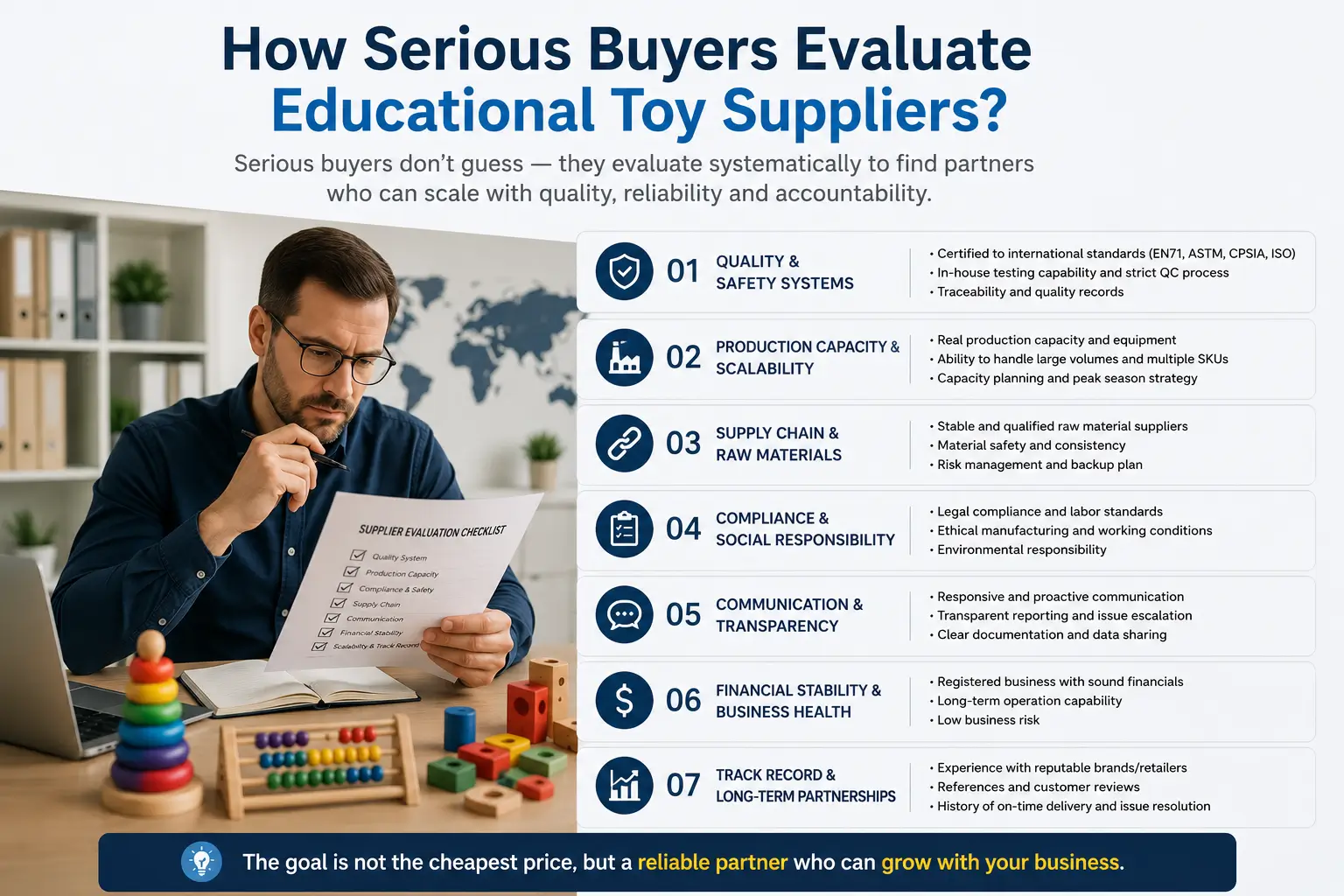
Given the high risks involved in scaling educational toy production, serious buyers do not choose suppliers randomly—they follow a strategic evaluation process to identify partners that can truly scale without falling into the problems discussed above.
Questions Smart Buyers Ask Before Scaling Orders
Experienced educational toy buyers do not rely solely on samples—they ask targeted questions designed to evaluate a supplier’s scalability. These questions reveal whether the supplier has the systems necessary to manage large-volume production and help distinguish reliable partners from risky factories.
- How do you manage raw material consistency?
This reveals whether the supplier has stable sourcing systems or depends on opportunistic purchasing. Reliable suppliers maintain long-term partnerships with trusted material vendors and test every incoming material batch. - What SOPs do you use for quality control during large-scale production?
This shows whether the supplier operates standardized systems or relies mainly on manual supervision. Look for suppliers that reference inline inspections, final random inspections, and defect tracking. - How do you ensure compliance with EN71, ASTM, and CPSIA standards for every production batch?
This reveals whether the supplier takes compliance seriously or simply provides outdated paperwork. Reliable suppliers test every batch and maintain detailed compliance documentation. - How do you handle packaging for retail and Amazon orders?
This indicates whether the supplier has practical experience with retail packaging requirements. Strong suppliers will mention FNSKU labeling, retailer-specific packaging standards, and automated packaging systems. - Can you provide references from clients who have successfully scaled orders with you?
This allows buyers to verify the supplier’s real-world performance. Reliable suppliers should have existing clients willing to confirm their consistency and scalability.
What a Scalable Educational Toy Supplier Actually Looks Like
A scalable educational toy supplier is far more than just a manufacturing facility—it is an operational partner built around systems and process control. These suppliers maintain documented SOPs covering every stage of production, from raw material sourcing to final shipment. They operate stable supplier networks that ensure raw material consistency even during peak production seasons. They also understand retailer packaging requirements, including Amazon FNSKU labeling and Walmart compliance standards.
Scalable suppliers maintain dedicated compliance teams that stay current with EN71, ASTM, and CPSIA requirements, testing every batch while keeping comprehensive records. They implement production traceability systems that allow every component to be traced back to its origin, making issue resolution faster and more transparent. They also establish clear escalation procedures for delays or quality issues, ensuring buyers remain informed and problems are addressed quickly.
Most importantly, scalable suppliers consistently deliver stable quality and reliable lead times even as order volume increases. They do not simply claim scalability—they demonstrate it through documented systems, client references, and disciplined process control.
Final Thoughts: The Biggest Risk in Educational Toy Manufacturing Is Invisible at the Beginning
After examining the risks of scaling and the methods serious buyers use to evaluate suppliers, one reality becomes clear: the most dangerous threat in educational toy manufacturing is often invisible at the start—instability that only appears once production volume increases.
Most Suppliers Don’t Fail at Manufacturing — They Fail at Stability
The greatest risk in educational toy manufacturing is not whether a factory can produce toys—it is whether the factory can maintain stability as orders scale. Most factories are capable of producing attractive small orders, but very few can sustain the same level of quality, consistency, and compliance during large-scale production. The hidden danger is that the supplier who appears perfect for sample orders may become your biggest operational problem once growth begins.
Long-term consistency, operational control, risk management, and scalable systems are what define a reliable educational toy supplier. These are the qualities that separate successful partnerships from costly failures. They protect your brand, maintain customer trust, and ensure you can meet the expectations of retailers and platforms such as Amazon.
Buyers planning long-term educational toy programs should evaluate suppliers based on stability, process control, and compliance discipline—not simply initial pricing. That is the difference between a supplier that supports your growth and one that limits it. In the highly competitive educational toy industry, it is often the difference between long-term success and expensive failure.