
Choosing the right educational toys is not just about entertainment it is a key investment in a child’s early development that combines fun with learning opportunities.
Many buyers and parents focus on appearance or price but overlook the core value of educational toys which may lead to toys that fail to stimulate learning or even fail to meet safety standards.
In this guide we break down the main types of educational toys explore their unique benefits analyze the common materials used in their production and provide practical insights for anyone looking to choose the right educational toys especially for bulk buyers sourcing from overseas manufacturers.
By understanding these essential aspects you can make informed decisions that align with learning goals safety requirements and practical needs whether you are a parent selecting toys for your child or a buyer seeking quality products.
What Are Educational Toys?
Educational toys are designed to combine playful engagement with targeted learning goals helping children develop essential skills while they have fun unlike traditional toys which mainly focus on entertainment without intentional developmental support.
These toys integrate learning into play seamlessly making it easier for children to absorb knowledge and build abilities without feeling pressured.
They prioritize active learning encouraging children to think critically explore new ideas and solve problems through hands on experiences rather than passive observation.
Interactive design is another key trait many educational toys require children to participate actively such as assembling pieces conducting simple experiments or collaborating with others to complete tasks.
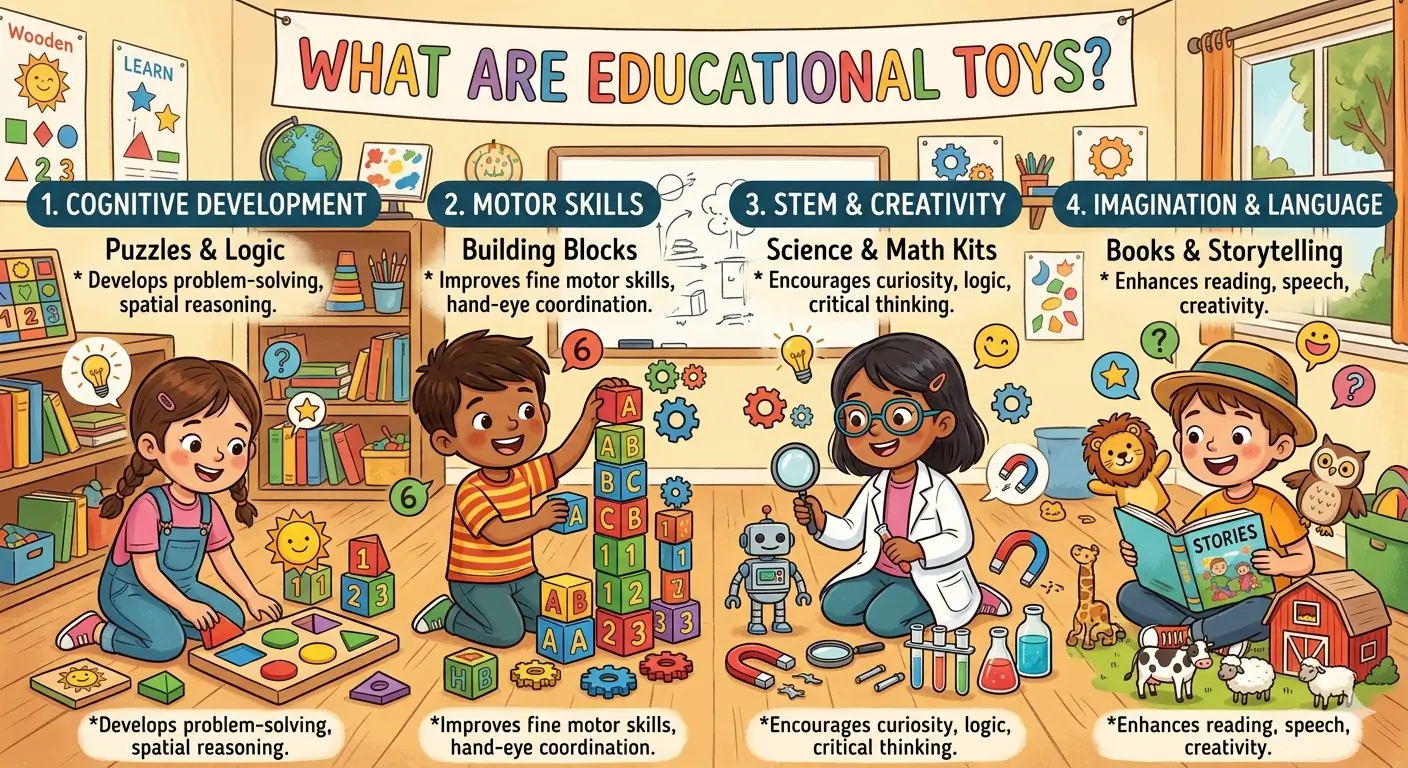
They are specifically tailored for skill development covering cognitive abilities like memory and logic fine motor skills such as hand eye coordination and social skills including sharing and communication.
Common specific examples include jigsaw puzzles which enhance spatial awareness and patience STEM kits that help children understand basic science and engineering principles through practical experiments building blocks that support problem solving and hand eye coordination alphabet matching cards that foster early literacy skills and sensory toys designed to stimulate young children’s touch and sight.
Different types of educational toys serve different learning purposes, which is why product design and manufacturing quality matter significantly in bulk sourcing.
Types of Educational Toys
Educational toys can be categorized based on the skills they develop and the learning experiences they promote. Rather than serving only as entertainment, these products are designed to encourage exploration, problem-solving, and meaningful learning experiences.
Understanding what defines a quality educational toy is an important first step for brands and buyers developing new product lines.
From a manufacturer’s perspective, educational value is closely connected with product design, target age group, learning objectives, and functional features.
A deeper understanding of what makes an educational toy effective from a manufacturing perspective can help buyers make better decisions when selecting products or developing custom toy projects.
Each category supports specific areas of growth, from analytical thinking and creativity to language development and fine motor skills, helping parents, educators, and businesses identify toys that match different learning stages and market needs.
STEM Educational Toys
STEM educational toys focus on science, technology, engineering, and mathematics.
These toys typically involve building, coding, measuring, and experimenting activities that introduce logical reasoning and analytical skills. Children use them to construct models, design circuits, or run simple robotic tasks at home and school.
Popular products include programmable robots, magnetic building sets, and experiment kits that simulate real-world scientific principles.
These toys appeal to parents seeking hands-on learning experiences and educators promoting critical thinking and structured problem solving.
STEM toys are among the fastest-growing categories in international markets, making them a priority for many importers.
Montessori Toys
Montessori toys emphasize independent exploration and sensory engagement, often using natural materials for a calm play environment.
These toys feature wooden textures, simple design, and a focus on hands-on learning rather than electronic stimulation.
Children use them to sort, stack, and match objects freely, developing focus and fine motor control. Popular items include wooden puzzles, geometric stacking blocks, and shape sorters that allow self-directed discovery without guided instruction.
Each product encourages concentration and purposeful movement, making them ideal for quiet learning spaces. Buyers targeting premium or eco-conscious markets often prefer Montessori-style products due to their natural materials and educational positioning.
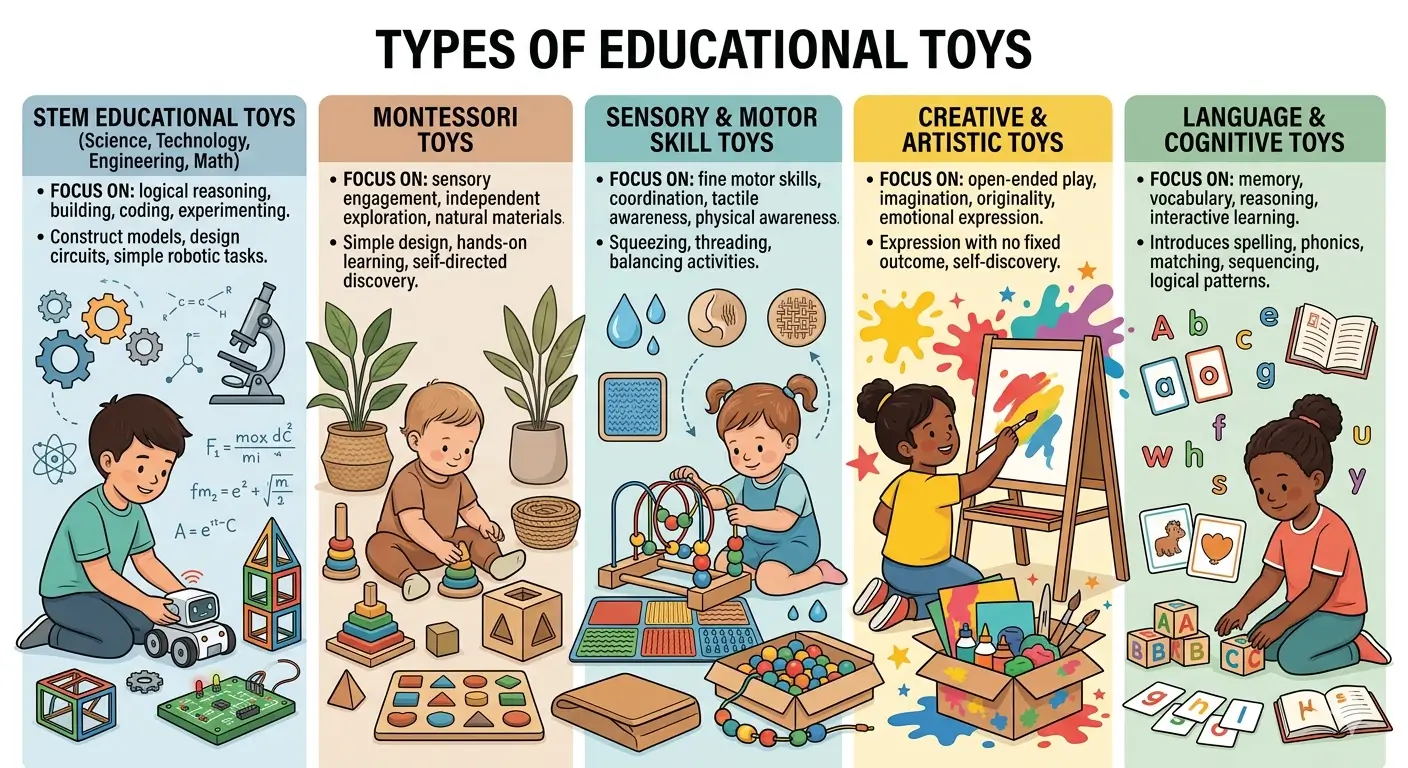
Sensory & Motor Skill Toys
Sensory and motor skill toys are ideal for toddlers and preschool children who are developing coordination and physical awareness.
These products support fine motor skills and hand-eye coordination through tactile and movement-based activities. Children play with texture mats, bead mazes, or balance boards that train touch sensitivity and physical control.
For instance, squeezing soft balls strengthens grip muscles, while threading beads enhances precision and rhythm. These products are widely used in early childhood education, especially in daycare and preschool supply chains.
- 6 Questions to Ask Before Working with a Preschool Toy Supplier
- Best educational toys for 3 4 year olds supplier amazon
- Which Educational Toys Have the Highest Repeat Purchase Rate?
- Educational toys material cost comparison China
- Best selling educational toys importers are reordering amazon
Creative & Artistic Toys
Creative and artistic toys encourage open-ended play where children express imagination through visual and manual projects.
Instead of following fixed instructions, kids explore ideas with no fixed outcome, fostering originality and emotional expression. Typical activities include painting sets, craft kits, and DIY creation boxes that supply endless possibilities for personal design.
Parents and schools favor these toys because they build confidence and communication through self-expression.
Creative toys often have strong repeat purchase potential due to consumable materials such as paints, paper, and clay that need regular replenishment.
Language & Cognitive Toys
Language and cognitive toys aim to strengthen memory, reasoning, and vocabulary through interactive learning.
These toys support early education by introducing spelling, matching, sequencing, and logical pattern recognition.
Children use them to form words, connect pictures with sounds, or complete memory cards during guided learning sessions.
Popular products include alphabet blocks, phonics flashcards, and word-matching games that help preschoolers build a foundation in communication and cognitive structure.
These toys are especially popular in educational institutions and language learning programs.
Learn more:Educational Toys vs Traditional Toys
Benefits of Educational Toys
Educational toys influence learning through experience and engagement rather than passive observation.
They combine play and structured challenge, allowing children to connect curiosity with understanding. The effectiveness of these toys arises from how they stimulate thinking and communication within natural play moments, creating a learning environment that feels both enjoyable and purposeful.
Cognitive Development
Educational toys enhance cognitive growth by guiding children toward active exploration. These toys encourage children to solve problems, remember patterns, and connect actions with outcomes, which strengthens both memory and reasoning skills.
Activities such as puzzle solving or matching games force the mind to organize information, reinforcing the link between effort and achievement. The process of identifying solutions teaches persistence and logical sequencing, helping young learners build stronger mental frameworks as they play.
Social & Emotional Skills
Play-based interaction through educational toys fosters empathy and cooperation among children. When kids work together on building sets or role-playing games, they learn negotiation, teamwork, and emotional regulation.
Sharing materials and taking turns cultivates understanding and respect for others’ ideas. Group challenges also trigger emotional feedback—success builds confidence, while small setbacks teach patience and self-control.
These experiences create deeper social learning that goes beyond verbal instruction, strengthening emotional intelligence through meaningful collaboration.
Creativity & Imagination
Creative toys stimulate imagination through open-ended play that encourages self-expression and innovation. Because there is no fixed outcome, children are free to interpret, invent, and experiment, developing flexible thinking and originality.
Painting, building, or crafting allows them to express feelings visually and physically while learning that creativity stems from exploration rather than imitation.
This process improves cognitive diversity, enhancing the ability to approach problems from multiple angles. As children create their own worlds through toys, they form self-awareness and confidence in their ability to think independently.
Early STEM Readiness
Toys designed around exploration and curiosity prepare children for STEM learning later in life. By involving logical thinking, measurement, and cause-effect experiments, these toys help young players understand how objects behave and interact.
Hands-on experiences, such as connecting circuits or observing motion, nurture curiosity that transforms into analytical reasoning.
When play becomes discovery, learning shifts from memorization to experimentation, establishing early foundations for scientific literacy. However, the actual learning impact depends heavily on product design, safety, and manufacturing standards.
Materials Used in Educational Toys
The material of an educational toy determines not only its appearance and texture but also its safety, sustainability, and consumer appeal.
Parents and buyers increasingly focus on what the product is made of, associating certain materials with quality, environmental care, or reliability.
Understanding these distinctions helps manufacturers and importers position their products accurately across different markets and age groups.
Wooden Educational Toys
Wooden educational toys are valued for their eco-friendly qualities and timeless durability.
The solid structure resists wear and offers a smooth, organic feel that makes them ideal for repeated classroom use.
Their premium perception comes from natural finishes and tactile warmth, which appeal strongly to parents seeking sustainable and long-lasting options.
Many feature minimalist designs that fit both Montessori and home-learning environments.
These toys encourage calm, focused play and integrate easily with other natural learning tools such as cloth mats or sensory baskets. Wooden toys are widely preferred in Europe and North America, especially when certified with FSC standards.
Plastic Educational Toys
Plastic toys dominate the global educational market due to their cost-effective nature and scalability in production. They allow manufacturers to create colorful, complex structures at affordable prices, making them convenient for mass distribution.
Modern plastics used in educational products must meet strict international requirements such as EN71 and ASTM standards, ensuring they are safe and suitable for children.
These toys often appear in settings requiring lightweight, washable materials, such as kindergartens and learning centers.
Their bright designs and versatile molding features make them suitable for teaching shapes, numbers, or sequencing. Compliance with international safety standards is a key requirement for bulk buyers.
Learn more:Plastic vs wooden educational toys price
Fabric & Soft Toys
Fabric and soft toys are particularly suitable for infants and toddlers because they provide comfort, safety, and sensory stimulation.
Their gentle texture and flexible form minimize injury risks during play. Materials such as cotton, felt, and plush fabrics are easy to clean and naturally warm to the touch, supporting a baby’s early tactile development.
These toys often include simple interactive elements like squeakers or crinkly paper to engage hearing and touch simultaneously. As parents prioritize baby-safe materials, soft fabric toys remain an essential category in early education product lines.
Non-Toxic & Eco Materials
Modern consumers and importers increasingly demand eco-conscious and health-safe educational toys. Non-toxic and BPA-free materials now represent a major selling point, protecting children from harmful chemical exposure. Manufacturers apply water-based finishes and non-toxic paint to ensure products are both safe and environmentally sustainable.
Many producers also experiment with biodegradable plastics, recycled wood composites, and organic fibers to reduce environmental impact. These features not only enhance brand reputation but also align with government policies promoting green products. Many importers require testing reports and certifications before placing large orders.
How to Choose the Right Educational Toys?
Selecting the right educational toy is not only about age or price but about matching the child’s learning stage, interests, and developmental goals.
A well-chosen toy bridges play and skill-building, turning curiosity into structured learning. Buyers—whether parents, schools, or importers—can make smarter decisions by evaluating several key aspects that influence both educational value and market performance.
First, consider the age group and developmental focus. Toys for toddlers should emphasize sensory and motor skills, while products for older children may introduce logic, problem solving, and creativity. When the functions align with the child’s abilities, learning feels natural rather than forced. Educational outcomes depend on how well the toy’s design supports active participation and discovery.
Second, review material and safety standards carefully. Choose products labeled as non-toxic, BPA-free, and compliant with recognized testing requirements such as EN71 or ASTM. Wooden and fabric models suit eco-conscious markets, while durable plastics serve institutional buyers who need volume and easy maintenance. Certifications not only protect users but increase trust in the brand—an essential factor for long-term business partnerships.
Third, assess play value and engagement. The most effective educational toys encourage open-ended play, allowing children to create, test, and modify outcomes on their own. Look for features that stimulate imagination and communication—such as adjustable parts, color variation, or sound elements. A toy that evolves with a child’s growth extends its lifespan, improving customer satisfaction and repeat purchase potential.
Fourth, examine the purpose behind the product. Is it designed for individual learning or group collaboration? Toys that promote teamwork often have strong appeal in classroom or daycare settings. Individual play options, on the other hand, work better for home education. Matching the toy to its environment ensures meaningful use and better educational results.
Finally, balance quality and value. Premium materials and strong educational design command higher prices but deliver greater brand credibility. Imported or bulk-purchase buyers should focus on proven suppliers offering safety certification and customization options such as packaging or logo branding. This reliability builds long-term trust and supports smooth entry into competitive markets.
Choosing the right educational toys involves thoughtful evaluation rather than impulse. When materials, design, safety, and developmental purpose align, both learning outcomes and business success can flourish.
Learn more:Educational Toys Properties and Applications
Educational Toys Market Trends
The global market for educational toys continues to expand, driven by shifting parenting approaches, digital integration, and greater awareness of skill-based learning. Worldwide buyers and distributors are responding to new educational priorities that emphasize creativity, sustainability, and cognitive development. Each key segment reflects evolving consumer values and offers strong potential for importers seeking high-performance categories.
Growth of STEM Education
STEM education has become a central focus in schools and households alike. The growing demand for science, technology, engineering, and mathematics learning tools comes from parents eager to strengthen problem-solving and analytical skills early.
Educational toys that integrate coding, robotics, and construction elements are gaining traction as digital literacy becomes essential for future careers. This increasing trend positions STEM toys as one of the most dynamic segments in the global market. This trend is pushing more buyers to work directly with manufacturers to stay competitive.
Demand for Eco-Friendly Toys
Environmental awareness is shaping consumer choices across all age categories. The growing demand for eco-friendly educational toys arises from parents seeking products that promote sustainability without compromising safety.
Wooden, fabric, and recycled-material items attract attention for their natural look and long-lasting value. Importers follow this increasing trend by sourcing from certified suppliers that meet green manufacturing requirements, ensuring compliance with both local and international standards. This trend is pushing more buyers to work directly with manufacturers to stay competitive.
Rise of Montessori Learning
Montessori-inspired play has evolved from a niche approach into a mainstream educational movement. The global market shows an increasing trend toward toys that encourage independent, self-guided learning using simple, tactile materials. Parents associate Montessori methods with balanced emotional and cognitive development, which has boosted demand for wooden puzzles, sensory sets, and sorting toys. As schools integrate Montessori-based programs, the commercial adoption of these products expands rapidly. This trend is pushing more buyers to work directly with manufacturers to stay competitive.
Conclusion
Educational toys represent more than a passing trend; they reflect the future of interactive and purposeful learning. Unlike ordinary products that simply entertain, these toys are designed to nurture essential skills—problem solving, creativity, communication, and emotional growth—through structured play.
Their educational impact depends not only on design and materials but also on how well they align with developmental needs and market preferences.
For buyers and distributors, success lies in selecting both the right products and the right suppliers. A strong supplier partnership ensures consistent quality, reliable certification, and adaptability to different market demands.
Premium materials, safety compliance, and thoughtful design all contribute to building long-term trust with consumers and institutions alike. For buyers, understanding materials, certifications, and supplier capabilities is essential before making sourcing decisions.